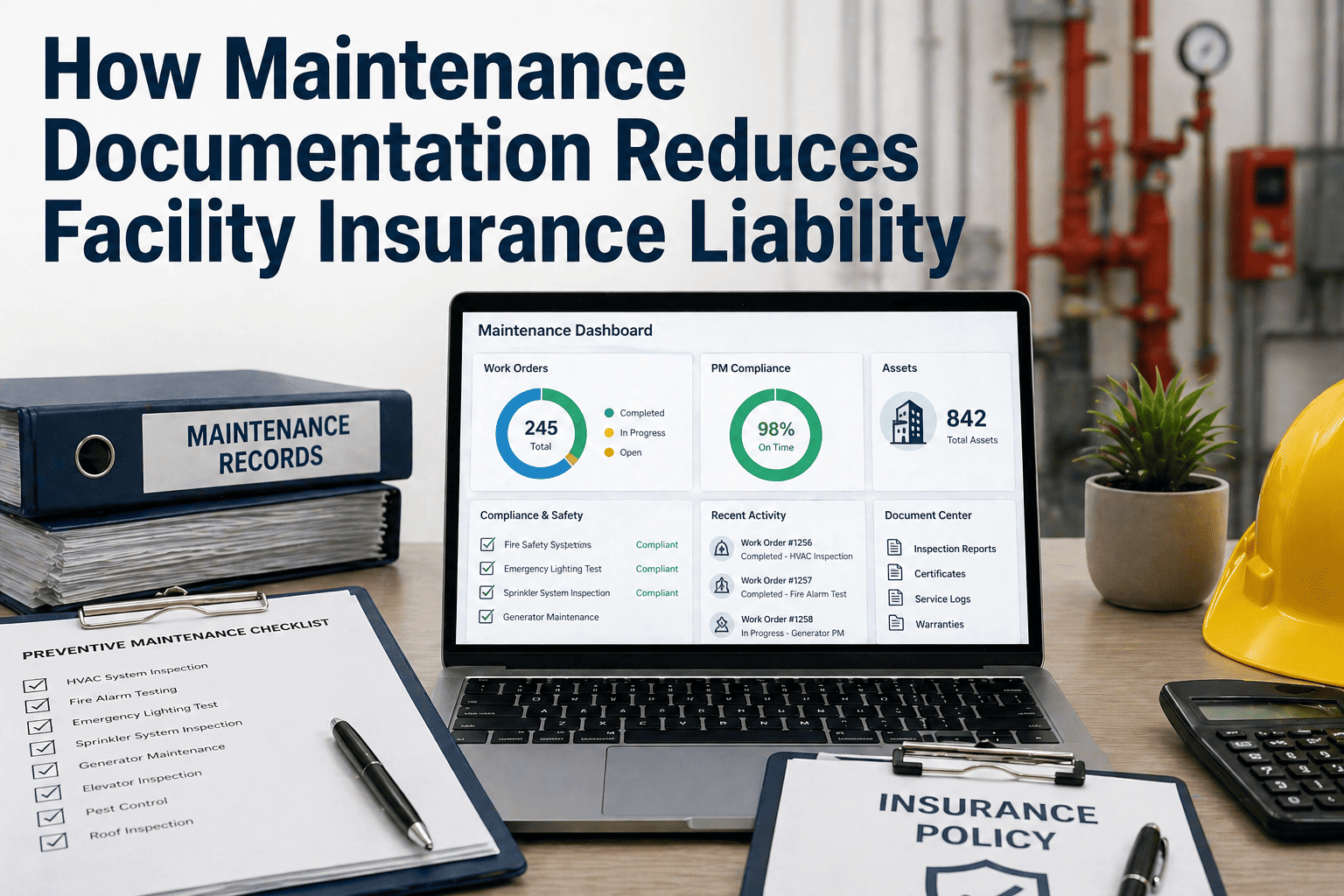
When a facility's insurance claim is disputed, the outcome almost never turns on what maintenance was performed — it turns on what can be proven. A slip-and-fall claim in a parking garage, a water damage claim traced to a roof drain, or a fire suppression failure claim against an equipment manufacturer all share the same litigation dynamic: the party with better documentation wins. Facility managers who can produce timestamped inspection records, signed maintenance logs, and contractor service histories have a decisive advantage over those who cannot — and that advantage translates directly into claim outcomes, premium rates, and litigation costs. Oxmaint CMMS creates the digital maintenance record that protects your facility in every insurance context — or book a session to see how maintenance documentation is structured in Oxmaint for liability protection.
$42B
Annual US commercial property insurance claims — facility maintenance records are the primary liability defense evidence
67%
Of disputed premises liability claims resolved in favor of the party with superior maintenance documentation (Insurance Research Council)
18%
Average insurance premium reduction documented for facilities that can demonstrate consistent, auditable PM compliance programs
3 yrs
Minimum maintenance record retention recommended by most commercial liability insurers — 5 years for high-claim-exposure facilities
How Documentation Affects Claims
The Four Insurance Scenarios Where Maintenance Records Are Decisive
Insurance claims involving commercial facilities almost always include a maintenance record review phase — either by the insurer's adjuster during the claims process or by opposing counsel in litigation. The scenarios below represent the four most common claim types where the presence or absence of maintenance documentation directly determines the outcome.
Slip and Fall — Premises Liability
A visitor falls on a wet floor near a building entrance during a rainstorm. The claim alleges the facility failed to address a known drainage deficiency near the entrance. With maintenance records: the facility produces work order history showing the entrance drain was inspected 3 weeks prior with no deficiency noted, and a corrective work order was created and completed for a minor seal issue 6 months earlier. Without records: the claimant's expert testifies that the absence of inspection records suggests the condition was known and ignored.
With Records: Claim Defended
Without Records: Likely Settled Against Facility
Roof Water Damage — Property Claim
A significant rainfall event results in interior water damage traced to a blocked roof drain. The insurer's adjuster asks for evidence of the facility's roof drain PM program. With records: the facility shows quarterly roof drain inspection records with the last cleaning 8 weeks prior and no blockage noted, attributing the failure to an unusual volume of debris accumulation from a nearby construction project. Without records: the insurer applies a maintenance exclusion clause, reduces the claim payment, or denies the claim on grounds of negligent maintenance.
With Records: Full Claim Coverage
Without Records: Partial or Denied Coverage
Documentation Standards
What Insurers and Courts Actually Look For in Maintenance Records
| Record Element |
Why Insurers Require It |
What Absence Implies |
Oxmaint Capture Method |
| Timestamp and Date |
Establishes when maintenance occurred relative to incident date |
Maintenance may have been performed after-the-fact or backdated |
Automatic system timestamp on all work order actions |
| Technician Identity |
Confirms qualified personnel performed the work |
Work may have been performed by unqualified personnel |
User-authenticated sign-off required for completion |
| Condition Finding |
Shows the asset's state was assessed, not just the work performed |
Maintenance was performed without understanding asset condition |
Required condition field on inspection work order templates |
| Corrective Action Link |
Proves deficiencies were identified and followed up on |
Deficiencies may have been observed and ignored |
Inspection-to-corrective-action work order linkage |
| Photo Documentation |
Visual evidence of asset condition before and after maintenance |
Claim about condition at maintenance time is uncorroborated |
Mobile photo attachment on any work order field |
| Contractor Records |
Confirms third-party work meets professional standard |
Liability may transfer to contractor without proper documentation |
Contractor portal for service record submission |
Premium Impact
How Maintenance Documentation Directly Affects Insurance Premiums
Risk Tier Improvement
8–18%
Average premium reduction for facilities that move from undocumented to documented PM programs during underwriter risk assessment. Insurers use PM compliance rates as a direct risk modifier in commercial property and liability pricing.
Loss History Improvement
23%
Average claim frequency reduction over 3 years for facilities that implement structured PM programs — which improves the loss history that directly drives renewal premium calculations.
Claim Defense Cost Reduction
41%
Average reduction in litigation costs for premises liability claims where the facility can produce complete maintenance documentation — more claims settle early rather than proceeding to expert witness and discovery phases.
Every Maintenance Record in Oxmaint Is an Insurance Asset
Timestamped work orders, photo documentation, technician sign-offs, contractor records, and corrective action links — Oxmaint creates the maintenance record that protects your facility in every insurance scenario, from underwriting reviews to litigation discovery. Start building your documented maintenance history today.
Expert Review
What Insurance and Facility Risk Management Experts Say
"In 22 years of handling commercial property and liability claims, the single most consistent predictor of claim outcome is the quality of the facility's maintenance documentation. Facilities with digital CMMS records — timestamped, technician-attributed, with photo documentation — resolve claims faster, settle for less, and win at trial more often than facilities relying on paper logs or institutional memory. The documentation is not just evidence; it changes the entire dynamic of the claim negotiation."
Robert Stein, JD, ARM
Associate in Risk Management, Commercial Claims Attorney — 22 Years in Facility Liability Litigation
"Underwriters are increasingly asking for CMMS-generated PM compliance reports as part of commercial property renewal submissions. A facility that can produce a 3-year PM compliance history showing 90%+ completion rates for critical systems is priced differently than one that cannot. The documentation is not just valuable after a claim — it is valuable before one, in the form of lower premiums. The ROI calculation is not complex."
Diana Chen, CPCU, CFM
Chartered Property Casualty Underwriter and Certified Facility Manager, Commercial Risk Consultant
Frequently Asked Questions
Maintenance Records and Insurance: Common Facility Manager Questions
The Next Claim Will Test Your Records. Build Them Before It Arrives.
Oxmaint gives facility managers the digital maintenance record that insurers respect, courts accept, and underwriters reward. Every work order, inspection, photo, and contractor record is timestamped, authenticated, and retained — ready for the claim you hope never comes and the premium review that comes every year.