Facility managers who cannot answer "what is our PM compliance rate?" or "what did we spend per square foot last quarter?" are managing blind. In 2026, with commercial real estate operating costs rising 6–12% year over year and boards demanding measurable facility ROI, gut-feel facility management is no longer defensible. The difference between high-performing FM operations and those stuck in reactive cycles comes down to one thing: which metrics they track, and how consistently they act on them. The global facility management market reached $1.35 trillion in 2023 and is growing at 5.2% CAGR — driven by data-driven operations that prove FM value with numbers, not narratives. This guide covers 20 facility management KPIs with industry benchmarks, explains what good looks like for each, and shows exactly how Oxmaint's analytics dashboard keeps every metric visible in real time. Ready to track every KPI in one dashboard? Sign up free or book a demo with our FM analytics team.
$1.35T
Global facility management market in 2023 — growing at 5.2% CAGR through 2030
4.8x
Cost of emergency repairs vs. planned maintenance — the most measurable FM KPI gap
30%
Of energy in commercial buildings wasted — directly measurable and reducible with FM KPI tracking
68%
Of FM teams report no structured KPI dashboard — managing cost centers without performance data
Track All 20 FM KPIs in One Real-Time Dashboard
Oxmaint's analytics dashboard gives facility managers live visibility into every metric in this guide — from PM compliance and MTTR to cost per square foot and energy intensity. Deploy in days. No IT project required.
What Are FM KPIs
What Facility Management KPIs Actually Measure — and Why Most Teams Track the Wrong Ones
FM KPIs are quantifiable metrics that measure how effectively a facility or portfolio is operated, maintained, and resourced against a defined standard. The distinction that matters: a KPI without a benchmark is just a number. A KPI tracked against industry standards, historical baselines, or contractual commitments becomes an operational decision trigger.
Maintenance KPIs
Equipment and Asset Performance
MTBF, MTTR, PM compliance rate, work order backlog, and planned vs. reactive maintenance ratio. These metrics measure whether your assets are being maintained proactively or failing reactively at 4.8x the cost.
Cost KPIs
Financial and Budget Performance
Cost per square foot, maintenance cost as % of asset replacement value, cost per work order, and budget variance. These prove FM value to leadership and identify cost optimization opportunities before year-end reviews.
Compliance KPIs
Regulatory and Safety Performance
Inspection completion rate, safety incident frequency, regulatory audit pass rate, and certification currency. In regions with OSHA, NHS, and Building Safety Act requirements, these are not optional dashboard items.
Sustainability KPIs
Energy and Environmental Performance
Energy intensity (kWh/sq ft), water consumption per occupant, carbon emissions per building, and renewable energy percentage. With ESG reporting now investor-grade, these KPIs feed directly into board-level sustainability reporting.
20 KPIs with Benchmarks
20 Facility Management KPIs — What to Measure, Why It Matters, and What Good Looks Like
Category 1 — Maintenance Performance KPIs
01
Preventive Maintenance Compliance Rate
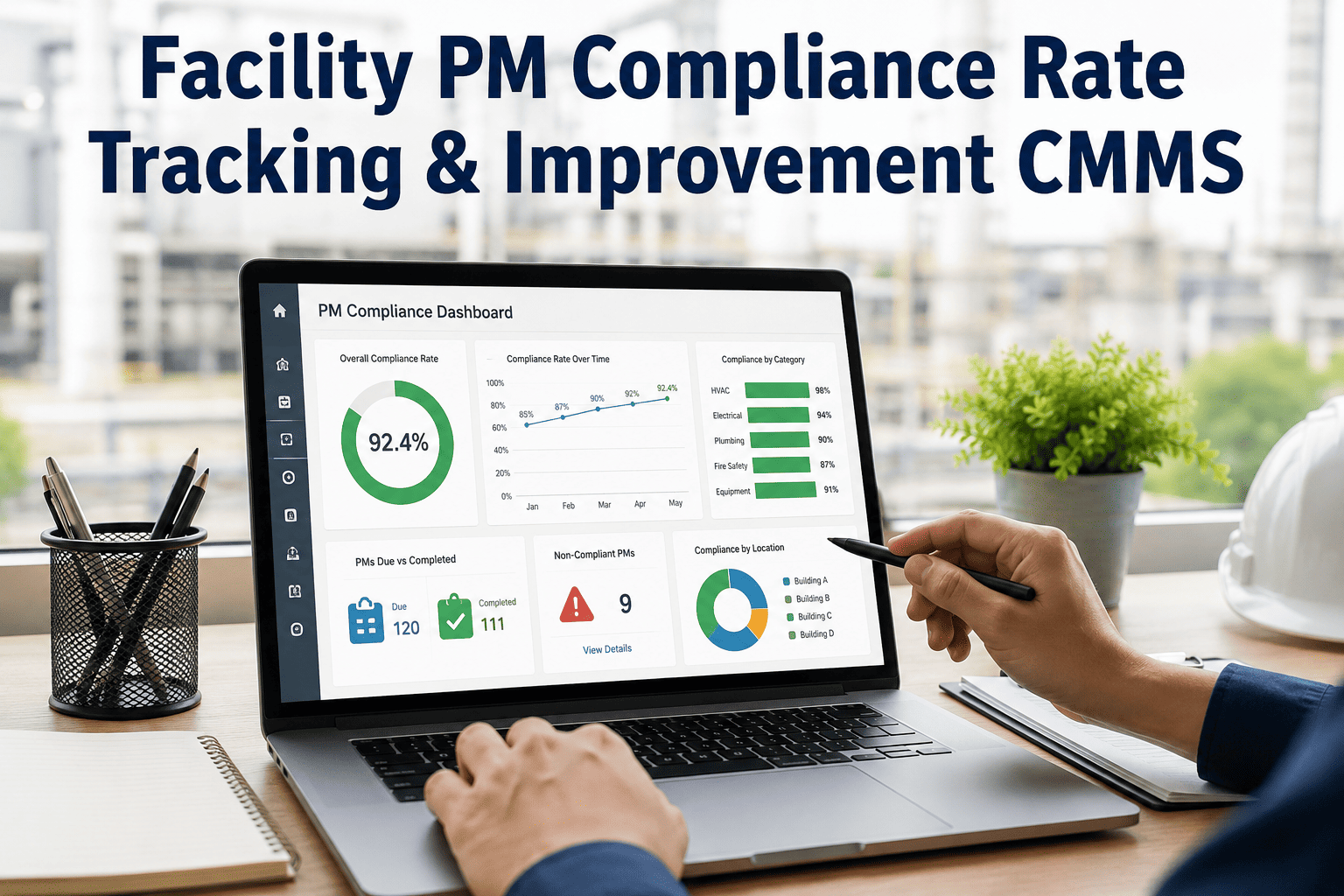
Percentage of scheduled PM tasks completed on time. Below 80% means reactive failures are accumulating. Best-in-class FM operations sustain 92%+.
Poor: below 65%Target: 90–95%
02
Mean Time Between Failures (MTBF)
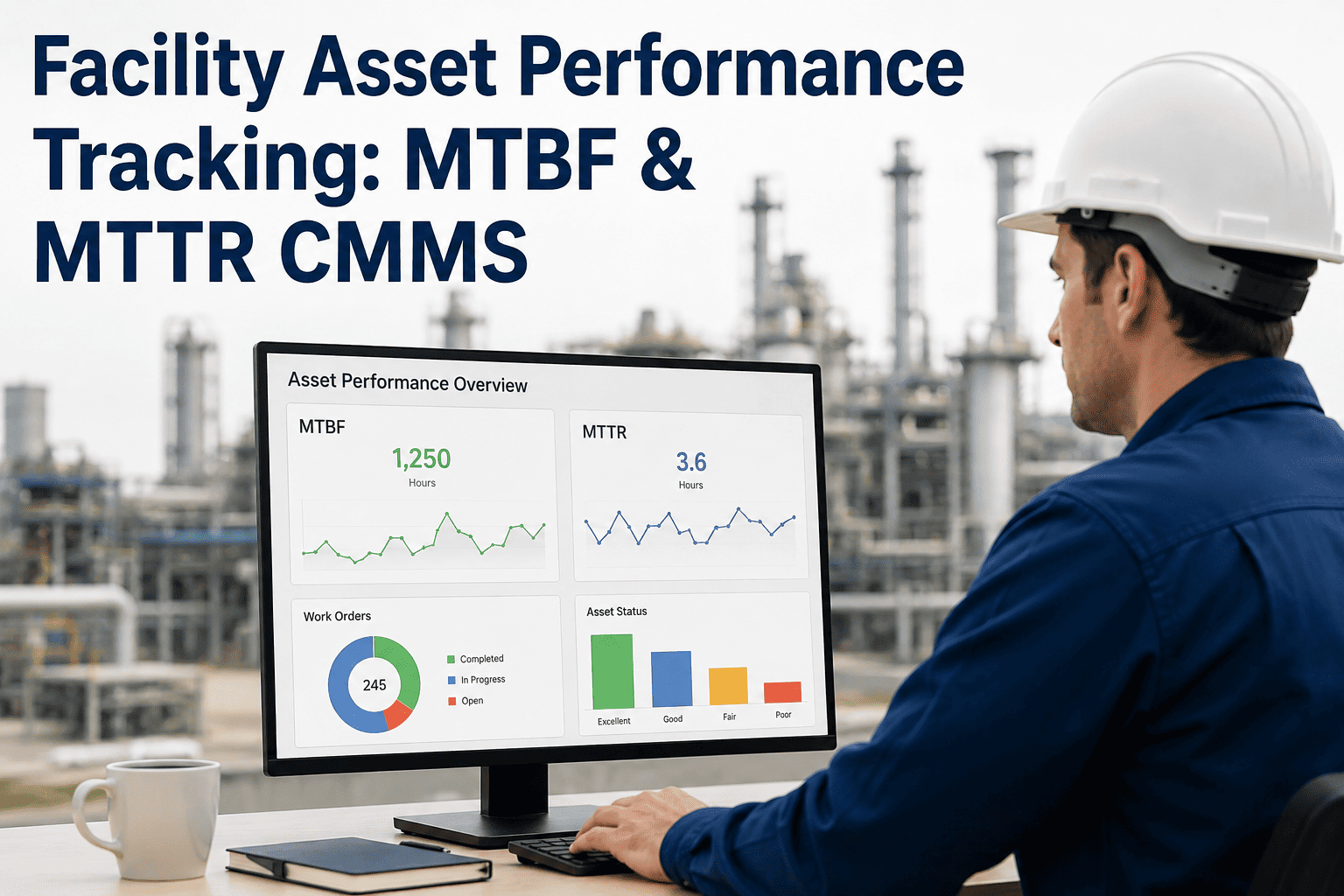
Average operating time between asset failures. Rising MTBF indicates effective preventive maintenance. Falling MTBF signals deferred maintenance accumulating into failure clusters.
Reactive: declining trendTarget: rising month-over-month
03
Mean Time to Repair (MTTR)
Average time from failure report to restoration. High MTTR indicates parts availability gaps, technician skill gaps, or work order process bottlenecks — each with a different solution.
Poor: 6+ hoursTarget: under 2 hours
04
Planned vs. Reactive Maintenance Ratio
The single most powerful indicator of FM programme maturity. Every reactive repair costs 4.8x more than the equivalent planned maintenance. Moving from 40% planned to 80% planned halves effective maintenance spend.
Reactive: below 50% plannedTarget: 80%+ planned
Category 2 — Cost and Financial KPIs
05
Maintenance Cost per Square Foot
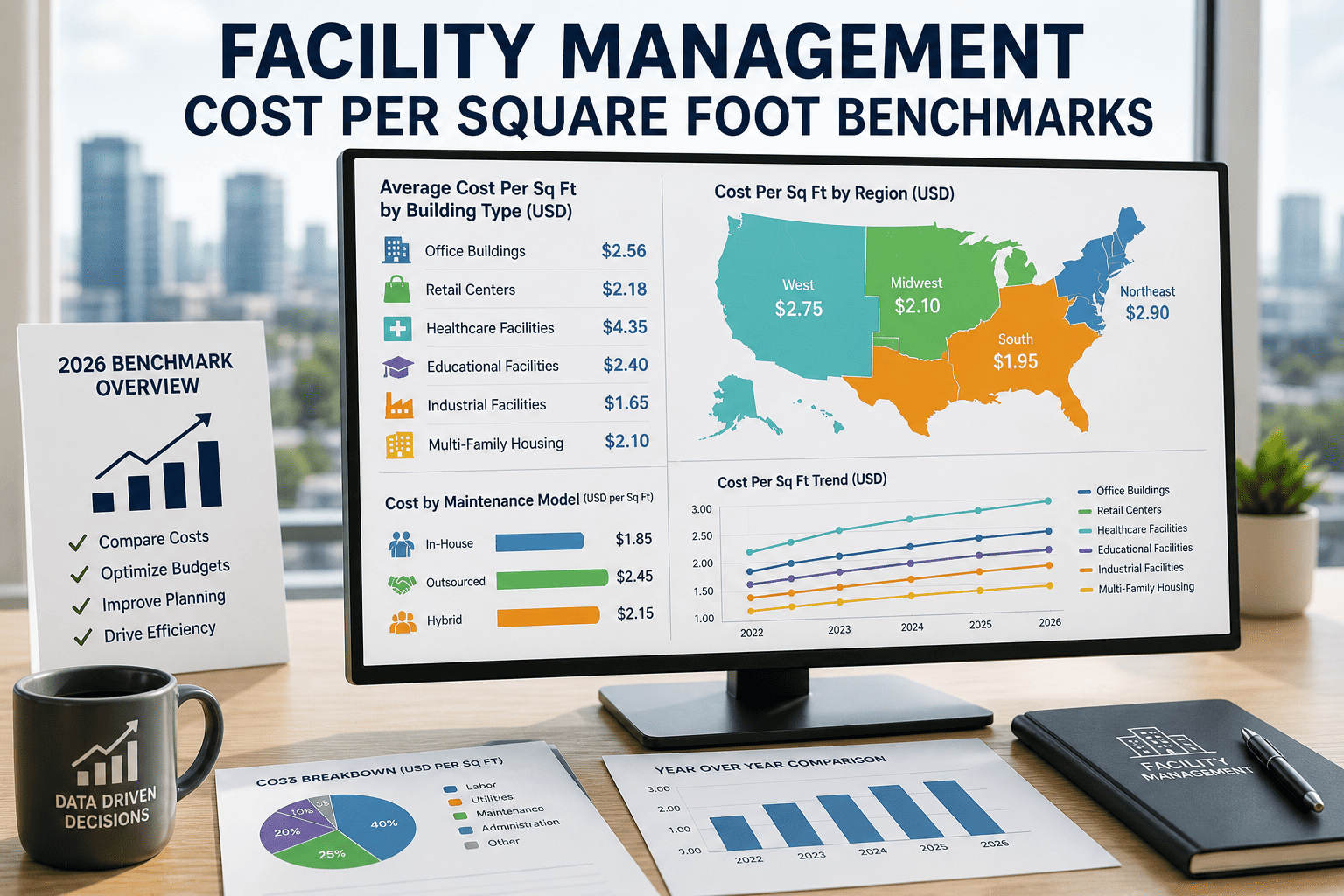
Total maintenance spend divided by total managed square footage. The primary FM cost benchmark for portfolio comparison and budget justification. Varies significantly by asset class and age.
High: above $3.50/sq ftTarget: $1.80–$2.80/sq ft
06
Maintenance Cost as % of Asset Replacement Value
Annual maintenance spend as a percentage of total asset replacement value (ARV). The Whitestone benchmark suggests 2–4% of ARV annually. Below 1% typically signals deferred maintenance accumulating as future CapEx risk.
Underspend: below 1.5% ARVTarget: 2–4% ARV annually
07
Cost per Work Order
Average total cost per completed work order, including labor, parts, and contractor costs. Benchmarked by work order type and asset class. Rising cost-per-order without volume increase signals process or parts inefficiency.
High: 30% above category avgTarget: within 10% of benchmark
08
Budget Variance (Actual vs. Planned Spend)
Monthly and annual variance between budgeted and actual FM spend. Consistently high variance in reactive programmes reflects capital planning without condition data. Best-in-class FM operations hold variance under 8%.
Reactive: 25–45% varianceTarget: under 8% variance
Category 3 — Asset and Operational KPIs
09
Asset Uptime / Availability Rate
Percentage of scheduled operational time assets are available and functional. Critical for HVAC, lifts, generators, and fire suppression systems where downtime creates occupant impact or compliance risk.
Poor: below 93%Target: 98%+ for critical assets
10
Work Order Backlog Rate
Open work orders older than 30 days as a percentage of total open orders. A growing backlog is an early warning indicator that reactive volume is exceeding team capacity — and that deferred maintenance is accumulating risk.
Poor: backlog growing month-over-monthTarget: under 10% over 30 days
11
Work Order Completion Rate
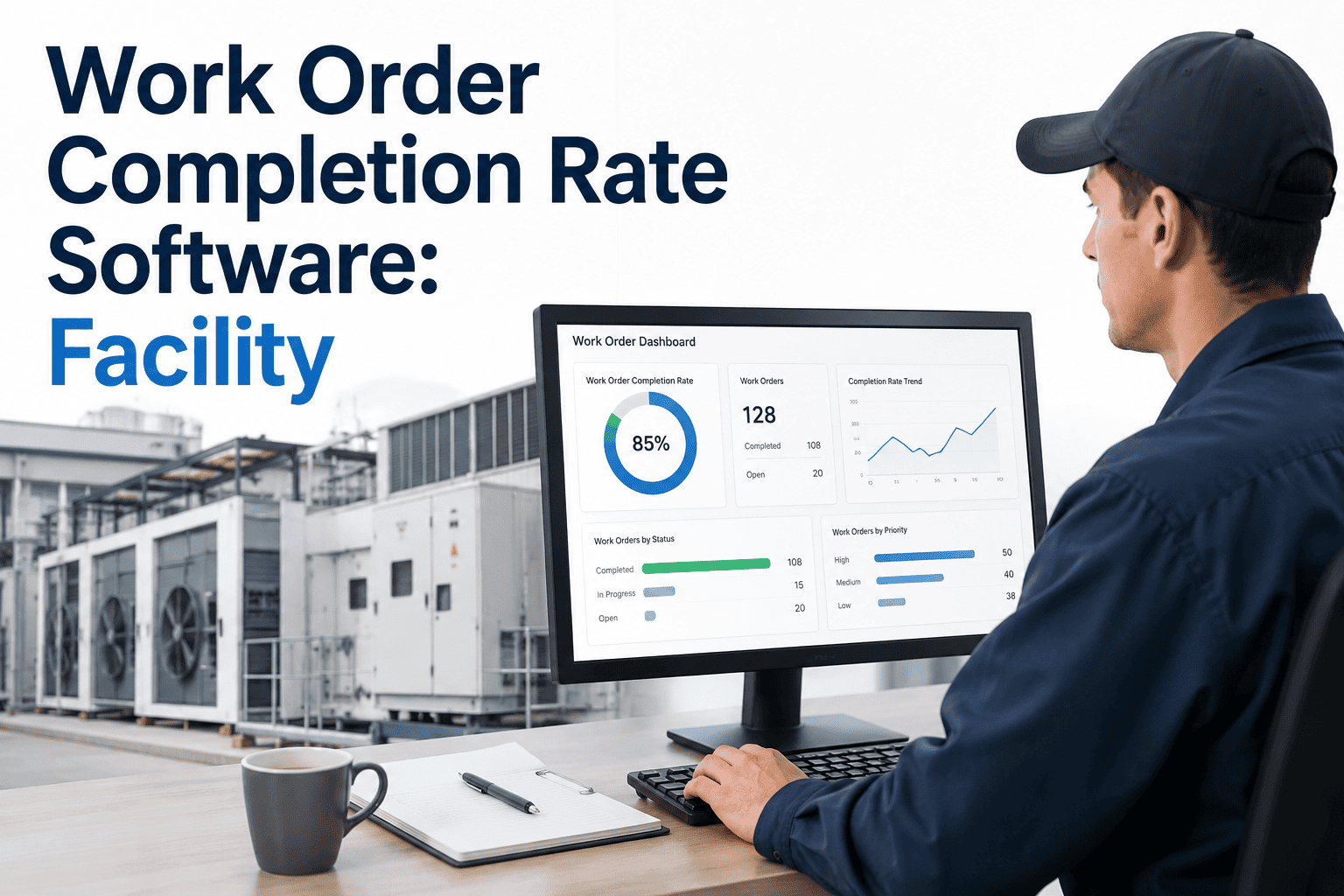
Percentage of work orders completed within the target SLA for each priority tier. Below 85% completion within SLA typically indicates workflow, staffing, or parts availability gaps that compound over time.
Poor: below 75% within SLATarget: 92%+ within SLA
12
Asset Condition Score (Average Portfolio)
Average condition rating across registered assets, scored against a defined scale (typically 1–5 or 1–100). Declining portfolio condition score is the leading indicator of increasing CapEx demand 2–5 years forward.
Alert: score declining trendTarget: stable or improving score
Category 4 — Energy and Sustainability KPIs
13
Energy Use Intensity (EUI — kWh/sq ft/yr)
Total energy consumption divided by gross floor area annually. The primary benchmark for building energy performance. ENERGY STAR certification requires EUI in the top 25% for the building category. 30% of commercial building energy is wasted through poor building systems maintenance.
High: 25+ kWh/sq ft officeTarget: 12–18 kWh/sq ft
14
Water Consumption per Occupant
Gallons or liters of water consumed per building occupant per day. Benchmarked against building type and climate zone. Leak detection and restroom fixture maintenance are the two highest-leverage maintenance interventions for this KPI.
High: 25+ gallons/occupant/dayTarget: 8–15 gallons/occupant/day
15
Carbon Emissions Intensity (kg CO2e/sq ft)
Total scope 1 and scope 2 emissions per square foot annually. Increasingly investor-grade for ESG reporting in commercial portfolios. HVAC maintenance, lighting controls, and BMS optimization are primary FM levers for this KPI.
High: 12+ kg CO2e/sq ftTarget: 4–7 kg CO2e/sq ft
16
Waste Diversion Rate
Percentage of facility waste diverted from landfill through recycling, composting, or reuse. LEED O+M certification requires 50%+ diversion. FM's operational responsibility — driven by waste stream management, contractor selection, and occupant engagement programmes.
Poor: below 40% diversionTarget: 55%+ for LEED compliance
Category 5 — Compliance, Safety and Reporting KPIs
17
Statutory Inspection Completion Rate
Percentage of legally required inspections (fire suppression, pressure systems, lifts, electrical) completed on schedule. A missed statutory inspection is not a KPI miss — it is a regulatory violation and potential insurance invalidation.
Non-negotiable: 100% requiredTarget: 100% on schedule
18
Safety Incident Rate (TRIR)
Total recordable incident rate per 100 full-time workers. OSHA benchmark for facility maintenance operations is 3.0 TRIR. FM operations with active inspection programmes and digital work order compliance tracking consistently run below 1.5.
Poor: above 3.0 TRIRTarget: below 1.5 TRIR
19
Occupant Satisfaction Score
Structured occupant feedback on space comfort, cleanliness, maintenance responsiveness, and environmental conditions. Benchmarked quarterly. Satisfaction below 65% predicts occupancy risk in commercial portfolios and staff retention issues in managed facilities.
Risk: below 65% satisfiedTarget: 80%+ consistently
20
CapEx Forecast Accuracy
Variance between planned capital expenditure and actual spend. FM operations with structured asset condition tracking and rolling CapEx models hold variance under 12%. Operations without condition data routinely see 35–55% variance driven by unplanned failure-triggered replacements.
Reactive: 35–55% varianceTarget: under 12% variance
Why FM Teams Fail at KPI Tracking
4 Reasons Most Facility Managers Cannot Answer Basic KPI Questions
01
Data Scattered Across Disconnected Systems
Work orders in one tool, energy data in another, inspection records on paper, and contractor invoices in accounts. No single FM team can calculate cost-per-square-foot or PM compliance rate when the source data lives in five systems that never talk to each other.
02
KPIs Assembled Manually for Monthly Reports
68% of FM teams assemble their performance data manually — spreadsheet exports, copy-paste from multiple logins, and data that is already 2–4 weeks stale by the time leadership reviews it. Decisions made on last month's data in a reactive environment are made on the wrong data entirely.
03
No Benchmarks to Contextualize Performance
A PM compliance rate of 72% means nothing without knowing that best-in-class FM operations sustain 92%. Without industry benchmarks built into the reporting layer, FM teams cannot identify whether their performance is improving, declining, or already behind peers competing for the same capital budget.
04
KPI Visibility Disappears at the Portfolio Level
Multi-site FM operations managing 5, 15, or 50 properties face an amplified version of every single-site problem. Aggregating KPIs across sites without a unified platform requires manual consolidation that takes days — by which point the data is too old to drive decisions at the property management level.
How Oxmaint Solves It
How Oxmaint's Analytics Dashboard Tracks All 20 FM KPIs in Real Time
Unified Asset and Work Order Data Layer
Every work order, inspection, PM task, and cost entry flows into a single data model — giving Oxmaint the source data to calculate every maintenance KPI in this guide automatically, without manual assembly or spreadsheet consolidation.
Live PM Compliance and MTTR Dashboard
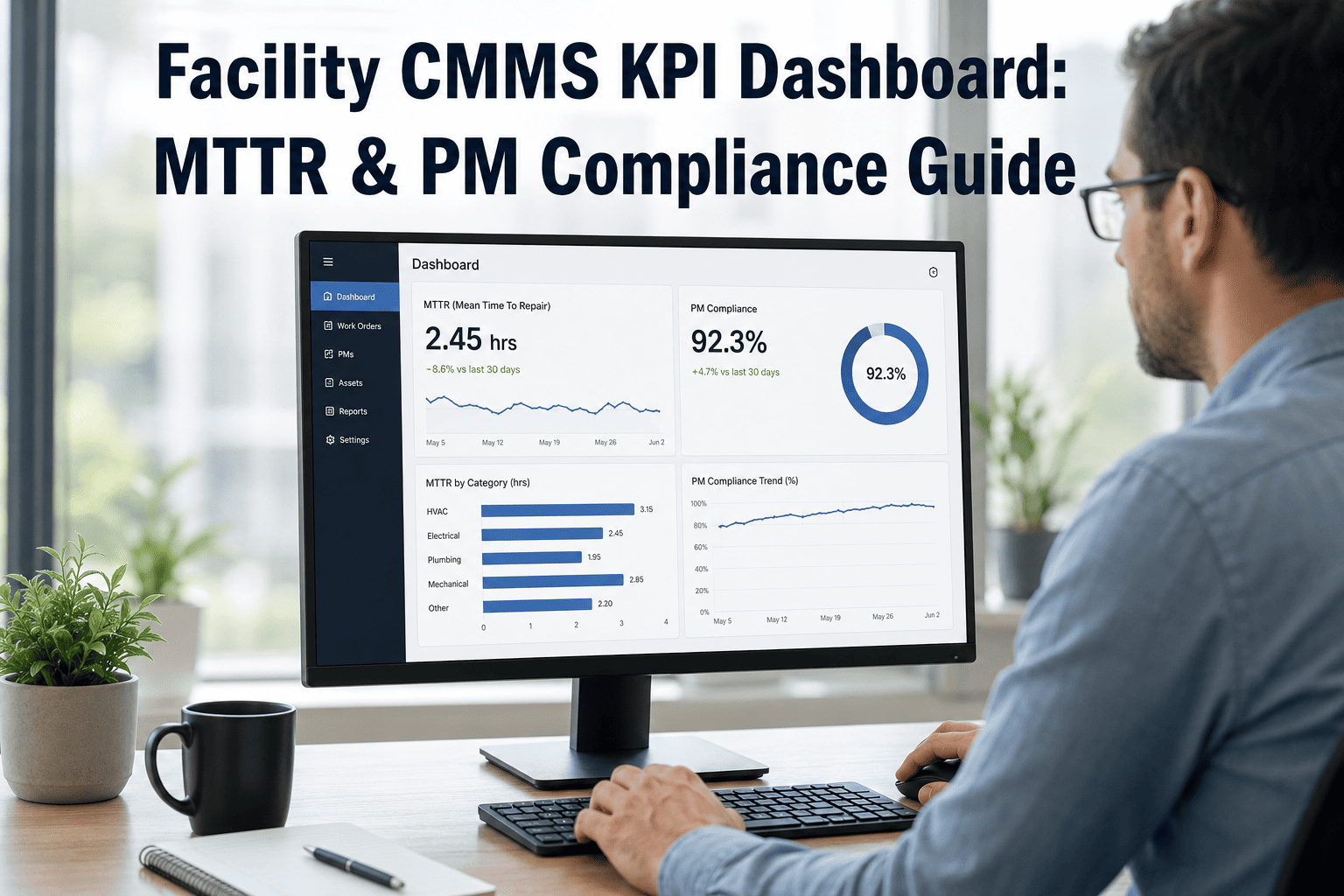
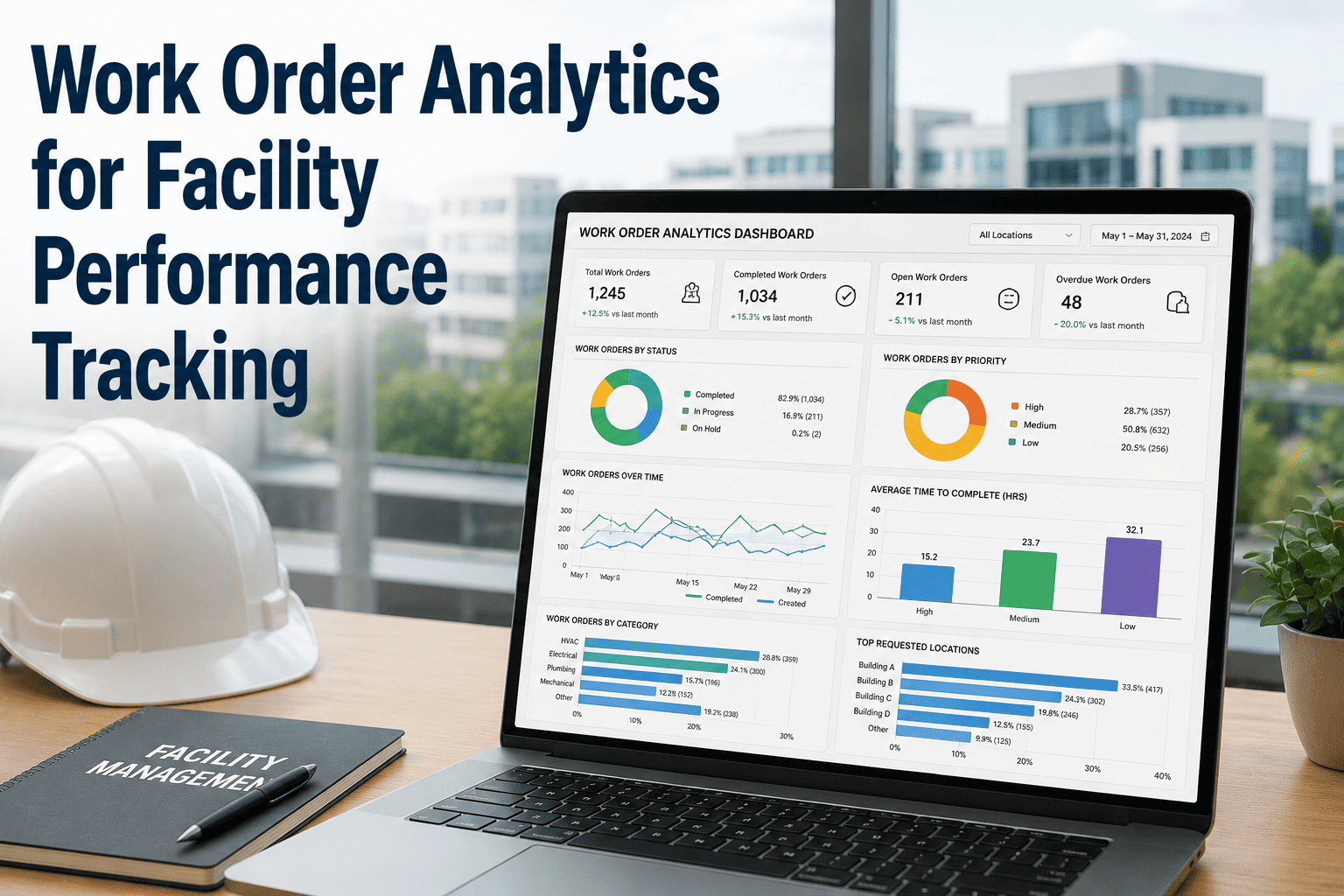
PM compliance rate, MTTR, work order completion rate, and planned vs. reactive ratio updated in real time as technicians complete tasks on mobile. No waiting for end-of-month reports — every KPI reflects the current operational state, not last week's snapshot.
Cost-per-Square-Foot Reporting by Property
Maintenance spend tracked by property, system, and asset class with area data in the asset registry — producing cost-per-square-foot reports for individual buildings and portfolio aggregates without any manual calculation step after data entry closes each month.
Rolling CapEx Forecasting from Condition Scores
Asset condition scores updated at every inspection feed into 5–10 year CapEx forecast models that reduce budget variance from the industry average of 40% to under 12%. Capital planning reports formatted for board-level review without requiring finance team translation of maintenance data.
Multi-Site Portfolio KPI Aggregation
Portfolio managers and directors of facilities see KPI roll-ups across every managed property — PM compliance by site, cost-per-square-foot by property class, and MTTR by building — in one dashboard. No manual consolidation. No stale data sent by property teams on different reporting cycles.
Compliance and Inspection Tracking Built In
Statutory inspection schedules, regulatory audit records, and safety incident documentation generated automatically from Oxmaint's work order and inspection workflows — satisfying OSHA, NHS, Building Safety Act, and PSSR requirements with audit-ready exports available on demand.
Before vs. After
FM KPI Tracking — Manual Operations vs. Oxmaint Analytics Dashboard
Measurable Results
What Oxmaint Analytics Customers Measure After Dashboard Deployment
52%
Reduction in Emergency Repair Spend
Achieved within 18 months of full Oxmaint deployment as PM compliance rate rises from sub-65% to 90%+ and reactive repair volume falls proportionally.
40%
Faster Mean Time to Repair
Complete repair history, parts lists, and prior failure records available on mobile before technicians reach the asset — eliminating the diagnostic time that inflates MTTR in paper-based operations.
84%
PM Compliance Rate Achieved
From a typical starting point of 31–45% compliance in reactive FM operations, Oxmaint customers reach 84%+ within 12 months through automated scheduling and mobile task management.
12%
CapEx Budget Variance
Down from an industry average of 40% variance. Rolling condition-based CapEx forecasts replace age-based replacement guesses — giving finance teams a defensible capital plan 3–5 years ahead.
Frequently Asked Questions
FM KPIs and Analytics Dashboard — What Facility Managers Ask First
Which facility management KPIs should I prioritize first if I am starting from scratch?
Start with the four maintenance KPIs that have the most direct financial impact: PM compliance rate, planned vs. reactive maintenance ratio, work order backlog rate, and cost per square foot. These four metrics give you the clearest picture of whether your operation is getting ahead of failures or constantly reacting to them, and they are the easiest to move quickly with a CMMS deployment. PM compliance rate below 70% is almost always the root cause of high emergency repair spend — and every percentage point of compliance improvement translates directly to lower reactive repair costs at the 4.8x cost differential. Once these four are stable and trending in the right direction, add MTTR, asset uptime, and statutory inspection compliance. Energy and sustainability KPIs typically come in the third phase as data infrastructure matures.
Sign up for Oxmaint to start tracking these KPIs from day one, or
book a demo to see the analytics dashboard configured for your property portfolio.
What is a good PM compliance rate benchmark for facility management operations?
Industry benchmarks for PM compliance rate in facility management operations break down into three performance tiers. Below 65%: reactive operations where emergency repairs are frequent and maintenance teams are permanently behind. 65–80%: transitional operations with some structured PM but significant reactive volume persisting. 80–95%: best-in-class FM operations where planned maintenance dominates and emergency repair spend is below 20% of total maintenance budget. The IFMA benchmark for well-managed commercial facilities targets 85%+ PM compliance across all asset classes, with critical systems (HVAC, fire suppression, lifts) maintained at 95%+ compliance regardless of the overall portfolio average. Oxmaint customers typically start at 31–45% compliance and reach 84%+ within 12 months of full platform deployment through automated PM scheduling and mobile task management. The cost reduction from this compliance improvement alone delivers full platform payback within the first year for most FM operations.
Book a demo to see how Oxmaint's PM scheduling engine works for your specific asset types and property portfolio.
How does Oxmaint calculate cost-per-square-foot for multi-property portfolios?
Oxmaint calculates cost-per-square-foot automatically from two data inputs: total maintenance spend captured through work order cost tracking, and gross floor area registered in the asset hierarchy for each property. Every work order closure captures labor cost, parts cost, and contractor cost against the specific property and system where the work was performed. The platform aggregates these costs by property and divides by registered area on a daily basis — meaning cost-per-square-foot is always current, not assembled at month end. For multi-property portfolios, Oxmaint provides both site-level cost-per-square-foot (for benchmarking individual properties against each other and against market data) and portfolio-level aggregates for ownership group reporting. Cost-per-square-foot can be filtered by system type, work order type, or time period — so FM managers can identify whether HVAC is driving cost above benchmark while other systems are performing well. The Whitestone benchmark for commercial office maintenance is $1.80–$2.80 per square foot annually — Oxmaint makes this comparison visible in real time rather than discoverable only at year-end budget review.
Sign up free to start tracking cost-per-square-foot across your properties from your first work order entry.
How do facility management KPIs connect to CapEx planning and asset replacement decisions?
The connection between FM KPIs and CapEx planning runs through asset condition scoring and historical maintenance cost accumulation. When MTBF for a specific asset class starts declining while repair cost-per-event is rising, the data is telling you that the asset is approaching end of economic life — regardless of its calendar age. Oxmaint captures this signal through two mechanisms. First, asset condition scores updated at every inspection feed into rolling Remaining Useful Life calculations that trigger CapEx forecast updates automatically. Second, cumulative work order cost by asset allows total cost of ownership analysis that makes refurbish-versus-replace decisions data-driven rather than gut-based. FM operations without this data routinely see 35–55% CapEx budget variance because replacements are triggered by failure events rather than planned from condition trends. Oxmaint customers sustain under 12% CapEx variance because replacement cycles are planned 3–5 years ahead from live condition data rather than discovered when an asset fails and demands emergency capital approval.
Book a demo to see Oxmaint's CapEx forecasting dashboard applied to your property's specific asset inventory and condition profile.
How quickly can a facility management team realistically start tracking all 20 KPIs in Oxmaint?
The timeline for full 20-KPI dashboard activation in Oxmaint follows three phases that most FM teams complete within 60–90 days. Phase 1 (Days 1–30): Maintenance and operational KPIs. Work order management goes live immediately — PM compliance rate, MTTR, work order completion rate, and backlog tracking activate from the first work orders entered. These four KPIs alone cover everything in the maintenance performance and operational categories of this guide. Phase 2 (Days 30–60): Cost KPIs. Once work orders are capturing labor, parts, and contractor costs, cost-per-square-foot and cost-per-work-order reports are available automatically. Asset condition scoring activates as inspection records accumulate against the asset registry. Phase 3 (Days 60–90): CapEx and compliance KPIs. With asset condition data accumulating, the CapEx forecasting model activates and statutory inspection tracking goes live. Energy and sustainability KPIs integrate as energy data connections are configured with existing building management systems. Oxmaint deploys with no IT project, no server installation, and no hardware procurement — most FM teams are tracking their first KPIs within days of data onboarding.
Sign up free to start your deployment, or
book a demo for a deployment timeline tailored to your portfolio size and current data infrastructure.
68% of FM Teams Have No KPI Dashboard. Oxmaint Changes That in Days.
PM compliance rate, MTTR, cost per square foot, CapEx forecast accuracy, statutory inspection compliance — all 20 KPIs tracked in one real-time analytics dashboard. No IT project. No spreadsheet consolidation. No stale data. Join 1,000+ FM operations already running on Oxmaint.