
Somewhere in your PM backlog is a technician opening a perfectly healthy air handler because the schedule says quarterly, reinstalling it slightly wrong, and creating the exact failure the PM was supposed to prevent. Over-maintenance is the quiet twin of under-maintenance — it doesn't show up as a downtime event, so it rarely gets questioned, but it burns labor hours, consumes parts, and sometimes causes the very failures it was meant to stop. Facility teams that treat every PM interval as fixed forever are usually running both problems at once: some assets get opened too often, others not nearly enough. The method below shows how to find that sweet spot, and where Start Free Trial fits into making the change stick.
When preventive maintenance becomes the thing that breaks your equipment
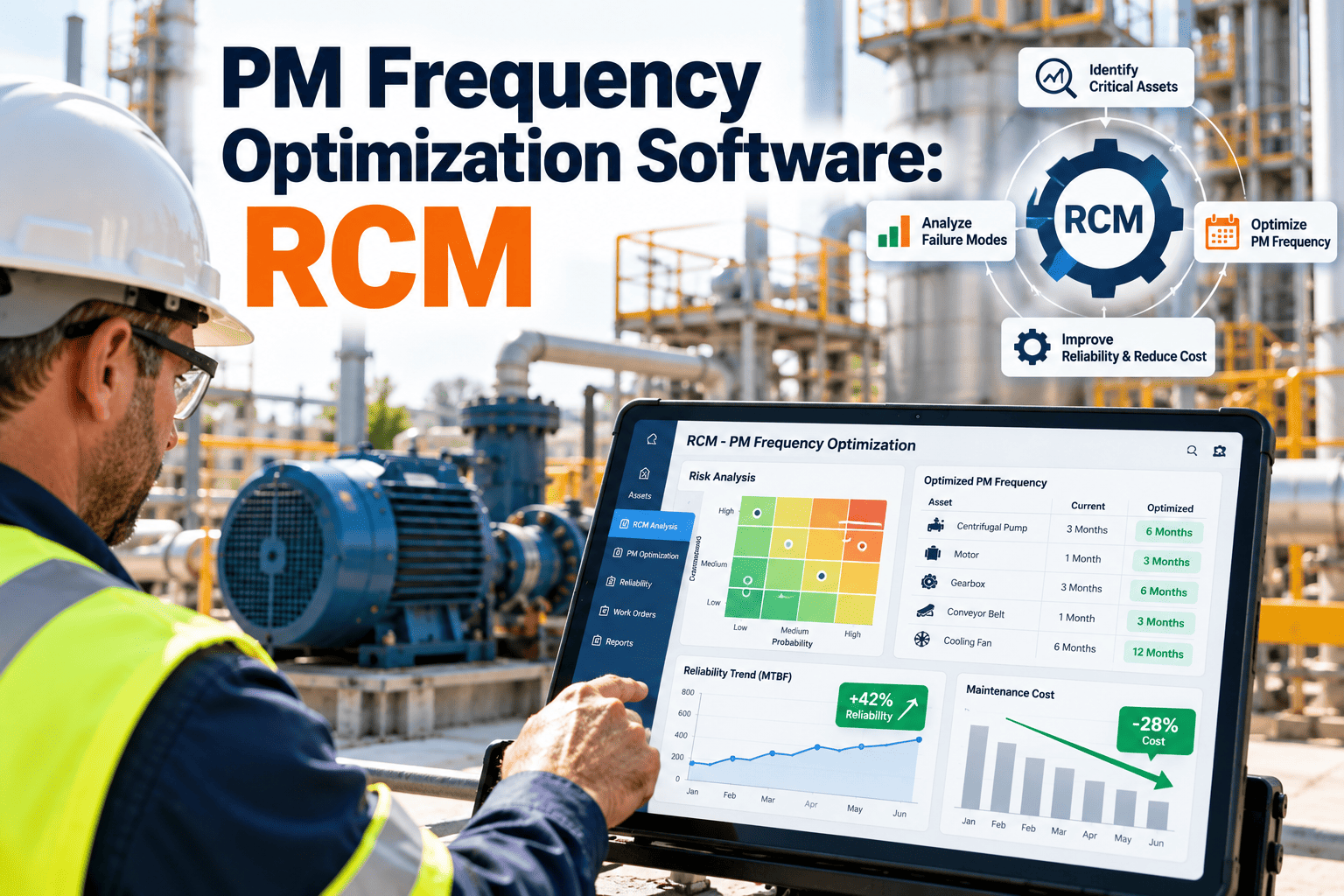
Fixed-interval PM schedules assume every asset degrades on the same calendar. Most don't. Interval optimization uses actual failure and condition data to right-size PM frequency — without opening the door to warranty disputes or unplanned downtime.
Over-PM and under-PM cost the same budget in different directions
The Society for Maintenance and Reliability Professionals recommends roughly 15% of total maintenance labor hours go to PM work as a starting benchmark. Facilities that drift far above or below that line are usually misallocating effort rather than under-resourcing it — a team spending 30% of its hours on PM isn't necessarily more reliable than one spending 15%, it's more likely spending a large share of that time on tasks that aren't preventing anything.
Fixed intervals set by manufacturer defaults or "always done it this way" habits, applied uniformly regardless of actual run hours, load, or condition.
- Labor spent on assets showing no degradation
- Unnecessary parts consumption and inventory churn
- Reassembly and calibration errors introduced by every teardown
- Equipment taken offline for maintenance that didn't need to happen
Intervals set too long relative to actual wear rate, often on assets nobody has re-evaluated since commissioning.
- Unplanned failures between scheduled PM visits
- Emergency repair premiums and secondary damage
- Safety exposure from unexpected equipment failure
- Compliance gaps on assets tied to code-required service intervals
How to tell which assets are ready for interval optimization
Not every asset class is a good first candidate. The strongest signals come from equipment with a long enough maintenance history to actually show a pattern, rather than something recently installed or recently overhauled.
Three or more clean PM cycles in a row
No findings, no adjustments, no parts replaced across consecutive scheduled visits — the clearest sign the current interval is tighter than the asset needs.
Stable, well-understood duty cycle
Equipment running a consistent load and schedule is easier to model than something with highly variable seasonal or production-driven demand.
Recent installation or major overhaul
There isn't enough post-install history yet to distinguish a genuinely low-wear asset from one that simply hasn't had time to develop a failure pattern.
The root cause: most PM schedules were never actually calculated
Facility teams inherit far more PM schedules than they build from scratch, whether through a change in staff, a new CMMS migration that carried the old intervals over unchanged, or simply because nobody has had the time to revisit a schedule that "seems to be working."
Ask where a given PM interval came from and the honest answer is usually the OEM manual, a predecessor's spreadsheet, or an insurance requirement written for a generic use case — not this building's actual load profile, run hours, or failure history. Manufacturer-default intervals are deliberately conservative, because the OEM has no visibility into how lightly or heavily a specific unit actually runs, so a default interval written for a worst-case duty cycle gets applied uniformly to units running well under that load.
Industry studies on scheduled maintenance consistently find that a meaningful share of PM tasks — commonly cited in the range of a quarter to a third — are performed on equipment showing no degradation at the time of service, while a smaller but costly share of unplanned failures trace back to intervals that were simply set too long for the asset's real wear rate. Both numbers point to the same conclusion: the fix isn't doing more or less maintenance overall, it's redistributing the same labor hours toward the assets where they actually reduce risk.
Extending an interval on equipment still under manufacturer warranty can void coverage if the OEM's minimum service schedule isn't met. Interval optimization should separate warranty-bound assets — which keep the manufacturer's minimum cadence — from post-warranty assets, where condition data can safely drive the schedule.
The distinction matters more than most facility teams assume, because warranty terms are usually written around documented service intervals, not just "regular maintenance" in the abstract. A chiller manufacturer's extended parts-and-labor warranty, for instance, often requires proof of an annual factory-authorized service visit; skip or stretch that visit to chase a PM optimization win and the facility can lose coverage on a failure that has nothing to do with the skipped task. The safest practice is to build a warranty end-date field into the asset record itself, so any interval change request is checked against it automatically rather than relying on someone remembering which units are still covered.
A four-phase interval optimization method for facility teams
The method below doesn't require a reliability engineering team or a formal RCM program to run — it's built around data most facilities already have in their CMMS, applied more deliberately than the ad hoc adjustments that usually happen instead.
Pull PM completion history against failure history
For each asset class, compare PM completion records to unplanned work orders over the last 12–24 months. Assets with zero findings across repeated PM visits are optimization candidates; assets with failures between visits need the opposite adjustment.
Separate warranty-bound assets from post-warranty assets
Flag any asset still inside its manufacturer warranty period or under a maintenance-contingent extended warranty. These keep OEM-minimum intervals regardless of what the failure data suggests, until warranty coverage lapses.
Test interval changes on a controlled subset
Extend or tighten intervals on a small, non-critical subset of assets first, tracking condition findings at each visit. Roll the change out to the full asset class only after two to three cycles confirm the new interval holds.
Layer condition triggers on top of the base interval
Where sensors or inspection data are available, let condition readings pull a PM forward or push it back within a set range, rather than replacing the calendar entirely. This catches the assets that drift outside their normal pattern between scheduled visits.
Matching the optimization approach to asset class
The same four-phase method applies across asset classes, but the starting interval, the lever available for adjustment, and the constraint to watch differ enough that a single facility-wide policy doesn't work well in practice. The table below reflects how the method typically plays out on the asset classes most facility teams manage.
| Asset class | Typical starting point | Optimization lever | Watch-out |
|---|---|---|---|
| HVAC — rooftop units | Quarterly filter/coil PM regardless of load | Extend to condition-based on filter differential pressure | Warranty terms on newer units |
| Electrical switchgear | Annual infrared scan and torque check | Rarely safe to extend; tighten if thermal findings recur | Insurance and NFPA 70B documentation requirements |
| Fire pumps | Weekly/monthly per NFPA 25 | Interval is code-fixed, not a candidate for optimization | Do not adjust without AHJ sign-off |
| Standby generators | Monthly load-bank test | Adjust load duration based on run-hour trend, not frequency | Emissions permit testing requirements |
| Conveyor and material handling | Fixed lubrication interval | Shift to run-hour or cycle-count triggered PM | Requires a working meter or cycle counter |
A mid-size facility portfolio applies the method
A commercial facilities team managing 340 PM tasks across three buildings audits twelve months of completion and failure history. They find 40% of 30-day HVAC PM tasks show zero findings across four consecutive visits and are safe to extend to a 60-day cycle for post-warranty units. A smaller group — segment bearings on two older air handlers — shows recurring vibration findings and gets tightened from quarterly to monthly. Fire pump and switchgear intervals stay untouched as code-fixed. Net effect: fewer unnecessary PM hours on the low-risk group, redirected toward the assets that were actually under-maintained, with no change to compliance-bound equipment.
The team documents the change in two stages before calling it final. First, the extended 60-day HVAC interval runs for two full cycles on a pilot group of six units before being applied to the rest of the fleet, catching one unit where a refrigerant charge issue would have gone unnoticed for an extra month under the new cadence — a reminder that even a well-supported interval extension needs a verification window, not a one-time decision. Second, the freed-up labor hours get tracked explicitly rather than absorbed invisibly into other work, so the facilities director can show leadership exactly where the recovered time went: additional vibration route coverage on the tightened bearing group, plus a backlog of deferred corrective work that finally gets scheduled.
What to track once the new intervals are live
An interval change that isn't measured tends to drift back toward the old default within a year, either because a new technician doesn't know why the cycle was extended or because one bad outcome gets blamed on the change instead of investigated properly.
PM hours recovered by asset class
Document the labor hours freed by each interval extension so the savings are visible to budget owners, not just felt informally.
Unplanned failure rate, pre- and post-change
A rising failure rate after an extension is the clearest signal the change went too far and needs to be pulled back.
Where recovered hours were reinvested
Optimization only pays off if freed labor goes toward the under-maintained assets it was meant to fund, not toward general slack.
Run the interval audit against your own PM history
See how OxMaint compares PM completion records to failure history by asset class and flags warranty-bound equipment automatically.
Optimizing intervals inside the same system that tracks the work
Interval optimization only works if PM completion data and failure history live in one place. Splitting that across a CMMS and a separate spreadsheet is how most facility teams lose track of which assets were actually tested.
PM-versus-failure reporting
Dashboards compare completed PM tasks against unplanned corrective work by asset class, surfacing over- and under-maintained groups automatically.
Warranty and compliance flags
Tag assets with warranty end dates or code-required intervals so interval changes never accidentally touch protected equipment.
Condition-triggered scheduling
Layer sensor or inspection thresholds on top of calendar-based PM triggers so intervals adjust within a controlled range.
Controlled rollout tracking
Pilot interval changes on a defined asset subset and track findings across cycles before extending the change portfolio-wide.
Facility PM optimization: frequently asked questions
How do I know if a PM interval is too frequent?
Look for a pattern of PM visits with no findings across several consecutive cycles on the same asset. Three or more clean visits in a row, combined with a stable and well-understood duty cycle, is a reasonable signal to test an extended interval on a controlled subset rather than the whole asset class at once.
Will extending a PM interval void my equipment warranty?
It can, if the manufacturer's warranty terms specify a minimum service schedule, and many extended parts-and-labor warranties are written exactly that way. Always confirm warranty-bound status before adjusting an interval, and keep those assets on the OEM minimum until the warranty period lapses, even if the failure history would otherwise support a longer cycle.
What percentage of maintenance hours should go to PM work?
SMRP's benchmark of roughly 15% of total maintenance labor hours is a common starting reference point, though the right figure varies by facility age, complexity, and asset mix.
Can code-required PM intervals be optimized?
No. Intervals set by NFPA, insurance, or the authority having jurisdiction — fire pumps and life-safety systems in particular — are compliance minimums, not scheduling suggestions, and should be excluded from optimization entirely.
How long does a PM interval optimization project take?
A first pass through completion-versus-failure history typically takes two to four weeks once the data is centralized in a single system rather than split across spreadsheets and paper records. Full validation of any interval change takes two to three PM cycles on a pilot group before it's rolled out portfolio-wide, so the entire process from kickoff to full rollout usually spans two to four months depending on how frequently the affected assets are serviced. Book a demo at calendly.com/oxmaintapp/30min to see the reporting used to run this analysis.
Stop guessing at PM frequency
Right-size your preventive maintenance intervals using your own completion and failure data — without touching warranty-bound or code-required equipment.





.jpeg)
