FM contract renewals are often handled in the last few weeks, when the outgoing provider holds most of the leverage. The buyer has little time to benchmark, no clean performance record, and no credible alternative. A 90-day preparation plan reverses that position by building evidence, resetting scope and creating real competitive tension early. This playbook sets out that plan and shows how work order data from maintenance management software becomes the strongest argument in the room.
FM Contract Renewal Negotiation: 90-Day Prep Playbook
Benchmark, reset scope, lift service levels and create competitive pressure before the renewal clock runs out, with performance evidence you own.
Why Renewals Go Wrong
Most weak renewals share the same root causes. Each one is fixable with early preparation.
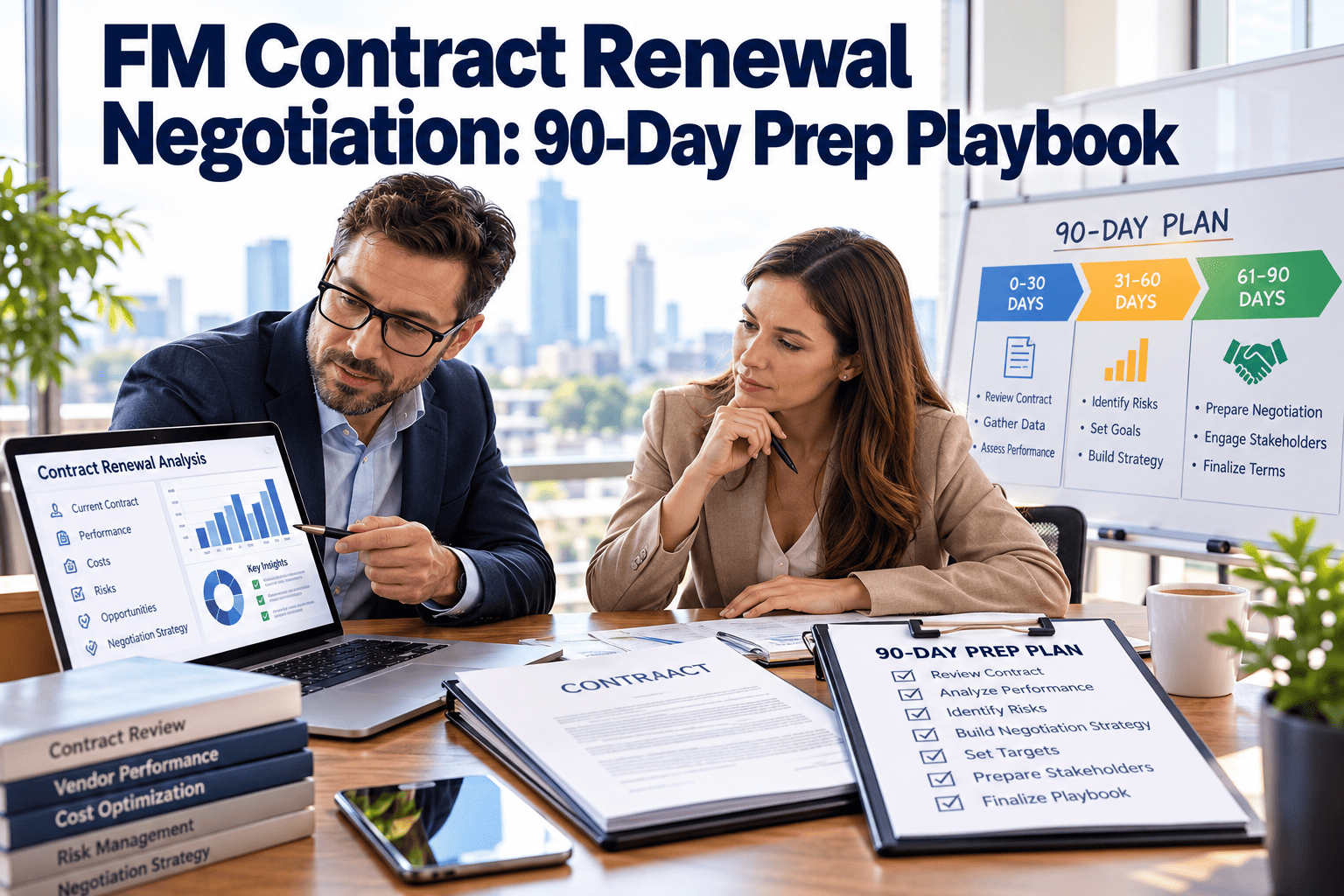
The 90-Day Plan
IACCM-style negotiation frameworks emphasize preparation, understanding both parties' interests, and having a credible alternative. The plan below puts those principles into a calendar.
- Export 12 to 24 months of work orders, response times, completion rates and repeat failures.
- Compare unit rates and staffing against market quotes or peer data.
- Survey occupants and internal stakeholders on service quality.
- Read the current contract for termination, notice, indexation and auto-renewal terms.
- Reconcile the asset register against what the provider actually maintains.
- Remove services no longer needed and add real gaps.
- Separate fixed fee, variable and reimbursable items.
- Decide which services to keep in-house, which to bundle, which to unbundle.
- Draft tighter, measurable service levels tied to evidence.
- Issue a request for proposal or quote to at least two alternatives.
- Prepare walk-away terms and a transition plan.
- Agree internal negotiating roles and approval limits.
Evidence That Wins Negotiations
Claims such as "response has been slow" are easy to dispute. Time-stamped data from your own system is not.
| Measure | Where it comes from | What it supports in negotiation |
|---|---|---|
| Response and resolution time against SLA | Work order timestamps | Service credits, tighter targets |
| Preventive maintenance completion rate | PM schedule versus completed tasks | Proof of missed obligations or evidence of strong delivery |
| Repeat corrective work on the same asset | Asset history | Quality of repair, root-cause obligation |
| Backlog and aging | Open work order reports | Staffing levels, resourcing clauses |
| Cost per asset class | Labor, parts and reimbursables per work order | Rate benchmarking and scope pricing |
| Compliance inspection records | Inspection and certificate logs | Statutory risk transfer terms |
Own the Performance Record Before You Negotiate
Oxmaint captures work orders, response times and asset history in one place, so your evidence does not depend on the provider's report.
Negotiation Levers
Scope Reset: Before and After
- Last term's scope copied forward
- Generic SLAs, one target for every asset
- Reporting defined by the provider
- Vague extras billed as variations
- Scope matched to the verified asset register
- SLAs tiered by criticality
- Reports drawn from shared system data
- Variation rules with pre-agreed rates
Creating Competitive Pressure Honestly
Competition is only useful if it is real. Bluffing damages trust and rarely survives scrutiny.
- Send the same scope pack and data to every bidder so quotes can be compared.
- Include the incumbent in the process, with the same information.
- Evaluate on total cost and service quality, not headline price alone.
- Cost the transition: mobilization, knowledge loss and short-term risk.
- Keep an in-house or hybrid option as a genuine comparison.
In the Room: A Simple Negotiation Sequence
How Oxmaint Supports Renewal Readiness
- Work orders record who did what, when and how long, forming the objective performance log.
- Asset management keeps a verified register so scope and pricing match what exists on site.
- Preventive maintenance schedules show planned versus completed tasks.
- Inspections and compliance records provide proof of statutory obligations.
- Dashboards and reports track SLA performance, backlog and repeat failures.
- Inventory and cost tracking support rate and parts benchmarking.
Renewal Readiness Checklist
FM Contract Renewal FAQs
Walk Into Your Next Renewal With Evidence
Start the 90-day plan now, build the performance record, and negotiate from a position of knowledge.