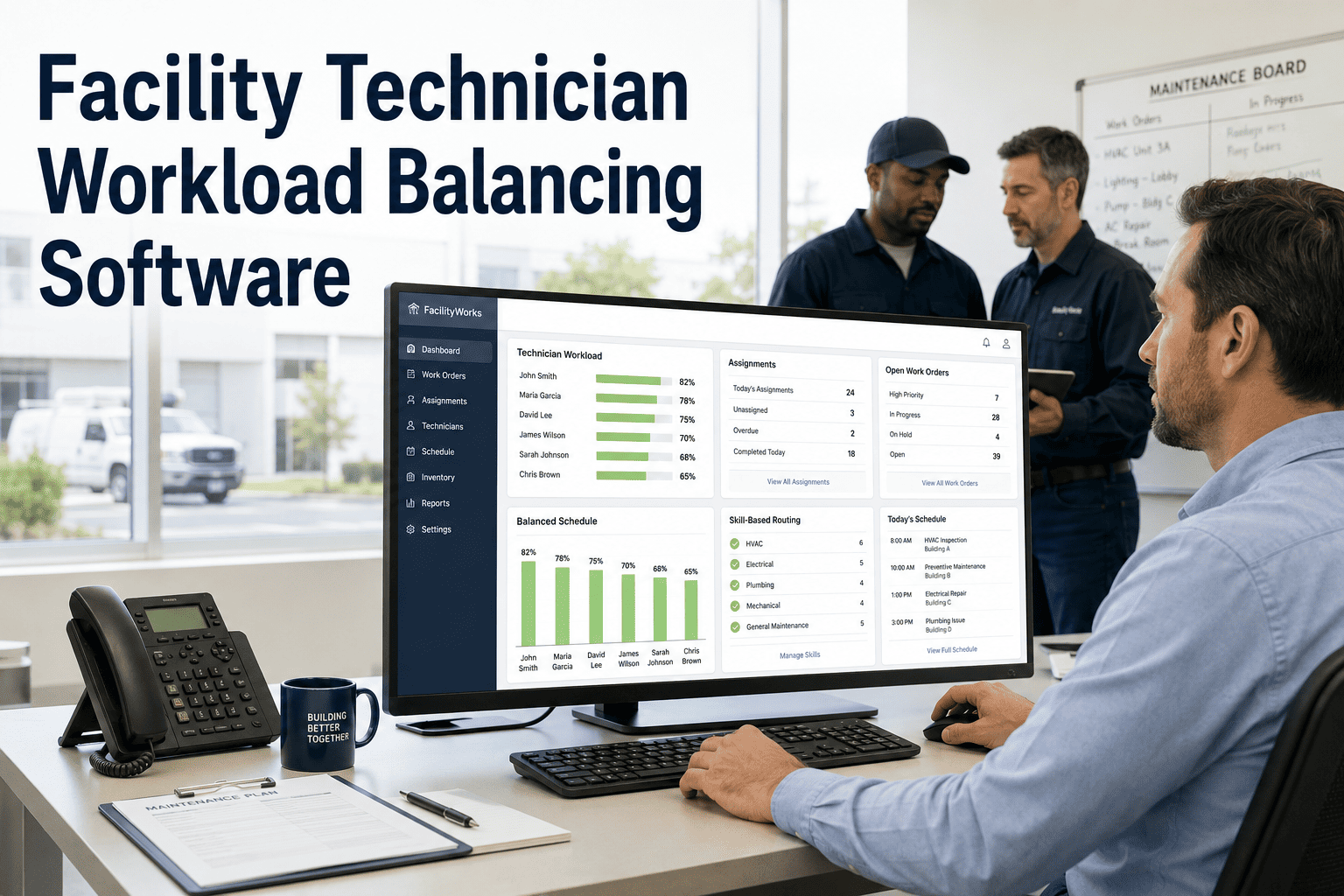
Bookings live in one app, visitor management in another, maintenance work orders in a CMMS nobody outside the trades team logs into, and cleaning verification in a spreadsheet that only gets updated on audit weeks. None of these tools talk to each other, so no report can actually answer a simple question like "how much did this building cost to run last quarter." The facility management software market is on track to nearly double by 2030, and most of that growth is teams replacing fragmented point tools with something unified. This guide covers FM platform consolidation: how to assess a fragmented stack, plan a migration, and get to reporting you can trust with one connected platform.
Platform Strategy
Technology
Data & Reporting
Software Selection
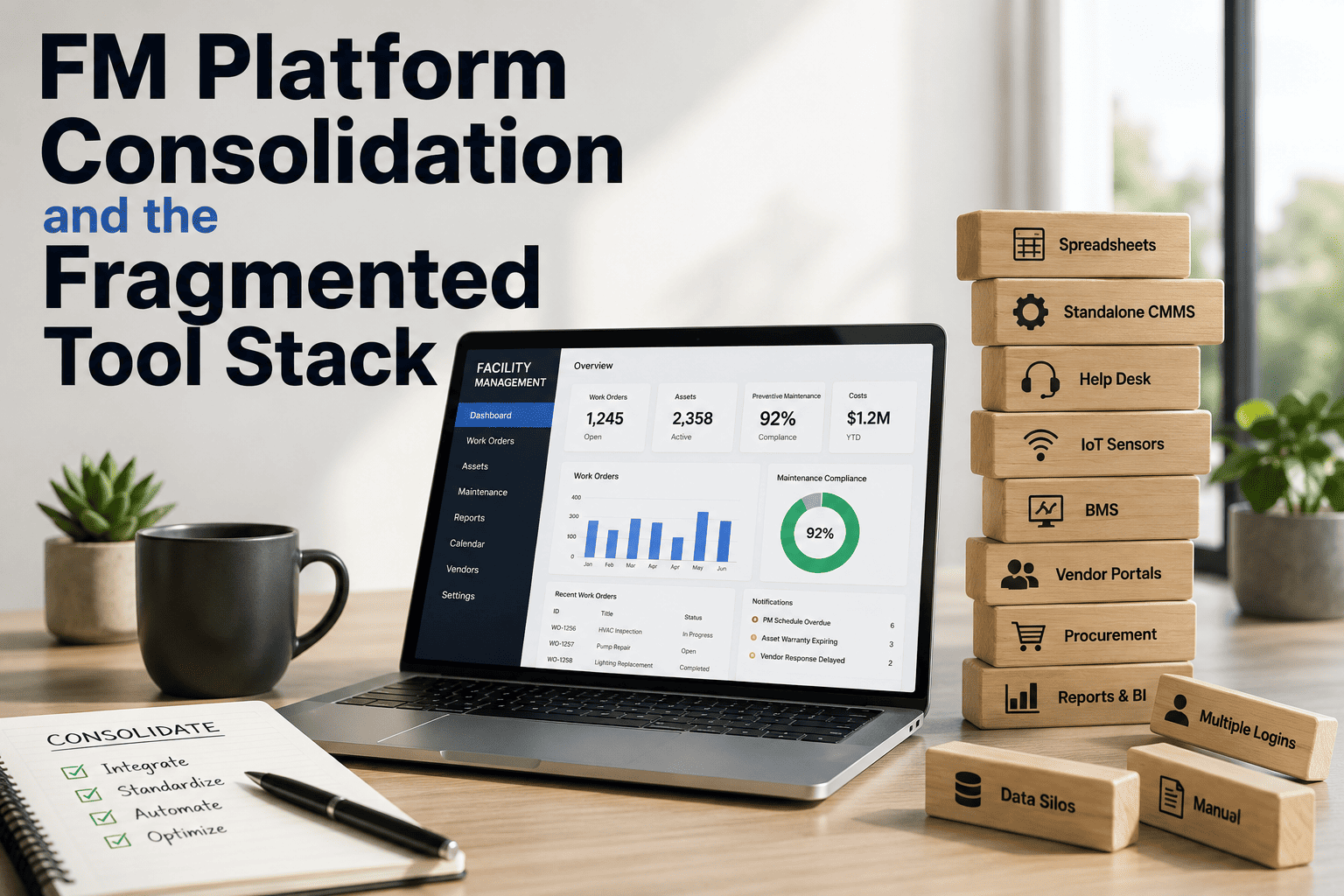
The Fragmented FM Stack
CMMS
Work orders and PMs, owned by the trades team
CAFM
Space and occupancy, owned by workplace
Visitor system
Front desk logins, owned by security
Spreadsheets
Cleaning and compliance, owned by whoever remembers to update them
Four systems, four owners, zero shared reporting layer — and most portfolios run closer to six or seven tools once BMS, energy, and vendor portals are counted
The Real Cost
What Fragmentation Actually Costs a Facility Team
The direct software cost of running multiple point tools is usually the smallest part of the bill. The larger cost shows up in the hours a coordinator spends reconciling numbers between systems, and in the decisions that get made on incomplete data because pulling the full picture takes too long to be worth it.
Duplicate data entry
The same asset or vendor gets entered separately into two or three systems, and the records drift apart within months.
No single source of truth
Finance, operations, and maintenance each report a different number for the same building because each pulls from a different tool.
Manual report-building
Monthly reporting becomes a spreadsheet-stitching exercise instead of a five-minute dashboard export.
Integration maintenance overhead
Every point-to-point integration between tools is another thing that breaks silently and needs someone to notice.
Market Context
Why Consolidation Is Accelerating Now
Facility software spend is shifting from a collection of single-purpose tools toward platforms that cover maintenance, space, and reporting together. Buyers increasingly evaluate a new tool by whether it reduces the number of systems in the stack, not just by what it adds.
$2.66B → $4.97B
FM software market, 2025 to 2030
13.3%
Annual market growth rate
16%
CAGR for CMMS, the fastest-growing FM software segment
~30%
Efficiency gain reported from integrated systems
Replace the Spreadsheet Layer With One Platform
Oxmaint brings maintenance, inspections, and reporting into one system, so your data stops living in four places that never agree with each other.
Assessment
CMMS vs. CAFM vs. IWMS vs. EAM — Choosing What to Consolidate Onto
Every one of these categories claims to be the platform of record, so the choice comes down to which workflow actually drives your daily operations. Most facility-led teams are better served by starting from maintenance and expanding outward, rather than starting from an enterprise platform and trying to make it fit daily work order habits.
Readiness Check
Signs Your Stack Is Overdue for Consolidation
Conflicting reports
Two departments present different numbers for the same building at the same leadership meeting.
Manual reconciliation
Someone spends a recurring part of every week copying data between systems by hand.
Vendor sprawl
New tools get added to solve one-off problems faster than old ones get retired.
Slow reporting cycles
Building a leadership report takes days instead of minutes because data has to be pulled from multiple places first.
Migration Plan
A Four-Phase Consolidation Roadmap
Consolidation projects fail when teams try to migrate everything at once. A phased approach keeps the current systems running while the new platform proves itself, so there is no point where reporting goes dark.
Phase 1
Audit the current stack
List every tool in use, who owns it, and which reports each one is supposed to feed. Most teams are surprised by the count, and the audit alone often surfaces tools nobody remembered were still active.
Phase 2
Pick the system of record
Decide which platform becomes the primary data source for maintenance and asset records — usually the CMMS for most portfolios — and document what stays connected versus what gets retired.
Phase 3
Migrate and retire
Move active data over in batches by site or system, validate it against the old records, and sunset the old tool once a full reporting cycle runs clean without it.
Phase 4
Standardize reporting
Build the dashboards leadership actually asked for, now that the underlying data comes from one trustworthy source instead of a monthly reconciliation exercise.
One Platform, One Version of the Truth
See how Oxmaint consolidates maintenance, inspections, and asset records so every report pulls from the same data.
Frequently Asked Questions
Platform Consolidation — Common Questions
How do we know our FM tool stack is actually fragmented?
If two departments can't agree on a single number for the same building — total work orders, total downtime, total spend — the stack is fragmented, regardless of how many tools you count.
Start a free trial to see one unified report for the first time.
Should we consolidate onto a CMMS, CAFM, IWMS, or EAM?
Most maintenance-led facility teams consolidate onto a CMMS first, since it is the fastest to deploy and covers the highest-frequency workflows. IWMS and EAM only make sense once the portfolio's needs genuinely extend beyond maintenance into capital and lifecycle planning.
How long does a platform consolidation project usually take?
A CMMS-centered consolidation for a single portfolio typically runs a few months from audit to full data migration, far faster than an enterprise IWMS rollout.
Book a demo to scope a realistic timeline for your sites.
What happens to historical data in the old tools during migration?
Historical work order and asset data should migrate in structured batches before any old tool is retired, so trend reporting doesn't lose continuity at the cutover point and comparisons stay valid year over year.
Is consolidation worth it for a smaller facility portfolio?
Yes — smaller teams often feel tool fragmentation the most, since there's no dedicated data analyst to reconcile conflicting spreadsheets by hand.
Start a free trial to see how quickly a small portfolio can move to one system.
Stop Reconciling Four Systems by Hand
Oxmaint unifies maintenance, inspections, and reporting into one platform your whole facilities team can trust.