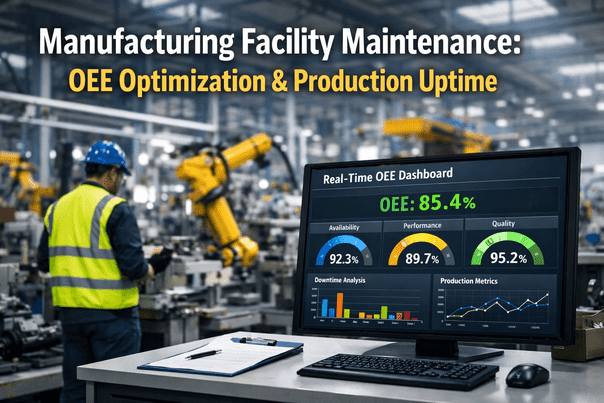
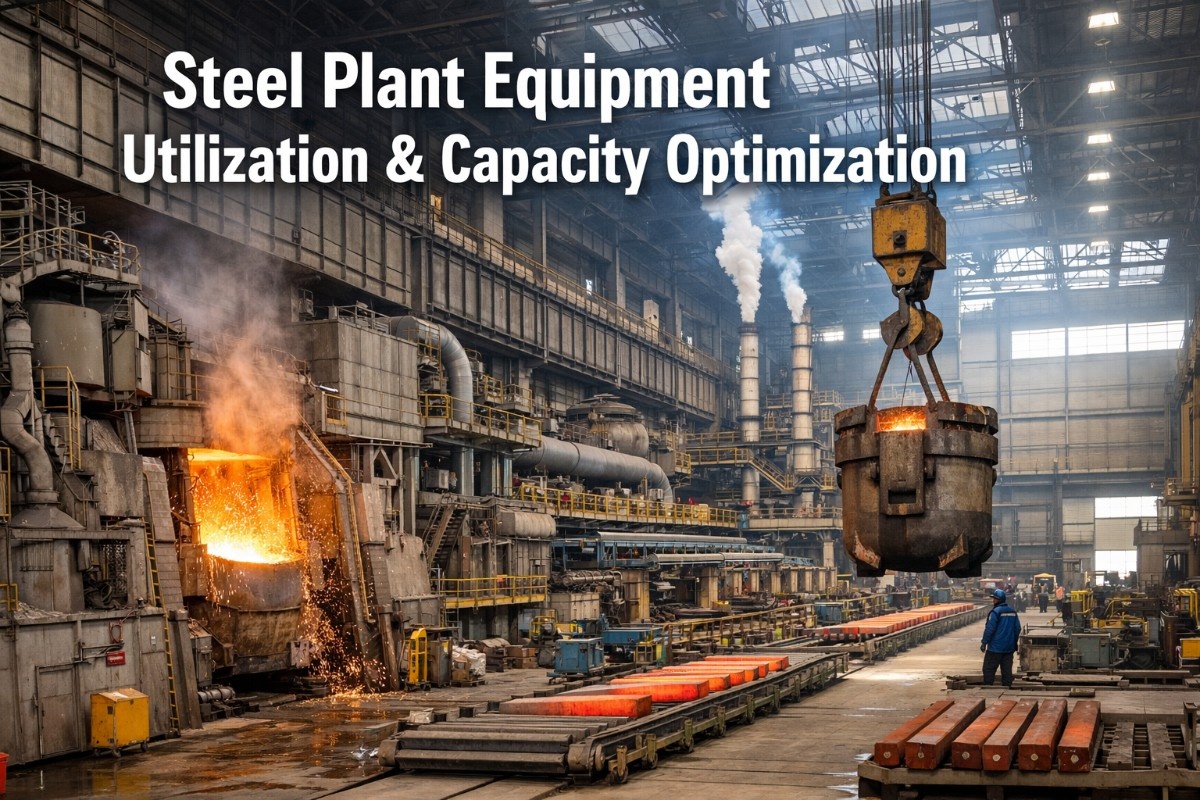
Global steel overcapacity now exceeds 550 million metric tons annually — yet the plants that survive margin compression are not the ones cutting headcount or deferring maintenance. They are the ones extracting maximum throughput from every scheduled production hour. A flat-rolled steel facility in the U.S. Midwest increased OEE from 58% to 81% in 14 months by replacing reactive maintenance practices with runtime-triggered preventive workflows managed through Oxmaint CMMS — Sign Up Free. Unplanned downtime on their hot strip mill dropped from 19% to 4.6%, and rolling speed consistency improved enough to reduce off-spec coil production by 37%. When every ton competes against subsidized imports, OEE becomes the only lever that does not require capital expenditure — it requires disciplined maintenance execution — Book a Demo to see how.
Why Steel Plants Underperform on OEE During Overcapacity
Overcapacity creates a paradox: plants reduce production schedules to match demand, but shorter campaigns amplify the impact of every unplanned stop. A blast furnace reline delay that costs 8 hours during a 30-day campaign represents 1.1% downtime. During a 12-day campaign, that same 8 hours becomes 2.8% — and the margin per ton has already shrunk. Facilities that defer maintenance during low-demand periods accumulate reliability debt that compounds when orders return. Sign up for Oxmaint to build runtime-based maintenance schedules that protect OEE regardless of production volume.
OEE Optimization Framework for Steel Production
Each module below targets a specific OEE loss category across the steelmaking value chain. Facilities managing these workflows through Oxmaint's integrated CMMS platform connect maintenance execution directly to production performance metrics — every work order closed feeds back into OEE calculations automatically.
Unplanned stops on rolling mills, caster breakouts, and furnace trips account for the largest share of OEE losses. Runtime-based PM scheduling ensures critical drive systems, hydraulic units, and cooling circuits receive maintenance at the right operating-hour threshold — not on arbitrary calendar dates.
Speed losses in steel plants are rarely sudden — they develop gradually as equipment condition degrades. A hot strip mill running 5% below rated speed across a 20-day campaign loses the equivalent of a full day of production. Book a demo to see how CMMS-tracked condition data connects directly to speed-loss analysis.
Off-spec coils, slab downgrades, and surface defects directly reduce the quality component of OEE. In overcapacity markets, quality downgrades are doubly expensive — the margin loss on the downgraded product compounds with the opportunity cost of production time consumed producing unsaleable material.
Grade changes, roll changes, and tundish swaps represent planned downtime — but poorly executed changeovers extend beyond scheduled windows and erode availability. Facilities using Oxmaint's work order sequencing reduce changeover overruns by standardizing task sequences and pre-staging maintenance materials.
Overcapacity Survival: The Six Equipment Groups That Define Steel Plant OEE
During overcapacity, maintenance budgets face pressure from two directions — cost reduction mandates and the operational reality that equipment reliability determines whether you win or lose available orders. The solution is not spending less on maintenance; it is spending precisely on the equipment that drives OEE. These six groups account for 73% of all unplanned downtime in integrated steel plants.
Motor bearing failures and gearbox faults in main drive systems cause the longest unplanned stops — averaging 14 hours per event. Vibration-based condition monitoring with CMMS-integrated alert thresholds reduces unplanned drive failures by 82%.
AGC (Automatic Gauge Control) and looper hydraulics operate under extreme precision requirements. Contaminated oil or worn servo valves cause gauge drift that forces speed reductions or produces off-spec material long before a visible failure occurs.
Burner maintenance, refractory condition, and combustion control accuracy determine whether slabs reach rolling temperature uniformly. A 15°C temperature variation across a slab produces gauge inconsistency that manifests as quality losses at the finishing mill.
Segment misalignment of just 0.5mm causes internal cracking and centerline segregation. Runtime-based alignment verification schedules — triggered by casting tonnage rather than calendar dates — maintain dimensional accuracy throughout the campaign.
Clogged spray nozzles, fouled heat exchangers, and pump degradation affect both caster and rolling mill performance. Cooling system maintenance schedules linked to water quality metrics and flow rate data prevent the gradual performance decay that steals OEE silently.
Ladle cranes, coil handling cranes, and charging cranes create bottlenecks when unavailable. A single crane failure in the melt shop can idle an entire EAF or BOF for the duration of repair — converting a mechanical issue into a plant-wide OEE loss event.
How Oxmaint Connects Maintenance to OEE Performance
Steel plants generate thousands of maintenance data points daily — but without a system that connects work order execution to production outcomes, that data remains operational noise. Oxmaint bridges maintenance and production through four integrated capabilities designed for heavy industrial environments.
Work orders trigger based on actual operating hours, rolling tonnage, heat cycles, or casting sequences — not calendar intervals. Equipment that runs 24/7 gets serviced more frequently than equipment on reduced schedules, automatically adjusting to overcapacity production patterns.
Every downtime event captured in the CMMS is automatically classified by OEE loss type — availability, performance, or quality. Maintenance teams see which equipment failures drive which loss category, enabling targeted improvement instead of broad-brush PM programs.
Overcapacity intensifies the cost of carrying excess inventory while simultaneously increasing the risk of stockouts on critical parts. Oxmaint's consumption-linked inventory tracks actual usage rates per equipment class and adjusts reorder points based on production schedules.
Steel plants require synchronized maintenance windows across melt shop, caster, rolling, and finishing operations. Oxmaint's integrated scheduling ensures maintenance activities in one department align with production plans across the entire value chain.
Frequently Asked Questions
Stop Losing OEE to Maintenance Gaps
In an overcapacity market, every percentage point of OEE translates directly to competitive survival. Oxmaint gives steel plant maintenance teams the runtime-based scheduling, cross-departmental visibility, and loss categorization tools needed to close the gap between current performance and world-class benchmarks — without capital expenditure.