This implementation guide is published by OxMaint as part of its Asset Lifecycle Management resource series. ISO 55000 is the international standard that defines how organisations should think about, structure, and improve their approach to managing assets throughout their entire lifecycle. For facility teams managing complex building systems, aging infrastructure, and growing compliance obligations, ISO 55000 is not just a certificate to pursue — it is a practical framework that directly improves maintenance decision-making, cost control, and operational performance.
Asset Management Standards · ISO 55000
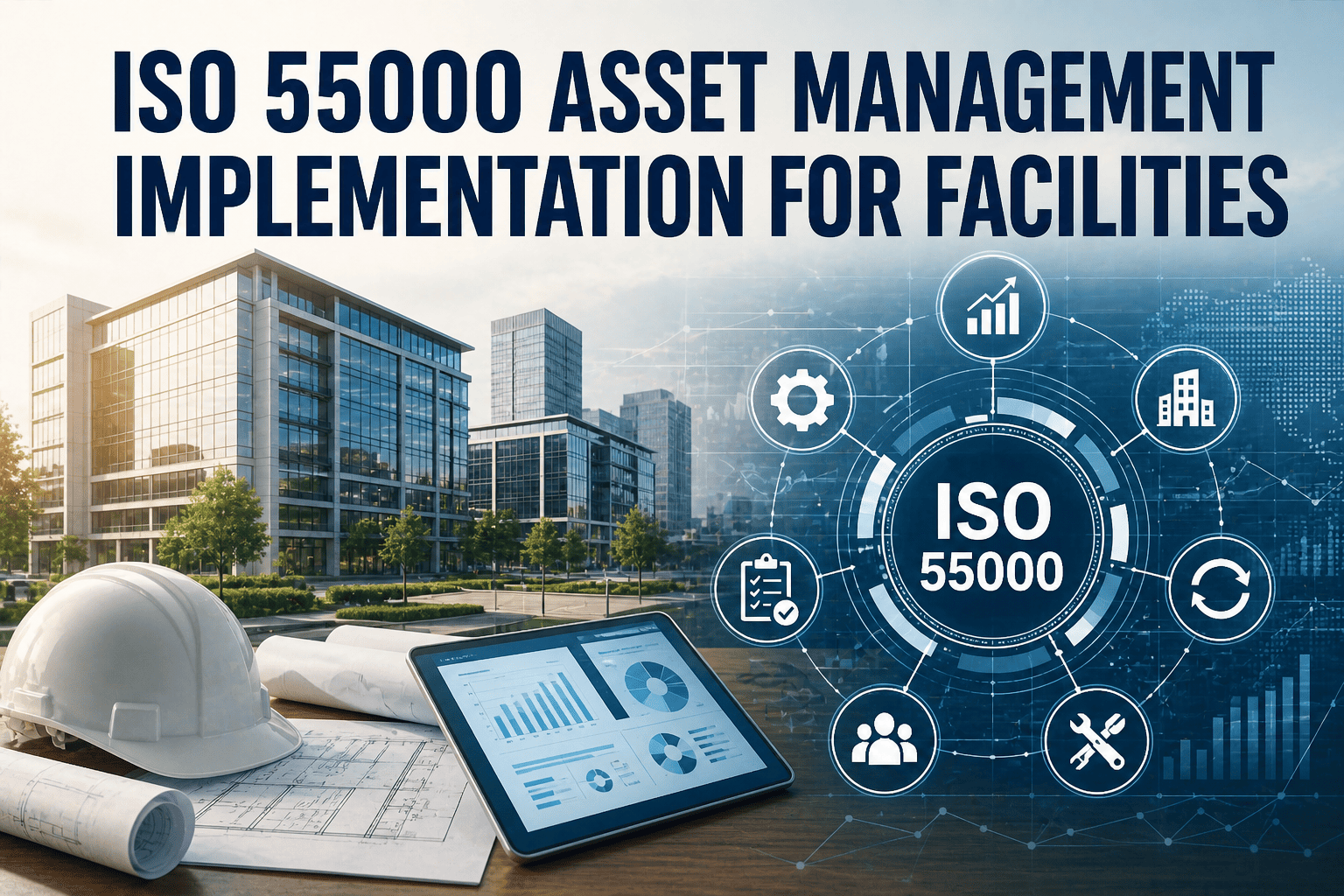
ISO 55000 Asset Management Implementation for Facilities
How to align your maintenance strategy, lifecycle planning, and compliance obligations with the world's leading asset management framework — and why facilities that implement it correctly cut costs, reduce risk, and make better capital decisions.
ISO 55000:2024 Updated Edition
All Facility Types
Asset Lifecycle Management
Foundation
ISO 55000:2024
Asset Management — Vocabulary, Overview & Principles
Defines the concepts, terminology, and core principles of asset management. The 2024 edition adds stronger focus on outcomes and expanded guidance on realising value from assets. The starting point for any implementation.
Requirements
ISO 55001:2024
Asset Management System — Requirements
Specifies the requirements for an asset management system. This is the certifiable standard. Updated in July 2024 with clearer requirements on decision-making, data management, and lifecycle operations after a decade of global feedback.
Guidelines
ISO 55002:2018
Guidelines for the Application of ISO 55001
Expanded practical guidance for every clause of ISO 55001. Clarifies how to apply requirements across the four fundamental areas: Value, Alignment, Leadership, and Assurance. Essential companion to the requirements standard.
1 Why ISO 55000 Matters for Facility Operations
ISO 55000 is not a maintenance checklist. It is a management framework that helps facility teams answer three critical questions: Are we managing assets for maximum value? Are our asset decisions aligned with organisational goals? Do we have systems that produce consistent, improving outcomes?
01
10–20%
Maintenance Cost Reduction
Facilities implementing ISO 55001 consistently report 10–20% reductions in maintenance costs through lifecycle planning and structured risk-based decisions
02
15%
Energy Cost Savings
CMMS-integrated asset management linked to ISO 55000 frameworks achieves verified 15% reductions in energy costs per Technavio FM market data 2026
03
50+
Countries Adopted
ISO 55001 has been adopted across 50+ countries, giving certified facilities a globally recognised credential that satisfies investors, insurers, and regulators
04
100%
Asset Type Coverage
The standard applies to physical, financial, and intangible assets — meaning building systems, IT infrastructure, data, and contractual rights all fall under one framework
05
Better
Capital Decisions
Lifecycle cost analysis replaces reactive capital requests. Facilities can demonstrate to boards and investors why and when to invest, refurbish, or divest specific assets
06
ESG
Sustainability Alignment
ISO 55000 aligns naturally with ESG goals — energy-efficient retrofits, lifecycle carbon planning, and environmental compliance all sit within the same framework
2 The ISO 55000 Asset Lifecycle Framework
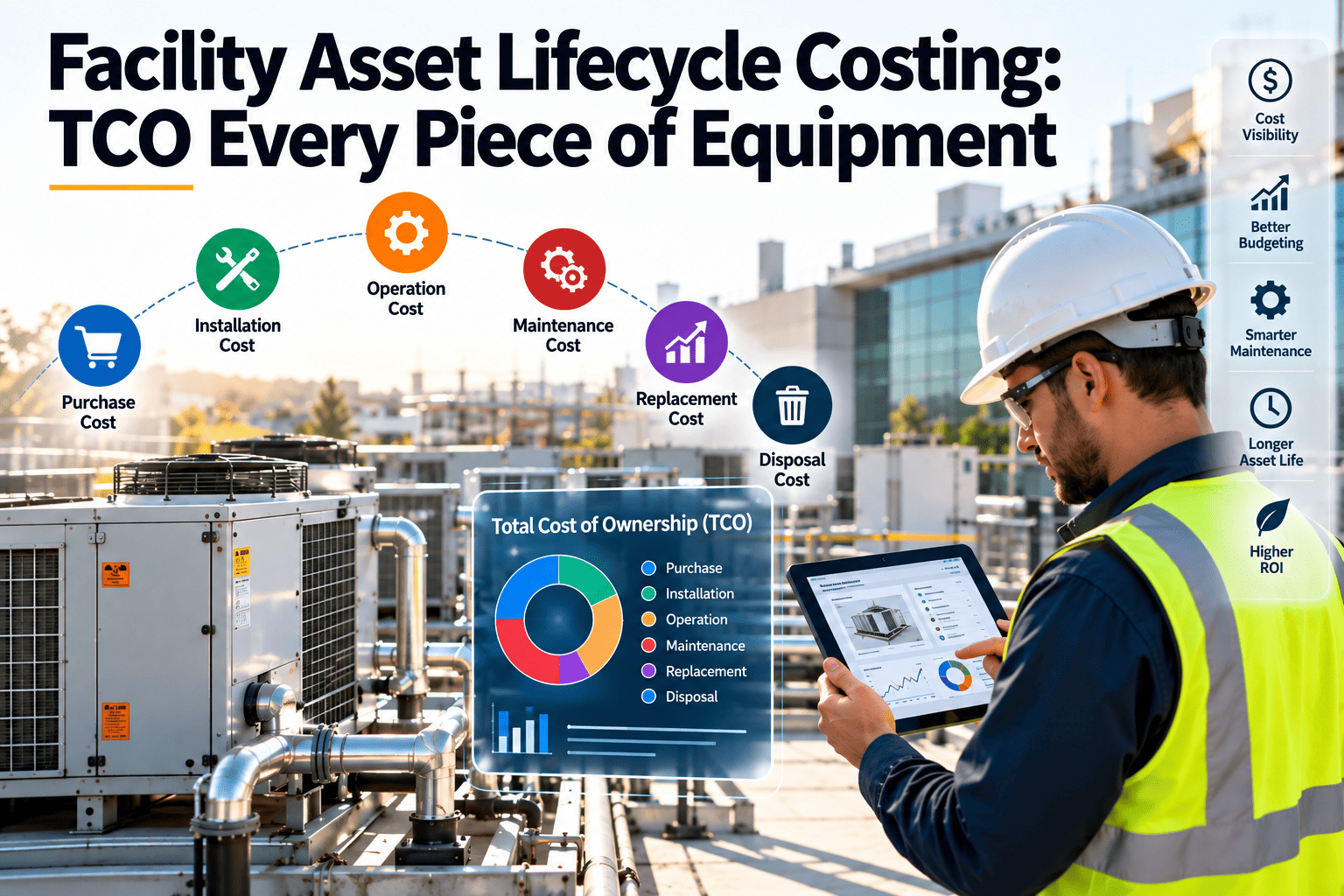
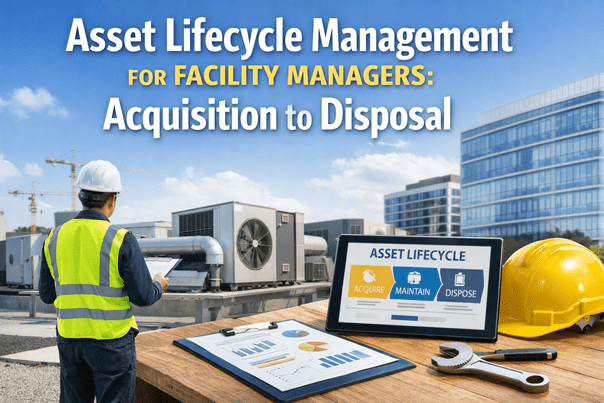
ISO 55000 emphasises that asset management spans the complete lifecycle — from strategic planning through to eventual disposal. For facility teams, this means every decision should be evaluated on whole-life cost, not just immediate maintenance spend.
01
Plan
Strategic asset plan aligned to organisational goals
02
Acquire
Capital decisions based on lifecycle value, not just initial cost
03
Operate
Condition monitoring, preventive maintenance, performance tracking
04
Maintain
Risk-based maintenance, predictive strategies, compliance records
05
Dispose
End-of-life planning, replacement decisions, asset retirement
3 ISO 55001 Implementation Roadmap for Facility Teams
Implementing ISO 55001 in a facility context follows a structured sequence. Most facility teams with existing CMMS infrastructure can move from gap assessment to audit-ready in 12–18 months.
1
Context of Organisation & Stakeholder Needs
Define the organisation's mission, strategic goals, and stakeholder requirements. This becomes the foundation of your Strategic Asset Management Plan (SAMP). Every asset decision must trace back to this context — this is what separates ISO 55000 from a basic maintenance programme.
2
Asset Inventory & Criticality Assessment
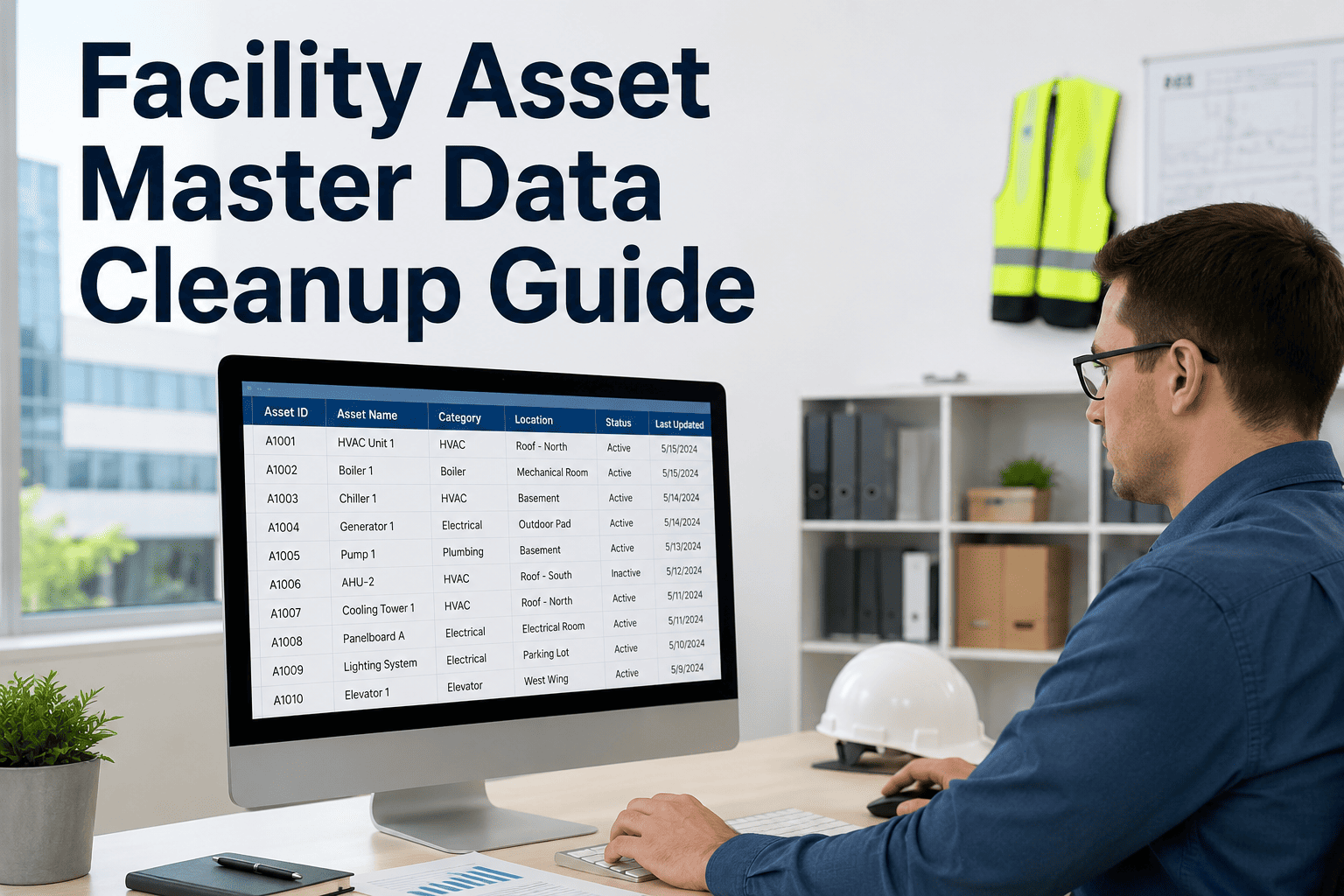
Create a complete, categorised asset register covering building systems, mechanical and electrical assets, IT infrastructure, and safety systems. Assess each asset's criticality to operations, compliance, and life safety — this drives maintenance strategy selection and budget prioritisation.
3
Strategic Asset Management Plan (SAMP)
The SAMP translates organisational objectives into long-term asset management objectives. It includes lifecycle plans, capital investment forecasts, risk tolerance levels, and performance targets. For facilities, this typically spans 5–15 year horizons depending on asset types and building age.
4
Asset Management Plans (Per Asset Class)
Develop maintenance strategies and plans for each asset class — HVAC, electrical distribution, fire safety, plumbing, access control, and structure. These plans specify maintenance type (preventive, predictive, condition-based), frequency, responsible parties, and performance criteria.
5
CMMS Integration & Data Management
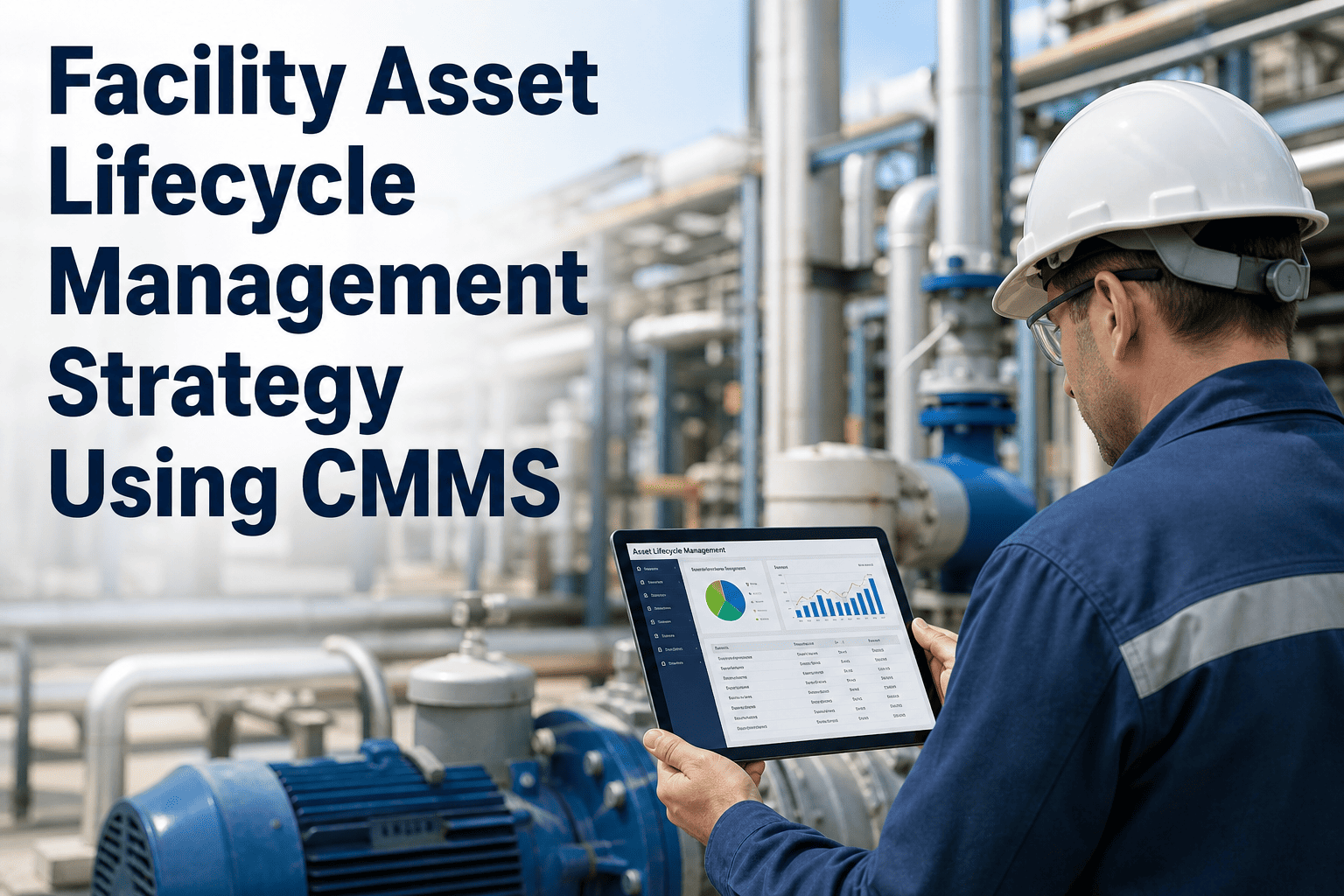
ISO 55001:2024 places stronger emphasis on data quality and knowledge management. Integrate your CMMS to capture asset condition data, maintenance history, work order completion rates, and failure patterns. This data becomes the evidence base for lifecycle decisions and ISO audit compliance.
6
Performance Monitoring & Continual Improvement
Establish KPIs — mean time between failures, maintenance cost per asset, energy consumption per m², and regulatory compliance rate. Review performance against the SAMP annually. ISO 55000 requires a culture of continual improvement, not a one-time certification exercise.
OxMaint Is Built for ISO 55000-Aligned Asset Management
From asset registers and criticality scoring to lifecycle planning dashboards and maintenance KPI tracking — OxMaint's Asset Lifecycle Management module maps directly to ISO 55001 requirements.
4 ISO 55000 vs Reactive Facility Management — Side by Side
| Decision Area |
Reactive Approach |
ISO 55000 Approach |
| Maintenance Strategy |
Fix when broken |
Risk-based, preventive & predictive by asset criticality |
| Capital Planning |
Annual budget requests based on current condition |
15-year lifecycle plans with modelled replacement timelines |
| Data & Records |
Paper logs or disconnected spreadsheets |
Digital CMMS with asset history, failure data, and KPI tracking |
| Risk Management |
Reactive to incidents and complaints |
Proactive risk register with defined likelihood and consequence ratings |
| Compliance Evidence |
Gathered at time of audit |
Continuously maintained through automated CMMS records |
| Cost Control |
Variable, emergency-driven spend |
Predictable budgets with 10–20% lower total maintenance cost |
| Stakeholder Reporting |
Ad hoc, inconsistent |
Structured, dashboard-driven performance reports aligned to SAMP |
KM
Facility teams that treat ISO 55000 as a compliance tick-box exercise consistently underperform compared to those that genuinely integrate it into how they make decisions. The power of the standard is not in the certificate — it is in the discipline of asking, for every asset decision: does this align with our strategic goals, and are we maximising value over the full lifecycle? When a facility team can answer that question with data, their conversations with boards, investors, and regulators completely change. They stop defending maintenance budgets and start justifying strategic asset investments. ISO 55001:2024's strengthened focus on data and decision-making quality makes that conversation even more structured and credible than before.
Dr. Kavita Mehta
Certified Asset Management Assessor (CAMA) · ISO 55001 Lead Auditor · 20 years in Built Environment Asset Management
5 Frequently Asked Questions
What is the difference between ISO 55000, ISO 55001, and ISO 55002?
ISO 55000 is the vocabulary and overview standard — it explains what asset management is, why it matters, and the principles behind it. ISO 55001 is the requirements standard — it defines what an organisation must do to operate a compliant asset management system and is the standard organisations certify against. ISO 55002 provides practical guidelines for implementing ISO 55001, expanding on every clause with detailed how-to guidance. For facility teams starting out, reading ISO 55000 first gives the conceptual foundation, then ISO 55001 defines the gap to close, and ISO 55002 shows how to close it. Both ISO 55000 and ISO 55001 were updated in July 2024 by ISO Technical Committee TC 251.
How long does it take to implement ISO 55001 in a facility?
Most facility organisations with an existing CMMS and basic asset register can move from gap assessment to certification-ready in 12 to 18 months. The timeline depends on three primary factors: the completeness of your existing asset data, the size and complexity of your portfolio, and the maturity of your current maintenance processes. Facilities without a CMMS typically need 18–24 months. The most time-intensive phase is building the Strategic Asset Management Plan and conducting lifecycle assessments for each major asset class. Organisations that integrate CMMS software like OxMaint from the start of their implementation can significantly compress the data collection and reporting phases of the process.
Does ISO 55000 apply to small and medium-sized facilities?
Yes, explicitly. ISO 55000 states that the standard can be applied to all types of assets and by all types and sizes of organisations. For smaller facilities, the depth and formality of the asset management system is scaled appropriately — a 50-person office building does not need the same SAMP complexity as a hospital or airport. The principles remain the same: manage assets for value, align decisions to organisational goals, and continuously improve. For smaller facility teams, the most practical starting point is ISO 55002's guidelines, which include a maturity assessment organisations can use to identify priority gaps without committing to full certification immediately. The
OxMaint Asset Lifecycle Management module is designed to be fully usable by small FM teams without requiring ISO certification as a prerequisite.
How does OxMaint support ISO 55001 implementation?
OxMaint's Asset Lifecycle Management module is structured to support the core requirements of ISO 55001. It provides a complete asset register with condition ratings, maintenance history, and failure data. It enables risk-based maintenance scheduling, which maps to the standard's requirements for planning and prioritisation. The reporting engine generates lifecycle cost data and KPI dashboards that serve as evidence for both internal reviews and external audits. Importantly, OxMaint's automated maintenance records and work order history are designed to satisfy the documentation requirements of ISO 55001, reducing the manual effort of preparing for third-party certification assessments. For a guided walkthrough of how OxMaint maps to specific ISO 55001 clauses,
book a demo with our team.
Start Your ISO 55000 Journey with OxMaint
Asset registers, lifecycle dashboards, maintenance KPIs, and audit-ready records — everything ISO 55001 requires, in one platform built for facility teams.