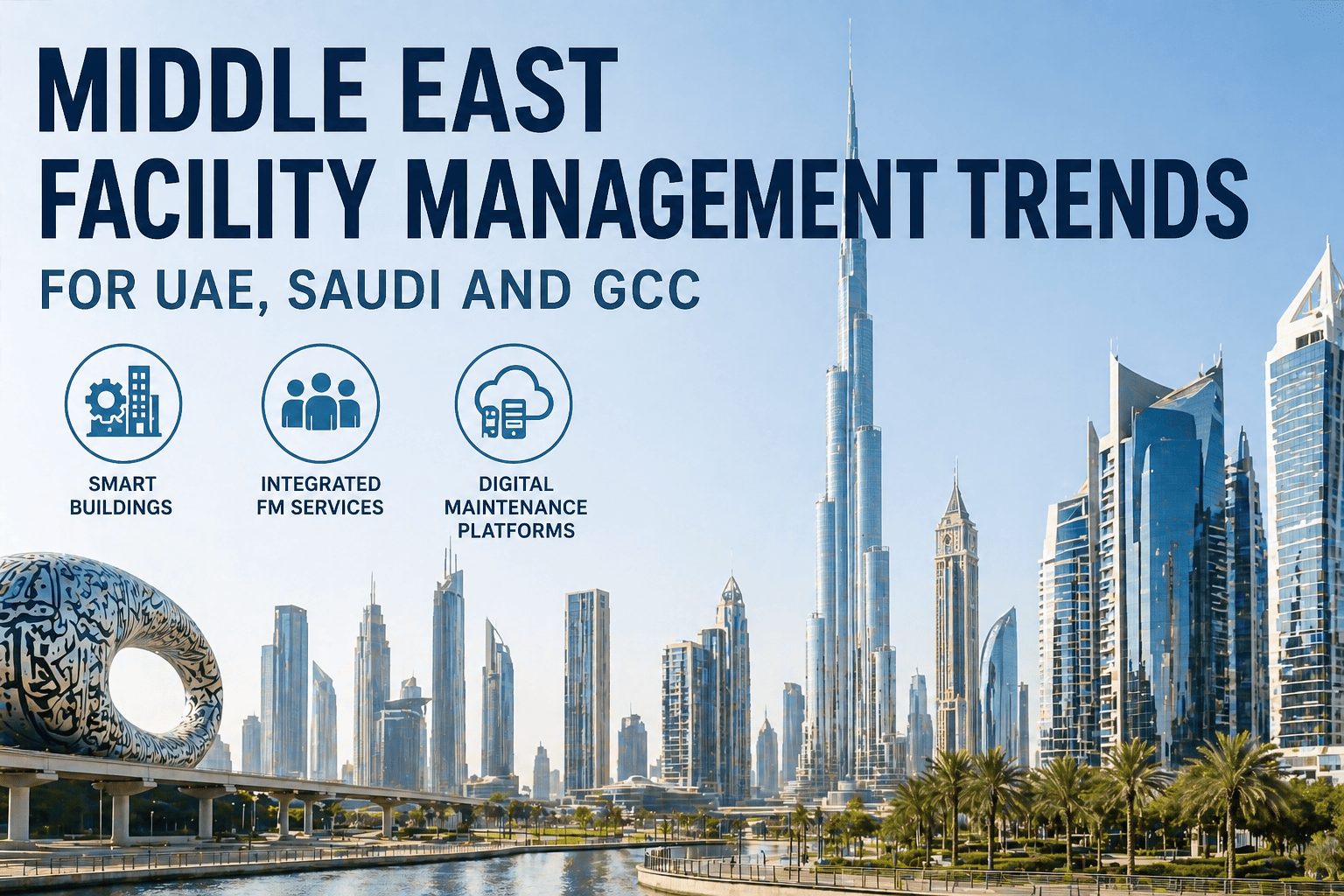
Middle East Facility Management Trends for UAE Saudi and GCC

By james smith on May 1, 2026

middle-east-facility-management-trends-uae-saudi-gcc

The Middle East facility management market crossed USD 65 billion in 2024 and is accelerating toward USD 105 billion by 2030 — driven by Vision 2030 giga-projects, UAE smart city programs, and 5+ major Saudi developments each exceeding 10,000 square kilometres. Fewer than 20% of GCC FM companies have fully integrated smart building systems, yet providers that combine digital platforms, predictive maintenance, and ESG reporting are commanding premium contract pricing and renewal rates above 90%. The technology gap is the market opportunity. This blog maps every major GCC FM trend for 2025 and beyond — and what your operations team needs to do about it. Start managing your GCC portfolio on Oxmaint — free trial, no credit card.

Blog · Regional Facility Markets · Cloud CMMS Platform

Middle East Facility Management Trends for UAE, Saudi Arabia and GCC

From NEOM's USD 500B masterplan to Dubai's 40% district-cooling target — here is what every FM operator in the GCC needs to know about the technology, contract, and regulatory forces reshaping the market through 2030.

GCC Region
$105B
market size projected by 2030
Saudi Arabia
39%
of GCC FM market share in 2024
UAE
$18.3B
FM market size in 2024
GCC CAGR
8.7%
projected growth rate 2025–2033
Market Drivers

What Is Fuelling GCC FM Growth Through 2030

The structural drivers behind Middle East FM growth are not cyclical — they are policy-mandated and multi-decade. Understanding them determines where FM companies should invest capital, technology, and talent in the next three years.

01
Vision 2030 Giga-Projects
Saudi Arabia's pipeline exceeds USD 850 billion. NEOM alone includes a SAR 10 billion financing structure. Over 800 hotels and commercial buildings are under simultaneous construction across Saudi Arabia and the UAE. Each project embeds multi-year FM budgets from the design phase — creating long-tail contracts for technology-capable providers.
02
District Cooling Expansion
Dubai is targeting 40% district-cooling penetration by 2030. Empower's 2024 record-breaking plant in Business Bay illustrates the scale of assets requiring specialized FM. District-cooling systems demand dedicated MEP maintenance expertise and CMMS-driven work order management across sprawling piping and chiller networks.
03
Green Building Mandates
40% of new buildings in Saudi Arabia were LEED-certified by 2024. UAE and Saudi national sustainability strategies require energy audits, building retrofits, and carbon emission reduction — all generating recurring FM services. Providers with green-building competency and digital energy monitoring command premium contract rates.
04
Outsourcing Shift to Integrated FM
Outsourced FM captured 61.9% of GCC market share in 2024, and integrated FM contracts are commanding the highest renewal rates. Clients are consolidating from single-service vendors to IFM bundles — security, maintenance, cleaning, and energy management under one contract. Providers without digital coordination capability are losing bids structurally.
Country Snapshots

UAE, Saudi Arabia & GCC — FM Market by Country

Country / Region 2024 Market Size Growth Rate Key FM Driver Technology Trend
Saudi Arabia USD 25.75B 10.8% CAGR to 2032 Vision 2030, NEOM, giga-project pipeline AI triage, FMTECH state-owned platform
UAE USD 18.29B Target $33.64B by 2030 Smart city agenda, Expo legacy, 3,000+ active construction projects IoT in 30%+ Dubai facilities, AI for BMS
Qatar USD 7.43B Growing to $9.57B by 2030 Post-World Cup asset legacy, Lusail City Outcome-based FM contracts gaining share
Bahrain Fastest-growing GCC market 17.01% CAGR to 2030 Financial-services Grade-A office expansion High-spec integrated FM adoption
GCC Total USD 60.11B (2025) To $77.52B by 2030 (5.22% CAGR) Across all six GCC nations AI, IoT, cloud CMMS, robotic cleaning
Technology Trends

5 Digital Trends Reshaping GCC Facility Management in 2025

By 2023, just 30% of UAE facilities had IoT devices for real-time monitoring. By 2030, that proportion will be the minimum threshold for competitive FM contracts — not a differentiator. These are the five technology shifts every GCC FM operator must be executing against now.

IoT
Real-Time Asset Monitoring
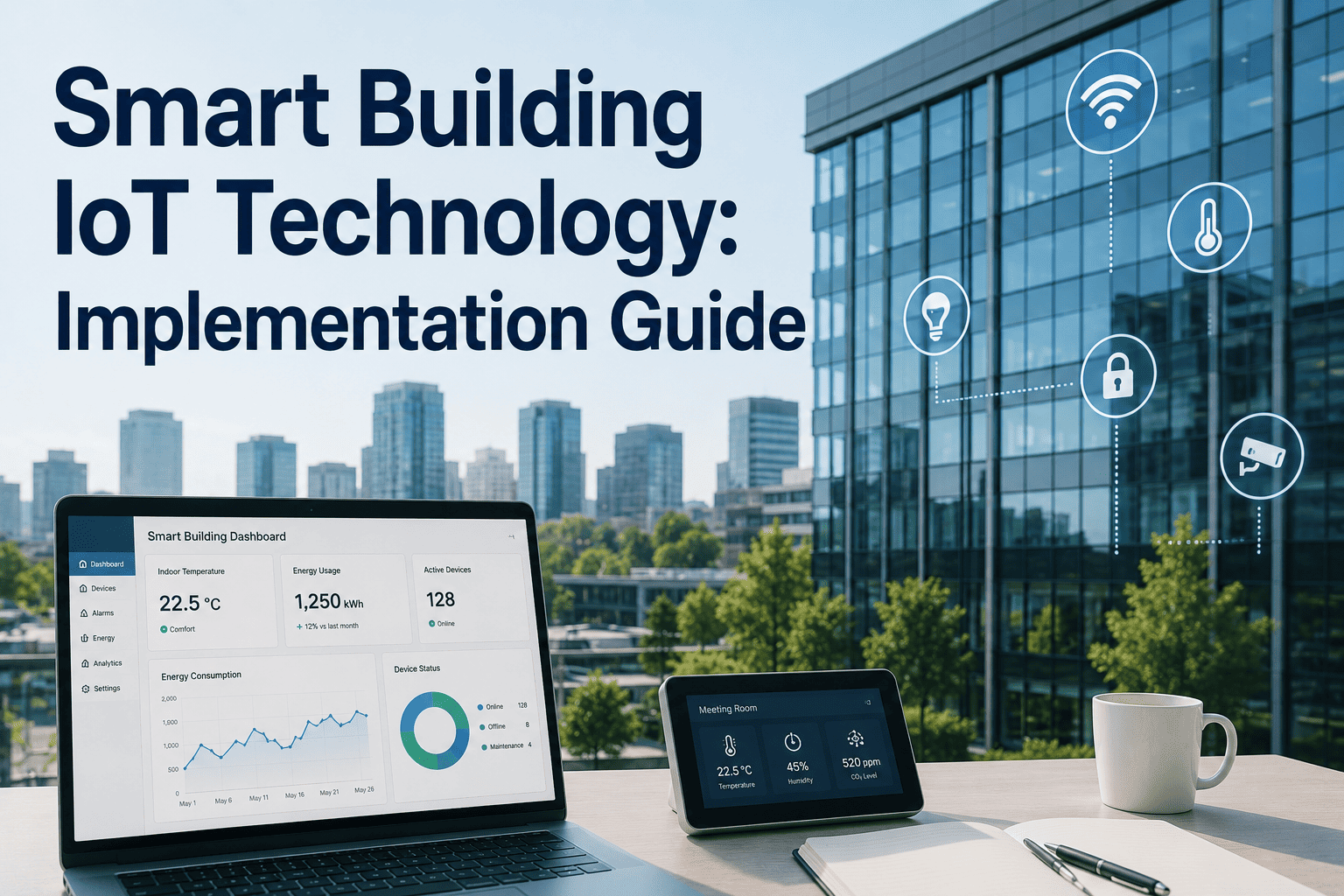
IoT sensors now track temperature, vibration, energy, and access across commercial and hospitality portfolios. Providers that feed sensor data into CMMS work orders — not just dashboards — convert monitoring into action and demonstrate measurable KPI improvement to clients.
AI
Predictive Maintenance Platforms
Enova's 2025 Google Cloud partnership for AI-driven service-ticket triage illustrates where GCC market leaders are investing. AI maintenance models reduce unplanned downtime by up to 30% and are becoming a contract pre-qualification criterion for hospitality and healthcare clients.
BMS
Building Management Integration
Smart building BMS integration with cloud CMMS closes the gap between detected anomalies and assigned work orders. The MEFMA's January 2025 Mustadam Certified Sustainability FM credential standardizes competency in this integration — establishing it as a market baseline skill.
ESG
ESG Reporting and Digital Audit Trails
Providers that combine digital maintenance records with ESG dashboards command renewal rates above 90% on enterprise accounts. Major GCC clients in BFSI and hospitality now require real-time energy and carbon data as part of FM contract deliverables — not just annual reports.
Cloud CMMS for GCC Operations
Compete for the Contracts That Require Digital FM Capability.
Oxmaint gives GCC FM teams real-time asset tracking, IoT-triggered work orders, predictive maintenance scheduling, ESG compliance reporting, and multi-site portfolio visibility — all from a cloud platform that deploys without local IT infrastructure.
Expert Review

What GCC FM Directors Say About Digital Transformation

KA
Khalid A.
Operations Director, Integrated FM Provider — Riyadh, KSA · 60+ Vision 2030 contract sites
★★★★★
Our IFM contract wins increased significantly after we could demonstrate real-time maintenance dashboards and ESG energy reports during the bid stage. Saudi clients on Vision 2030 projects now expect digital maintenance proof as standard — not an add-on. Oxmaint gave us the client-facing reporting capability that closed three major contracts in our first year using the platform.
FN
Fatima N.
Facilities Manager, Grade-A Commercial Portfolio — Dubai, UAE · 14 towers
★★★★★
Dubai's LEED compliance and district cooling monitoring requirements generate significant documentation obligations. Managing compliance records manually across 14 towers was unworkable. After deploying Oxmaint, our compliance audit preparation time dropped from two weeks to two days, and our LEED renewal documentation is now auto-generated from maintenance records rather than compiled manually from technician logbooks.
FAQs

GCC Facility Management — Frequently Asked Questions

What is driving the shift from single-service to integrated FM contracts in the GCC?
Corporate occupiers on large-format assets — particularly hospitality, healthcare, and commercial properties on giga-projects — are seeking cost efficiency through single-vendor accountability rather than managing 6–8 separate service contracts. Vision 2030 developments have accelerated this shift because their scale demands coordinated MEP, cleaning, security, landscaping, and energy management from day one of occupancy. IFM providers with digital coordination platforms (cloud CMMS, IoT dashboards, ESG reporting) are winning these contracts structurally over single-service providers. Book a demo to see how Oxmaint supports IFM coordination across GCC sites.
What are the key technology requirements for FM contracts on Vision 2030 projects?
Vision 2030 project owners — particularly NEOM, the Red Sea Development Authority, and Diriyah Gate Authority — are embedding technology requirements directly into FM tender specifications. These typically include: cloud-based CMMS with real-time work order tracking, IoT integration for asset monitoring, energy consumption dashboards for LEED and Mostadam compliance, mobile technician access for field operations, and automated SLA compliance reporting. Providers using spreadsheet-based or legacy systems are increasingly disqualified at the RFQ stage. Start your free Oxmaint trial and build your GCC bid capability today.
How does the extreme GCC climate affect FM maintenance schedules?
Ambient temperatures exceeding 45°C in UAE and Saudi summers significantly increase maintenance frequency requirements for cooling systems, outdoor electrical equipment, and HVAC components. CRAC units, chillers, and cooling towers require filter inspection and coil cleaning at 4–6 week intervals during peak summer rather than standard quarterly schedules. FM operators managing GCC portfolios must configure CMMS PM schedules to reflect seasonal climate variations — not global standard intervals — to prevent heat-related equipment failures during peak demand. Book a demo to configure climate-adjusted PM schedules for your GCC sites.
GCC Facility Management · Cloud CMMS · 2025 Trends
The GCC FM Market Is Moving to Digital. Move First.
Oxmaint gives GCC FM operators cloud-based asset tracking, IoT-integrated work orders, predictive maintenance AI, ESG reporting dashboards, and multi-site portfolio management — the platform capability that is becoming a contract pre-qualification requirement on Vision 2030 projects and UAE commercial portfolios.

Share This Story, Choose Your Platform!