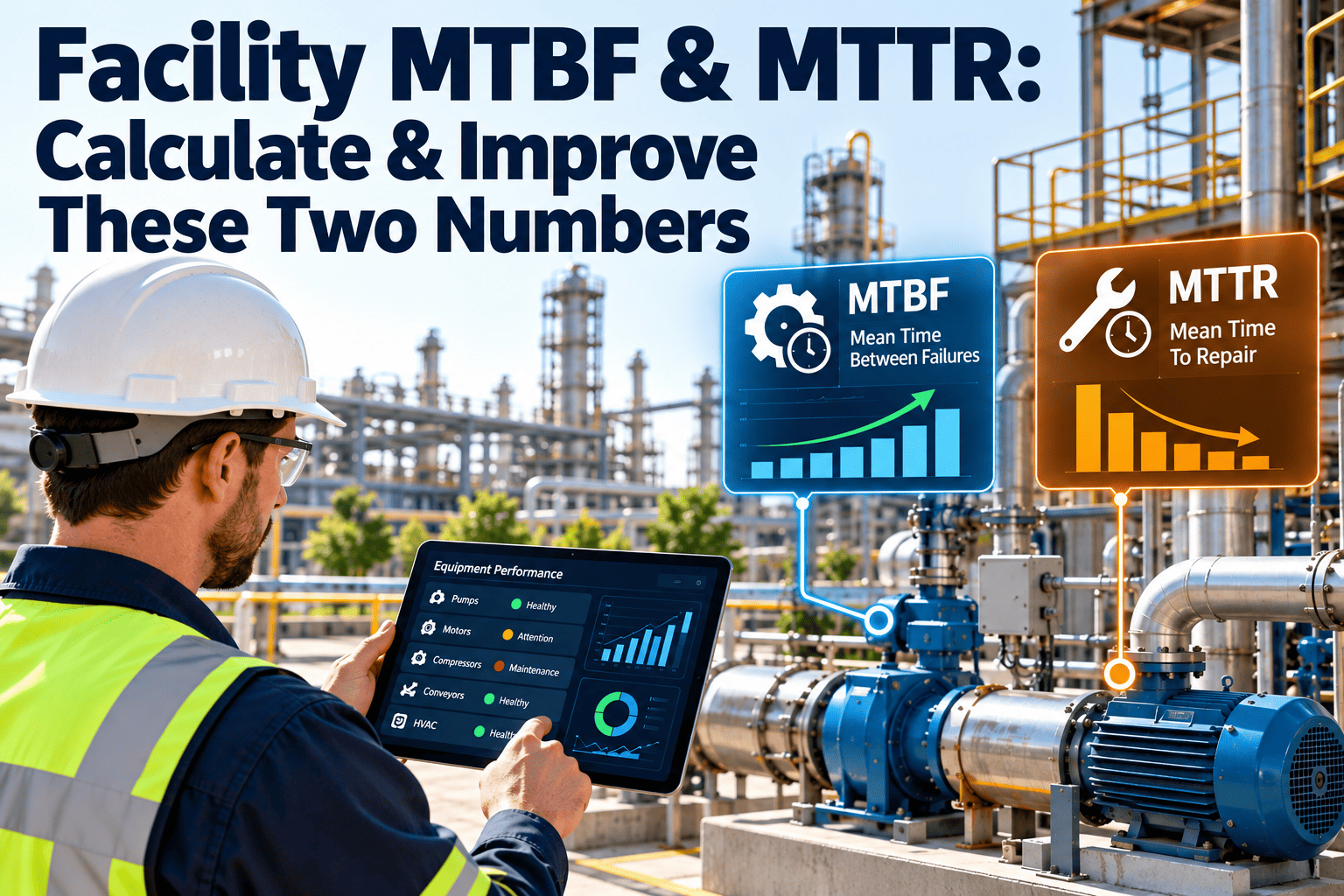
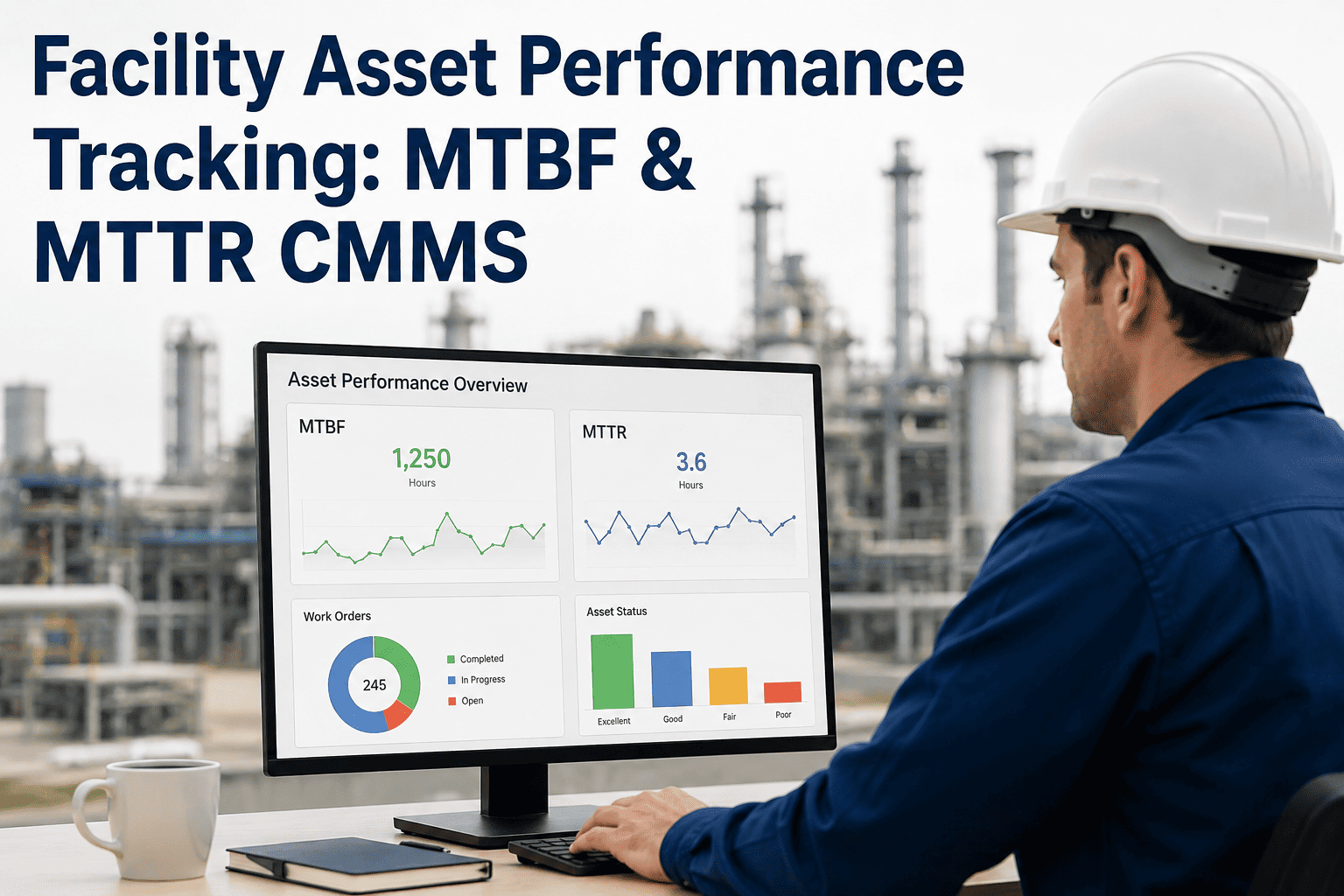
Most facility managers track maintenance activity — work orders completed, hours logged, parts consumed. Far fewer track maintenance performance. MTTR, MTBF, and OEE are the three metrics that separate reactive maintenance teams from data-driven ones — and they are simpler to calculate than most teams think. Once you understand these numbers for your critical assets, you can benchmark against industry standards, identify your worst-performing equipment, justify capital investment decisions, and measure the real impact of every improvement you make. This guide shows you exactly how to calculate, interpret, and act on all three using OxMaint's analytics dashboard.
MTTR, MTBF, and OEE: The Facility Manager's Guide to Maintenance Metrics
Learn how to calculate, benchmark, and use MTTR, MTBF, and OEE to measure equipment reliability, optimize your maintenance strategy, and build the data case for every capital decision.
How to Calculate MTTR
Mean Time to Repair measures the average time your team takes to restore a failed asset to operational status — from the moment the failure is detected to the moment the equipment is back in service. It captures repair speed, not just fix quality.
| MTTR Range | What It Signals | Common Causes | Target Action |
|---|---|---|---|
| < 2 hours | World-class performance | Strong PM program, parts availability | Maintain — document best practices |
| 2–4 hours | Good — improvable | Occasional parts delays or skill gaps | Review parts stocking levels |
| 4–8 hours | Reactive team indicators | No parts on hand, limited trained staff | Audit inventory and training plan |
| > 8 hours | Systemic maintenance failure | No documentation, no skilled coverage | Full maintenance program review |
How to Calculate MTBF
Mean Time Between Failures measures asset reliability — how long a piece of equipment operates before experiencing an unplanned failure. MTBF is your primary indicator of whether your preventive maintenance program is working. Rising MTBF means your PMs are effective. Declining MTBF signals an asset approaching end of life or a PM gap that needs closing.
OxMaint calculates MTTR and MTBF automatically as work orders close — no spreadsheets, no manual formulas. See your asset reliability metrics live in a 30-minute demo.
How to Calculate OEE
Overall Equipment Effectiveness is a composite score that combines three factors — availability, performance, and quality — into a single percentage that reflects how effectively you are using an asset relative to its full potential. OEE is particularly valuable in manufacturing and critical facility environments where equipment downtime has a direct revenue or operational impact.
(Uptime ÷ Planned Time)
(Actual Output ÷ Ideal Output)
(Good Units ÷ Total Units)
Industry average — room to improve
| OEE Score | Classification | What It Means | Priority Action |
|---|---|---|---|
| 85%+ | World-Class | Top 10% of facilities globally | Sustain and benchmark others to this asset |
| 70–84% | Good | Above average — clear improvement path | Target the lowest of the 3 factor scores first |
| 60–69% | Average | Significant losses present — typical for reactive teams | Conduct loss analysis to identify top failure modes |
| < 60% | Poor | Major reliability or process issues | Immediate MTTR / MTBF root cause investigation |
Using These Metrics Together in Practice
MTTR, MTBF, and OEE are most powerful when used together — not in isolation. Each metric answers a different question, and the combination tells a complete story about your maintenance program's effectiveness.
"MTTR and MTBF are not just numbers for reliability engineers — they are the language that gets maintenance investment approved at the executive level. When a facility manager can show that their MTBF improved from 800 to 3,200 hours after implementing a structured PM program, the ROI case for continuing that investment writes itself. Metrics convert maintenance from a cost center argument into a performance conversation."
— Reliability Engineering Consultant, serving Fortune 500 industrial and commercial facility portfolios
Research from the Association for Facilities Engineering (AFE) confirms that facilities tracking MTTR and MTBF on critical assets reduce unplanned downtime by 38–55% within 18 months of consistent measurement — compared to 8–12% improvement for facilities using calendar-based PM alone.
Stop Estimating. Start Measuring.
OxMaint automatically calculates MTTR, MTBF, and asset health scores from your work order data — no spreadsheet formulas required. See exactly which assets are dragging down your reliability numbers and where to focus your team's attention first.