Maintenance teams talk about PM compliance as a percentage. Finance teams talk about dollars, risk and payback. When those two languages never meet, preventive maintenance gets treated as a cost to trim rather than a spend that avoids larger, less predictable costs. A CFO does not need to be convinced that maintenance matters; they need to see what a missed PM actually costs, in numbers they can audit. This guide builds a financial impact model from emergency premiums, warranty exposure and capital impact, using data your maintenance management system already holds.
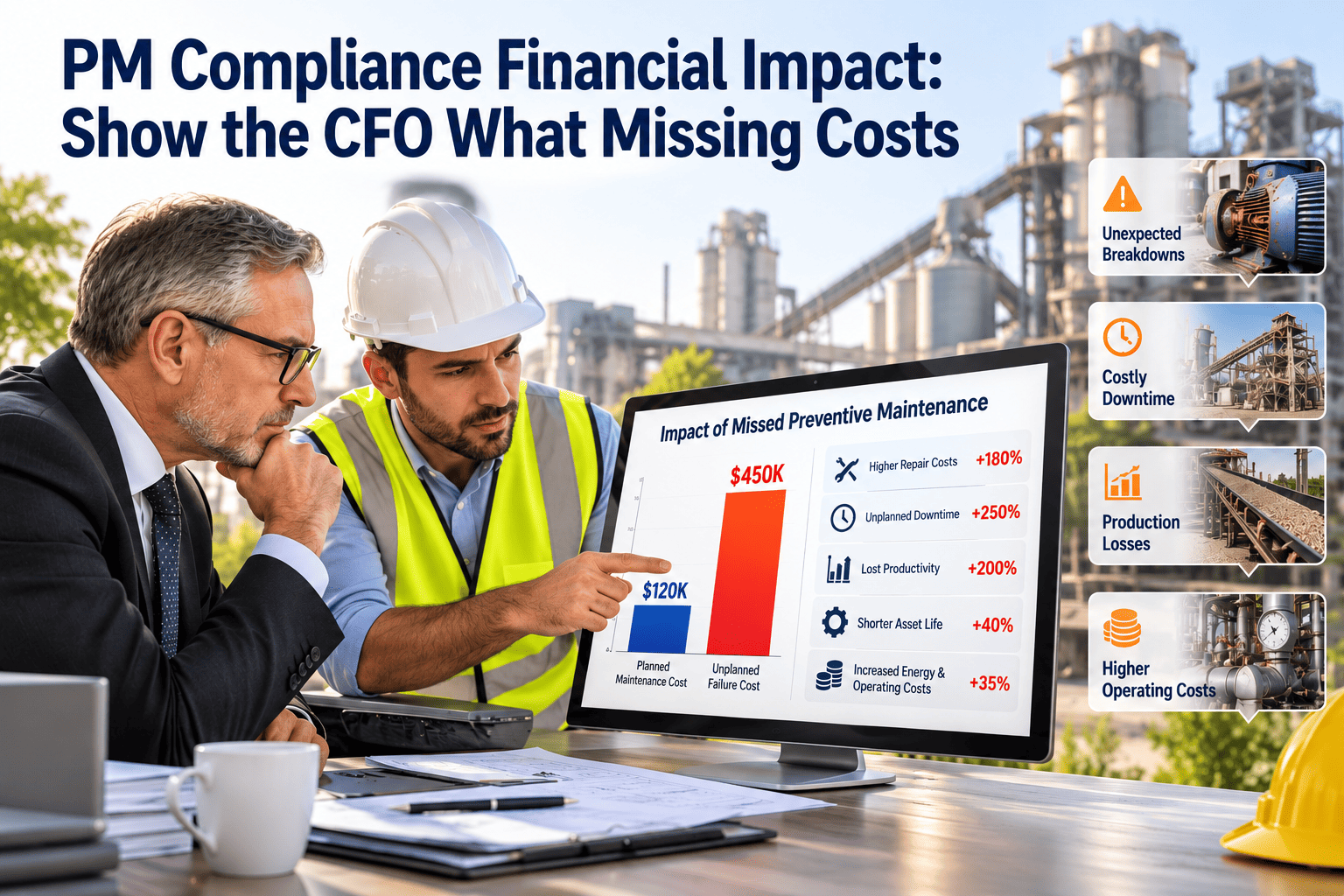
PM Compliance Financial Impact: Show the CFO What Missing Costs
Turn PM compliance from a maintenance metric into a financial case. Quantify the emergency premium, warranty exposure and capital acceleration that follow a missed preventive task.
The Miss Cost Formula a CFO Can Follow
Finance leaders accept a model when its inputs are visible and each term can be traced to a record. Break the cost of a missed PM into five components, then show where each number comes from.
Five Cost Layers Behind a Single Missed PM
Each layer is separate on the balance sheet, which is why the full cost of a missed task is rarely seen in one place. Collect them together and the comparison with the PM changes.
Emergency premium
Collateral damage
Warranty and contract exposure
Disruption and downtime
Capital impact
Worked Example: One Chiller, Planned Versus Emergency
The figures below are illustrative assumptions, not benchmarks. Replace them with your own labor rates, rental quotes and parts prices before presenting the model to finance.
Planned PM (scheduled)
- Labor, 6 hours at $85$510
- Filters, oil sample, consumables$240
- Disruption, planned window$0
- Total$750
Emergency failure (missed PM)
- Labor, 14 hours at $85 with 1.5x overtime$1,785
- Replacement parts$3,600
- Expedited freight premium$1,900
- Temporary chiller rental, 5 days$4,200
- Total$11,485
Capital Impact: What Lost Service Life Does to the Budget
The largest financial effect of weak PM compliance is often invisible in the year it happens. It shows up later, as a replacement that arrives earlier than the capital plan assumed.
Disciplined PM path
Neglected PM path
Translating Maintenance Language Into Finance Language
A technical argument often fails in front of a CFO because the vocabulary does not match. Reframe each maintenance statement as a financial one and attach the evidence behind it.
| Maintenance Says | Finance Hears | Evidence to Bring |
|---|---|---|
| PM compliance dropped this quarter | More spend is shifting from planned to unplanned | Planned versus unplanned work hours and cost by month |
| The chiller needs attention | A potential unbudgeted repair or early capital request | Asset history, recent readings and probability of failure |
| We are short on technicians | Labor is being bought at overtime and contractor rates | Overtime hours and outside labor invoices |
| The warranty is at risk | Potential loss of covered repair value | Warranty terms, PM records and any gaps |
| We need more spare parts | Inventory investment that cuts expedite fees and downtime | Past expedite costs and stock-out incidents |
Put Your Real Miss Cost on One Page
Warranty and Compliance Exposure: The Costs Nobody Budgets
Some of the most expensive consequences of a missed PM are conditional. They only appear when a claim, an inspection or an incident forces someone to produce records.
- Equipment warranties that require documented maintenance at set intervals
- Service contracts that exclude failures linked to missed tasks
- Insurer expectations for inspection and testing records
- Code-driven inspections on life-safety systems
- Lease obligations that specify building system performance
- Lender or investor reporting on building condition
- Internal audit findings on maintenance control gaps
- Liability questions after an injury or major outage
Building the One-Page CFO Brief in Five Steps
The goal is a single page a finance leader can read in minutes and challenge line by line. Keep the method simple enough to repeat every quarter.
Financial Metrics That Belong Next to PM Compliance
PM compliance percent is a lead indicator. Pair it with measures that finance already understands so the connection to spend is obvious.
Isolating the Emergency Premium Line by Line
The emergency premium is the easiest layer to prove because every part of it appears on an invoice or a time sheet. Show finance the same task priced two ways.
| Cost Element | When Planned | When an Emergency | Where the Record Lives |
|---|---|---|---|
| Labor rate | Standard hours inside the normal shift | Overtime, weekend or after-hours call-out rates | Time entries on the work order |
| Parts purchase | Ordered in advance at contract or stock price | Bought urgently, often at a higher price | Purchase orders and inventory transactions |
| Freight and delivery | Standard shipping | Expedited or same-day delivery fees | Supplier invoices |
| Contractor support | Booked on a regular visit | Emergency response with minimum charges | Contractor invoices and service reports |
| Temporary measures | Not needed | Rental equipment, spot cooling or heating, safety cover | Rental agreements and cost codes |
| Diagnostic time | Known fault, short job | Unknown fault, longer troubleshooting and repeat visits | Work order history and technician notes |
Budget Conversations Before and After a Financial Model
The same request lands very differently when it arrives with numbers attached. This contrast shows what changes in the room when maintenance presents a cost model instead of an opinion.
Without a model
- The request is framed as "we need more budget for maintenance"
- Finance sees a rising cost line with no visible return
- PM funding is the first candidate for trimming in a tight year
- Failures are explained after the fact, one at a time
- The deferred backlog is described but never valued
With a model
- The request shows planned cost against avoided emergency cost
- Finance can test the assumptions and challenge individual inputs
- PM funding is discussed alongside capital and risk, not instead of them
- Failures are tracked as variances against the forecast
- The backlog is carried as a quantified liability with owners
Common CFO Objections and How to Answer Them
Expect skepticism, because maintenance savings are cost avoidance rather than a line item that disappears. Prepare an honest answer for each objection in advance.
"You cannot prove a failure would have happened."
"We have skipped PMs before and nothing broke."
"Can we outsource this and cap the cost?"
"Is every PM worth doing?"
A Quarterly Reporting Rhythm That Keeps Finance Engaged
A one-time presentation fades quickly. A short, repeatable report keeps the financial case current and builds trust in the numbers over several quarters.
Mistakes That Undermine a PM Financial Case
A single weak assumption can cost the whole presentation its credibility. Check the model against these common errors before it reaches finance, and ask a colleague outside maintenance to read it the way a skeptical reviewer would. If they cannot follow a number back to a record, simplify it or remove it.
- Using vendor claims or industry averages without labeling them as such
- Counting every missed PM as a certain failure
- Ignoring the cost of the PM program itself
- Mixing one-time repairs with recurring annual cost
- Presenting estimated disruption cost as if it were invoiced
- Leaving out assets where PM spend has little effect on risk
- Reporting compliance percent with no link to cost
- Failing to separate labor, parts and contractor spend
- Assuming savings begin immediately rather than over time
- Presenting a single scenario with no conservative case
Where Oxmaint Supplies the Data Behind the Model
A financial impact model is only as strong as its inputs. Oxmaint helps facility teams capture those inputs as a by-product of normal maintenance work.
Preventive maintenance records
Corrective and emergency work orders
Asset management history
Inventory and reporting
Tailoring the Message to Each Finance Audience
The same model should be presented differently depending on who is reading. Choose the emphasis that matches what each person is accountable for.