Every budget season, the same conversation happens: the maintenance manager knows the CMMS has transformed operations — unplanned downtime down, emergency spend eliminated, work orders completed on time — but when the CFO asks "what's the ROI?", the answer falls apart. Not because the value isn't real. Because the framework to quantify it in financial language isn't in place. Sign up for Oxmaint to start capturing the baseline data your ROI case requires — or book a demo to see how Oxmaint's analytics dashboard surfaces the numbers leadership needs.
Why Most CMMS Business Cases Fail Before They Reach the CFO
CMMS value is primarily delivered through prevention — equipment failures that never happen, emergency orders that were never placed, overtime hours that were never worked. These events don't appear on the income statement. The CFO sees only the subscription cost. This asymmetry between visible costs and invisible savings is the fundamental challenge of maintenance ROI — and why business cases built on operational metrics alone get rejected by finance teams that speak in NPV, payback period, and cost avoidance.
Step 1: Establish Your Baseline Before Implementation
You cannot calculate improvement from an unknown starting point. Before deploying a CMMS — or while building the ROI case for one already running — capture these four baseline numbers. Everything else in the business case flows from them. Sign in to Oxmaint to access the analytics reports that surface each of these figures automatically.
Step 2: Project Your CMMS Savings — The Formula
Once you have baseline numbers, project realistic savings using industry benchmark ranges. Conservative estimates build credibility with CFOs — never present best-case figures as expected outcomes. Book a demo to see how Oxmaint's dashboard tracks actuals against these projections automatically.
| Saving Category | Conservative Estimate | How to Calculate | Industry Benchmark |
|---|---|---|---|
| Downtime reduction | 20–30% of baseline downtime cost | Baseline downtime cost × reduction % | 42% reduction documented at CMMS-adopting facilities |
| Reactive maintenance reduction | 12–18% of total maintenance spend | Total maintenance budget × reduction % | Shift from reactive to preventive saves 12–18% (Reliable Plant) |
| Labor productivity gain | 8–15 hrs/week per tech recovered | Hours recovered × hourly rate × weeks × headcount | $50K–$150K annually for 10-person team |
| Inventory optimization | 15–25% reduction in MRO carry cost | Carrying cost baseline × reduction % | Limble customers reduce inventory spend avg 17% |
| Emergency order elimination | 60–75% reduction in rush orders | Emergency order spend × reduction % | 73% reduction in emergency spend documented in 8 months |
| Asset life extension | 10–20% longer replacement cycle | (Asset value ÷ current life years) × extended years | 20–40% extended asset lifespan with PM programs |
Step 3: Present to Leadership — The CFO-Ready Framework
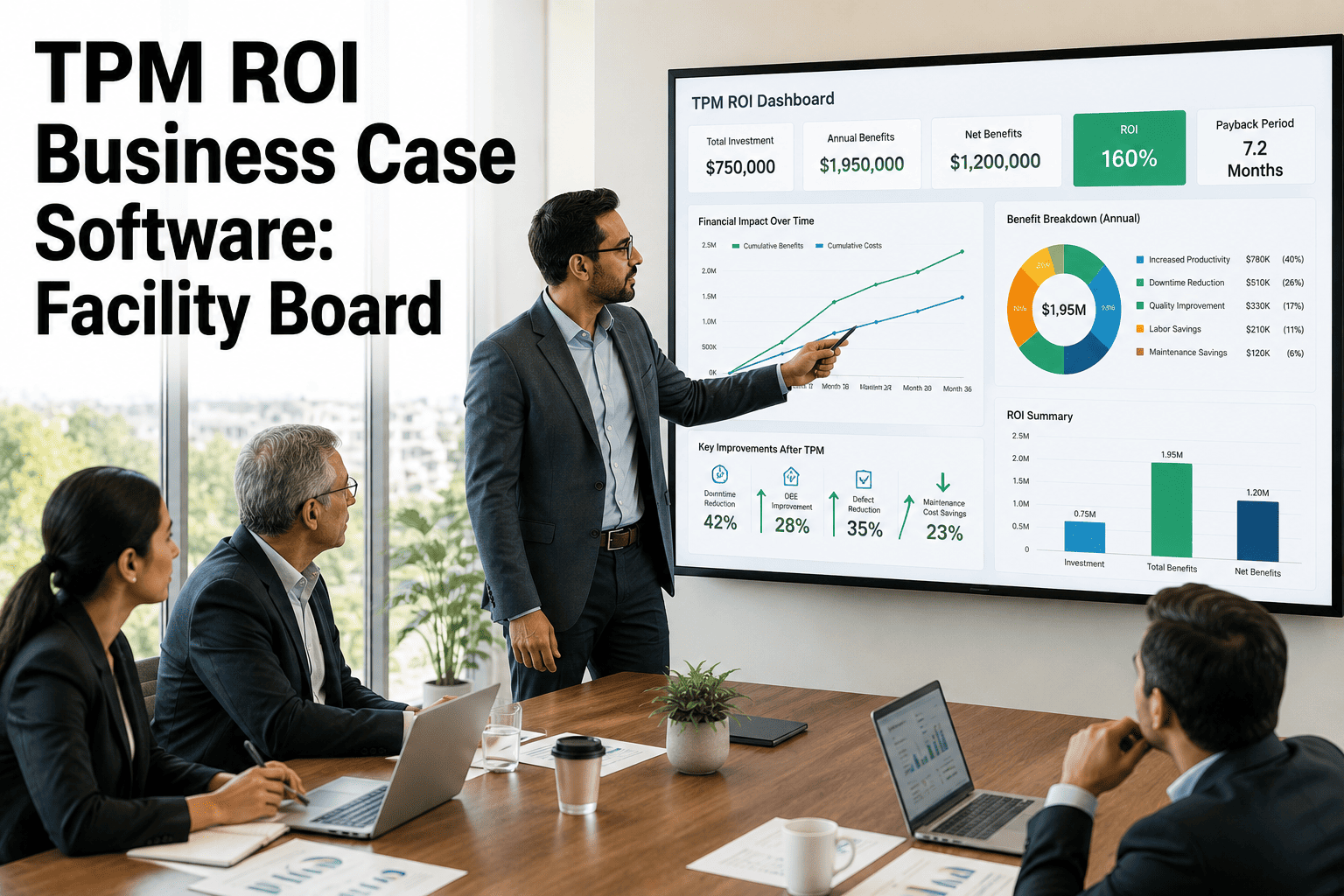
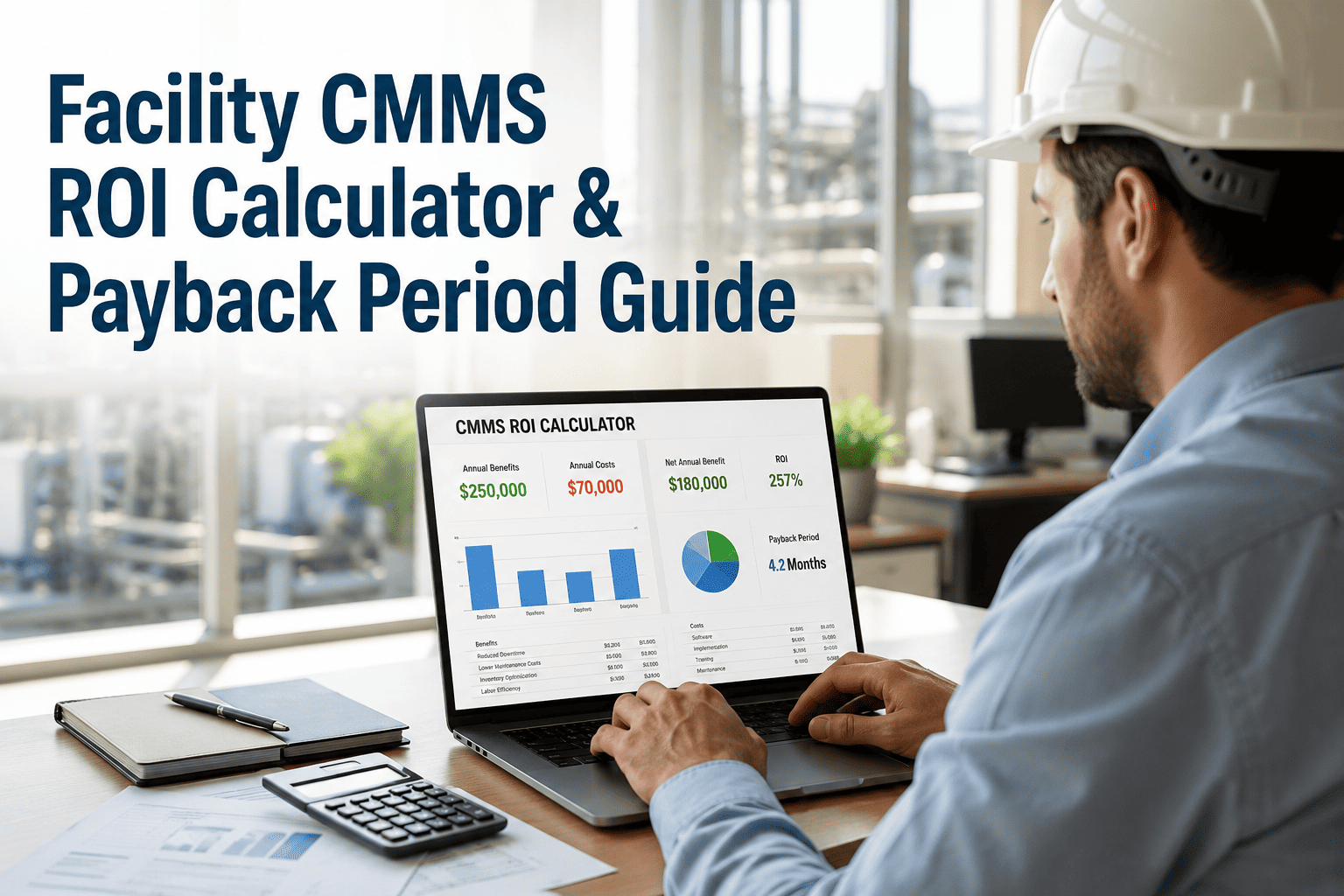
Finance teams approve investments when they recognize the financial metrics they use to evaluate everything else. Present your CMMS ROI in three numbers — payback period, year-one ROI, and 5-year NPV — and the conversation changes from "can we justify this?" to "why haven't we done this already?" Sign in to Oxmaint to pull the reports that feed each of these calculations directly.
Under 12 months: Compelling
Under 6 months: Obvious yes
150% minimum to exceed hurdle rate
Match to finance team's standard metric
Use company's standard discount rate
Positive NPV = investment creates value
Build Your CMMS ROI Case with Real Data from Oxmaint Analytics
Oxmaint tracks downtime costs, emergency order frequency, PM compliance rates, and labor productivity — the exact inputs your ROI calculation needs — from day one of use.
Frequently Asked Questions
Most manufacturing facilities see payback within 12–18 months. Facilities with high emergency maintenance costs or significant unplanned downtime often recover the investment in 6–9 months. The payback period is fastest when the starting baseline is worst — which means the facilities that need a CMMS most also benefit from the strongest financial case. Sign up for Oxmaint to start tracking the baseline data your payback calculation requires.
Use both — but distinguish them clearly. Hard savings are reductions in actual spending: less overtime, fewer emergency orders, lower parts costs. Cost avoidance is preventing future spending: an equipment failure that didn't happen, a compliance penalty that was avoided. CFOs accept both when they are quantified and tied to specific budget lines. Business cases that rely only on cost avoidance (soft benefits) are weaker than those with a mix of both. Book a demo to see how Oxmaint separates hard savings from avoidance in its analytics reports.
Downtime cost = unplanned downtime hours × production value per hour. Your finance or operations team can provide the production value per hour — it includes lost revenue, idle labor, and often a portion of fixed overhead that continues regardless. Multiply that by actual downtime hours from your maintenance logs for the past 12 months. Even a 20% reduction in that figure typically covers the CMMS cost many times over in the first year.
Oxmaint's analytics dashboard tracks downtime frequency and cost, emergency vs. planned maintenance ratio, PM compliance rate, labor productivity, and inventory spend — all the inputs needed to quantify ROI before and after implementation. Reports can be filtered by time period and exported directly into the format leadership needs for budget reviews. Sign in to Oxmaint to access the analytics that turn operational data into financial language for your CFO.
Stop Defending CMMS Cost. Start Proving Its Value.
Oxmaint captures the baseline metrics, tracks improvement, and surfaces the financial data your leadership team needs — turning every budget conversation from justification into expansion.