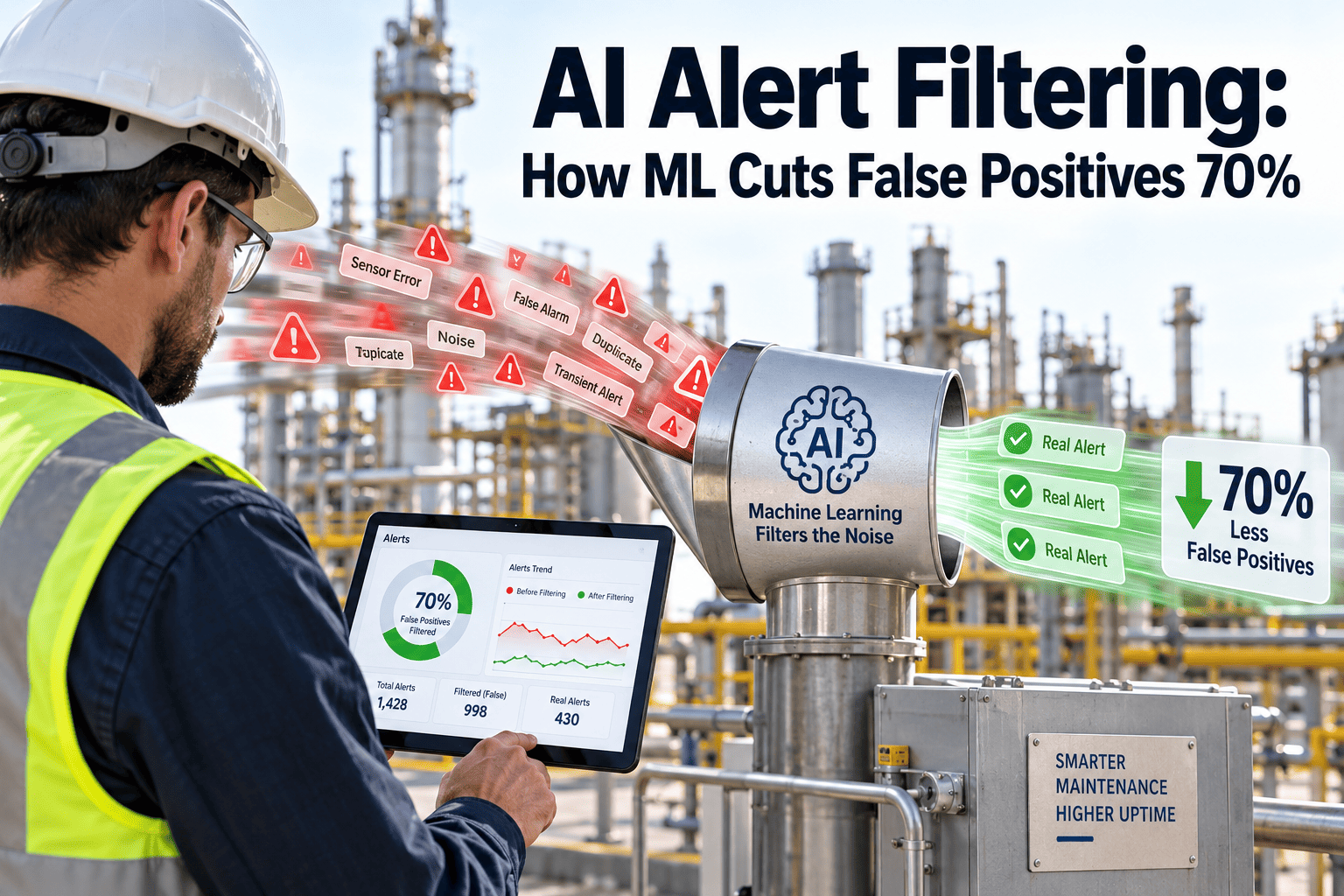
A safety manager opens the dashboard Monday morning to 40 hard-braking alerts, a dozen distraction warnings, and a handful of tailgating flags — and by lunch, three of them turn out to be genuine risk events. The other 49 are a delivery driver braking for a cyclist, sun glare tripping a camera, or a pothole registering as harsh acceleration. This is alert fatigue, and it's quietly the biggest reason video telematics programs get abandoned within their first year: not because the cameras don't work, but because the alerts stop meaning anything. Machine learning models built specifically to filter that noise before it reaches a human reviewer are changing that math, and fleets running them report false positive reductions in the range of 70% — see how the filtering actually works in practice.
Every driver safety alert, filtered before it reaches a human
Machine learning models separate genuine risk events from sensor noise, cutting false positive rates by up to 70% and giving safety teams their trust in the alert queue back.
Why alert fatigue is the real threat to fleet safety programs
Video telematics and AI dash cams promise fewer incidents and lower claims costs. In practice, many fleets get a daily flood of alerts that don't warrant action, and the entire system becomes noise. Safety managers routinely spend a meaningful chunk of every shift sorting legitimate incidents from false triggers, reviewing footage that turns out to be a shadow crossing the lens or a third-party vehicle braking hard nearby. Drivers, meanwhile, get flagged for events that weren't actually unsafe, and they learn quickly that the alerts aren't reliable — which means they stop taking the real ones seriously either.
Where false positives actually come from
Most false triggers trace back to a small set of sensor and environmental conditions that rule-based systems handle poorly.
G-force thresholds without context
A basic accelerometer trigger can't distinguish a pothole from a hard brake, so any sharp jolt fires an alert regardless of actual driving risk.
Lighting and lens conditions
Sun glare, nighttime glare from oncoming headlights, and rain on the lens all commonly trigger distraction or lane-departure warnings that have nothing to do with the driver.
Third-party driving behavior
A tailgating or hard-braking alert often reflects another vehicle cutting in front, not the fleet driver's own decision-making — but a basic system scores it as the driver's event either way.
From raw sensor trigger to a reviewed, confident alert
ML-based filtering doesn't remove alerts arbitrarily — it adds a confidence layer between the raw trigger and the human reviewer.
Raw sensor trigger fires
Accelerometer, forward camera, or driver-facing camera detects a threshold-crossing event — hard brake, lane drift, eye closure, phone-like hand position.
Multi-signal fusion runs
Rather than relying on one sensor, the model cross-checks GPS speed change, forward and cabin video, and road-type context together before scoring the event.
Confidence score assigned
The event receives a probability of being a genuine risk behavior versus environmental noise, based on patterns learned from millions of prior labeled events.
Low-confidence events are suppressed
Events below the confidence threshold are logged for pattern analysis but never reach the coaching queue, so reviewers only see events worth acting on.
Reviewer feedback retrains the model
When a safety manager marks an alert as a false positive, that correction feeds back into the model, so accuracy improves for that fleet's specific routes and conditions over time.
What changes in the daily alert queue
- Every g-force spike or glare event generates an alert
- Safety managers manually triage dozens of alerts daily
- Drivers get flagged for events outside their control
- Genuine risk events get buried in the noise
- Only high-confidence events reach the coaching queue
- Review time drops because most triage happens automatically
- Drivers are scored on behavior the model has verified is theirs
- Coaching conversations carry more weight because alerts are trusted
Stop reviewing alerts that were never real risk events
See how confidence-scored filtering fits into your existing telematics and dash cam data.
What good filtering actually looks like in the numbers
Production ML fatigue and distraction detection systems now report strong precision under normal driving conditions, though accuracy still depends on cab lighting and camera positioning.
Accuracy drops in extreme low light, with sunglasses, or when a driver's face is partially obscured, which is why the strongest systems fuse multiple signals — head position, gaze, and behavioral trend — rather than relying on a single camera cue. Fleets should expect a tuning period rather than instant accuracy on day one.
Getting filtering right before drivers lose more trust
Run a baseline period to measure current false positive rate before tuning anything.
Set the confidence threshold conservatively at first, then tighten it as reviewer feedback accumulates.
Route every reviewer correction back into the model, not just the ones that seem significant.
Tell drivers the filtering exists — a quieter alert stream only rebuilds trust if drivers know why.
Keep suppressed low-confidence events logged for trend analysis, don't discard them entirely.
Why the psychology of alert fatigue matters as much as the model
Once drivers learn that an alert is more likely wrong than right, they stop reacting to it in real time — and that habit doesn't reverse the moment the false-positive rate drops. Rebuilding trust takes more than a quieter dashboard.
Explain the change to drivers
Announce that filtering has been tuned and explain roughly what changed, so a quieter week reads as improvement rather than the system going silent.
Show drivers their own accuracy trend
Letting drivers see that their flagged-event count has genuinely dropped, not just been hidden from them, rebuilds confidence that the scoring is fair.
Close the loop on disputed events
When a driver contests an alert and review confirms it was a false positive, communicating that outcome back reinforces that the appeal process actually works.
Why single-sensor systems can't get past a certain accuracy ceiling
A dash cam relying only on forward-facing video, or only on accelerometer thresholds, hits a hard ceiling on filtering accuracy no matter how the model is tuned, because it's missing context the event actually depends on. Fusing GPS-derived speed change, forward video, cabin-facing video, and road-type metadata gives the model enough independent signals to tell a genuine hard brake from a pothole, or genuine driver distraction from a passing truck's shadow crossing the windshield, and that redundancy is exactly what a single-sensor system structurally cannot replicate. Fleets evaluating AI dash cam vendors should ask specifically which signals feed the confidence score, not just what the advertised accuracy percentage is, since accuracy figures vary widely depending on lighting and test conditions.
What filtering actually saves beyond reviewer time
Fewer disputed coaching conversations, since drivers are less likely to contest an alert the model has already confirmed with high confidence.
Lower churn risk, since alert fatigue and perceived unfair scoring are common reasons drivers cite for leaving a fleet.
Faster claims exoneration, because reviewers spend their time on footage that's actually relevant to an incident instead of unrelated noise.
Better long-term coaching data, since a smaller set of verified events produces cleaner behavioral trend lines per driver.
Connecting filtered alerts to the maintenance and coaching workflow
A filtered alert is only useful if it actually reaches the right work order or coaching record, not just a cleaner inbox. Oxmaint connects verified safety events to driver and asset records automatically, so a high-confidence hard-braking alert can trigger both a coaching workflow and a maintenance inspection if the event pattern suggests a mechanical cause, such as worn brake components rather than driver behavior. Dashboards separate suppressed low-confidence events from ones requiring action, and reporting tools track false positive trends over time so fleets can see the filtering actually improving, month over month, instead of taking accuracy on faith.
Questions to ask before choosing an AI alert filtering vendor
Advertised accuracy percentages vary widely depending on how a vendor's test conditions were set up, so the useful questions go deeper than the headline number. Ask specifically which sensors feed the confidence score for each alert type, since a vendor relying on a single camera angle will underperform in poor lighting no matter what the marketing claims. Ask how reviewer corrections get incorporated — some systems retrain centrally across all customers, others tune per-fleet, and per-fleet tuning generally converges on your specific routes, terrain, and driver population faster than a shared model built for a generic customer base ever will. Finally, ask what happens to suppressed low-confidence events: a system that discards them entirely gives you no way to audit whether the threshold is set correctly, while one that logs them for periodic review lets your safety team verify the filtering is actually working as intended.
A realistic first 90 days with alert filtering
Weeks 1-2: Baseline measurement
Run existing alert thresholds unchanged and log how many events reviewers ultimately mark as false positives, to establish a true starting number.
Weeks 3-6: Conservative filtering
Apply the confidence model with a cautious threshold, suppressing only the most obviously low-confidence events while the model gathers fleet-specific feedback.
Weeks 7-12: Threshold tuning
Tighten the threshold as reviewer feedback accumulates, tracking the false positive rate weekly against the original baseline.
AI alert filtering — common questions
Does ML filtering ever suppress a genuine risk event?
It can, which is why suppressed events stay logged rather than deleted. Reviewer feedback and periodic audits of low-confidence events help catch and correct any threshold set too aggressively.
How long does it take to see the false positive reduction?
Most fleets see meaningful improvement within a few weeks of reviewer feedback, though accuracy continues improving as the model learns route-specific and fleet-specific patterns.
Does this replace the need for a safety manager to review footage?
No — it reduces the volume reaching that reviewer so their time goes toward genuine events instead of sorting noise, not toward removing human judgment from the process.
What causes accuracy to drop for fatigue or distraction detection?
Low light, sunglasses, and partial face occlusion are the most common causes. Systems that fuse multiple signals rather than relying on eyelid tracking alone hold up better under those conditions.
Can filtering be applied to an existing dash cam and telematics setup?
In most cases, yes, provided the existing hardware captures the sensor and video data the model needs. Get Started to see how it connects to your current fleet data.
Where a person still needs to stay in the loop
Filtering reduces volume, but a few categories of event should never be fully automated away from human review, regardless of how confident the model becomes, because confidence scores describe statistical likelihood, not certainty, and the highest-stakes events deserve a person's judgment on top of the model's. Any event tied to an actual collision or near-miss with property damage should route to a reviewer even at high confidence, since the footage often matters for claims and legal exposure beyond just coaching, and an automated system that quietly closes out a collision-adjacent event without a person looking at it creates real risk during a later dispute. Events that trigger a suspension-level response under a driver's coaching history should also require a second reviewer's confirmation before the consequence is applied, since the cost of a wrongly escalated driver is higher than the cost of a slightly slower review, and that extra step preserves the fairness the whole filtering program is meant to protect. The goal of filtering is to protect reviewer attention for the events that need it, not to remove judgment from the events where it matters most.
Where alert filtering is headed next
The next meaningful gain isn't a higher headline accuracy number — it's models that adapt faster to a specific fleet's routes, cargo type, and driver population without months of manual tuning. Fleets that start collecting clean reviewer feedback now, even on a conservative filtering threshold, build the labeled dataset that makes that faster adaptation possible later. The fleets still running unfiltered rule-based thresholds a year from now won't just have noisier dashboards — they'll be further behind on the data that makes every future improvement compound, and their safety teams will still be spending an hour a day sorting shadows and potholes from genuine risk.
Give your safety team an alert queue they can actually trust
Filter the noise, keep the genuine risk events, and rebuild driver trust in the coaching process.
Free trial · No credit card



.png)