A regional logistics operator running 340 vehicles across five depots was losing $1.2 million per year to breakdowns they couldn't predict, routes they couldn't optimize fast enough, and compliance gaps that took three days to reconcile manually. Their maintenance team was skilled. Their dispatchers were experienced. But every critical decision — when to pull a truck for service, which route to run given live traffic, which driver needed coaching — was being made on instinct and lagging spreadsheet data. That changed when AI entered the picture. Within six months of deploying an AI-driven fleet management platform, breakdowns dropped 28%, fuel spend fell 13%, and compliance reporting that used to consume three days each quarter was done in under an hour. The technology didn't replace the team — it gave them the predictive intelligence to stop reacting and start leading. Sign up for OxMaint free to connect your fleet assets and start generating AI-driven optimization within weeks, or book a demo to see it running on real fleet data today.
Fleet Technology Guide · 2025–2026
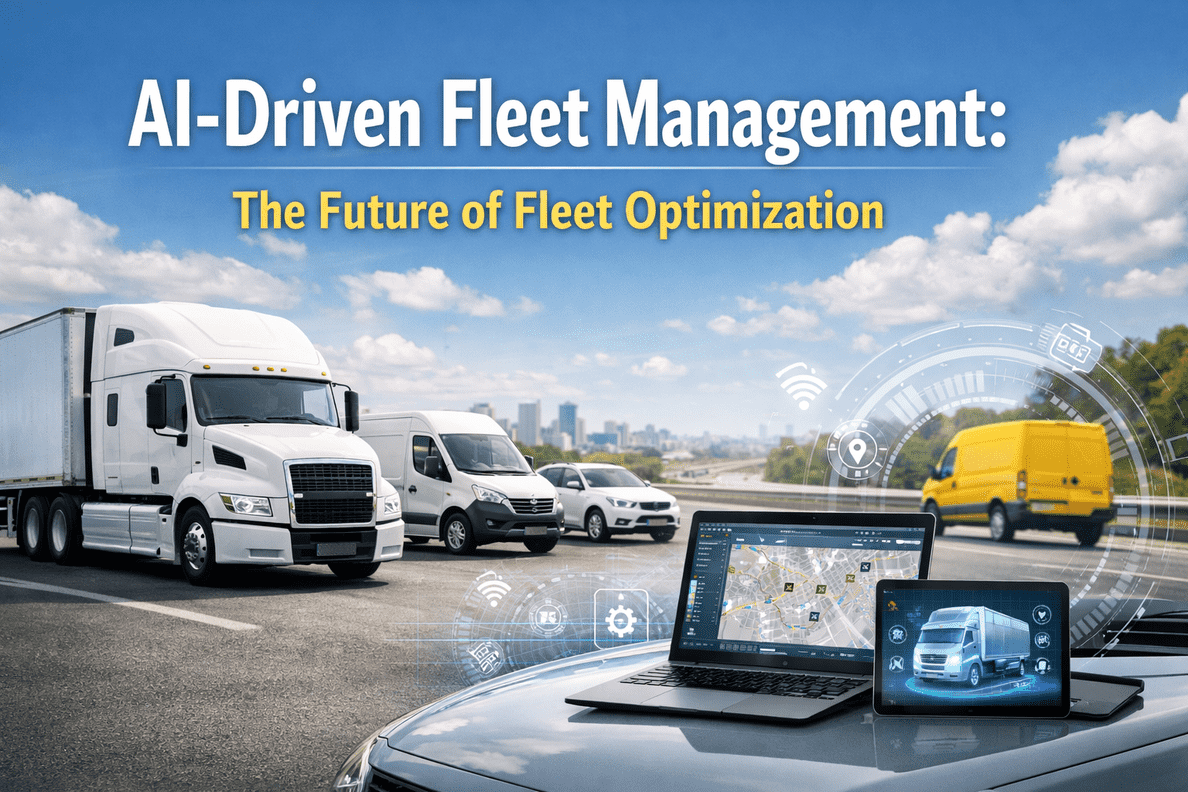
AI-Driven Fleet Management: The Future of Fleet Optimization
The global fleet management market hit $32.87 billion in 2025, growing at 15.32% CAGR. AI is no longer a future investment — it is the operating standard for fleets that want to compete on cost, reliability, and compliance. This guide covers how AI changes every layer of fleet operations and what measurable results you should expect.
$32.9B
Global fleet management market size 2025 — growing at 15.32% CAGR to $67B by 2030
10–15%
Fuel cost reduction from AI-driven route optimization and driver behavior analysis
650–850%
ROI within 18 months reported by fleets using comprehensive AI-powered management platforms
65%
Of fleet maintenance teams planning AI adoption by end of 2026 — from early-majority to mainstream
Experience the AI Fleet Platform Built for Real Operations
OxMaint combines AI-powered predictive maintenance, compliance automation, asset lifecycle tracking, and fleet analytics in a single platform. Deploy in days. Measurable results within weeks.
The Market Shift
Why 2025–2026 Is the Inflection Point for AI in Fleet Management
Three forces are converging simultaneously to make AI adoption in fleet management not just beneficial but operationally necessary for competitive fleets.
01
Data Volume Has Crossed the Human Processing Threshold
Modern vehicles with embedded telematics generate thousands of data points per hour — engine diagnostics, GPS position, fuel consumption, driver behavior events, fault codes, and sensor readings. A fleet of 100 vehicles generates more operational data in a single day than a human analyst can meaningfully review in a week. AI is not optional at this data volume — it is the only viable processing layer. Fleets that don't apply AI to their telematics data are paying for sensors they can't use.
02
Regulatory Complexity Is Accelerating
ELD mandates, CO₂ emission reporting requirements under the EU's Corporate Sustainability Reporting Directive, DOT inspection compliance, and driver hours-of-service regulations are all tightening simultaneously across global markets. Manual compliance management at this complexity level is a genuine operational risk — not just an administrative burden. AI-powered compliance automation converts what used to be days of manual documentation into real-time automated record-keeping with one-click audit export.
03
The Driver and Technician Shortage Is Structural
The US faces an 80,000+ truck driver shortage in 2026 that shows no sign of near-term resolution. The maintenance technician talent pool is equally constrained. AI doesn't replace these roles — it amplifies the capacity of the people you have. AI-guided diagnostics help junior technicians perform at senior-level accuracy. AI scheduling tools let dispatchers manage larger fleets with the same headcount. The fleets that adapt to the labor reality with AI-augmented workflows will out-execute those that don't.
04
ROI Is Now Quantified and Proven
Early AI fleet deployments were measured in directional improvements. The 2025–2026 data is specific: $3,500–$6,200 annual savings per vehicle from combined fuel optimization, predictive maintenance, route efficiency, and driver behavior improvement. Fleets running comprehensive AI platforms report 650–850% ROI within 18 months. This is no longer an innovation bet — it is a capital allocation decision with well-documented financial return profiles that CFOs and board-level stakeholders are increasingly driving.
6 AI Capabilities
Six AI Capabilities That Transform Fleet Operations — And What Each One Delivers
01
Predictive Maintenance
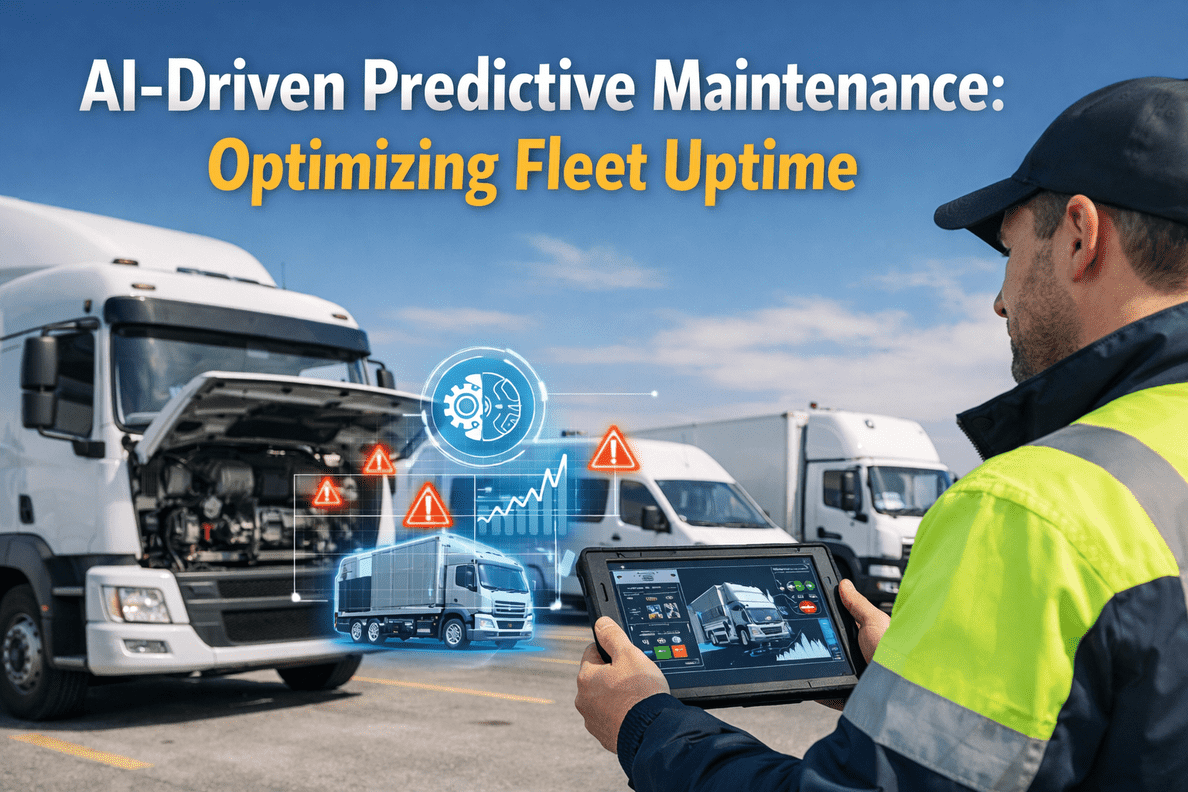
AI analyzes engine diagnostics, sensor readings, mileage patterns, and historical failure data to identify components showing degradation signatures weeks before they fail. A vehicle with a brake caliper showing 12% increased resistance at current mileage and operating conditions gets a service alert 3 weeks before it would become a roadside failure — not a calendar-based PM reminder that may be 6 weeks too late or 3 weeks too early. AI predictive maintenance reduces unplanned breakdowns by 20–30% and cuts emergency repair costs by up to 40% compared to reactive maintenance programs.
20–30%fewer unplanned breakdowns from AI predictive maintenance
02
Dynamic Route Optimization
AI routing engines process real-time traffic data, weather conditions, delivery window constraints, vehicle load and fuel efficiency profiles, and driver hours-of-service remaining — simultaneously, continuously, and for every vehicle in the fleet. When a route is disrupted by an accident or sudden congestion, AI recalculates optimal alternatives for affected vehicles in seconds, not the 20–40 minutes it takes a human dispatcher to manually reroute multiple trucks. AI routing consistently delivers 10–15% fuel savings and reduces empty miles by up to 35% across transportation fleets operating in complex urban environments.
35%reduction in empty miles from AI dynamic route optimization
03
Driver Behavior Intelligence
AI continuously monitors telematics data for driver behavior patterns — hard braking frequency, rapid acceleration events, extended idle time, speeding above thresholds, and fatigue indicators. Unlike periodic manual report reviews, AI identifies behavioral drift in real time — a driver whose harsh braking frequency has increased 40% over the past two weeks is flagged for coaching before it becomes an insurance claim, not after. Fleets using AI-powered driver scoring consistently reduce accident rates by 15–25% and see fuel savings from behavior improvement of 6–10% per driver coached.
15–25%accident rate reduction from AI-driven driver behavior monitoring
04
Fuel Intelligence & Cost Optimization
Fuel represents 30–40% of total fleet operating costs — making it the single largest lever for operational savings. AI fuel intelligence goes beyond tracking fuel consumption to identifying the specific causes: idle time by location and driver, inefficient routing adding unnecessary miles, vehicle loading patterns that increase resistance, and maintenance deficiencies that degrade engine efficiency. AI cross-references fuel consumption data with route, load, driver, and vehicle condition data to pinpoint exactly where fuel is being lost and generate specific corrective recommendations rather than general awareness that fuel costs are high.
30–40%of fleet operating costs is fuel — AI's highest-impact optimization target
05
Compliance Automation
ELD data, DVIR inspection records, driver certification status, vehicle registration and insurance documents, and maintenance compliance records all require continuous monitoring against regulatory deadlines and requirements. AI compliance automation maintains a real-time compliance dashboard for every vehicle, driver, and regulatory requirement — generating proactive alerts when expiry dates approach, automatically creating work orders when inspection defects are logged, and producing audit-ready reports for any date range in minutes. Compliance gaps that previously took 3 days to manually identify and reconcile are surfaced automatically in real time.
Real-timecompliance visibility replacing 3-day manual quarterly reconciliation processes
06
Total Cost of Ownership Analytics
AI TCO analysis combines maintenance cost history, fuel consumption, tire wear rates, insurance claims, downtime events, and depreciation data to calculate the true per-mile operating cost for every vehicle in the fleet — and project remaining useful life with resale value optimization recommendations. Fleet managers using AI TCO analytics replace gut-feel vehicle replacement decisions with data-driven timing recommendations that maximize vehicle value at disposal and minimize the period where maintenance costs exceed the savings from replacement. Correct replacement timing decisions alone typically save 8–12% of total fleet lifecycle costs.
8–12%fleet lifecycle cost savings from AI-optimized vehicle replacement timing
Before vs. After
The Same Fleet Operation — With and Without AI
2026 Trends
Six AI Fleet Trends Reshaping Operations Right Now
Trend 01
EV Fleet Integration
Electric vehicles crossed 20% global market share in 2025. AI fleet platforms are evolving to manage the fundamentally different maintenance profile, charging schedule optimization, battery health monitoring, and range-aware routing that EVs require. Fleets with mixed ICE and EV assets need AI that manages both under one unified system.
Trend 02
5G-Enabled Real-Time Intelligence
5G network expansion enables sub-10 millisecond data latency — meaning AI can update routes for urban dispatch vehicles before congestion materializes, not minutes after. Edge AI on vehicles now processes safety alerts locally and sends only exceptions to the cloud, reducing bandwidth costs while accelerating driver intervention speed.
Trend 03
Digital Twin Fleet Modeling
Digital twin technology — creating real-time virtual models of fleet operations — is moving from large enterprise to mid-market fleets. By 2027, over 75% of large enterprises will use digital twins. Fleet managers can simulate route changes, maintenance schedule adjustments, and fleet size decisions against AI-modeled outcomes before committing resources.
Trend 04
AI-Guided Technician Tools
AI diagnostic tools that guide technicians step-by-step through complex repairs are addressing the structural maintenance labor shortage. A junior technician with AI diagnostic support performs at near-senior-level accuracy — reducing mean time to repair and enabling fleet operators to effectively expand their maintenance capacity without competing for scarce experienced talent.
Trend 05
Cybersecurity as a Fleet Risk
Upstream Security documented 494 automotive cyber incidents in 2025, with ransomware attacks on fleet management systems doubling year-over-year. Connected fleet platforms are now a cybersecurity target. AI-powered anomaly detection in fleet network traffic is becoming part of fleet management platforms — not just a separate IT function.
Trend 06
Sustainability Compliance Automation
The EU's Corporate Sustainability Reporting Directive and similar frameworks globally are creating mandatory fleet carbon reporting requirements for mid-to-large fleet operators. AI fleet platforms that automatically calculate CO₂ per vehicle, per route, and per fleet total — and generate regulatory-compliant reports — are shifting from a premium feature to a compliance necessity.
How OxMaint Delivers It
OxMaint's AI Fleet Platform — What Each Module Does for Your Operation
FAQ
AI-Driven Fleet Management — Questions Fleet Managers Ask First
What does AI-driven fleet management actually mean in daily operations — and how is it different from GPS tracking with basic analytics?
GPS tracking with basic analytics tells you where your vehicles are and generates summary reports of what happened. AI-driven fleet management tells you what is going to happen — and recommends what to do before it does. The critical distinction is predictive versus descriptive intelligence. A basic analytics dashboard tells a fleet manager that Vehicle 47 was driven hard last week and consumed 14% more fuel than average. AI fleet management identifies that Vehicle 47's fuel consumption trend, combined with its engine diagnostic data and recent maintenance history, indicates a fuel system issue developing over the next 8–12 days — and automatically generates a work order to inspect it during the scheduled downtime window on Tuesday. For maintenance, the difference is between knowing you had a breakdown and being alerted to a developing component failure 3 weeks before it occurs. For routing, the difference is between reviewing yesterday's fuel waste report and having every route automatically optimized in real time as traffic conditions change. For compliance, the difference is between manually reconciling 90 days of ELD records and having a real-time compliance dashboard that alerts you the moment any driver, vehicle, or document approaches an expiry threshold. OxMaint operates as this predictive intelligence layer — not just a data repository.
Sign up free to see the difference on your actual fleet data.
How long does it take to see ROI from AI fleet management — and what are the first savings that typically appear?
The first measurable savings from AI fleet management typically appear in the first 30–90 days of deployment, with the fastest returns coming from three areas. First, compliance efficiency: within the first week, the time spent on compliance documentation and ELD reconciliation drops dramatically as automated record-keeping replaces manual compilation. Fleets that were spending 2–3 days per quarter on compliance reporting see this reduced to under an hour immediately. Second, emergency repair cost reduction: as predictive maintenance alerts begin surfacing developing failures, the ratio of planned repairs to emergency breakdowns shifts within 60–90 days. Each emergency repair converted to a planned service saves 2–4× the repair cost when emergency parts procurement, overtime labor, and towing are included. Third, fuel optimization: route adjustments and driver behavior coaching driven by AI recommendations typically deliver 8–12% fuel savings within 90 days on fleets with no prior optimization program. Comprehensive AI fleet platforms consistently report 650–850% ROI within 18 months when all value streams are measured together. The single largest ROI event for many fleet operators is the first major breakdown prevented — a single avoided transmission failure or engine seizure on a Class 8 truck, which carries a total event cost of $35,000–$80,000 including downtime, can cover the annual platform cost in one incident.
Book a demo for an ROI projection based on your fleet size and operational profile.
Does OxMaint work with telematics hardware we already have — or does it require specific devices?
OxMaint is hardware-agnostic by design. The platform connects to telematics data from any provider — Geotab, Samsara, Verizon Connect, Fleet Complete, Motive, Zonar, and others — through open APIs and pre-built integration connectors. If your vehicles already have GPS trackers or OBD-II dongles installed, OxMaint ingests that data stream to power maintenance predictions, compliance monitoring, and fleet analytics without requiring any hardware swap or additional device installation. For assets without telematics coverage, OxMaint's mobile inspection workflow provides structured digital inspection data from technicians that feeds the AI maintenance model — so you capture predictive value from inspection observations while telematics coverage is being expanded selectively. This means most fleet operators can deploy OxMaint on their existing infrastructure immediately, with sensor and telematics upgrades made selectively where the AI analysis identifies the highest-impact monitoring gaps.
Sign up free to connect your existing telematics provider and start generating predictions within days.
How does AI fleet management handle mixed fleets with different vehicle types, ages, and maintenance profiles?
Mixed fleet management is one of AI's strongest capabilities — and one of the biggest pain points for fleet operators using legacy systems that force all vehicle types into the same maintenance templates and reporting structures. OxMaint's AI engine builds individual baseline models per vehicle, accounting for vehicle type, age, operating profile, and maintenance history. A 2019 diesel heavy truck operating on long-haul interstate routes has a fundamentally different maintenance pattern than a 2024 electric light commercial vehicle doing urban last-mile delivery in the same fleet — and the AI manages these completely differently within the same unified dashboard. For maintenance scheduling, PM intervals are set per vehicle type and adjusted by AI based on actual usage patterns rather than applying blanket calendar intervals to everything. For compliance, inspection templates adapt per vehicle class and regulatory requirements. For TCO analysis, vehicle type-specific depreciation curves and maintenance cost benchmarks are applied. For fleets transitioning to EVs alongside legacy ICE vehicles, OxMaint manages both asset types with EV-specific modules for battery health monitoring, charging schedule optimization, and range-aware work order scheduling running alongside standard ICE maintenance workflows.
Book a demo to see mixed fleet management configured for your specific vehicle types.
What does deployment look like — how long does it take and how much IT involvement is required?
OxMaint deploys as a cloud-native platform — no server installation, no hardware procurement, no IT infrastructure setup. Most fleet operations are creating digital work orders and running their first AI-powered inspection workflows within their first week. Full deployment — including vehicle data import, maintenance schedule configuration for your specific asset types, telematics integration, team mobile onboarding, and compliance template setup — typically takes 1–3 weeks depending on fleet size. IT department involvement is minimal: typically limited to approving the telematics integration access request and confirming mobile device management settings for the OxMaint mobile app. Oxmaint's implementation team handles data migration from legacy systems, API configuration for telematics connections, and live training sessions for maintenance managers, technicians, and dispatchers. Because OxMaint is a SaaS platform, updates, security patches, and infrastructure scaling are handled automatically by OxMaint's engineering team — no ongoing IT maintenance required post-deployment.
Sign up free — your fleet can be operational within days.
How does OxMaint's AI handle compliance for fleets operating across multiple jurisdictions with different regulatory requirements?
Multi-jurisdiction compliance management is one of the most time-consuming challenges for fleet operators running vehicles across US states, Canadian provinces, or multiple countries with different ELD standards, inspection requirements, and hours-of-service regulations. OxMaint addresses this through a configurable compliance framework that applies jurisdiction-specific rules per driver, per vehicle, and per route — rather than applying one-size-fits-all compliance templates across a fleet with genuinely different regulatory obligations. The AI compliance engine monitors every driver's hours-of-service against applicable regulations in real time, alerts dispatchers before violation thresholds are approached, and generates jurisdiction-specific compliance documentation for roadside inspection or regulatory audit. For vehicle inspections, OxMaint's digital DVIR forms are configurable per vehicle class and state/province requirements — ensuring that inspection records meet local standards regardless of where the vehicle operates. For Canadian fleets, CCMTA compliance requirements are built into the platform alongside US DOT standards. Audit-ready compliance reports can be exported for any vehicle, any driver, any jurisdiction, and any date range in minutes — replacing what used to be days of manual record assembly.
Book a demo to see multi-jurisdiction compliance management configured for your operating regions.
Your Fleet Is Generating the Data. OxMaint Is the AI Layer That Turns It Into Decisions.
Every vehicle in your fleet is already producing the sensor data, telematics signals, and maintenance records that AI needs to predict failures, optimize costs, and automate compliance. OxMaint connects all of it into one intelligent platform. Deploy in days. First measurable results within weeks. Proven 650–850% ROI within 18 months.