In February 2026, Aurora Innovation tripled its autonomous freight network to 10 routes with 250,000+ driverless miles and zero collisions. Every vehicle in that network is maintained by an AI system that has never seen the inside of a paper binder, never missed a service trigger, and never discovered a failure the moment it happened rather than weeks before. The AI knew about every developing component stress condition — because it was reading the vehicle's sensor data in real time, comparing it against fleet-wide failure patterns, and scheduling interventions before the driver experienced any symptom. For the other 99% of commercial fleets still running on time-based PM schedules, the performance gap that AI creates is growing every quarter. A 250-vehicle logistics fleet that deployed AI-powered predictive maintenance documented $1.8 million in annual savings. A 35-vehicle construction fleet cut its maintenance budget from $620,000 to $410,000. The math is not theoretical — it is operational, documented, and reproducible. The question for every fleet manager in 2026 is not whether AI predictive maintenance delivers ROI. It is how fast you can deploy it before your competitors lock in the advantage you have not yet captured. Sign up for OxMaint and deploy AI-powered predictive maintenance across your fleet today.
Fleet Technology · Guide · 2026
AI-Powered Predictive Maintenance: Revolutionizing Fleet Operations
65% of maintenance teams plan to use AI by end of 2026 — yet only 27% are operational today. The fleets that deploy now gain compounding advantages: models that improve with every mile, failure patterns that become invisible to competitors still reading spreadsheets, and a maintenance cost structure that drops 20–40% while uptime climbs to 93–97%.
220–650%
First-year ROI range documented across fleet AI predictive maintenance implementations
90%+
Failure prediction accuracy achieved by leading AI fleet models processing real-time telematics data
2–8 wks
Advance warning window AI provides before component failure — vs. zero warning in time-based PM-only programs
$11.7B
AI-driven fleet maintenance market projected by 2033 — growing at 19.3% CAGR from $4.2B in 2024
What AI Predictive Maintenance Does That Time-Based PM Cannot
Traditional preventive maintenance schedules vehicles on fixed intervals — every 5,000 miles, every 3 months, every 500 engine hours. The schedule doesn't know that one vehicle is operating in desert heat at 105°F while another runs light urban routes. It doesn't know that the same model truck develops cooling system stress at 40,000 miles on highway routes but 70,000 miles on city routes. It treats every vehicle identically — and misses the 23% of emergency repairs that occur within 2,000 miles of a completed service.
AI predictive maintenance reads each vehicle's actual condition data continuously — temperature trends, vibration signatures, efficiency drift, fluid consumption rates — and compares it against that vehicle's own historical baseline, not a fleet average. When a pattern indicates developing failure, it flags the specific component, estimates time to failure, generates a work order, and schedules the repair — automatically, weeks before the driver experiences any symptom.
What AI Reads
Engine temperature trending 9°F above baseline at equivalent load — early cooling system degradation indicator
Fuel efficiency declining 5.2% over 3 weeks on consistent route — injector fouling or turbocharger wear pattern
Vibration frequency shift in drivetrain — bearing wear developing 4–6 weeks before audible symptom
Brake deceleration efficiency declining 8% over 2,000 miles — pad wear progressing faster than calendar schedule predicts
Oil consumption rate increasing from 0.4 to 0.9 quarts/1,000 mi — ring seal degradation pre-failure signal
DTC code frequency increasing from 1 to 6 soft faults/week — component progression toward hard failure
What Time-Based PM Sees
Mileage counter — oil change due at 5,000 miles, executed on schedule, failure invisible
Calendar date — quarterly service completed on schedule, efficiency decline not measured
Manufacturer interval — drivetrain serviced per schedule, bearing wear not detectable by standard inspection
Fixed interval — brakes serviced at scheduled mileage, actual wear rate variability untracked
Level check at service — oil level OK at time of check, consumption rate between services invisible
Fault code dashboard — only hard fault codes visible, soft fault frequency patterns not tracked
The 7 AI Models Running Inside a Modern Fleet Predictive Maintenance System
AI predictive maintenance in 2026 is not a single algorithm — it is a constellation of specialized machine learning models, each trained on specific failure physics, each processing different data streams, each contributing to a unified risk assessment that prioritizes maintenance actions across the fleet.
01
Thermal Anomaly Detection
Tracks operating temperature deviation from vehicle-specific baseline at equivalent load conditions. Flags cooling system degradation, combustion inefficiency, and oil breakdown patterns 3–5 weeks before fault code generation.
Failure lead time: 3–5 weeks
02
Vibration Spectrum Analysis
Analyzes accelerometer data for frequency signature changes indicating bearing wear, driveshaft imbalance, and suspension fatigue. Pattern changes visible in data 4–6 weeks before audible symptoms or driver-reported concerns.
Failure lead time: 4–6 weeks
03
Efficiency Decline Modeling
Isolates vehicle-attributable fuel efficiency decline from driver and route variation using ML regression. A statistically significant efficiency drop on consistent route profiles indicates mechanical degradation — not driving style.
Failure lead time: 2–4 weeks
04
Fault Code Frequency Analysis
Tracks diagnostic trouble code generation rate — not just current active codes, but the frequency trend of soft and pending codes over time. A component generating fault codes at increasing frequency is progressing toward failure even when currently "cleared."
Failure lead time: 1–3 weeks
05
Fluid Consumption Monitoring
Per-vehicle oil, coolant, and DEF consumption rate tracked against baseline miles-per-quart. Consumption rate acceleration is an early indicator of seal degradation, combustion issues, or cooling system compromise — catchable at $400–$800 intervention cost vs. $5,000–$15,000 engine damage.
Failure lead time: 4–8 weeks
06
Brake Performance Ratio Tracking
Compares brake application force to deceleration rate per stop, per vehicle — identifying brake efficiency decline before driver-reported concerns or visual inspection reveals wear. The most preventable cause of roadside violations and DOT inspection failures.
Failure lead time: 2–4 weeks
07
Fleet-Wide Failure Pattern Learning
Cross-vehicle ML models identify failure patterns specific to vehicle model, duty cycle, and route type across the fleet. A failure pattern that appears on 3 vehicles of the same model at similar mileage generates a fleet-wide preventive alert — catching the next 20 before they fail.
Value: fleet-wide failure prevention
08
Remaining Useful Life Estimation
Integrates all model outputs into a per-component Remaining Useful Life (RUL) estimate — the expected operational time remaining before failure probability exceeds acceptable threshold. RUL powers the CMMS scheduling decision: repair now, plan for next week, or monitor and reassess.
Output: actionable repair window
6 Fleet Operations Problems AI Predictive Maintenance Eliminates
These are the most expensive and most persistent fleet operations failures — and the ones that AI predictive maintenance eliminates systematically, not occasionally.
01
Roadside Breakdowns at 4–5× Shop Repair Cost
Every roadside breakdown costs 4–5× the same repair done in the shop — plus towing, driver downtime, missed delivery penalties, and secondary damage from operating a failing component to complete failure. AI predictive maintenance eliminates 60% of emergency repairs by flagging the developing failure while planned repair is still possible.
02
70% of AI Pilots That Never Scale
In 2026, 70% of industrial AI projects remain stuck in pilot purgatory — they demonstrate value on 10 vehicles but fail to scale to 200 because AI predictions don't automatically trigger maintenance workflows. OxMaint closes this loop: prediction to work order to parts check to technician assignment — automated, at any fleet scale.
03
Emergency Parts Sourcing at 15–30% Premium
When a vehicle breaks down without warning, parts are sourced at emergency rates. The same component ordered 3 weeks ahead of a predicted failure costs 15–30% less at planned procurement rates. AI converts emergency demand to planned demand — at fleet scale, this difference funds the system subscription.
04
Invisible Repeat Failure Patterns
Without fleet-wide ML pattern recognition, the fifth transmission failure on a specific truck model looks like bad luck. AI identifies the pattern from vehicle 2, generates a fleet-wide preventive alert, and prevents vehicles 3–20 from experiencing the same failure. This capability alone consistently delivers the highest single ROI event in AI fleet deployments.
05
EV Maintenance Blind Spots
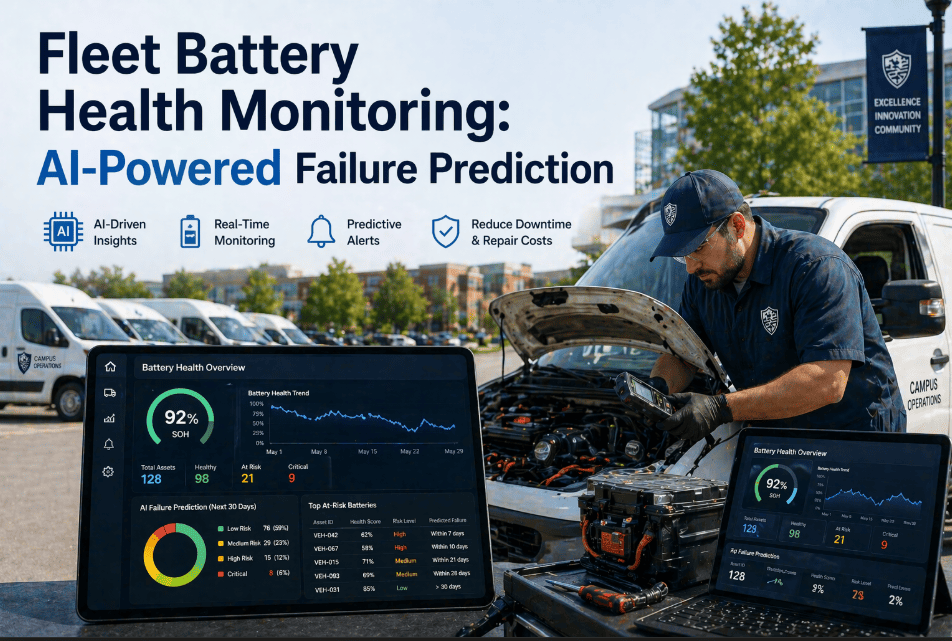
Electric vehicle fleets require fundamentally different maintenance monitoring — battery health, thermal management, regenerative braking wear patterns, and charging cycle analysis. Time-based PM schedules designed for ICE vehicles provide no condition visibility for EV-specific degradation. AI models designed for EV telematics data are the only reliable maintenance strategy for mixed ICE-EV fleets in 2026.
06
CapEx Decisions Made on Mileage Alone
Fleet replacement decisions made without component condition data default to mileage thresholds that retire some vehicles too early and keep others in service after the economics have turned negative. AI-powered condition scoring — the accumulation of failure risk scores per component over time — converts replacement decisions from mileage-based guesses to engineering-data-based analysis.
How OxMaint Deploys AI Predictive Maintenance Across Your Fleet
OxMaint's AI predictive maintenance connects your existing telematics to a fleet-wide machine learning platform and automates the complete maintenance response cycle — from anomaly detection to work order completion. No data scientist required. No separate AI platform to manage. The intelligence is built into the CMMS.
Telematics-Agnostic AI Connection
OxMaint connects to telematics data from any provider — Samsara, Geotab, Verizon Connect, Motive, or any OEM telematics system — through open APIs. No proprietary hardware. No replacing existing devices. The AI models begin building individual vehicle baseline profiles from day one, reaching 85–90% prediction accuracy within 60–90 days as fleet-specific patterns accumulate.
Vehicle-Specific Baseline Modeling
OxMaint's ML models evaluate each vehicle against its own historical behavior at equivalent load and route conditions — not against a fleet average. This vehicle-specific comparison dramatically reduces false positives and surfaces genuine developing failures earlier. The model for your heaviest-duty truck is calibrated to that truck's specific stress profile — not a generic commercial vehicle baseline.
Automated Work Order Generation
When OxMaint's AI flags a developing failure, the CMMS automatically generates a prioritized work order — vehicle, component, confidence score, estimated time to failure, and recommended action. The work order is assigned to the appropriate technician, checked against parts inventory, and scheduled in the next maintenance window. No dispatcher intervention. No alert lost in an inbox. 70% of AI pilots fail here — OxMaint closes the loop.
Fleet-Wide Failure Pattern Intelligence
Beyond individual vehicle prediction, OxMaint's cross-vehicle ML identifies failure patterns across vehicle models, operators, and duty cycles. When 3 vehicles of the same model begin showing similar degradation patterns at similar mileage, the system generates a fleet-wide preventive alert — catching the developing failure across all similar vehicles before any of them reach breakdown. This pattern intelligence compounds in value with every mile of fleet data.
Condition-Based CapEx Forecasting
AI-powered condition scoring — the accumulated failure risk score per component over the vehicle's service life — feeds OxMaint's rolling 5–10 year CapEx forecast. Fleet managers see replacement priority ranked by actual component health, not mileage. Investors and ownership groups receive the engineering-data-backed CapEx case that justifies replacement investment on schedule rather than crisis.
Mobile-First for Technicians and Drivers
AI-generated work orders are delivered to technicians on OxMaint's mobile app — with the specific vehicle, component risk assessment, and recommended parts visible before they open the hood. Drivers complete digital DVIR inspections that feed additional condition data back into the AI models. Every field interaction makes the predictions more accurate for that vehicle and the fleet as a whole.
Deploy AI Predictive Maintenance Across Your Fleet in Days — Not Months
OxMaint connects your existing telematics to a full AI predictive maintenance platform — vehicle-specific baseline models, automated work order generation, fleet-wide failure pattern intelligence, and condition-based CapEx forecasting. Free to start. No new hardware required.
Reactive vs. AI-Powered Predictive Maintenance: The Performance Gap in 2026
Reactive / High Cost
Time-Based / Moderate
AI Predictive / Optimal
AI Predictive Maintenance ROI: Documented Fleet Outcomes
$1.8M
Annual savings — 250-vehicle fleet
30% maintenance cost reduction + 45% downtime decrease. AI deployed through OxMaint CMMS integration.
$210K
Annual savings — 35-vehicle construction fleet
$620K to $410K maintenance spend. 73% reduction in hydraulic failures within 6 months. System paid back 3× over.
3–6 mo
Typical payback period — all fleet sizes
Small fleets often see faster ROI percentage. First prevented breakdown typically covers 3–6 months of system subscription cost.
52%
Fleet managers reporting AI directly reduced vehicle downtime (2025 industry survey)
Early risk identification translates directly to operational uptime gains — confirmed across fleet types and sizes.
Frequently Asked Questions
How does AI predictive maintenance actually work — and what data does it need from fleet vehicles?
AI predictive maintenance uses machine learning models that continuously analyze real-time and historical vehicle sensor data to detect patterns that precede component failures — often 2–8 weeks before any symptom appears or any fault code is generated. The data inputs come from existing telematics systems: engine temperature and coolant temperature trends, fuel consumption rates per route and load profile, OBD-II diagnostic data including soft fault code frequency, vehicle vibration signatures from accelerometers, brake performance ratios, and fluid consumption rates between services. OxMaint's AI connects to telematics data from any provider through open APIs — no new hardware required in most fleet configurations. The ML models begin building vehicle-specific baseline profiles immediately and reach 85–90% prediction accuracy within 60–90 days as fleet-specific behavioral patterns accumulate. The key operational distinction is that OxMaint's AI evaluates each vehicle against its own historical baseline at equivalent conditions — not against a fleet average — which dramatically reduces false positive alerts and surfaces genuine developing failures earlier.
Sign up free to connect your telematics and start building your fleet's AI baseline today.
What is the ROI of AI predictive maintenance — and how do small fleets justify the investment?
AI predictive maintenance ROI ranges from 220–650% in the first year, documented across fleet implementations at scale. The ROI calculation has five independent components that each stand alone: emergency repair cost reduction (roadside repairs cost 4–5× shop rates — fleets reducing emergency frequency by 60% generate substantial direct savings), parts procurement savings (planned purchasing 3+ weeks ahead costs 15–30% less than emergency sourcing), technician productivity improvement (15–25% improvement in wrench time), fleet uptime improvement (each additional percentage point of uptime generates revenue from vehicles that are on the road rather than in the shop), and CapEx optimization (condition-based replacement decisions extend service life and avoid premature vehicle retirement). For small fleets, the ROI calculation is actually more compelling per vehicle: one prevented failure has immediate, significant impact on tight margins. A $5,000 emergency engine repair prevented on a 10-vehicle fleet represents a much higher percentage of annual maintenance spend than the same event on a 500-vehicle fleet. Modern cloud platforms eliminate the infrastructure investment barrier — OxMaint starts free with no hardware procurement required. The first prevented breakdown typically covers 3–6 months of subscription cost.
Book a demo to calculate the ROI for your specific fleet size and maintenance spend.
How does OxMaint's AI prevent the "pilot purgatory" problem where AI proves value on 10 vehicles but fails to scale to 200?
The reason 70% of industrial AI projects remain stuck in pilot purgatory in 2026 is not model accuracy — it is the failure to close the loop from AI prediction to executed maintenance workflow. In a pilot, a data scientist interprets each alert and manually creates a maintenance action. At 200 vehicles with multiple daily alerts per vehicle, that manual interpretation layer collapses completely. OxMaint prevents this by building the full automation loop into the platform from the start, not as an afterthought. When OxMaint's AI flags a developing failure, the CMMS automatically generates a prioritized work order with vehicle identification, predicted component, confidence score, estimated time to failure, and recommended action — without any dispatcher or analyst intervention. The work order checks parts inventory, assigns the appropriate technician, and schedules the repair in the next maintenance window. This workflow operates identically whether your fleet has 10 vehicles or 10,000. The asset registry and the AI data stream use the same unique vehicle identifier — the most common scaling failure in fleet AI implementations is mismatched naming conventions between AI platforms and CMMS systems. OxMaint enforces this alignment from initial setup.
Sign up free to deploy AI that actually scales across your full fleet.
How does AI predictive maintenance handle electric vehicles differently from ICE fleet vehicles?
Electric vehicles require fundamentally different predictive maintenance models than internal combustion engine vehicles — because the failure physics are different. Battery degradation follows electrochemical cycles, not mileage or engine hours. Thermal management of battery packs requires continuous monitoring of cell temperature gradients, not periodic coolant checks. Regenerative braking creates different wear patterns on brake components than hydraulic braking alone. EV drivetrain components (motor, inverter, single-speed reduction gear) have different degradation signatures than multi-speed ICE transmissions. OxMaint's AI models for EV fleet maintenance monitor: battery state of health and cell-level temperature gradient trends, charging cycle efficiency degradation indicating battery pack aging, regenerative braking performance ratio per vehicle, thermal management system performance under sustained load, and motor efficiency decline correlated with operating temperature and load cycles. For mixed ICE-EV fleets — the dominant fleet configuration in 2026 as adoption crosses 20% global market share — OxMaint's platform maintains separate AI model frameworks for each powertrain type while providing a unified dashboard view of the full fleet's maintenance status. Time-based PM schedules designed for ICE vehicles provide no condition visibility for EV-specific degradation patterns — AI monitoring is the only viable maintenance strategy for EV components.
Book a demo to see OxMaint's EV and mixed fleet predictive maintenance configuration.
Your Fleet Is Generating AI-Readable Failure Data Right Now. OxMaint Reads It.
OxMaint connects your fleet telematics to AI predictive maintenance models that flag developing failures 2–8 weeks before breakdown — then automates the complete response from work order generation to technician completion. Free to start. No new hardware. No data scientist required. Results in 60–90 days. Join 1,000+ organizations already running AI-powered fleet maintenance with OxMaint.