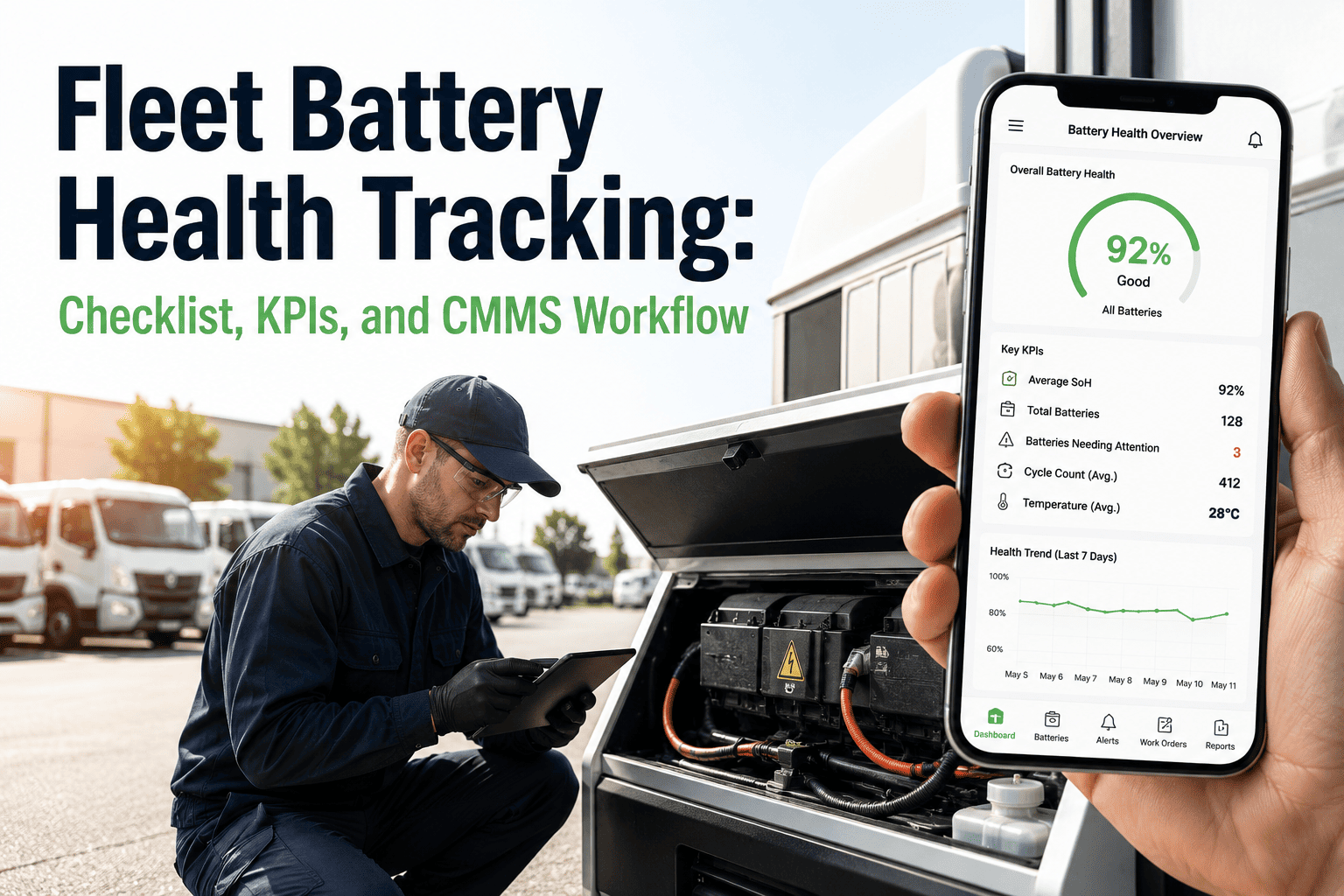
The number on your battery dashboard that says "100%" is lying to you — that's State of Charge, and it tells the driver how far they can go today. The number that decides your fleet's economics is State of Health, and it's the one almost nobody tracks until a van can't finish its afternoon route. The gap between a battery that hits its 80% threshold at year 10 and the identical battery that hits it at year 6 is $80,000–$120,000 in early replacement across a 50-unit fleet — and that gap is entirely a matter of whether SoH lived in a dashboard nobody checked or a workflow that acted on it. Oxmaint moves battery health out of the telematics portal and into your work order system.
Track Battery Health Where It Drives Action
Oxmaint pulls State of Health, charge cycles, temperature, and internal resistance from your vehicle APIs — converting raw battery telemetry into preventive work orders before degradation becomes a range problem or a missed warranty claim.
SoC vs SoH — The Confusion That Costs Fleets Money
The single most common mistake new EV fleet managers make is confusing these two. They sound alike. They measure completely different things — and mixing them up leads to surprise range loss, buses that can't finish routes, and warranty claims missed by months.
Here's the detail most managers miss: the SoH your battery management system displays is not always accurate. Some manufacturers lock it at 100% for months to mask an initial buffer burn-off. Independent monitoring through your CMMS — cross-referencing real energy throughput against stated capacity — gives you the true picture.
The Battery Health KPIs Worth Tracking
A battery dashboard with forty numbers gets ignored. These four are the ones that predict cost, range loss, and warranty windows. Each has a target and a clear action trigger.
Battery Health Inspection Checklist — By Zone
Battery maintenance is organised by zone, not by calendar. Items marked HV require a high-voltage-certified technician — modern packs run at up to 800V and contact can be fatal. Log every item per vehicle in Oxmaint to build the warranty-ready record.
Read State of Health independently against energy throughput
Don't trust the on-screen SoH alone — cross-check actual throughput against stated capacity to catch a masked buffer burn-off. HV-certified
Review temperature logs for out-of-range events
Pull the BMS log and flag any operating-temperature excursions — repeated thermal events are the fastest route to premature capacity loss. Any technician
Inspect battery coolant level, concentration, and pump flow
Check coolant condition and verify the pump moves fluid with no leaks — thermal management is what protects 15–20% of battery life. Any technician
Inspect HV connectors and charge port for heat or damage
Check pins for cleanliness, seals for moisture, and connectors for overheating signs — a hot connector precedes a charging-system failure. HV-certified
Verify charging rate and onboard charger fault codes
Confirm the charge rate matches spec and clear any charger DTCs — and audit the charging protocol on any vehicle degrading above target. Any technician
Record firmware version and confirm safety recalls applied
Document the current BMS firmware per vehicle — both for warranty compliance and to keep pace with evolving charging protocols. Any technician
Route Every Battery Task to a Certified Tech
Oxmaint applies the right checklist per powertrain and routes HV work only to certified technicians — keeping diesel, hybrid, and EV vehicles on one platform with the correct schedule for each.
The CMMS Workflow — From Telemetry to Work Order
Battery health only protects your investment when a degradation signal triggers an action. The workflow below is what separates fleets capturing EV savings from those treating EVs as "diesel minus oil changes."
The Charging Habits That Protect Battery Health
Charging is the single most controllable factor affecting battery life — how you charge matters more than how much you drive. Most of the checklist items above exist to verify these habits are holding. Get these right and you slow degradation from a problem into a footnote. Oxmaint flags any vehicle whose charging pattern breaks these rules.
Why the Checklist Protects Your Warranty
The firmware logging, SoH readings, and charge records on the checklist aren't busywork — they're the evidence a manufacturer requires to approve a claim. No documented history, no claim. The warranty landscape below shows why the paper trail is worth real money.
| Typical coverage | What it guarantees | What you must document |
|---|---|---|
| 8 yr / 100k mi | 70% capacity floor over term | SoH trend, charge logs |
| 10 yr / 150k mi | State-mandated minimum in many regions | maintenance history, BMS data |
| 12 yr standard | longer unconditional cover from some makers | full service and firmware record |
A pack replacement runs from $50,000 to $150,000 depending on vehicle class. Catching a battery approaching the 70% threshold while it's still under warranty is the difference between a covered swap and a five- or six-figure bill. Monthly SoH tracking is what makes that catch possible.
Why This Protects Your Biggest Asset
A battery pack is the most valuable component in any EV — and the warranty on it is the easiest coverage to lose. No documented SoH history, charging logs, and BMS data means no claim. The numbers below show what's at stake.
Frequently Asked Questions
Common questions from fleet managers building a battery health tracking program and protecting warranty coverage.
SoC is how full the battery is today — a driver metric. SoH is total capacity versus original — a fleet-economics metric. SoC changes every trip; SoH degrades slowly and permanently. Confusing them causes missed warranty claims.
Track SoH monthly for every vehicle. Any unit degrading above 3% per year should be reviewed and have its charging protocol audited immediately, before range loss becomes operational.
Most degradation is irreversible at the cell level. But corrected charging and thermal practices dramatically slow further loss — turning a battery on track to fail in 18 months into one that lasts 3–4 more years.
Telematics shows the number; it doesn't act on it. Oxmaint turns a threshold breach into a work order and builds the documented history a warranty claim requires.
Yes. Each powertrain gets the correct PM schedule automatically — EV battery and HV tasks trigger by cycle or interval while diesel PM continues on its own schedule, all on one dashboard.
Make Battery Health a Daily Workflow, Not a Dashboard Nobody Checks
Oxmaint converts battery telemetry into preventive work orders and warranty-ready records — protecting your most expensive asset and flagging claims before coverage runs out. See the alert workflow on your fleet.