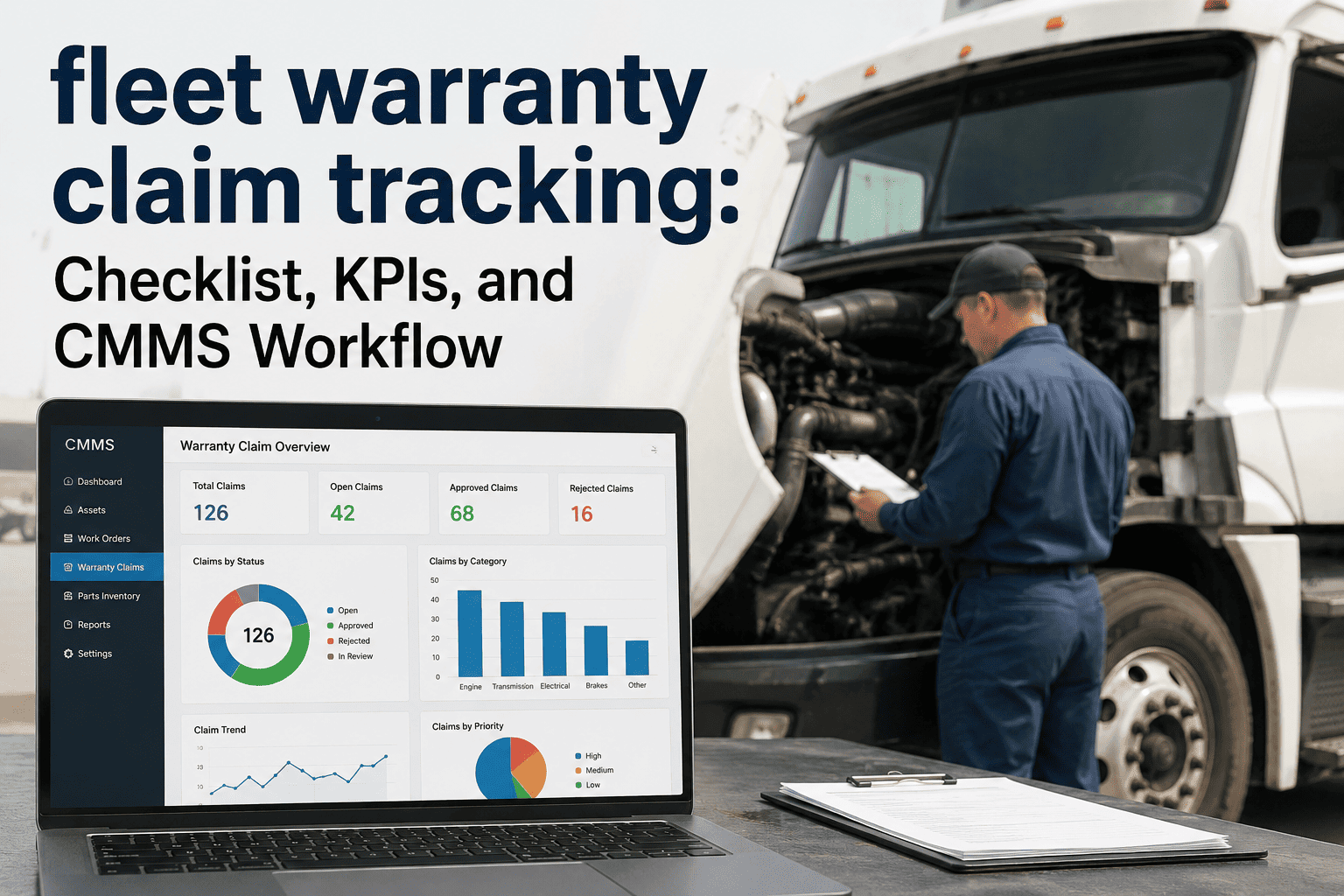
Fleet warranty recovery is one of the most underperformed cost-recovery levers in vehicle maintenance — fleets without structured tracking recover less than 30% of claimable repair costs, while operators on digital warranty platforms consistently recover 85–95% of eligible reimbursements. The gap is rarely about coverage existing; it is about whether anyone checked the warranty status before approving the work order. A $4,200 transmission replaced at 86,000 miles on a vehicle with 100,000-mile powertrain coverage goes to the repair budget because no one verified the warranty was still active. Every component on a modern truck carries up to eight overlapping warranties — basic, powertrain, emission, extended service contract, tire, aftermarket — each with separate mileage and calendar limits that expire silently. Sign Up Free to auto-flag every claimable repair, or Book a Demo to see live coverage mapping in action.
Auto-Flag Every Claimable Repair at Work Order Creation
Oxmaint maps every vehicle's warranty coverage against mileage and date, flags qualifying repairs the moment a work order is opened, attaches OEM-required documentation automatically, and tracks every claim from submission to reimbursement — turning a leaky cost centre into a measurable revenue recovery operation.
The 5-Stage Warranty Claim Lifecycle
A warranty claim is not a single event — it is a five-stage workflow where missing any stage either delays reimbursement or kills the claim entirely. Most claim denials happen at Stage 2 or Stage 4, where documentation gaps surface only after the repair is closed and the OEM rejects the submission.
Verify active coverage before approving the repair
Before any work order is authorised, check the vehicle's current odometer reading against every active warranty — basic, powertrain, emission, and any extended service contract. Confirm the failure mode is covered under the specific warranty terms. A failure that occurs at 99,800 miles under a 100,000-mile powertrain warranty is fully claimable; the same failure approved at 100,200 miles is not. Coverage verification at this stage is the single highest-leverage step in the entire warranty programme.
Capture diagnostic and pre-repair evidence digitally
Photograph the failed component in place. Record fault codes from the diagnostic scan. Document odometer reading, in-service date, last PM service interval, and the technician's failure-mode assessment. OEMs reject claims on missing evidence more often than on actual ineligibility. Digital capture at the work order level — rather than retrospective document hunting — converts most marginal claims into approved ones.
Obtain OEM pre-authorisation for major repairs
Most heavy-duty OEMs require pre-authorisation for repairs above a dollar threshold, typically $1,500–$3,000 depending on the brand. Performing the repair first and seeking reimbursement later usually results in a denied claim regardless of coverage validity. Pre-authorisation also confirms the OEM's approved parts list and labour time allowance before the technician begins work.
Submit claim with VMRS-coded line items within window
File the claim through the OEM's portal within the prescribed window — usually 30 days from repair completion, sometimes as short as 7. Submit with VMRS-coded line items, replaced part numbers, technician identification, and the full diagnostic evidence pack. Claims submitted late or with missing VMRS coding are the second most common rejection category after coverage misses.
Track recovery against repair cost and close the loop
A submitted claim is not a recovered claim. Track every claim through OEM review, parts return verification, approval, and credit posting. Reconcile recovered amounts against original repair costs and surface partial reimbursements for follow-up. Without recovery tracking, the warranty programme has no visible ROI and is the first cost-recovery function cut during budget reviews.
Warranty Coverage Matrix — What's Active on Your Fleet
Modern fleet vehicles carry simultaneous overlapping warranty coverages, each governing different components with different expiration triggers. Mapping all coverages against actual mileage and age is the foundation of any recovery programme.
| Warranty Type | Typical Coverage Window | Components Covered | Claim Frequency |
|---|---|---|---|
| Basic Bumper-to-Bumper | 36 mo / 36,000 mi | Most mechanical and electrical failures | Highest — most likely to be missed when it expires before powertrain |
| Powertrain | 60 mo / 100,000 mi | Engine, transmission, driveline components | Highest value — transmission claims can reach $4,000–$8,000 |
| Emission Component | 60 mo / 100,000 mi (federal) | Catalytic converter, EGR, DPF, sensors | High — frequently confused with main powertrain coverage |
| Extended Service Contract | Up to 10 yr / 1M mi | Negotiated — varies by contract terms | Variable — terms often unclear at shop level |
| Tire | Mileage or tread depth based | Manufacturing defects, premature wear | Often overlooked — small per-claim but high volume |
| Aftermarket Parts | 12–24 mo from install | Replacement parts installed during repair | Most missed — no central record of install date |
Warranty Tracking Audit Checklist
Use this checklist quarterly to audit warranty capture across the fleet. Each gap discovered is a recoverable cost that can be addressed before the coverage window closes. Sign Up Free to run this audit digitally against every asset in your fleet.
Every vehicle has all active warranty types mapped against current mileage
Confirm each asset record shows basic, powertrain, emission, and extended service contract status with mileage-remaining and date-remaining for each. Missing or incomplete coverage records mean the warranty check at work order creation is impossible. Critical gap
Work order creation triggers automatic warranty status check
Every new work order should auto-flag the asset's active warranty coverage. Technicians and service writers receive a warranty alert before approving the repair — not after the parts are installed. This single workflow change converts the largest share of historical denials. Critical workflow
VMRS coding applied to every claim line item
VMRS system, assembly, and component codes are mandatory on most OEM claim portals. Work orders without VMRS coding are rejected at submission or require manual coding before resubmission, wasting administrator hours. Process defect
Pre-authorisation obtained for repairs above OEM threshold
Confirm every repair above the OEM's pre-authorisation threshold has a documented authorisation number attached before parts are ordered. Post-hoc authorisation requests on completed repairs are denied at near 100% rate by most OEMs. Critical step
Claim submission completed within OEM window — typically 30 days
Track claim submission age against the OEM's filing window. Most warranty administrators have a backlog of 60+ day claims that have expired the filing window and become unrecoverable. A 30-day SLA on submission preserves the full claim value. Time-bound
Failed parts retained for OEM return inspection
Many OEMs require physical return of the failed component for inspection before approving the claim. Discarded parts mean an automatic denial regardless of documentation quality. A tagged parts retention bin tied to claim numbers prevents this entire category of denial. Evidence gap
Maintenance compliance documentation available to support claim
OEMs deny claims when the fleet cannot show the vehicle was maintained to the prescribed PM schedule. A missed oil change can void the powertrain warranty entirely. Digital PM records linked to the asset provide instant compliance evidence at claim submission. Critical evidence
Recovery tracked against repair cost in monthly P&L
Reconcile every claim's recovered amount against the original repair cost. Surface partial reimbursements and denied claims for follow-up or appeal. Without recovery tracking, the warranty function shows no measurable ROI and gets defunded in the next budget cycle. Reporting gap
KPIs Every Fleet Warranty Programme Must Track
Claim Recovery Rate
Total recovered dollars divided by total claimable dollars. Industry baseline is 30–50% for manual programmes; mature digital programmes deliver 85–95%. Below 70% indicates a workflow problem, not a coverage problem.
Claim Submission Cycle Time
Days between repair completion and claim filed with the OEM. Best-in-class fleets file within 5–7 days; struggling programmes average 30+ days. Cycle time directly predicts whether claims fall outside the filing window and become unrecoverable.
First-Pass Approval Rate
Percentage of claims approved without rework or resubmission. A low first-pass rate indicates documentation gaps in the submission workflow. Mature programmes target 80%+ first-pass approval to keep administrative cost per claim under control.
Coverage-Mapped Asset Coverage
Share of fleet assets with complete warranty coverage profiles loaded. A fleet at 70% coverage mapping is leaving 30% of assets exposed to silent expiration losses. Target is 100% within 30 days of any new vehicle hitting service.
Before Oxmaint, our warranty team was a single administrator with a spreadsheet trying to chase claims a week after the work order closed. Half the time the diagnostic photos were missing, half the time the VMRS codes were wrong, and at least a quarter of the time we missed the filing window completely. After switching to digital tracking with coverage flags at work order creation, our recovery rate moved from around 42% to over 88% in two quarters. The recovered dollars paid for the platform in the first month.
Frequently Asked Questions
Industry data places warranty-recoverable cost at 8–20% of total fleet repair spend. Most fleets capture only 30–50% of that recoverable pool because of missed coverage checks, late filings, and documentation gaps. Closing that gap with Oxmaint's digital warranty tracking typically delivers 85–95% capture.
When a work order is opened against any vehicle, Oxmaint checks the active warranty coverage records (basic, powertrain, emission, extended) against the current odometer reading and flags any covered failure mode before the repair is authorised — preventing out-of-pocket payment on claimable work.
VMRS coding is the OEM industry-standard language for failure modes, components, and reasons for repair. Most OEM claim portals reject submissions without proper VMRS coding. Book a Demo to see Oxmaint's auto-VMRS coding workflow that eliminates manual code lookup at submission.
Filing windows vary by manufacturer but commonly range from 7 to 30 days after repair completion. Claims submitted outside the window are denied regardless of coverage validity. Digital tracking with submission SLA alerts is the most reliable way to preserve the full claim value.
Yes. OEMs frequently deny powertrain and emission warranty claims when the fleet cannot show the vehicle was maintained to the prescribed PM schedule. Digital PM records linked to each asset are the strongest defence against this denial category at claim review.
Stop Leaving Warranty Money on the Table
Oxmaint maps every vehicle's warranty coverage, flags claimable repairs at work order creation, attaches OEM-required documentation, and tracks recovery against repair cost — turning warranty tracking from a deferred admin task into a measurable revenue function. Start free in minutes, or book a 30-minute walkthrough.