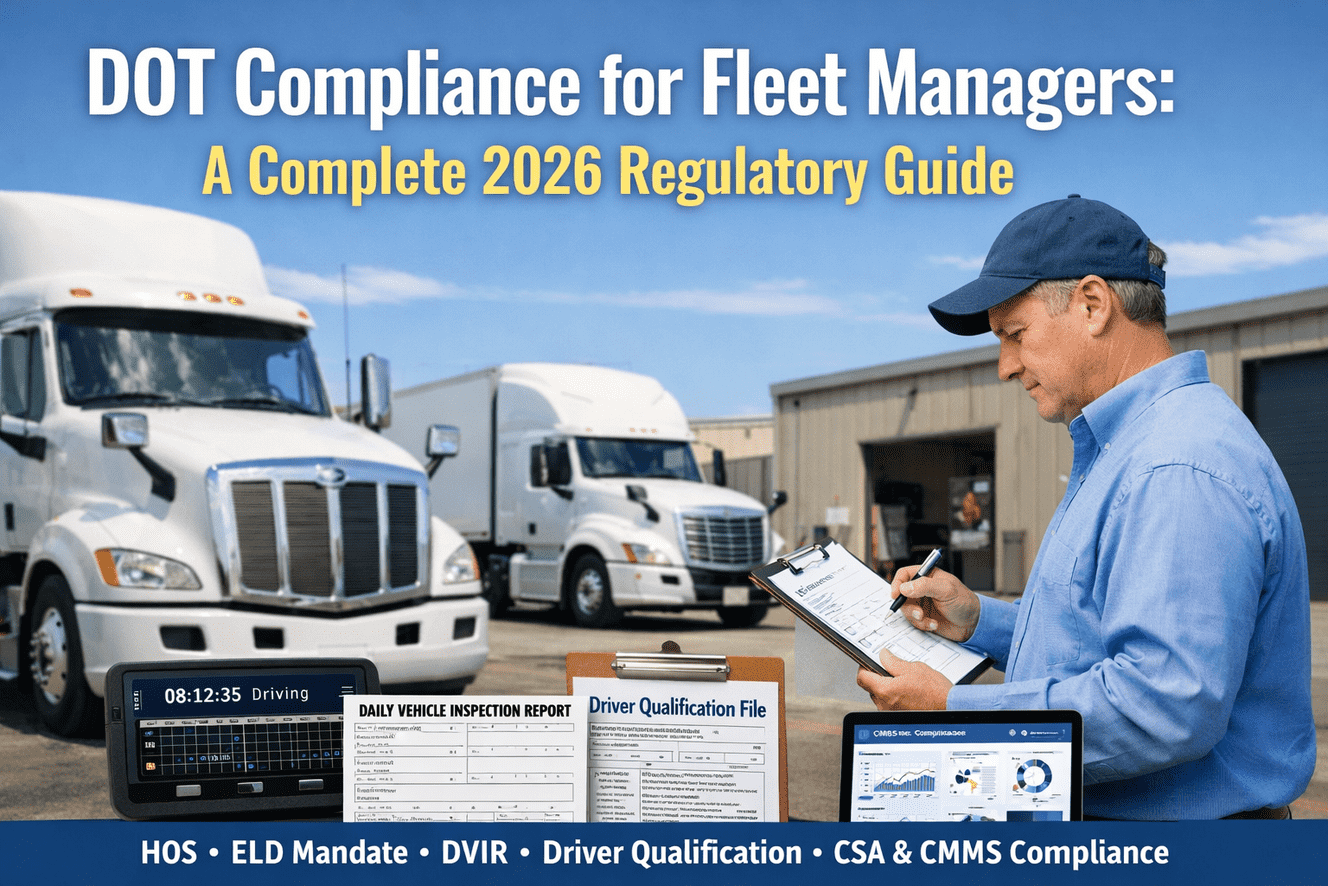
Your CSA BASIC score is the single most visible safety metric the FMCSA uses to decide whether your fleet gets a warning letter, an onsite investigation, or a full compliance review that can take trucks off the road for weeks. Managing CSA scores proactively — before they cross the 65th-percentile intervention threshold — is what separates carriers that keep moving from carriers that lose shippers, pay surging insurance premiums, and face escalating enforcement. This fleet CSA score guide breaks down the post-2026 SMS overhaul, the eight BASIC categories, the intervention ladder, and exactly how to keep every percentile below the review-trigger line. Ready to stop tracking violations on spreadsheets? Start Free Trial and let OxMaint pull your SMS data automatically.
CSA SCORE MANAGEMENT GUIDE
Is one rising BASIC percentile about to park your fleet?
Scores above 65% trigger FMCSA intervention. Without a system to track inspections, challenge violations, and close DVIR defects before dispatch, a single bad month can spiral into a compliance review — costing weeks of revenue and shipper contracts.
FLEET CSA 2026 FRAMEWORK
What changed in the February 2026 CSA SMS overhaul
The FMCSA's Compliance, Safety, Accountability system scores carriers across seven safety behavior categories using 24 months of roadside inspection and crash data. In February 2026, FMCSA split the Vehicle Maintenance BASIC into two distinct categories — recognizing that a violation a driver should have caught during a pre-trip walkaround is fundamentally different from a defect found only during a Level I inspection.
Speeding, reckless operation, following too close, and inattention violations.
Driving beyond limits, false logs, and missing time records.
Unlicensed, disqualified, or medically unqualified driver operation.
Positive drug or alcohol tests and refusal to test violations.
Defects found during full mechanical inspections (brakes, lights, suspension).
Defects a driver should have caught during a pre-trip DVIR walkaround.
Improper placarding, packaging, or loading of hazmat shipments.
Frequency and severity of reportable crashes weighted by preventability.
INTERVENTION LADDER
How elevated CSA scores trigger a compliance review
A fleet CSA score doesn't just sit on a dashboard — it drives a cascading enforcement process. Each BASIC produces a percentile comparing your carrier to peers in the same safety event group. Once you cross the threshold, FMCSA intervention escalates predictably, and the consequences compound rapidly across your operations.
Warning Letter
FMCSA issues a formal warning letter to the carrier. The carrier's score is now visible to shippers and insurance underwriters, many of whom refuse to load or rate fleets with any BASIC over 65%.
Offsite Investigation
FMCSA requests documents, records, and corrective action plans remotely. Carriers must produce HOS logs, maintenance records, and driver qualification files within strict deadlines — often 48 to 72 hours.
Onsite Investigation
Federal investigators arrive at your terminal. Operations are disrupted for days as auditors review every record. Findings can result in immediate out-of-service orders for vehicles or drivers.
Compliance Review & Unfit-to-Operate
The final escalation: a full compliance review that can suspend your operating authority. Fleets face weeks off the road, lost contracts, and in severe cases, forced shutdown. Recovering from this level takes months.
THE COMPOUNDING COST
Why an elevated fleet BASIC score keeps getting worse
A high CSA score creates a negative feedback loop: elevated percentiles trigger more frequent CVSA roadside inspections, which produce more violations, which push your score even higher. By the time a carrier notices the trend on the public SMS website, the damage is already compounding across three critical business areas.
Insurance Premium Spiral
Underwriters pull SMS data at renewal. Many reject any carrier with a BASIC above 65%, forcing fleets into high-risk surplus lines at 30–60% higher premiums. A single elevated HOS or Unsafe Driving percentile can add $150K+ annually to a 100-truck fleet's coverage.
Shipper Contract Loss
Major shippers and brokers enforce CSA score cutoffs in their carrier onboarding agreements. A fleet BASIC score above a shipper's threshold — often 60% for HM or 70% for general freight — means immediate load refusal. Losing a top shipper can erase $2M+ in annual revenue overnight.
Inspection Frequency Surge
Elevated CSA scores flag your trucks in roadside enforcement systems. CVSA officers target high-score carriers, pulling drivers in for Level I inspections at 2–3x the normal rate. More inspections mean more violations discovered, feeding the cycle and pushing percentiles higher each month.
A 120-power-unit regional fleet saw its Vehicle Maintenance BASIC jump from 58% to 72% in a single quarter after a burst of brake-adjustment violations. Within 60 days: insurance renewal jumped $180K, two national shippers suspended loading, and roadside inspection frequency doubled. The root cause? DVIR defects that were logged on paper but never closed before dispatch — exactly what the new "Driver Observed" BASIC now penalizes.
CSA SCORE MANAGEMENT CHECKLIST
How to manage CSA BASIC scores before they trigger a review
Proactive CSA score management means closing the loop on every data point the FMCSA uses against you. These four disciplines, tracked systematically, keep every BASIC percentile below the intervention line and give you the audit trail needed to challenge incorrect violations.
Track & Challenge Every Inspection
- Log every roadside inspection outcome in a central system within 24 hours
- Review each violation for accuracy — officer errors are common and challengeable
- File DataQs challenges on incorrect violations before the 30-day evidence window closes
- Track challenge status through to resolution and SMS score recalculation
Close DVIR Defects Before Dispatch
- Require driver pre-trip DVIRs on every unit, every trip — no exceptions
- Flag any defect as a hold on dispatch until a mechanic signs off the repair
- Trend repeat defects by unit to identify chronic maintenance lemons
- Eliminate the "Driver Observed" violations that now carry their own BASIC weight
Engineer HOS Schedules That Comply
- Audit driver HOS logs weekly for 11-hour, 14-hour, and 70-hour violations
- Identify routes and lanes that systematically produce log form-and-manner errors
- Coach drivers on edge cases before violations appear at roadside
- Maintain ELD exemption documentation and malfunction reporting protocols
Maintain D&A Program Compliance
- Track pre-employment, random, post-accident, reasonable suspicion, and return-to-duty tests
- Monitor the Clearinghouse for prohibited drivers before each dispatch
| BASIC Category | Intervention Threshold | Primary Data Source | Quickest Win |
|---|---|---|---|
| Unsafe Driving | 65% | Speeding & reckless citations | Speed limiter enforcement |
| HOS Compliance | 65% | Roadside ELD checks | Weekly log audits |
| Driver Fitness | 65% | License & med-card checks | DQ file automation |
| Controlled Substances | 60% | Clearinghouse & test results | Pre-dispatch eligibility check |
| Vehicle Maintenance | 65% | Level I inspection defects | Predictive PM scheduling |
| VM: Driver Observed | 65% | DVIR & walkaround defects | Defect-hold dispatch rule |
| Hazmat Compliance | 60% | Placard & shipping papers | Pre-trip hazmat checklist |
| Crash Indicator | 65% | Reportable crash records | Preventability reviews |
HOW OXMAINT HELPS
CSA score tracking built into your maintenance workflow
OxMaint is an AI-powered CMMS and EAM platform that treats CSA compliance as a maintenance problem — because most BASIC violations trace back to equipment condition, DVIR discipline, and dispatch decisions. Instead of pulling SMS data manually and chasing paper DVIRs, OxMaint connects the dots automatically so you catch score-driving defects before a roadside inspector does.
Automated SMS Score Sync
OxMaint pulls your carrier SMS data automatically and drills through every percentile to the underlying roadside violations. No more logging into the FMCSA portal monthly — see every BASIC score and the specific inspections driving it on one dashboard.
DVIR Defect Hold on Dispatch
Driver pre-trip DVIRs flow directly into OxMaint work orders. Any logged defect automatically places a hold on that unit's dispatch until a mechanic closes the repair ticket — eliminating the "Driver Observed" violations that FMCSA now scores separately.
DataQs Challenge Tracking
When OxMaint flags an incorrect roadside violation, it generates a DataQs challenge record with evidence attachments, submission tracking, and deadline alerts. You'll never miss a challenge window or lose track of a contested violation's resolution status.
Predictive PM Scheduling
OxMaint's AI analyzes inspection history and work-order data to predict component failures before they become roadside violations. Brake, tire, and lighting PMs are scheduled automatically based on wear patterns — not arbitrary mileage intervals — keeping the Vehicle Maintenance BASIC low.
See OxMaint catch your CSA violations before FMCSA does
Book a 30-minute demo and we'll show you exactly how OxMaint pulls your SMS data, automates DVIR defect holds, and tracks DataQs challenges — all on your own assets.
FAQ
CSA BASIC score management — common questions
What is a good CSA BASIC score for a fleet?
A good CSA BASIC score is anything below the 50th percentile, which means your fleet has fewer violations than half of carriers in your safety event group. Scores between 50% and 64% are acceptable but trending toward risk; once any BASIC reaches 65% (or 60% for Hazmat and Passenger), FMCSA intervention begins. Most shippers and insurers prefer to see all BASICs below 60%.
How often are CSA BASIC scores updated?
The FMCSA updates CSA SMS scores once per month, typically on the first or second Monday. Each score reflects the most recent 24 months of roadside inspection and crash data, with more recent violations weighted more heavily. Carriers should monitor their scores monthly and review any percentile that moves more than 5 points in a single update — you can automate this by pulling SMS data into OxMaint for continuous tracking.
What happens when a fleet CSA score exceeds the intervention threshold?
When a BASIC percentile exceeds 65% (or 60% for HM/Passenger), FMCSA sends a warning letter and the carrier becomes visible on the public SMS site with an "alert" symbol. From there, intervention can escalate to an offsite investigation, an onsite investigation, and ultimately a compliance review that can suspend operating authority. Each escalation level requires more documentation, more corrective action, and more downtime.
Can you challenge incorrect CSA violations on your score?
Yes — carriers can challenge incorrect roadside inspection violations through the FMCSA DataQs system within a specific evidence window. If the challenge is approved, the violation is removed and your BASIC score is recalculated at the next monthly update. OxMaint tracks each DataQs challenge from submission through resolution, including evidence attachments and deadlines, so no challenge window is missed.
What changed in the CSA SMS overhaul in February 2026?
In February 2026, FMCSA split the Vehicle Maintenance BASIC into two separate categories: "Vehicle Maintenance" (defects found during full mechanical inspections) and "Vehicle Maintenance: Driver Observed" (defects a driver should have caught during a pre-trip DVIR walkaround). This means carriers are now scored on whether drivers are actually performing and acting on pre-trip inspections — making DVIR discipline a directly scoreable safety behavior for the first time.
Stop guessing. Start managing your CSA scores.
Join the fleets using OxMaint to track every BASIC, close every DVIR defect, and challenge every incorrect violation — all in one AI-powered platform built for maintenance and reliability teams.
Free 14-day trial · No credit card