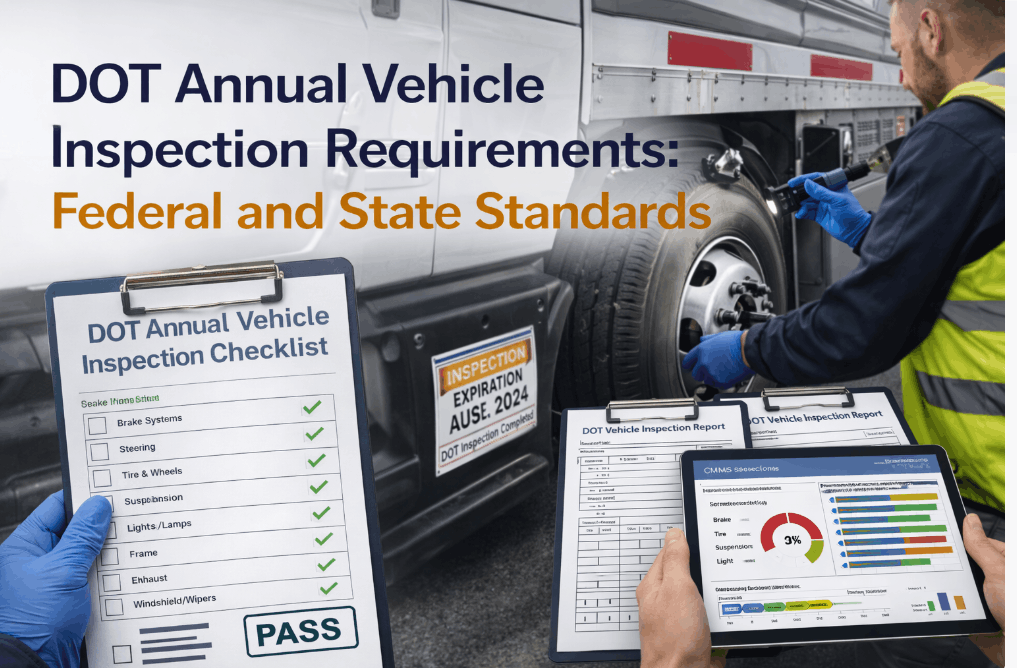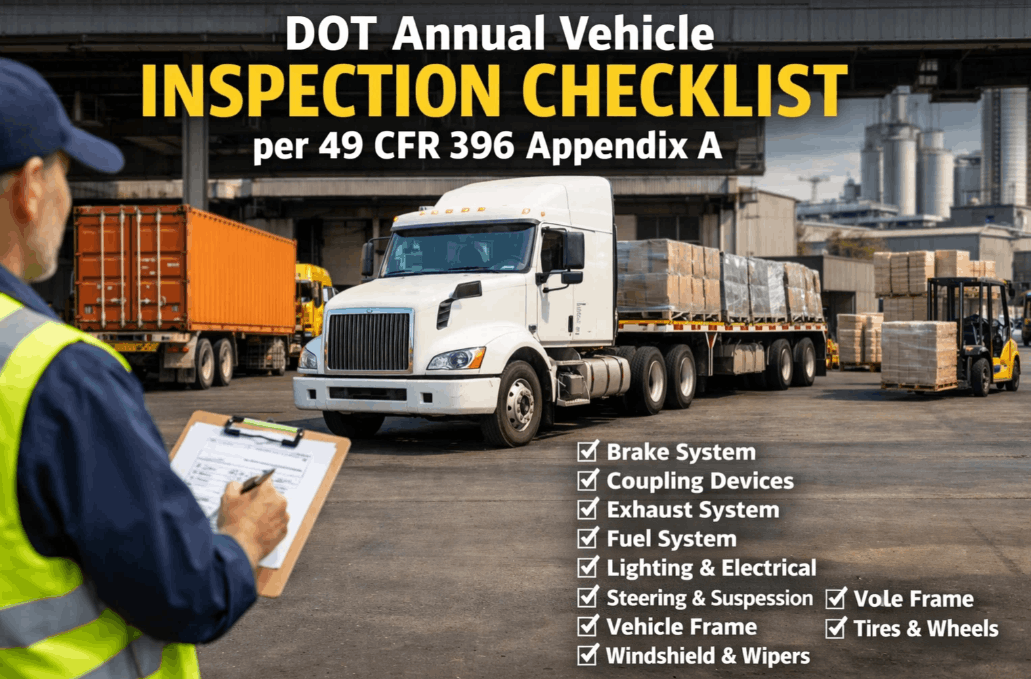
Every commercial motor vehicle operating in interstate commerce must pass a full DOT annual inspection under 49 CFR Part 396 Appendix A — covering all 13 prescribed categories — before an Annual Inspection Certificate can be issued. A single out-of-service finding removes the vehicle from service until corrected and re-inspected. This is not a driver walk-around: it is a measured, documented technical assessment against specific federal acceptance standards. Oxmaint digitises every Appendix A category into a guided inspection workflow with auto-generated audit-ready records retrievable in seconds during any DOT compliance review.
13 Appendix A Categories — Inspection Scope at a Glance
49 CFR 396 Appendix A defines exactly which systems must be inspected, what the acceptance criteria are, and which findings trigger an out-of-service order. Every category below must be completed — there is no partial annual inspection. A vehicle with 12 categories passed and one skipped does not have a valid inspection certificate.
How Technology Is Upgrading DOT Annual Inspection Programmes
The DOT annual inspection is a legal requirement — but it is also an opportunity. Fleets that connect their inspection programme to AI-assisted tools and CMMS platforms turn the annual event into a predictive intelligence exercise that flags developing faults months before they become roadside OOS citations. Oxmaint integrates all four technologies into a single annual inspection workflow.
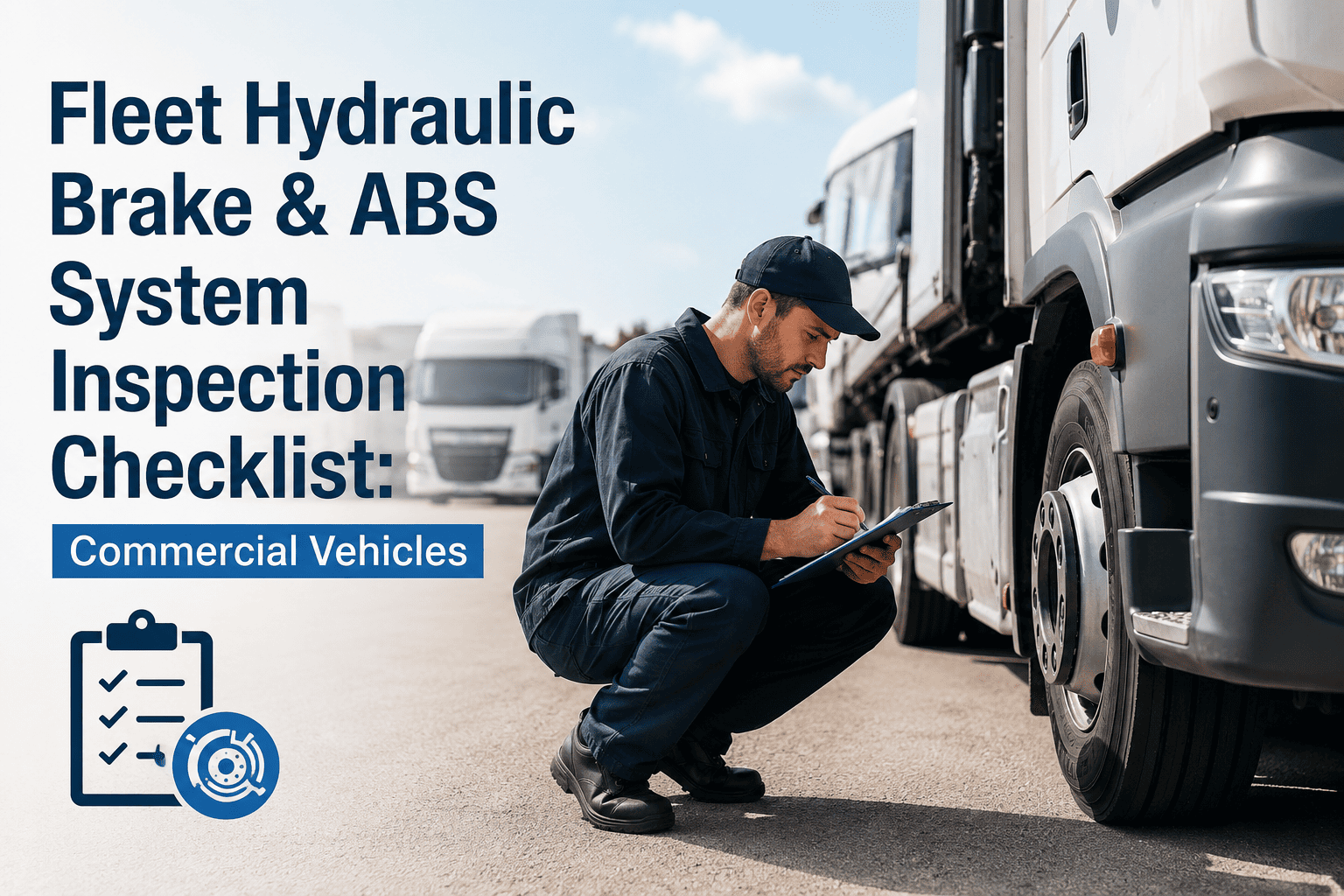
1. Brake System Inspection Checklist
The brake system is the single most cited OOS category at DOT annual inspections — cited in 58% of all OOS orders. Appendix A requires inspection of every brake component on every axle. There is no sampling or representative axle approach — every wheel position must be individually verified. Track brake inspection findings and corrective work orders with Oxmaint.
Brake lining and pad thickness — all axles, all wheels
Measure lining thickness at each wheel position. OOS criteria: 1/4" or less on non-steering axles; 1/8" or less on steering axles. Visual estimation is not acceptable under Appendix A — caliper measurement required at each position with result recorded per axle. OOS — at/below limit
Brake drums and rotors — cracking, scoring, and thickness
Inspect for cracks, heat checks, and severe scoring. Measure drum or rotor thickness — below manufacturer minimum is OOS. A drum with a crack extending to the friction surface is OOS regardless of thickness measurement. OOS — cracked or below min
Air brake system — pressure build, hold, and governor
Primary and secondary circuits must build to governor cut-out (120–135 psi). Hold test: pressure loss must not exceed 4 psi/min on single vehicles or 6 psi/min on combination vehicles with brakes unapplied. Low-air warning must activate above 60 psi. OOS — fails hold test
Brake pushrod stroke — all chambers measured
Measure pushrod stroke at all brake chambers with brakes applied at 90 psi. Any chamber at or beyond the applicable readjustment limit (varies by chamber size — see Appendix A Table) is OOS. This is the most frequently missed measurement in annual inspections. OOS — at readjustment limit
Brake hoses, lines, and fittings — all axles
Inspect for cracking, chafing, collapse under pressure, and leaks audible at any connection. Any brake hose that is abraded to the reinforcement layer is OOS. Check glad hand seals and locking rings on combination vehicles at every trailer connection point. OOS — audible leak
Spring brakes and parking brake — hold test
Apply parking brake and attempt to move vehicle under power. Vehicle must hold on a 20% grade. For spring brake vehicles, verify spring brake application occurs when air pressure drops to 20–45 psi range and that spring brakes cannot be manually caged with a defective hold-off system. OOS — fails hold
ABS malfunction lamp — function test
Cycle ignition — ABS warning lamp must illuminate and extinguish on self-test completion. Any ABS fault code stored in the ECU that prevents the ABS lamp from extinguishing is a defect requiring investigation. ABS lamp remaining on at road speed indicates an active fault. Defect — lamp stays on
AI Camera Vision tip: Automated brake lining thickness measurement systems capture all wheel positions in a single drive-through pass — eliminating the per-wheel caliper measurement that accounts for up to 35% of total annual inspection time on multi-axle commercial vehicles. See how Oxmaint integrates AI brake measurement into digital inspection records.
2. Coupling Devices, Exhaust and Fuel System Checklist
Coupling device failures at highway speed are not survivable. Exhaust and fuel system defects are fire and carbon monoxide hazards. Appendix A inspection standards for these three categories are written around catastrophic failure modes — not routine maintenance — and OOS criteria reflect that severity.
Fifth wheel — locking mechanism, mounting, and wear
Inspect locking mechanism in both locked and unlocked positions. Measure kingpin-to-jaw play — maximum 1/2" under §393.70. Check all mounting bolts are present, tight, and free from cracks in the mounting bracket. Any cracked mounting bracket is OOS. OOS — cracked bracket
Pintle hooks, drawbars, and safety chains
Inspect hook latch for positive lock and wear beyond manufacturer specification. Check drawbar eyes for cracks or elongation at the pin bore. Safety chains must have no broken links, hooks must not be deformed, and chain must be of adequate strength for the rated combination. OOS — positive lock failure
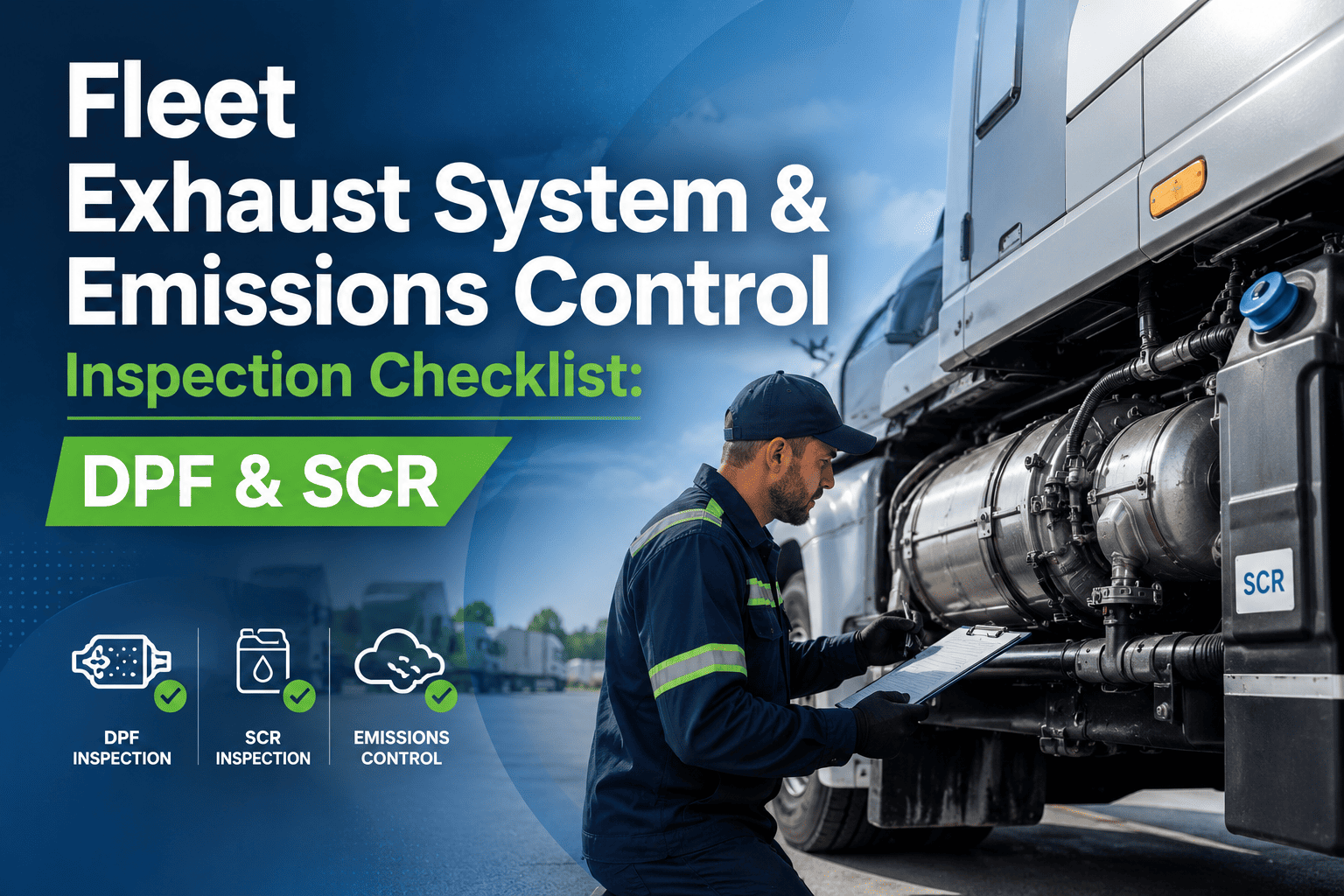
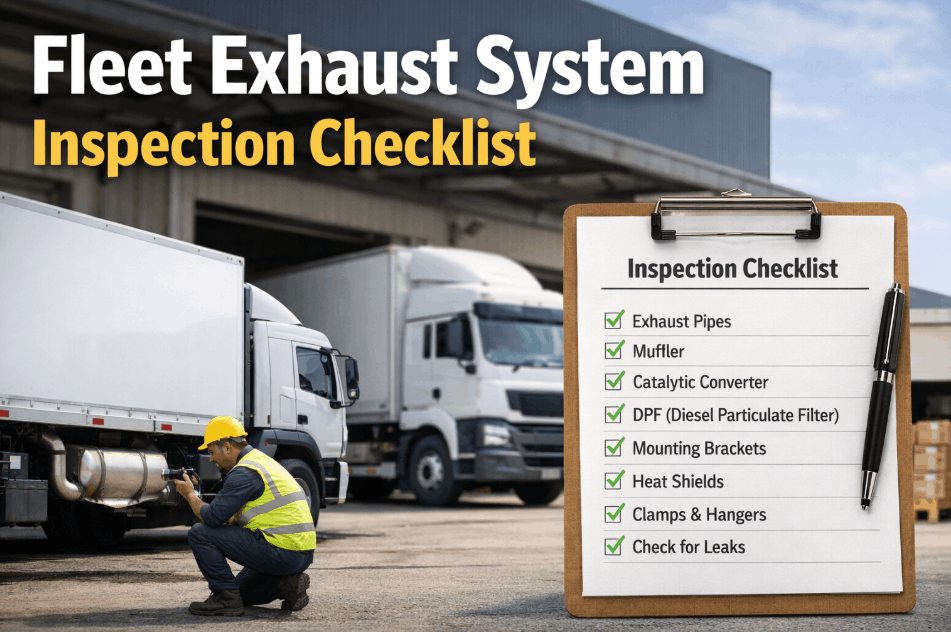
Exhaust system — leaks, routing, and proximity to fuel
Inspect manifold, pipes, flexible sections, muffler, and DPF for leaks, cracks, and loose connections. No exhaust gas leaks inside the cab or in locations within 6" of fuel lines, tanks, or brake hoses. Any exhaust leak into the cab is OOS under Appendix A — carbon monoxide poisoning risk. OOS — cab leak
Fuel system — tank mounting, cap, and lines
Fuel tank must be securely mounted with all straps and mounting hardware intact. Filler cap must seal fully. Inspect all fuel lines for chafing, corrosion, or leaks — any fuel leak at a fitting, seam, or line is OOS regardless of leak rate. Fuel contact with hot exhaust is a direct fire ignition source. OOS — any fuel leak
3. Lighting Devices and Safe Loading Checklist
The annual lighting inspection covers every lamp required by 49 CFR Part 393 — not just the lamps drivers check on pre-trip. Appendix A requires every circuit to be verified operational, not just checked for physical presence. Safe loading inspection covers cargo securement hardware and trailer body integrity that affects both cargo protection and road safety. Log lighting and loading defects into Oxmaint work orders automatically from the inspection screen.
Headlights — both beams, both sides, correct aim
Both headlamps must illuminate on low and high beam. Aim must be within DOT specification — horizontally and vertically. Headlamps that are aimed significantly above horizontal are OOS at annual inspection. Check for cracked or moisture-filled lenses that degrade beam pattern. OOS — aim violation
Stop lamps, turn signals, and hazard flashers
All stop lamps must illuminate on brake application. Turn signals must flash at 60–120 flashes per minute on both sides. Hazard flashers must operate independently. A single inoperable stop lamp is OOS. Check trailer electrical connection is supplying all circuits correctly. OOS — any stop lamp
Clearance, marker, and identification lamps
All required amber front and red rear clearance lamps must illuminate. Identification lamps (3 amber front, 3 red rear) required on vehicles over 80" wide. Side marker lamps must illuminate. Cracked or missing lamp lenses that allow water ingress are defects requiring correction. Defect — inoperable lamp
Cargo securement — anchor points, tie-downs, and blocking
Inspect all cargo anchor points for cracks, deformation, or pulling free from the floor or wall. Tie-down hardware must have rated capacity markings present and legible. Working load limit of tie-down system must meet the aggregate weight of the cargo being secured per FMCSA §393.100. OOS — insufficient securement
Trailer doors, hinges, and latches
Cargo doors must latch and lock fully on both sides. Hinges must not be cracked, missing, or deformed. A cargo door that cannot be latched securely is a safe loading OOS finding — an unlatched door at highway speed creates debris and secondary collision risk for following traffic. OOS — unlatching door
4. Steering Mechanism and Suspension Checklist
Steering and suspension defects are the third and fourth most common OOS categories at DOT annual inspections. The Appendix A criteria for these categories require physical measurement — not visual assessment alone — of play, wear, and structural integrity at each component.
Steering wheel free play — measured with engine running
Measure free play with front wheels straight ahead, engine running, and power steering active. OOS limits: 2" on a 20" wheel for vehicles with power steering; 4.5" without. Any looseness in the steering column or U-joints felt before the wheels respond is additional free play that must be included in the measurement. OOS — above limit
Steering gear — mounting, backlash, and power steering
Check steering gear box mounting — no loose bolts, no cracks in mounting bracket. Verify no excessive backlash in the gear box itself. Check power steering fluid level and belt. Inspect power steering hoses for bulging or leaks — a leaking power steering hose that causes sudden loss of assist is an OOS condition. OOS — broken mounting
Tie rod ends, drag link, and ball joints
Check all steering linkage components for looseness by grasping each and applying force in multiple directions. Any perceptible looseness in a tie rod end or ball joint that is not within manufacturer specification is OOS. Torn ball joint boots that have allowed water and debris ingress require immediate replacement regardless of measured play. OOS — perceptible looseness
Leaf springs and spring hangers
Inspect all leaf spring packs for cracked, broken, or missing leaves. Check U-bolts for tightness — loose U-bolts allow axle wrap and axle shift under braking. Spring hangers with cracks in the frame at the mounting point are OOS — the frame finding and the suspension finding are both cited. OOS — broken leaf
Air ride suspension — bags, lines, and height control
Inspect air bags for cuts, abrasion, or deflation. Check air lines for chafing and connections for leaks. Verify height control valve maintains correct ride height within 1" of specification at static loaded condition. A deflated air bag causing the vehicle to rest on the jounce bumper is OOS. OOS — deflated bag
Torque rods, radius rods, and axle alignment
Check torque rod bushings for wear, cracking, or complete failure — a failed torque rod allows the axle to rotate under braking, causing brake application angle changes. Measure axle alignment if torque rod wear is detected. Any axle misalignment exceeding manufacturer specification requires correction before certification. Defect — worn bushings
Digital Twin tip: A vehicle's digital twin that continuously ingests steering torque sensor data and suspension load cell readings can identify a developing steering or suspension fault 6–8 weeks before it reaches the OOS threshold — allowing pre-inspection remediation that prevents annual inspection failures entirely. See Oxmaint's predictive inspection intelligence.
5. Frame, Tires, Wheels and Glazing Checklist
The final four Appendix A categories cover the structural and contact systems that determine whether a vehicle stays on the road under load. Frame failures are catastrophic and often preceded by months of visible corrosion or cracking that structured annual inspection catches before failure. Tire and wheel OOS criteria are among the most precisely defined in Appendix A. Capture tyre and frame measurements digitally in Oxmaint — no paper required.
Frame rails — cracking, corrosion, and deformation
Inspect both frame rails full length for cracks, particularly at cross-member connection points, spring hanger mounting brackets, and any previous repair locations. Severe corrosion that reduces rail section to below 50% of original thickness is OOS. Any crack extending more than 10% of the rail width is OOS regardless of location. OOS — crack over 10% width
Cross-members, body mounts, and sub-frames
Check cross-members for cracks, bowing, and missing fasteners. Body mounts must not be collapsed, cracked, or missing. Any sub-frame or body mount failure that allows the body to move on the frame under load creates a secondary hazard to cargo retention and is a defect requiring repair. Defect — collapsed mounts
Tire tread depth — all positions, all axles
Measure tread depth at the shallowest point in the major tread groove. OOS: 2/32" or less on front steering axle tires; 1/32" or less on all other axle positions. Record measurements per position — not a single average. Two tires on the same axle below the limit doubles the OOS finding severity. OOS — at/below limit
Tire condition — sidewalls, bulges, and recaps on steer axle
Any sidewall bulge, exposed cords, or boot repair is OOS regardless of tread depth measurement. Regrooved tires on the steering axle are OOS under §393.75. Check inflation pressure — a tire under-inflated by more than 50% of its rated cold pressure is OOS. OOS — bulge or exposed cord
Wheel and rim integrity — cracks and fasteners
Inspect each wheel for cracks in the disc, rim flange, or spoke. Any crack in a wheel that is in the load path is OOS. Check all wheel nuts — missing, loose, or cross-threaded nuts are OOS under Appendix A. Use torque wrench — hand-tight wheel nuts are not acceptable for annual inspection certification. OOS — cracked wheel
Windshield glazing — critical area and obstruction
Inspect the critical area (area swept by wipers, approximately 8.5" × 11" centred on driver's line of sight) for discoloration, vision-reducing damage, or cracks longer than 1/4". Any crack, chip, or discoloration in the critical area that impairs driver vision is OOS under Appendix A. OOS — critical area damage
Windshield wipers — both blades, motor, and wash system
Both wiper blades must make full contact across their sweep area. Torn, hardened, or streaking blades are defects requiring replacement. Wiper motor must operate at all required speeds. Washer system must deliver fluid to the windshield — a non-functional washer system in states with mandatory washer requirements is an OOS finding. Defect — streaking blade
OBD Integration tip: Tyre pressure monitoring system data from TPMS sensors streams via OBD into Oxmaint's vehicle health record continuously — so inspectors arrive at the annual inspection knowing which tyres have shown pressure variance events in the preceding 12 months, directing caliper measurement effort to highest-risk positions first. Book a demo to see year-round tyre monitoring integrated with annual inspection records.
Switching from paper Appendix A inspection forms to Oxmaint cut our annual inspection time per vehicle from 4.5 hours to under 3 hours. The pre-populated categories and digital measurement recording mean our certified inspectors spend their time on the vehicle, not on paperwork — and our first-attempt pass rate went from 71% to 94% because the system flags deferred maintenance that should have been caught months earlier.
DOT Annual Inspection — Compliance Impact Metrics
Fleets using digital Appendix A checklists with CMMS-tracked deferred maintenance pass annual inspection on first attempt at 94%+ vs. 71% industry average.
Digital Appendix A inspection with pre-populated categories and auto-recorded measurements reduces per-vehicle inspection time by 1.5 hours vs. paper forms.
Digital annual inspection records retrievable in 30 seconds during a DOT roadside inspection — vs. the average 22-minute search for paper certificates in multi-vehicle fleets.
Brake system violations account for 58% of all annual inspection OOS orders — the single most effective category to remediate before inspection day using 12-month OBD monitoring data.
Frequently Asked Questions
The most common questions from inspection technicians, fleet managers, and compliance teams about DOT annual inspections and 49 CFR 396 Appendix A requirements.
An inspector must understand the inspection criteria in Appendix A and be capable of performing the inspection. FMCSA does not require a specific certification, but inspectors must have documented training or experience. Third-party inspection facilities and motor carrier mechanics both qualify — the carrier must maintain evidence of the inspector's qualifications.
The completed inspection report must be retained by the carrier for 14 months. The annual inspection certificate (sticker or document) must be carried on or in the vehicle at all times. Digital certificates stored on a mobile device are accepted at roadside inspections provided they are immediately retrievable upon officer request.
Yes — any facility or individual that meets the FMCSA qualification standard can perform the inspection. The carrier is responsible for verifying the inspector's qualifications and retaining documentation. State-run inspection programmes that meet or exceed Appendix A criteria may be used to satisfy the federal annual inspection requirement under §396.23.
The vehicle must be taken out of service until all OOS conditions are corrected and re-inspected. Operating a CMV with a failed or expired annual inspection subjects the carrier to civil penalties up to $16,000 per violation and a negative CSA score impact in the Vehicle Maintenance BASIC that affects roadside inspection selection frequency.
Yes, under §396.23(b), a roadside inspection that meets the criteria of Appendix A and results in an inspection report may be used to satisfy the annual inspection requirement. However, the inspection must cover all 13 Appendix A categories — a North American Standard Level I inspection qualifies; Level II and III do not cover enough categories.
Oxmaint structures all 13 Appendix A categories into a guided digital inspection workflow, captures inspector identification, timestamps every finding, attaches photos to each OOS item, auto-generates repair work orders, and stores the completed inspection record against the vehicle's asset profile — retrievable in seconds during any DOT compliance review or post-accident investigation.

.png)