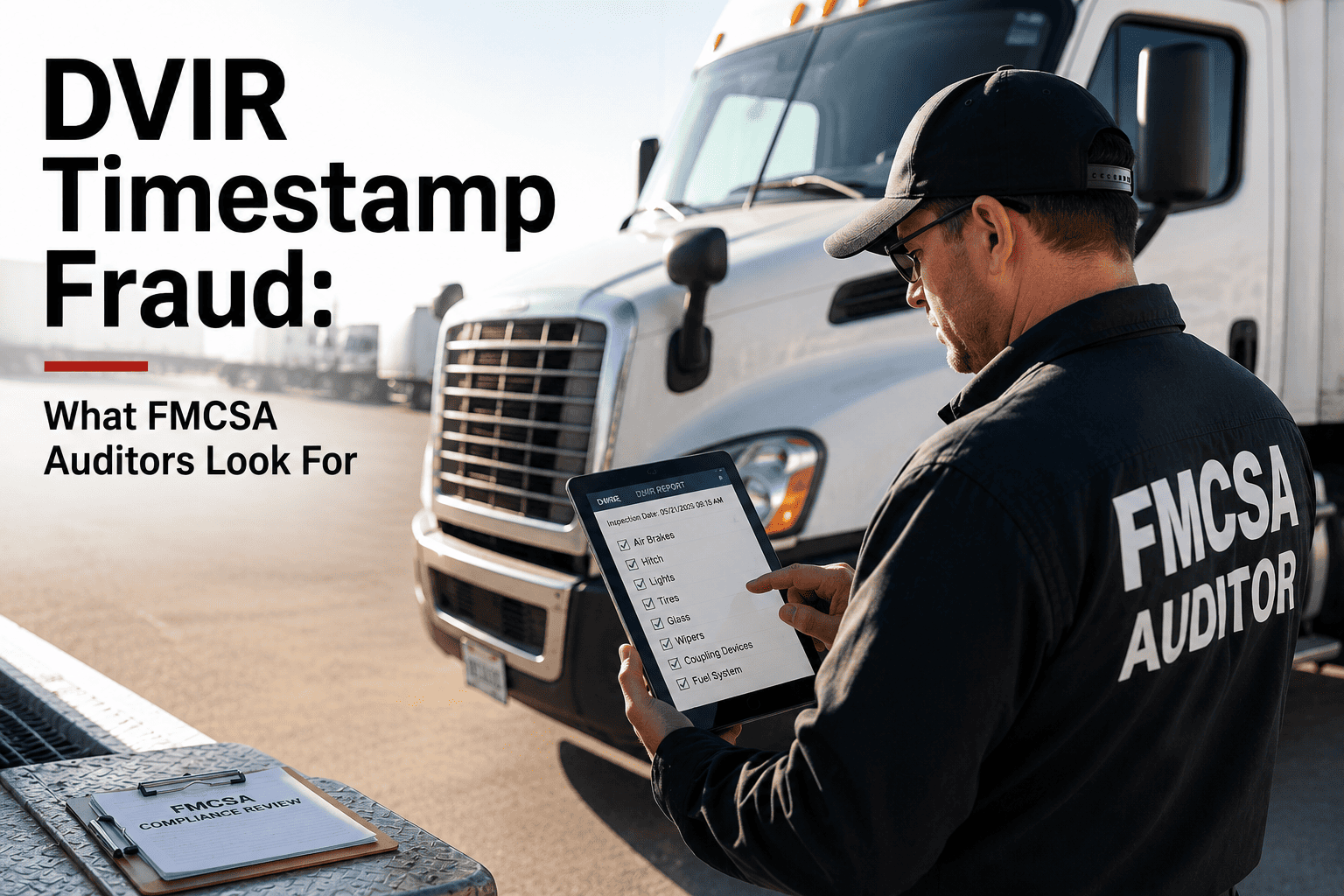
A federally compliant pre-trip inspection takes a driver several minutes to walk a tractor-trailer, check the lights, tires, brakes, and coupling, and log what they find. A 45-second DVIR isn't a fast driver — it's a form filled out while the truck was still parked, and most fleets never catch it until an inspection defect turns into a roadside violation or worse. Below is the pattern of signals that separates a genuine inspection from a pencil-whipped one, the kind of pattern an AI review layer catches automatically instead of an auditor catching it six months later, and you can run this check against your own DVIR history with a free trial.
Your Inspection Records May Already Be Telling You Who's Pencil-Whipping
Most fleets don't discover a falsified inspection until it's too late to matter — a roadside out-of-service order, a post-crash investigation, or an audit that pulls six months of records at once. The timing data that exposes the pattern is already sitting in your DVIR logs. See what your own inspection history shows before an inspector or a claims adjuster finds it for you.
What the Clock Actually Shows
Duration alone won't prove fraud on any single inspection — a driver might genuinely find nothing wrong in under two minutes once in a while. What gives it away is the pattern: the same driver logging the same suspiciously short duration, inspection after inspection, regardless of vehicle condition or weather.
A single 45-second entry might just be a familiar truck and an uneventful morning. The same driver logging that same duration for weeks, on different vehicles and in different weather, is a pattern no honest inspection habit produces on its own.
Six Signals That Flag a Fake Inspection
None of these signals alone is proof. Together, and repeated across a driver's inspection history, they build a pattern that's very hard to explain as coincidence.
Run Your DVIR History Against These Signals
Bring three months of inspection records and we will show you exactly which drivers and vehicles carry a timing pattern worth a closer look, before it shows up on a roadside inspection report.
How the Detection Layer Actually Works
Catching a pencil-whipped inspection isn't about accusing one driver on one bad day — it's about surfacing a pattern early enough that a conversation, not a violation, is what fixes it.
| Data Point | What It's Compared Against | What Triggers a Flag |
|---|---|---|
| Inspection duration | Fleet-wide average for that vehicle class | Repeated durations under a realistic minimum |
| Completion timing pattern | Driver's own inspection history | Suspiciously consistent duration across every log |
| GPS movement | Expected walk-around path around the vehicle | No meaningful location change during the window |
| Photo checkpoints | Required capture points for that inspection type | Skipped, missing, or visibly reused images |
| Defect rate | Vehicle's actual maintenance and repair history | Zero-defect streak on a vehicle with known issues |
| Post-inspection outcomes | Roadside inspections and breakdown reports | Defect surfaces that a clean DVIR missed |
What a Missed Pattern Actually Costs
A pencil-whipped inspection rarely stays a paperwork issue. Left uncaught, it tends to surface later in one of these three places, usually at a worse moment than a routine review would have been.
Common Questions on DVIR Fraud Detection
Does a short inspection automatically mean a driver is falsifying records?
Can this detection work alongside our existing ELD and DVIR software?
What should a fleet do once a pattern is flagged?
Does fraud detection replace a supervisor's periodic ride-along audits?
How far back does the pattern analysis look?
Find Out What Your DVIR Data Is Already Telling You
The patterns are usually sitting in inspection records fleets already collect. Put them to work before an auditor or a roadside inspection finds the gap first.