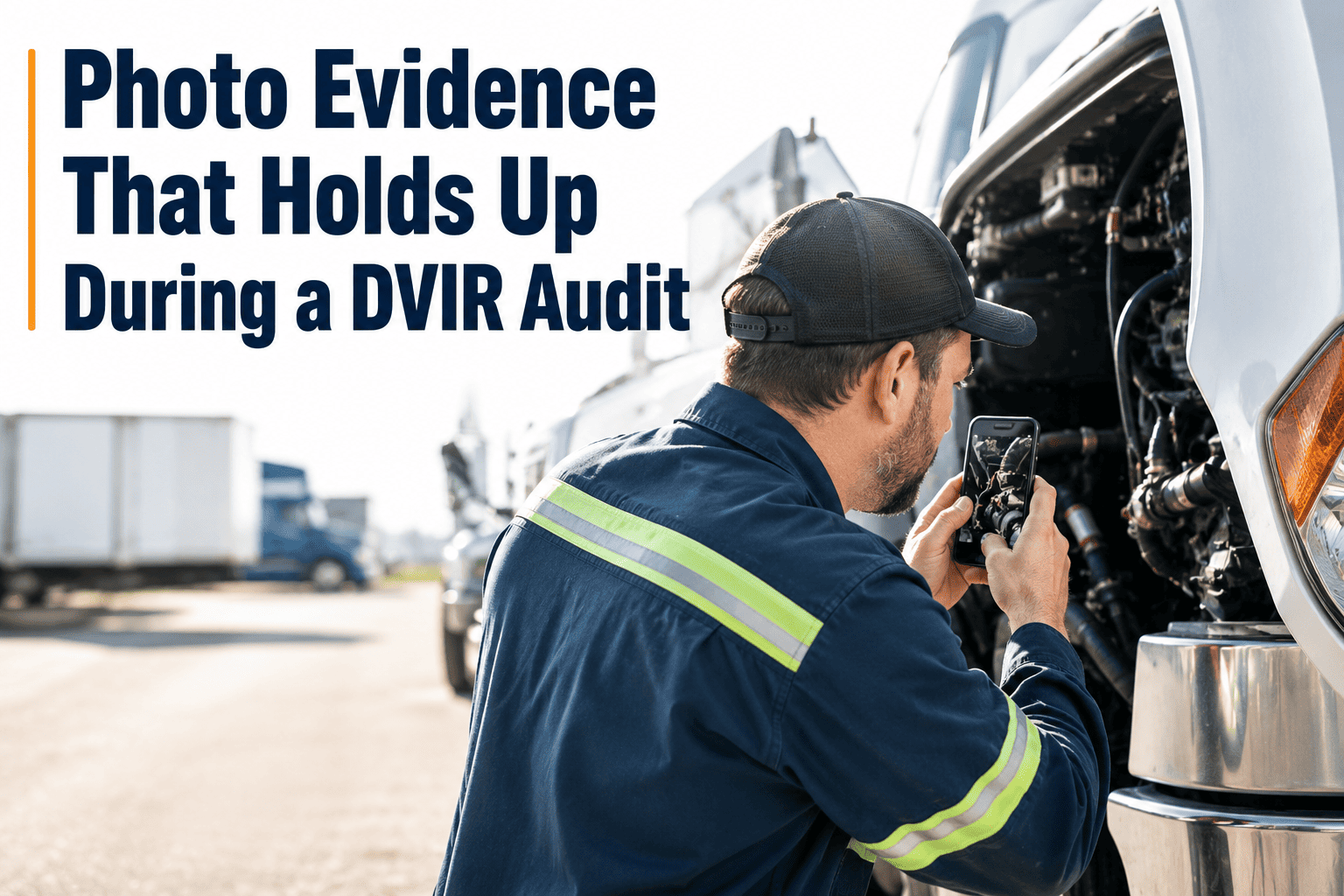
A written DVIR entry describing a chipped brake-pad edge or a bulging tire sidewall is worth something in an audit room — but the same entry paired with a timestamped, GPS-tagged photograph is worth an order of magnitude more. Paper-based inspection reports leave fleets exposed: a mechanic can claim "no defect found," a roadside officer sees only checkboxes, and a plaintiff's attorney can argue the driver never looked at the component at all. Requiring photo evidence on safety-critical defect categories closes those gaps and shifts liability where it belongs. This guide breaks down how to operationalize photo evidence in a digital DVIR program — and you can spin up the workflow in minutes with a Start Free Trial of Oxmaint.
Can your last DVIR survive a roadside inspection, a DOT audit, and a deposition?
If the answer is anything less than a confident yes, you are relying on checkboxes and pencil marks — not evidence. Photo documentation converts a written defect report into defensible proof that the driver was at the component, the defect existed, and the carrier was notified.
Why a written DVIR entry is only half a record
FMCSA § 396.11 requires every driver to prepare a DVIR at the completion of each day's work — but the regulation specifies the format of the report, not the proof behind it. That ambiguity is where audits unravel.
Driver pencil-whipping
When a DVIR is a paper checklist, a driver can mark every box "satisfactory" from the cab in under 30 seconds. Requiring a photo of a tread-depth gauge reading, a brake chamber, or an air-pressure gauge physically forces the driver to the component — the camera is the inspection.
Mechanic "no defect found" disputes
A mechanic inspects the vehicle hours later and logs "no defect" — contradicting the driver's report. Without a photo, it is one person's word against another's. A timestamped photo taken at the moment of inspection ends the argument before it reaches a service-manager meeting.
Carrier liability for un-repaired defects
If a driver reports a defect and the carrier dispatches the truck anyway, a downstream incident exposes the carrier — but only if the driver can prove they reported it. Photo metadata with GPS and timestamp is that proof, shifting liability cleanly to the carrier.
Which defect categories demand mandatory photo evidence
Not every line item on a DVIR carries the same risk weight. Best practice — and the default in Oxmaint — is to require photos on every safety-critical category and allow optional photos on comfort or cosmetic items. Storage is cheap; disputes are expensive.
Brake system
Brake chambers, push-rod travel, slack adjuster stroke, air-pressure gauge readings. A roadside defect here is an out-of-service violation and a CSA hit in the Unsafe Driving BASIC.
- Photo of air-pressure gauge at full application
- Photo of push-rod stroke at brake applied
- Photo of any visible leak or damaged chamber
Tires & wheels
Tread-depth readings, sidewall bulges, missing lugs, cracked rims. FMCSA regulation § 393.75 sets a 4/32-inch minimum on steer tires — a photo of the gauge on the tread is the only defensible record.
- Photo of tread-depth gauge reading on each steer tire
- Photo of any sidewall damage or embedded object
- Photo of wheel-end, lugs, and rim condition
Steering & coupling
Fifth-wheel jaw wear, kingpin condition, steering-linkage play, drag-link damage. A separation incident traced to an un-photographed coupling defect is a seven-figure exposure.
- Photo of fifth-wheel jaw closed on kingpin
- Photo of landing-gear and air-line connections
- Photo of any visible play or wear in steering linkage
Comfort & cosmetic
Cab interior damage, mirror-glass cracks, body dents, torn seats. These do not trigger out-of-service conditions, but a photo prevents "it was like that when I got in" disputes between drivers.
- Photo encouraged but not blocked at submission
- Stored with same GPS and timestamp metadata
- Useful for inter-shift handoff documentation
Paper-and-checkbox DVIR versus photo-evidence DVIR
A 180-truck regional fleet spending roughly $42,000 a year on DVIR-administration labor and dispute resolution can cut that figure by an estimated 60–70% when photo evidence replaces he-said-she-said resolution cycles.
| Audit dimension | Paper / checkbox DVIR | Photo-evidence DVIR (Oxmaint) |
|---|---|---|
| Pencil-whipping proof | None — checkbox is the only artifact | GPS + timestamp prove driver was at the component |
| Mechanic dispute resolution | Verbal argument; service-manager arbitration | Photo ends the dispute before it escalates |
| DOT audit defensibility | Weak — auditor sees checkboxes only | Tamper-evident photo chain shows defect existed at time of report |
| Post-incident liability | Driver and carrier share exposure ambiguously | Liability shifts cleanly to whoever ignored the documented defect |
| Time to close a defect ticket | 2–4 days with back-and-forth | Same shift — mechanic sees exactly what the driver saw |
| Storage & retrieval | Paper file cabinets, 90-day retention typical | Cloud archive, 8-year retention, instant search |
| Cost per disputed defect | $180–$350 in labor + downtime | $0 — photo resolves it on first review |
What photo evidence actually costs and saves
The arithmetic is lopsided. A single defended post-incident lawsuit involving a brake or tire defect runs $85,000–$1.2M in legal fees and settlement. A photo costs roughly $0.003 in cloud storage. The return on requiring photos is not a margin question — it is a risk-elimination question.
Who sees the photo, and when
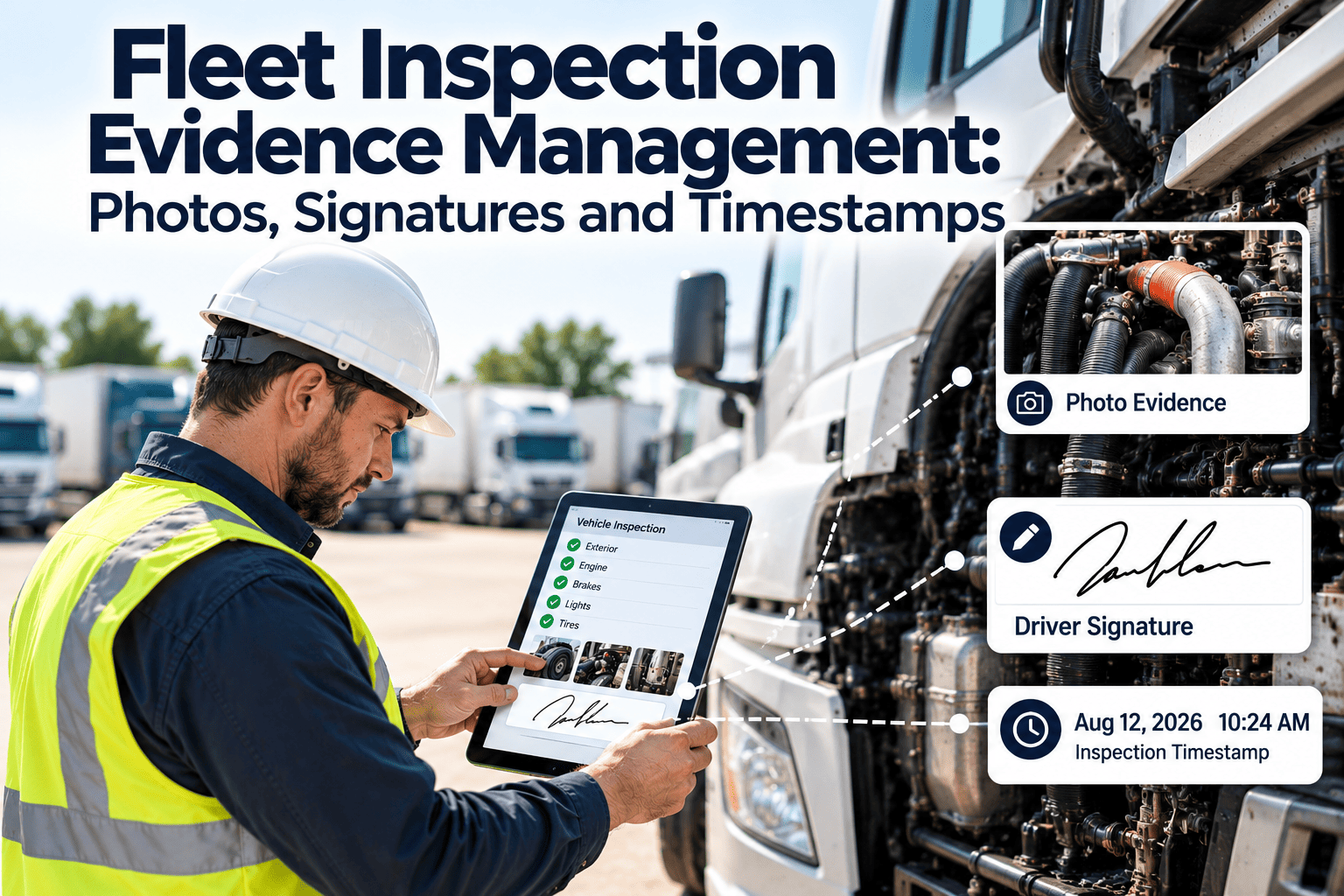
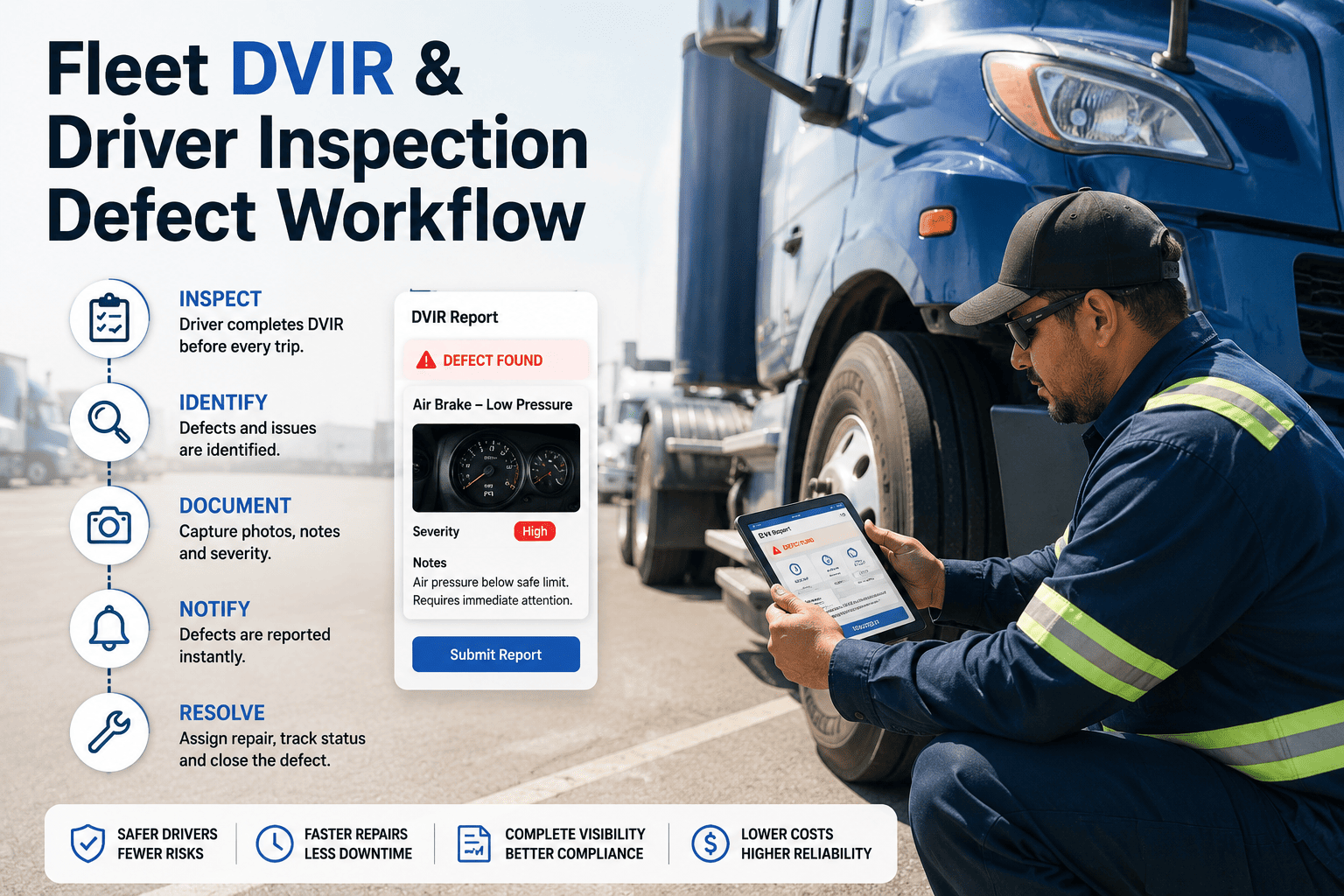
In Oxmaint, every photo attached to a DVIR entry flows through a visible chain of custody. The driver who captured it, the mechanic who resolves it, and the next driver who inherits the truck each see the same image — eliminating the information silos that produce repeat defects and dispatch-on-defect incidents.
Driver captures photo at component
Driver opens the Oxmaint mobile DVIR, selects the defect category, and is prompted to photograph the component. GPS and timestamp are embedded automatically — the driver cannot disable them.
Photo enters tamper-evident storage
The image is uploaded to Oxmaint's cloud archive with a cryptographic hash. Any subsequent alteration is flagged. The original is preserved for the full 8-year retention window.
Mechanic reviews photo before repair
The mechanic sees exactly what the driver saw — same angle, same lighting, same defect. No more "I couldn't find anything wrong" tickets that close without resolution.
Next driver confirms repair in handoff
The driver inheriting the truck sees the original defect photo and the mechanic's repair confirmation side by side. If the defect persists, they re-photograph and the cycle restarts — all logged.
A 180-truck regional carrier and the steer-tire that was not replaced
A regional refrigerated carrier operating 180 power units across the Midwest had a driver report a steer tire at 3/32-inch tread depth — below the 4/32-inch FMCSA minimum — on a Tuesday morning DVIR. The paper report was filed. The tire was not replaced. The truck was dispatched on a 600-mile run. On Wednesday, the tire experienced a tread separation on Interstate 80. A passenger vehicle swerved, and a multi-vehicle incident followed.
In the subsequent litigation, the carrier's paper DVIR was produced — but the driver's specific notation was ambiguous ("tire worn"), and no photograph existed. The plaintiff's attorney argued the driver had not actually measured the tread. Settlement discussions opened at $1.4M.
Had the driver captured a photo of the tread-depth gauge reading 3/32-inch with embedded GPS and timestamp, three things would have changed. First, the carrier would have had unambiguous notice that the tire was out of compliance and could not legally dispatch the truck. Second, liability would have shifted cleanly to the carrier for dispatching a known defective vehicle. Third — and most importantly — the carrier's maintenance software would have flagged the defect and prevented dispatch in the first place, averting the incident entirely. The cost of that one missing photo: roughly $1.4M. The cost of requiring photos on every steer-tire defect going forward: $0.003 per image in cloud storage.
Convert your DVIR program from checkboxes to defensible evidence
Set mandatory-photo rules by defect category, activate tamper-evident storage, and give every driver, mechanic, and auditor the same picture of the truth.
DVIR photo evidence — what fleets ask before they deploy
Does FMCSA require photos on a DVIR?
No. FMCSA § 396.11 specifies the required content of a DVIR — identification, defects noted, and the driver's signature — but does not mandate photographs. Photos are a best-practice layer that strengthens the evidentiary value of an already-required record. Carriers that add photo evidence do so to protect themselves, not to satisfy a federal mandate.
Can a driver disable the GPS or timestamp on a photo?
In Oxmaint, no. GPS and timestamp metadata are embedded server-side at upload and cannot be stripped by the driver. Photos are stored with a cryptographic hash in tamper-evident storage, so any post-capture alteration is detectable. This is what makes the evidence defensible in a deposition. You can review the full chain-of-custody workflow when you Start Free Trial.
What happens if a driver cannot get a photo — poor signal, dark yard, broken camera?
Oxmaint allows offline capture with deferred upload — the photo is stored locally on the device and synced when connectivity returns, preserving the original timestamp and GPS. For low-light conditions, the app prompts the driver to use the device flash. A broken-camera exception is logged as a flag for that driver's device, and the DVIR can proceed with a mandatory text description that routes to a supervisor for follow-up.
How long are photos retained, and who can access them?
Photos are retained for 8 years in cloud storage, aligned with FMCSA record-keeping expectations. Access is role-based: drivers see their own submissions, mechanics see open defect photos for assigned units, and fleet administrators see the full archive. Every view is logged. For a walkthrough of the permissions model, Book a Demo.
Should we require photos on every DVIR line item or only safety-critical defects?
Best practice is tiered: mandatory photos on brakes, tires, steering, and coupling — the categories that produce out-of-service violations and CSA hits — and optional photos on comfort and cosmetic items. Requiring photos on every line item creates friction and reduces compliance. Oxmaint lets you configure the mandatory-photo rule by defect classification, so the policy follows the risk.
Stop defending checkboxes. Start defending photographs.
Every day without photo evidence is a day your fleet is one un-repaired defect away from a roadside violation, an audit finding, or a deposition. Deploy Oxmaint's photo-evidence DVIR in a single afternoon.
Free 14-day trial · No credit card

.png)