
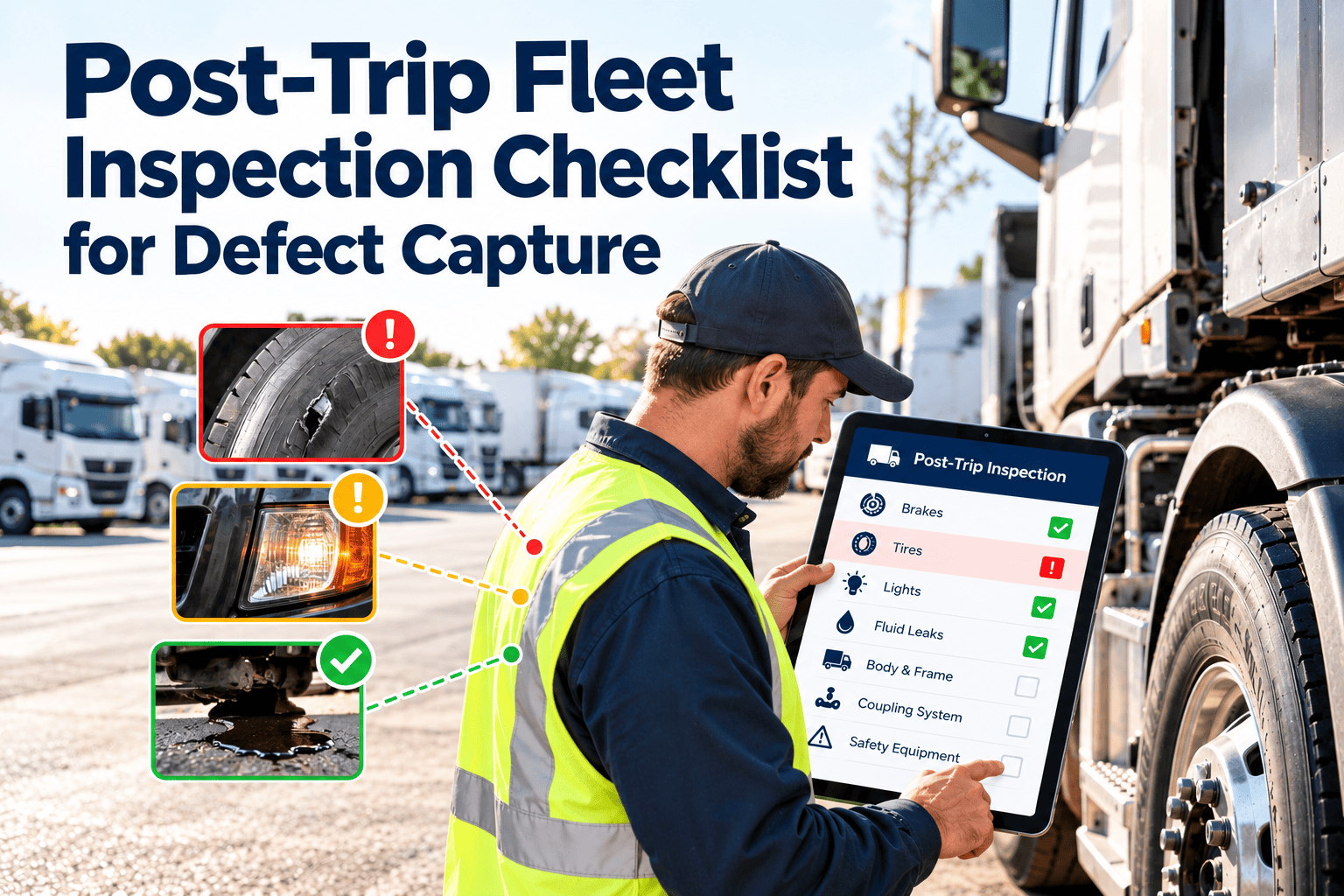
Under 49 CFR 396.11, the post-trip inspection is the regulated moment where every defect a commercial motor vehicle developed during the day gets formally documented into the Driver Vehicle Inspection Report — and for property-carrying carriers since the 2014 rule revision, that written DVIR is only legally required when a defect is actually found. A no-defect day still deserves a completion record as company policy, but it is the quality and timing of the defect entry that determines whether your fleet survives a DOT audit or a post-accident review. Same-day documentation, written before the driver leaves the yard, is what separates a defensible maintenance program from one that gets pieced together retroactively. Oxmaint enforces required fields and photo evidence by defect category, so a brake or tire finding can never be logged as "brakes bad" again — you can Start Free Trial and see the workflow on your own assets today.
Every defect your truck developed today needs to be documented before it leaves the yard — not reconstructed tomorrow.
The post-trip DVIR is the only federally recognized record that captures brake pulse, steering wander, air leaks, and tire wear observed during a shift. Same-day, photo-backed entries are what FMCSA auditors look for first.
-
Defects observed by the driver — steering wander, brake pulse, air leak, engine noise during the shift.
-
Defects reported to the driver — relayed by the shop, a supervisor, or another driver on the same power unit.
-
Quantitative detail — pad thickness in mm, tread depth in 32nds, specific wheel position, speed condition.
-
Photo evidence — category-mandatory images attached before the DVIR can be submitted.
What "affecting safe operation or likely to cause breakdown" actually means on paper
Federal language is intentionally broad — the compliance test is whether your defect entries are specific enough that a mechanic can act on them without a follow-up conversation and an auditor can confirm the fleet took the finding seriously.
Tells the mechanic nothing about position, severity, or symptom. Tells the auditor the fleet has no documentation discipline. Defeats both repair speed and the defense that the carrier reports defects in good faith.
- No axle or wheel position
- No measurable thickness or symptom
- No operating condition (speed, load, grade)
- No photo to corroborate the finding
"Right front brake pad below 3mm remaining thickness, visible metal on outboard side, brake pulses on downgrade decel." Paired with a photo of the pad and a tread-depth coin measurement on any tire flagged.
- Specific wheel position named
- Thickness stated in millimeters
- Symptom tied to a driving condition
- Photo evidence attached to the record
Why documentation done before the driver leaves the yard is fundamentally different
Retroactive DVIR completion — filling in the report the next morning, or worse, at the end of the week — is the single most common documentation-quality failure auditors flag. Memory degrades, symptoms blur together, and the entry collapses back into "brakes bad."
End of shift — defect observed or reported
Driver parks, notes the symptom while it is fresh: which axle, under what load, at what speed, on what grade. If the defect was relayed by the shop or another driver, that source is named in the entry.
Quantify before you leave the cab
Pad thickness in millimeters, tread depth in 32nds, air leak rate if measurable, fluid level if visible. A number turns a subjective complaint into a repairable specification.
Photo evidence captured against the asset
Oxmaint enforces a mandatory photo on categorical defects — any brake flag requires an image, any tire flag requires a tread-depth measurement photo. The system blocks submission until the image is attached.
Submit before leaving the yard
The DVIR is timestamped, geo-stamped, and routed to the shop queue. The driver leaves with zero outstanding documentation. The mechanic receives a work order with the exact symptom, measurement, and photo — no clarification call needed.
What every flagged category must contain to survive a DOT audit
Different defect categories carry different documentation burdens. Brake and tire findings are the two most heavily scrutinized by roadside inspectors and post-accident investigators — they need the most disciplined entries.
| Defect category | Minimum required detail | Photo required | Audit risk if vague |
|---|---|---|---|
| Brake system | Axle position, pad/shoe thickness in mm, symptom (pulse, pull, fade), speed condition | Yes — pad or drum image | Critical — OOS violation likely |
| Tires | Wheel position, tread depth in 32nds, pressure if checked, cut or bulge location | Yes — depth gauge photo | Critical — CSA severity 8 per tire |
| Steering | Wander, pull, play description, speed and road-crown condition observed | Recommended | High — hard to defend verbally |
| Air system | Leak location, audibility (key-on / key-off), pressure drop rate if measured | Recommended | Medium — depends on severity |
| Engine / drivetrain | Noise type (knock, tick, grind), RPM or speed range, load condition, fluid visible | Recommended | Medium — breakdown risk if ignored |
| Lights / electrical | Specific lamp position (LF headlight, RR turn, etc.), intermittent vs. inoperative | Optional | Low — but pattern of neglect hurts |
Federal minimum vs. fleet policy — and why most carriers still log every day
Since the 2014 rule change, property-carrying carriers are not federally required to file a written DVIR on a no-defect day. But most fleets still require a daily inspection completion record — because the absence of a log is itself an audit liability.
396.11
Stop reconstructing DVIRs the morning after. Document defects the moment the truck parks.
Oxmaint enforces category-specific required fields, mandatory photos, and same-day timestamps — so every post-trip entry is audit-ready by default.
Post-trip inspection and defect documentation, answered
Is a written DVIR required every single day under federal rules?
For property-carrying carriers, no — since the 2014 revision to 49 CFR 396.11, a written DVIR is federally required only when defects are found or reported. A no-defect day does not require a written report under federal minimums. However, most carriers still require a daily inspection completion record as company policy, because a gap in the log is harder to defend than a clean no-defect entry.
What makes a DVIR entry "audit-defensible" instead of useless?
An entry like "brakes bad" is useless to the mechanic and to your audit defense. A defensible entry names the wheel position, states a measurable condition (pad thickness in mm, tread depth in 32nds), describes the symptom under a specific driving condition, and includes a photo. Oxmaint enforces these fields by defect category — you can Start Free Trial to see the mandatory-field workflow on your own fleet.
Do defects reported by someone other than the driver need to be documented?
Yes. The standard covers both defects the driver personally observed during the day and defects reported to the driver by others — a shop technician, a supervisor, or another driver who operated the same unit. The source of the report should be named in the entry so the documentation chain is traceable during an audit.
How long does photo evidence need to be retained?
DVIR records and supporting evidence should be retained for at least 12 months under typical fleet recordkeeping practice, and longer if the vehicle is involved in any incident under investigation. Digital systems like Oxmaint retain photo evidence indefinitely, tied to the asset and the defect record, so it is retrievable on demand for audits, claims, or litigation.
What happens if a driver submits a DVIR retroactively the next morning?
Retroactive completion erodes documentation quality — symptoms blur, measurements become estimates, and the timestamp no longer proves the defect was captured at end-of-shift. In a post-accident review, a DVIR logged hours or days after the shift is treated as reconstructed, not contemporaneous, and loses much of its defensive value. Same-day submission before the driver leaves the yard is the standard that holds up. Book a walkthrough at calendly.com/oxmaintapp/30min to see the enforcement in action.
Make every post-trip inspection audit-ready by default.
Enforce required fields, capture photo evidence, and timestamp every defect before the driver leaves the yard — all inside Oxmaint.
Free 14-day trial · No credit card



.png)
