
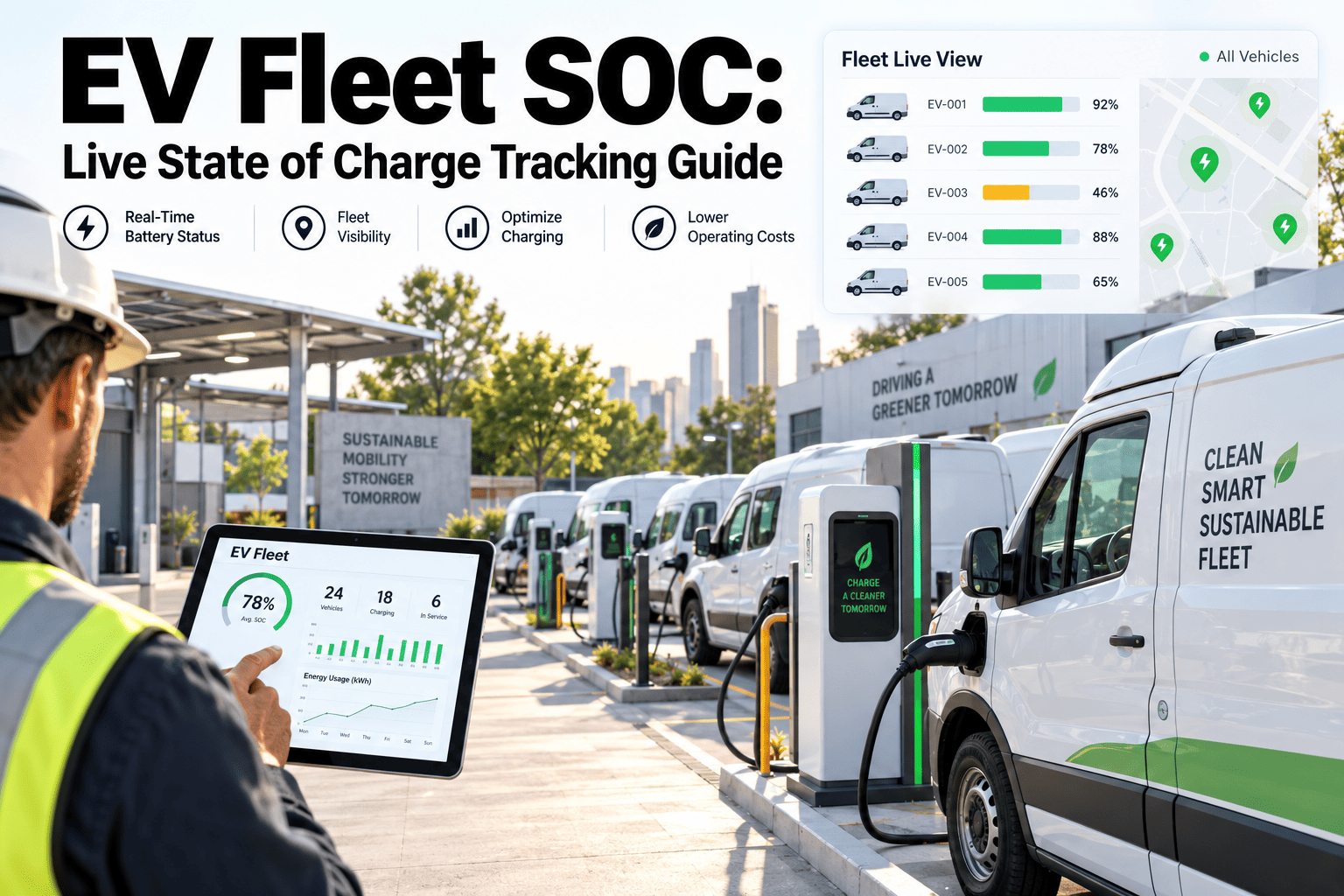
Every charging session an electric fleet vehicle completes generates a data trail — kWh delivered, session duration, connector used, driver, location, and dozens of smaller signals most fleets never look at again once the invoice is paid. That trail is a diagnostic record hiding in plain sight: a charger degrading before it fails outright, a cable with an intermittent fault, a driver habit quietly shortening battery life. This guide covers the charging session analytics that turn routine energy data into early warnings, and how OxMaint connects that data to a work order before a bad charger takes a vehicle out of service.
Every kWh, every cable, every driver — the data is already there
Most fleets treat charging session data as a billing input and nothing else. The same data, tracked over time, exposes failing hardware and costly driver habits before either one causes downtime.
The data most fleets are already collecting and ignoring
Every networked charger and most fleet EVs already report a consistent set of session-level data: energy delivered in kWh, session start and end time, charging power and current draw, connector or port ID, state of charge at plug-in and unplug, and often diagnostic trouble codes tied to the vehicle's onboard charging system. None of this requires new hardware — it's already flowing into a charging network's cloud dashboard or the vehicle's telematics feed. The gap is almost never data availability; it's that nobody has connected the data to a maintenance or fleet management workflow that acts on it, so the signal sits in a portal that only gets opened when a driver reports a problem out loud.
This is a familiar pattern from the fuel-fleet era translated into a new form. Fuel transaction data — location, volume, time, price — sat unused in card-processor portals for years before fleets started running exception reports against it to catch theft and misuse. Charging session data is at the same stage today: the raw feed exists, the analytical layer that turns it into action mostly doesn't, and the fleets that build it early get a head start on both cost control and equipment reliability while it's still a competitive advantage rather than table stakes.
| Signal | What it's usually used for | What it can also reveal |
|---|---|---|
| kWh delivered per session | Billing and cost-per-mile tracking | A charger delivering less energy than expected for its rated power |
| Session duration | Yard scheduling and turnaround planning | Charging sessions running long relative to state-of-charge gained |
| Charging power / current draw | Peak demand and utility tariff management | A degrading connector or cable causing a power throttle mid-session |
| Session failure / interruption events | Rarely reviewed unless a driver complains | An intermittent fault pattern building toward full charger failure |
| State of charge at plug-in | Route planning and range assurance | Driver habits — deep discharge before charging, frequent partial charges |
How a failing charger shows up in the data before it fails outright
Chargers rarely fail all at once. A connector's contacts corrode gradually, a cable's internal conductor frays from repeated coiling and uncoiling, a power module's cooling fan starts underperforming in hot weather — each of these produces a measurable signature in session data well before the charger stops working entirely.
The reason these signatures go unnoticed in most depots isn't that they're subtle — several of them are quite visible once you're looking at the right chart. It's that nobody is looking at per-port trends at all. A site-level "average uptime" metric can look perfectly healthy while one specific port has been quietly degrading for weeks, because the other ports at the same site are absorbing the slack. Catching the signal requires breaking performance down to the individual connector, not the site as a whole.
Falling delivered power on a single port
A port that used to deliver its full rated kW now consistently underdelivers relative to identical vehicles charging on other ports at the same site — a classic connector wear signature.
Intermittent session interruptions
Sessions that start, drop, and restart on the same cable — especially when the pattern correlates with cable position or temperature — point to an internal conductor issue before a full open circuit occurs.
Power tapering earlier in the session
A charger that used to hold peak power for the first twenty minutes now tapers after ten — often a cooling system losing effectiveness well before an outright shutdown.
Rising session-start failure rate
A charger that increasingly fails to authenticate or initiate a session — even when it eventually works on a retry — is showing early signs of a controller or connectivity issue.
See charger health trends across your whole depot
OxMaint pulls charging session data into the same dashboard as your vehicle and asset records, so a degrading charger becomes a work order instead of a driver complaint.
The charging behaviors that quietly shorten battery life and pad energy cost
Not every anomaly in the data is a hardware problem. Charging session history also exposes driver-level patterns that cost a fleet money or battery life over time, long before any single incident would ever get flagged on its own.
None of these habits are usually intentional or careless — they're defaults that form when a driver has no visibility into how their charging choices compare to a colleague running the same route on the same vehicle type. A driver who always fast-charges to full isn't ignoring guidance, they're following the path of least resistance in the absence of any feedback loop telling them a slower, partial charge would have been just as sufficient for the day's route.
Habitual deep discharge before charging
Drivers consistently plugging in below 10–15% state of charge accelerate battery degradation compared to drivers who top up more frequently at moderate charge levels.
Frequent unnecessary DC fast charging
A vehicle that could reasonably charge on slower depot power but is routed to fast charging out of habit accumulates thermal stress and higher session cost for no operational benefit.
Charging to 100% when it isn't needed
Routinely charging to full when the next route doesn't require it adds battery stress at the top of the charge curve, where degradation accelerates fastest.
Charging during peak utility rate windows
A driver defaulting to plug-in-immediately habits regardless of time-of-use pricing can materially inflate a depot's energy cost per vehicle compared to a scheduled-charge peer.
Turning session logs into a maintenance and coaching workflow
The gap between having charging session data and using it is almost always a workflow gap, not a data gap. A charging network's own dashboard is built for billing and session monitoring, not for cross-referencing charger performance against a fleet's maintenance history or flagging a driver pattern that needs a conversation. Closing that gap means routing the same session data into the system that already tracks vehicle condition and work orders.
The payoff for closing that gap shows up in two separate places on a fleet's ledger. On the maintenance side, a charger caught early is a scheduled repair instead of an emergency service call and a stranded vehicle mid-route. On the operating cost side, shifting even a portion of charging sessions away from unnecessary fast-charging and peak-rate windows compounds across a full EV fleet into a meaningful annual energy cost difference — without a single change to routes, vehicles, or drivers' actual schedules.
Four steps to a working charging analytics program
A charging analytics program doesn't need to start with a complex predictive model. The fleets that get the most value fastest start with a simple, disciplined baseline and layer complexity in only after the basics are running reliably.
It's tempting to try to build the driver-coaching layer and the predictive-failure layer at the same time, since both draw from the same session data. In practice, fleets that try to launch everything at once tend to stall on neither getting fully built, because the baseline work — tagging every port, confirming the data feed is complete and reliable — takes longer than expected and eats the time meant for the more advanced analysis. Sequencing the four phases below, rather than running them in parallel, gets a working program live faster.
Centralize session data per port and per vehicle
Pull session history from every charger and vehicle telematics feed into one place, tagged by port ID and vehicle ID, before attempting any trend analysis.
Establish a normal-range baseline per charger
Chargers of the same model and power rating should deliver similar performance — use that peer comparison to define what "normal" looks like for each port.
Set alert thresholds for deviation
Flag a port automatically when delivered power, session failure rate, or duration drifts meaningfully from its own baseline or its peer group.
Layer in driver-level behavior review
Once charger health monitoring is running, add a recurring review of charge-to-100%, deep-discharge frequency, and fast-charge reliance by driver.
Charging data, work orders, and vehicle history in one place
OxMaint treats depot chargers as tracked assets alongside the vehicles they serve, so a charging session isn't just a billing line — it's a data point that feeds the same maintenance workflow already running for the rest of the fleet.
That matters most as an EV fleet grows past the point where one person can eyeball every charger's dashboard each morning. A five-charger depot can run on tribal knowledge — someone just knows port 3 has been acting up. A fifty-charger depot across three sites can't, and that's exactly where an undetected degrading connector starts costing real uptime, because nobody is watching closely enough to notice the trend before a driver shows up to a dead port during a morning surge.
Charger asset records with session history
Each charger and connector gets its own asset record, so performance trends are tracked per port instead of blended into a site-wide average that hides which unit is actually degrading.
Automatic work orders on threshold breach
A port drifting outside its normal delivered-power range generates a maintenance work order automatically, before the charger fails a vehicle mid-shift.
Driver-level charging behavior dashboards
Roll up deep-discharge frequency, fast-charge reliance, and full-charge habits by driver to support coaching conversations with actual data instead of impressions.
Unified history for warranty and total cost tracking
Charger repair history, vehicle battery health signals, and session data sit in one record, simplifying warranty claims and total-cost-of-ownership comparisons across your EV fleet.
Frequently asked questions
Do I need new hardware to start collecting charging session analytics?
Usually not — most networked chargers and EV telematics systems already report the session data needed; the missing piece is routing it into a system that tracks it over time.
How early can degrading charger hardware actually be caught?
Signatures like falling delivered power or rising session-interruption rates often appear weeks before a full failure, giving enough lead time to schedule a repair instead of losing a charger mid-shift.
Can charging data really show battery-damaging driver habits?
Yes — state of charge at plug-in and unplug, charge-to-100% frequency, and fast-charge reliance are all visible in standard session logs and are strong proxies for behaviors that accelerate degradation.
How does OxMaint fit alongside our existing charging network's dashboard?
OxMaint doesn't replace the charging network's billing dashboard — it pulls the session data into asset and work order records so charger health and driver behavior connect to your existing maintenance workflow. You can Start Free Trial to see it connected to your depot.
Is this only useful for large EV fleets with many chargers?
A depot with even a handful of chargers benefits, since losing one port to an undetected failure represents a much larger share of total charging capacity than it would in a large deployment.
Stop letting charging data sit in a billing dashboard
Book a demo and see how OxMaint turns every kWh, cable, and driver session into an early warning instead of an after-the-fact invoice.
Free 14-day trial · No credit card required





.png)