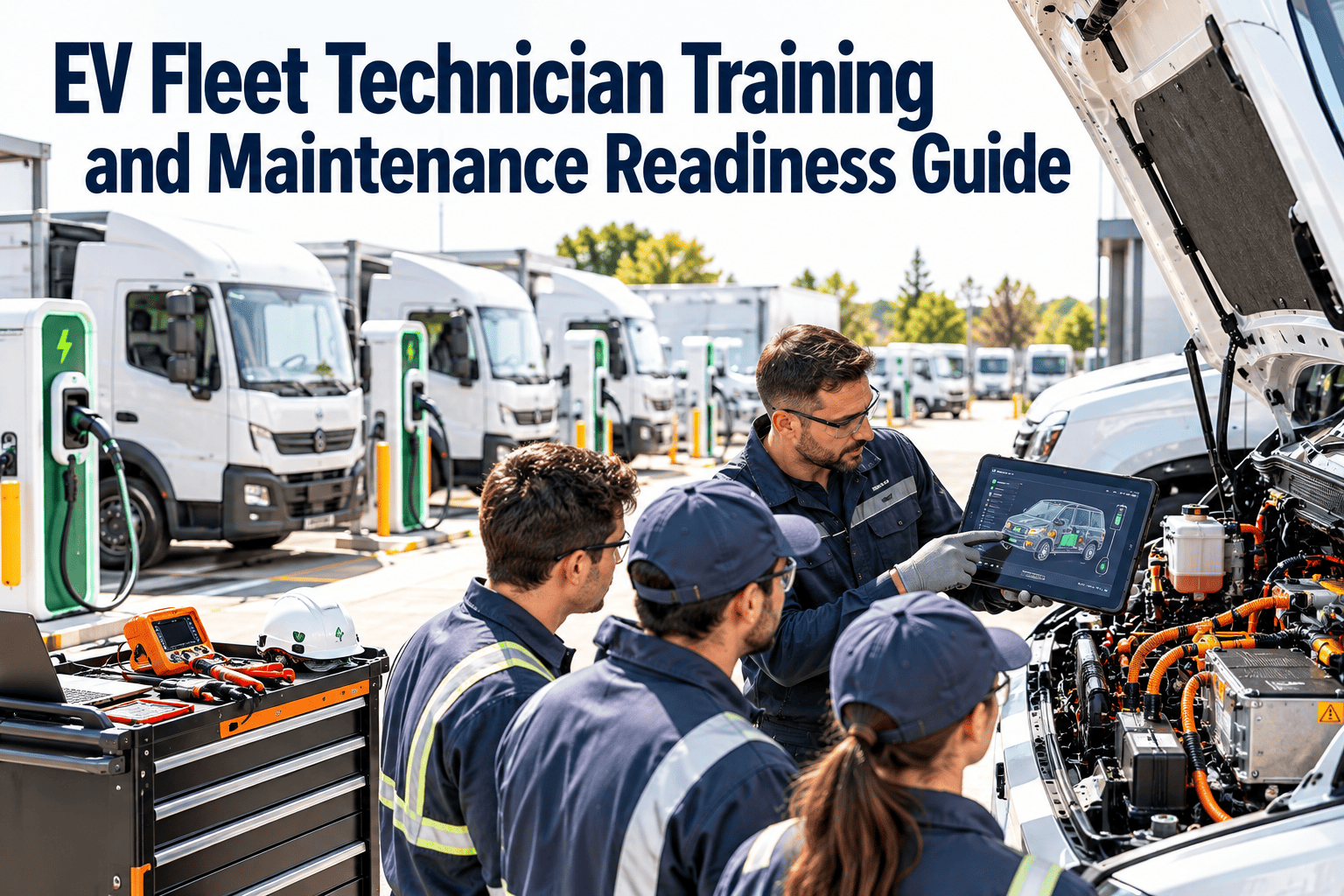
Electric vehicles remove oil changes and exhaust systems, but they do not remove maintenance. They add high-voltage safety, battery and thermal management, software, and charging equipment to the shop's responsibilities. A technician who is excellent on diesel is not automatically ready to work near an energized battery pack. This guide covers the training, controls, and work order discipline behind readiness, and a fleet maintenance platform can track each requirement.
EV Fleet Technician Training and Maintenance Readiness Guide
Prepare technicians, work orders, and shop procedures for electric vehicles so that safe work is the default and every repair is recorded against a qualified person.
What changes in the shop when the fleet goes electric
- High-voltage systems require defined isolation procedures, insulated tools, and rated protective equipment.
- Traction batteries need inspection for damage, coolant leaks, and thermal management faults rather than fluid changes.
- Regenerative braking reduces friction brake wear, yet brakes can corrode or seize from low use.
- Heavier vehicles and high torque can wear tires faster than expected.
- Software updates and diagnostic tools become part of routine service.
- Charging equipment becomes an asset that also needs inspection and repair.
Preventive tasks that still matter
| System | Typical inspection focus | Who should perform it |
|---|---|---|
| Tires and wheels | Pressure, wear pattern, damage, torque | Any trained technician |
| Friction brakes | Corrosion, sticking, pad and rotor condition, brake fluid | Brake-qualified technician |
| Thermal system | Coolant level and condition, hoses, pumps, leaks | Per OEM, often EV-trained |
| Cabin filter and HVAC | Filter condition, airflow, heat pump function | Any trained technician |
| 12-volt battery | Voltage, terminals, charge state | Any trained technician |
| High-voltage cables and connectors | Visual condition only unless qualified | High-voltage qualified technician |
| Charge port | Damage, debris, latch, seals | EV-trained technician |
| Software and warnings | Pending updates, stored faults | Diagnostics-trained technician |
Safe work sequence for high-voltage tasks
Always follow the manufacturer's service information and your employer's safety program. This sequence shows the structure, not a substitute for the OEM procedure.
Standards and references to review with your safety lead
- OEM service information for each model, which governs every procedure
- Applicable workplace electrical safety rules in your country, such as OSHA requirements and NFPA 70E in the United States
- Industry qualifications such as ASE electric vehicle certifications, where recognized locally
- Your insurer's requirements for battery storage and fire response
Tie every EV repair to a qualified technician
Track certifications, safety checks, and repair history on the same work order.
Role-based training matrix
Not every role needs the same depth. Assign training by the work each person can be asked to do.
| Role | Core topics | How to verify |
|---|---|---|
| Drivers | Charging basics, warning lights, pre-trip checks, what to do after a collision | Short assessment and signed acknowledgement |
| Yard and cleaning staff | Hazard recognition, exclusion zones, tow and jump precautions | Toolbox talk record |
| General technicians | High-voltage awareness, safe tire, brake, and cabin work | Practical observation by a qualified lead |
| High-voltage technicians | Isolation, lockout, testing, PPE, connector handling, repair procedures | Formal course plus supervised jobs |
| Diagnostic leads | Battery health data, fault trees, software updates, charger faults | Practical assessment on live cases |
| Supervisors and planners | Job assignment rules, tow and storage, incident response | Scenario review |
Work order design for electric vehicles
Fields worth adding
- Required qualification level for the task
- High-voltage task flag
- Isolation and lockout confirmation
- Voltage verification result
- Battery state readings before and after
- Software version and updates applied
- Parts, torque values, and photos
Rules worth enforcing
- High-voltage jobs assigned only to qualified people
- Work order cannot close without safety checks recorded
- Damaged battery events get a separate priority path
- Repeat faults trigger a diagnostic review
- Vehicles awaiting repair follow a defined storage rule
- Warranty repairs are tagged for recovery
Shop and equipment readiness checklist
- Training plan by role
- Named safety lead
- Two-person rule for high-voltage work where required
- Insulated gloves and tools, inspected and tested on schedule
- Rated voltage testers
- Lockout devices and signage
- Marked EV service bays
- Isolation area for damaged vehicles
- Lifting points and equipment suited to vehicle weight
- OEM service access for each model
- Diagnostic tools and licenses
- Emergency response guides on hand
Ninety-day readiness plan
Assess and plan
Map current skills against the matrix, identify gaps, book courses, and confirm OEM service access.
Train and equip
Run awareness sessions for all staff, complete high-voltage courses for selected technicians, and set up equipment and bays.
Supervised operation
Start service on pilot vehicles with supervision, refine work orders, and review findings weekly.
Readiness scorecard and KPIs
| Measure | What it shows |
|---|---|
| Percentage of technicians trained by level | Coverage against the training matrix |
| Qualified-technician assignment rate | Whether high-voltage work goes to the right people |
| Safety checklist completion | Discipline on isolation and verification steps |
| Time to repair EV faults | Skill and parts readiness |
| Repeat EV repair rate | Diagnostic quality |
| Preventive maintenance compliance | Schedule control on the EV fleet |
| Charger uptime | Impact of charging equipment on vehicle availability |
How Oxmaint supports the process
- Asset management for vehicles, chargers, and related equipment
- Preventive maintenance schedules for EV-specific inspections
- Work orders with assignments, checklists, and closing requirements
- Mobile inspections so drivers and technicians record findings at the vehicle
- Inventory and reports for parts use, cost, and repeat issues
Frequently asked questions
Do all technicians need high-voltage certification?
No. Assign training by task. Only people who work on high-voltage components need that level.
Do EVs need less maintenance?
Often fewer fluid services, but tires, brakes, thermal systems, and software still need scheduled attention.
How do we prove technicians were qualified for a job?
Record the qualification on the work order. You can create your workspace to test this workflow.
Where do OEM procedures fit in?
They take priority over any general guide. Reference them in task instructions for every model.
Can we review our setup with an expert?
Yes. Choose a time to schedule a walkthrough for your fleet.
Make EV readiness visible on every work order
Organize training records, safe work steps, and repair history so your team is ready as the fleet electrifies.