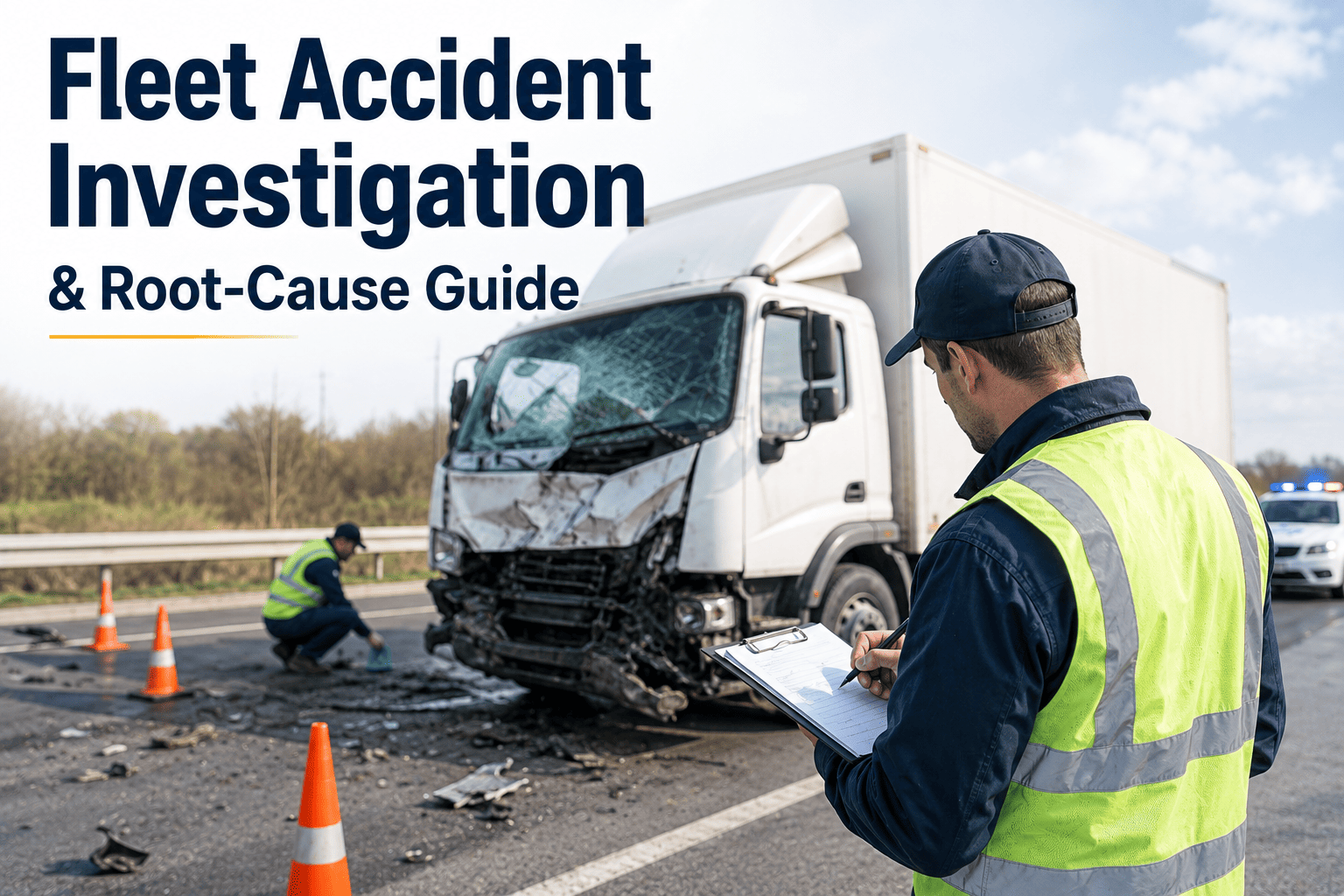
The 72 hours immediately following a commercial vehicle accident determine the carrier's legal and financial exposure more than anything that happens in the subsequent months of litigation. Dashcam footage that is not preserved within the first 48 hours may be overwritten. Black box telematics data that is not downloaded before the next ignition cycle is at risk. Witness accounts that are not recorded within 24 hours begin to degrade. A driver's post-incident statement that is not structured and documented correctly creates liability exposure rather than protection. Yet most commercial fleets have no standardized post-accident investigation workflow — the safety manager drives to the scene, takes photos on their phone, files a police report number in a spreadsheet, and waits for the claims adjuster to call. Oxmaint's AI-powered accident investigation module captures dashcam footage, reconstructs the incident sequence from telematics data, automates evidence preservation, and generates a structured root cause analysis — creating a defensible incident record from the moment the driver reports the accident. See Oxmaint's accident investigation module configured for your fleet — start free.
Fleet Accident Investigation Using AI Video Analytics
Automated incident reconstruction, AI dashcam video review, liability assessment, evidence preservation, root cause analysis, and claims documentation — all triggered the moment a driver reports an accident in Oxmaint.
When a driver reports an accident in Oxmaint, the system immediately locks dashcam footage, downloads telematics data, generates a speed/braking/position reconstruction timeline, and creates a structured incident investigation work order — so the safety manager arrives at the scene with a preliminary reconstruction already complete, not a blank incident form.
The 72-Hour Window That Determines Carrier Liability
Commercial vehicle accident litigation is won or lost on the completeness of the incident record assembled in the first 72 hours. Plaintiff attorneys filing spoliation motions target three specific evidence categories: dashcam footage that was not preserved before overwrite, electronic control module data that was not downloaded before vehicle repair, and driver statements that were not properly documented before the driver had time to discuss the incident with other parties. Carriers that cannot produce complete, contemporaneous evidence from these three categories face the legal presumption that the missing evidence was unfavorable — a presumption that significantly increases settlement pressure regardless of actual fault.
Oxmaint's accident investigation workflow automatically locks all three evidence categories the moment an incident is reported: dashcam footage is flagged for preservation and download, telematics ECM data is queued for extraction, and the driver's guided incident statement is captured through a structured mobile interview form that meets the evidentiary documentation standard most commercial litigation requires. Start free to see the accident investigation workflow for your fleet.
AI Accident Investigation Results — Oxmaint Fleets
Measured outcomes at commercial fleets using Oxmaint's AI video investigation module — 12-month post-deployment data on claims costs, investigation quality, and fraud identification.
What Oxmaint's AI Analyzes in Every Incident
Oxmaint's AI accident investigation module analyzes seven data streams from every incident — combining dashcam video, telematics ECM data, and structured driver reporting into a unified investigation record that meets the documentation standard for commercial vehicle litigation and FMCSA accident register requirements. See Oxmaint's investigation module for your dashcam and telematics systems.
| Data Source | What Oxmaint AI Analyzes | Legal Value | Preservation |
|---|---|---|---|
| Forward Dashcam Video | Speed, following distance, lane position, reaction time | Primary liability evidence | Auto-Lock on Report |
| Cab Interior Camera | Driver attention, seatbelt status, phone use, fatigue indicators | Driver behavior defense/evidence | Auto-Lock on Report |
| ECM / Black Box Data | Speed at impact, brake application, hard braking, acceleration history | Speed and braking reconstruction | Auto-Download |
| GPS / Telematics Track | Route, position at impact, lane changes, geofence violations | Location and movement reconstruction | Auto-Archive |
| Driver Statement (Structured) | Guided mobile interview — conditions, sequence, contributing factors | Contemporaneous driver account | Mobile Form |
| Vehicle Maintenance Record | Last PM date, open repair orders, brake/tire status at incident | Vehicle condition defense | Auto-Attached |
| DVIR History (Last 90 days) | Pre-trip defect reports, mechanic close-outs, condition trend | Due diligence documentation | Auto-Attached |
AI Investigation Workflow — From Report to Claims Package
Oxmaint's accident investigation workflow connects incident report, evidence preservation, AI reconstruction, root cause analysis, and claims package delivery in five automated steps — compressing what typically takes 2 to 3 weeks into 72 hours.
Root Cause Analysis — How Oxmaint Prevents Recurrence
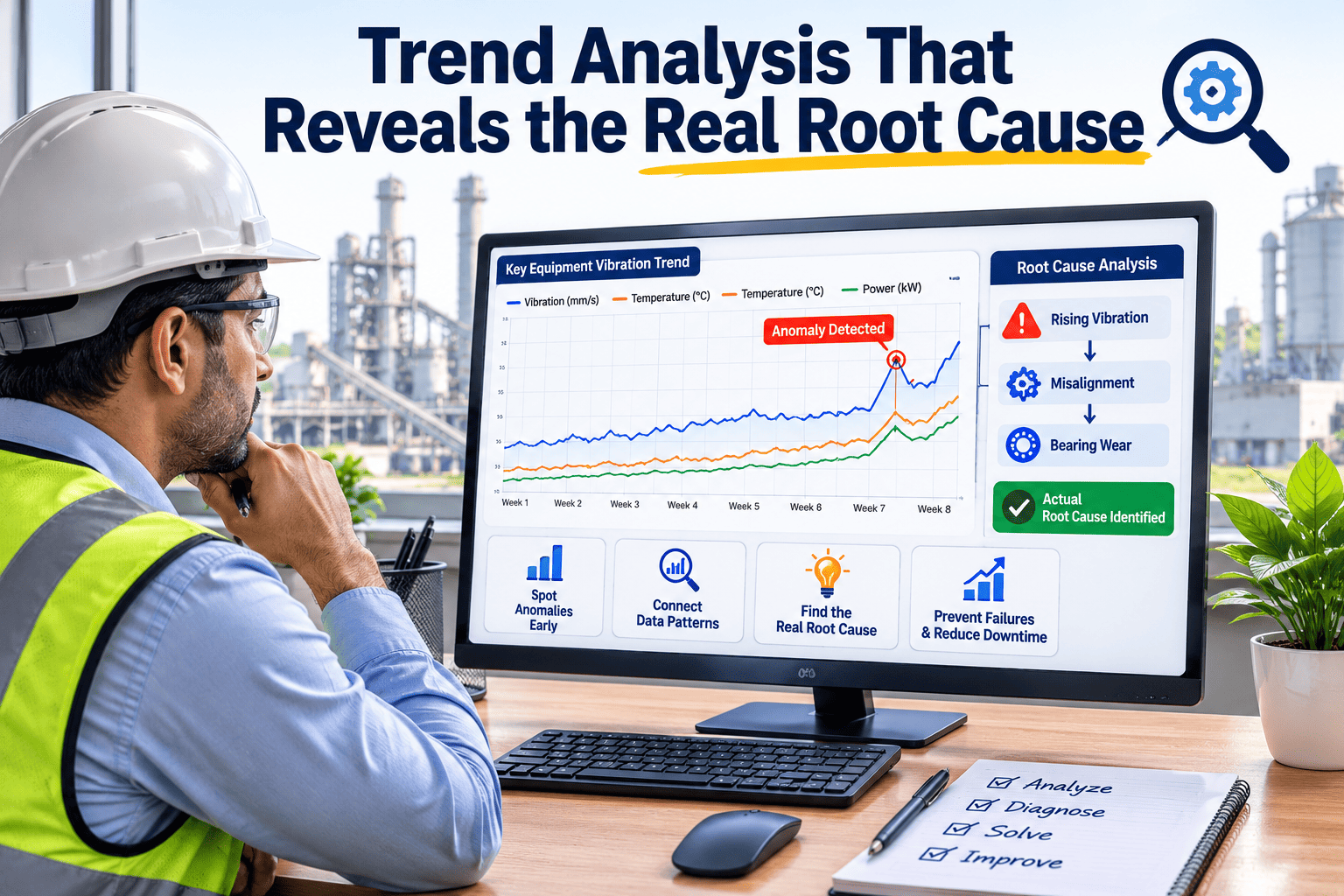
An accident investigation that produces only a claims package misses the opportunity that every incident creates: understanding what conditions allowed the accident to occur and correcting the systemic factor that will cause the next one. At fleets running 20 or more vehicles, the accident patterns that drive insurance premium increases are almost always systemic — a specific driver behavior, a vehicle maintenance gap, a route characteristic, or a dispatch practice that repeats across multiple incidents. Oxmaint's root cause analysis framework categorizes every incident across three factor groups: driver behavior (distraction, following distance, speed management, fatigue), vehicle condition (brake performance, tire condition, steering, lighting), and environmental or operational factors (route, time of day, weather, dispatch window pressure).
When multiple incidents share a root cause category, Oxmaint surfaces the pattern — and generates specific corrective actions. A pattern of rear-end incidents in a specific route corridor generates a driver coaching work item for the affected drivers and a review of dispatch scheduling on that route. A pattern of tire-related incidents generates a PM frequency review for the units involved. These targeted corrective actions are what move the Crash Indicator BASIC score and what insurance underwriters look for when pricing renewal premiums. Book a demo to see Oxmaint's root cause analysis dashboard.
We had a staged accident claim — the claimant said our driver ran a red light and hit them. The Oxmaint dashcam footage showed the claimant running the red and steering into our lane deliberately. The claim was dismissed in 6 weeks. Without that footage, we were looking at a $400,000 settlement. The system paid for itself on that one incident.
Frequently Asked Questions
-68% Claims Cost. 91% Fraud Detection. Complete Investigation in 72 Hours.
AI video accident investigation — live in Oxmaint within 1 week of dashcam integration.