Fleets are adding AI to flag likely failures, summarize driver reports, and suggest work orders. The risk is not the technology itself but unclear authority: who reviews an AI recommendation, what it is allowed to trigger, and who answers when it is wrong. Governance answers those questions before an automated suggestion takes a vehicle off the road or lets one stay on it. This article sets out practical review and action rules, and shows how a fleet maintenance CMMS keeps decisions traceable.
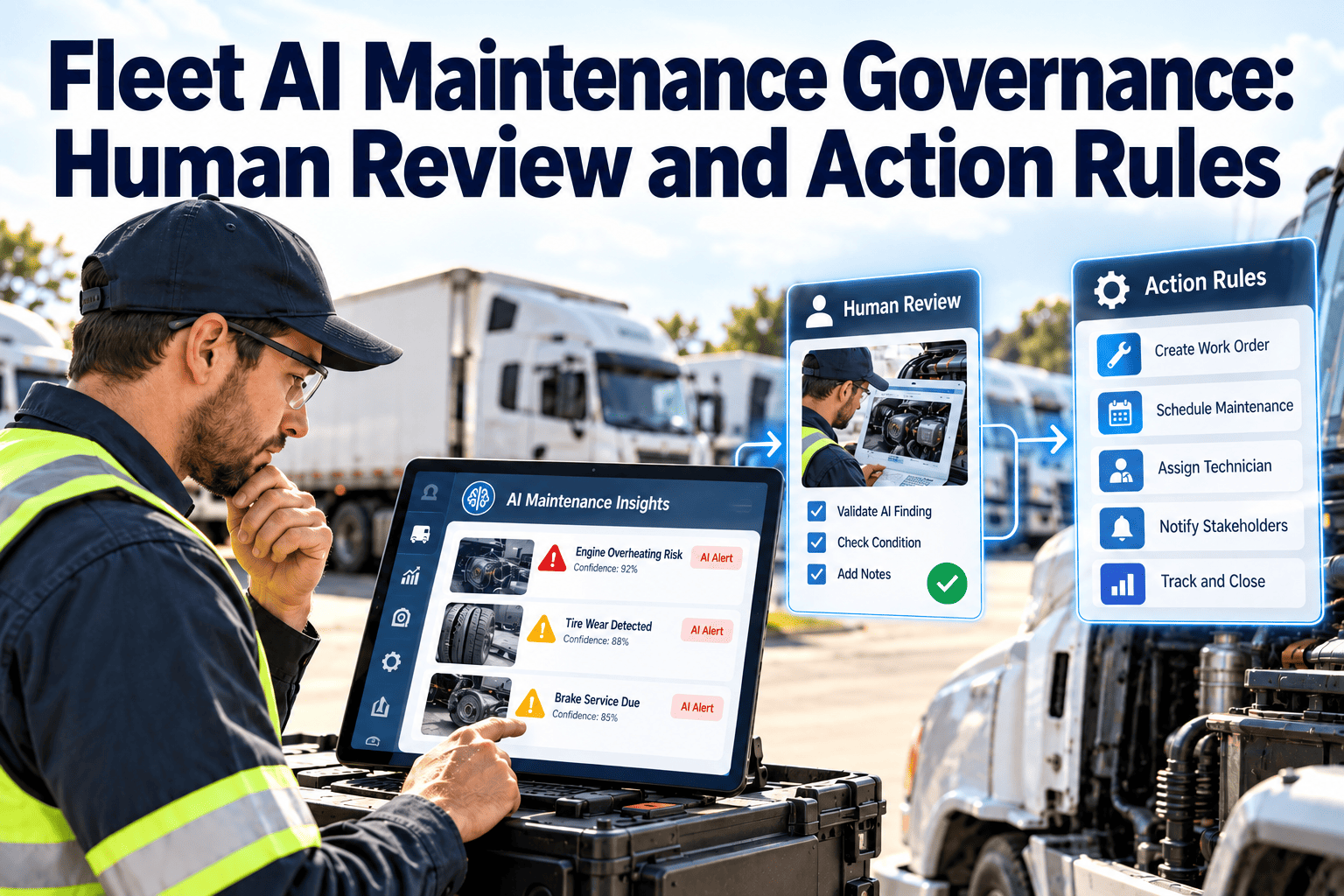
Fleet AI Maintenance Governance: Human Review and Action Rules
Decide in advance what AI may suggest, what a person must approve, and what is never automated.
Datathen
AI suggestionthen
Human reviewthen
Work orderthen
Audit record
What can go wrong without rules
False alarmHealthy vehicles pulled from service, wasting shop hours and eroding trust.
Missed warningA real defect is scored low and left in the queue.
Silent changeA model update changes behavior and nobody notices.
No ownerAfter an incident, nobody can show who approved what.
Match autonomy to consequence
The higher the safety or cost impact, the more human control is needed. Treat this table as a starting point for your own policy.| Action type | Example | AI role | Human role |
|---|---|---|---|
| Low impact, reversible | Summarize a driver note, suggest a category | May act automatically | Spot-check samples |
| Moderate impact | Propose a preventive task or parts list | Drafts only | Planner approves before release |
| Safety relevant | Recommend removing a vehicle from service | Flags with evidence | Qualified person decides |
| Compliance or legal | Certify a repair, clear a defect | Never decides | Authorized signer only |
Ten rules for human review
- Every AI output is labeled as a suggestion, with the data it used.
- Name an accountable reviewer for each action tier.
- Safety-relevant recommendations need a documented human decision.
- Reviewers can override and must record the reason.
- No AI output closes a defect or certifies a repair.
- Set confidence or severity thresholds, and route low-confidence items to people.
- Keep an audit trail of suggestion, reviewer, decision, and outcome.
- Review false alarms and misses monthly, and adjust thresholds.
- Log model or rule changes with a date and an owner.
- Train staff on what the system can and cannot see.
Who does what: responsibility map
| Role | Responsibility |
|---|---|
| Fleet manager | Owns the policy, approves automation levels, reviews exceptions |
| Maintenance planner | Reviews suggested work orders and scheduling changes |
| Lead technician | Confirms diagnoses and safety recommendations |
| Compliance lead | Checks that records meet regulatory expectations |
| Data or IT owner | Monitors data quality, access, and model changes |
Put a human decision between every suggestion and every action
Keep approvals, work orders, and asset history in a single traceable system.Data quality is a governance issue
- Predictions built on missing meter readings or unclosed work orders will mislead.
- Duplicate asset records split history and hide repeat failures.
- Inconsistent defect wording weakens any model trained on it.
Pre-launch checklist
- Asset records are unique and current.
- Work orders have failure cause and parts recorded.
- Inspection results are structured, not only free text.
- Access rights match each role.
- A fallback manual process exists if the tool is unavailable.
Measuring whether governance works
Override rateHow often reviewers reject suggestions, and why
Review timeDelay between suggestion and decision
Missed failuresBreakdowns that had no prior flag
Audit completenessDecisions with a named approver and reason
How Oxmaint supports controlled workflows
- Work orders. Suggested tasks become reviewed, assigned, and tracked jobs.
- Preventive and condition-based workflows. Triggers can be set from meter readings and inspection results under planner control.
- Asset history. Each decision and repair stays attached to the vehicle.
- Compliance records. Inspections, sign-offs, and repairs remain searchable.
- Reporting. Dashboards show overdue work, repeat failures, and review activity.
Where AI appears in fleet maintenance today
Governance starts with knowing which AI-style functions you actually use or plan to use, because each carries different risk.
| Use case | What it does | Main risk | Suggested control |
|---|---|---|---|
| Defect text summarization | Condenses driver notes into categories | Wrong category hides severity | Keep the original text visible, sample-check results |
| Failure prediction | Flags vehicles likely to fail from telematics and history | False alarms or missed events | Planner review, track hit and miss rates |
| Parts and labor suggestions | Proposes parts from past similar jobs | Wrong part ordered | Technician confirms before issue |
| Schedule optimization | Suggests service timing around utilization | Overdue safety items deferred | Hard rules for regulatory and safety intervals |
| Image review | Interprets photos of damage or wear | Misreads lighting or angle | Human confirmation for any safety call |
| Natural language search | Answers questions about maintenance records | Confident but incorrect answers | Show source records for every answer |
What a fleet AI policy should contain
- Purpose and scope. Which systems and decisions the policy covers.
- Approved uses. A list of permitted functions, with the autonomy tier for each.
- Prohibited uses. For example, closing safety defects or certifying repairs automatically.
- Roles. Named owners for approval, monitoring, and exceptions.
- Data rules. What data is used, who can access it, and how long it is kept.
- Review cadence. How often performance is examined and by whom.
- Change control. How new models, rules, or vendors are introduced.
- Incident handling. What happens when the system is wrong.
When the AI is wrong: an incident routine
1. ContainStop acting on the affected recommendations and fall back to manual review.
2. RecordLog the vehicle, the suggestion, the decision, and the outcome.
3. InvestigateCheck data quality, thresholds, and any recent changes.
4. CorrectAdjust rules or data, and note the change with an owner and date.
Questions for the post-incident review
- Did the reviewer have the information needed to challenge the suggestion?
- Was the threshold appropriate for this type of vehicle?
- Were similar errors visible earlier in the override or miss data?
- Does any other vehicle class face the same risk?
Questions to ask any AI or analytics vendor
- What data does the system use, and can we see which inputs drove a recommendation?
- How are accuracy, false alarms, and missed events measured and reported?
- How are model or rule changes announced and tested?
- Can we export our data and decision history?
- Who can access our fleet and driver data, and where is it stored?
- What happens to our workflow if the AI feature is switched off?
Red flags
- Claims of guaranteed accuracy without evidence from your own fleet.
- No way to override or annotate a recommendation.
- No audit history for who accepted or rejected suggestions.
Driver data, privacy, and fairness
- Limit collected data to what maintenance decisions need.
- Separate vehicle condition analysis from driver performance management unless there is a clear, disclosed policy.
- Tell drivers what inspection and telematics data is used and why.
- Check local employment and privacy rules before using data in any decision about people.
- Review whether recommendations treat depots, routes, or vehicle groups unevenly without good reason.
Training the people who review AI output
Know the inputsReviewers should understand what data feeds each suggestion.
Know the limitsExplain where the system is weak, such as new vehicle types.
Practice overridesMake rejecting a suggestion normal and easy to record.
Escalate doubtsGive a clear route when a reviewer is unsure.
A maturity path for fleet AI governance
| Stage | Typical state | Next step |
|---|---|---|
| 1. Manual records | Paper or scattered spreadsheets, no structured history | Centralize assets, inspections, and work orders |
| 2. Structured data | Consistent defect, cause, and parts fields | Add dashboards and simple rule-based alerts |
| 3. Assisted decisions | Suggestions reviewed by planners | Define approval tiers and audit records |
| 4. Governed automation | Low-risk tasks automated, monitored monthly | Expand carefully with measured results |
A monthly governance review agenda
- Review override rates and the most common reasons given.
- Examine breakdowns that were not flagged in advance.
- Check a sample of automated low-impact actions for accuracy.
- Confirm that every safety-relevant decision has a named approver.
- Review data quality issues, such as missing readings or duplicate assets.
- Record any rule, threshold, or vendor changes made since the last review.
Setting thresholds that people can trust
- Start conservative. Begin with fewer, higher-confidence alerts so reviewers do not drown in noise.
- Separate by consequence. Use stricter thresholds for safety systems than for cosmetic items.
- Tune by vehicle class. A threshold that suits vans may not suit heavy trucks.
- Track both error types. Count false alarms and missed failures, since reducing one often raises the other.
- Change one thing at a time. This makes it clear which adjustment caused a result.
Alert fatigue is a governance risk
- If reviewers approve everything without reading, the human check is only nominal.
- Monitor how quickly decisions are made. Very fast bulk approvals deserve a closer look.
- Rotate sampling reviews so someone checks the checkers.
Documenting a decision: the minimum record
| Field | Example content | Purpose |
|---|---|---|
| Suggestion | Replace brake chamber on unit, high wear flagged | Shows what the system proposed |
| Evidence | Inspection results, meter reading, repair history | Lets others see the basis |
| Reviewer | Named planner or technician | Establishes accountability |
| Decision | Accepted, modified, or rejected | Records the human judgment |
| Reason | Short note, mandatory on rejection | Feeds improvement of rules |
| Outcome | Repair findings and closure date | Allows accuracy to be measured |
Safety-critical systems need extra care
- Brakes, steering, tires, and restraint systems should never rely on an unreviewed automated decision.
- Defects affecting road legality should follow existing regulatory processes first, with AI as a supporting tool at most.
- Where the system suggests deferring a safety item, require a second qualified reviewer.
- Keep manual inspection and test steps in place, even when predictions are positive.
- Record when a human overrides an AI recommendation to continue operating, as well as when they park a vehicle.
Roles in the review chain, in practice
Suggestion ownerMonitors that suggestions reach the right queue and are not ignored.
Decision ownerAccepts, modifies, or rejects and records why.
Quality ownerSamples decisions and measures accuracy and delay.
Policy ownerUpdates tiers, thresholds, and training from findings.
Practical examples of rules in action
- Driver note summarization. The system proposes the category "tire". The planner sees the original note, confirms or edits it, and the final category is stored.
- Predicted failure flag. A recommendation appears on a vehicle with rising defect reports. A lead technician inspects it, records findings, and only then is a work order released.
- Schedule suggestion. The system proposes moving a service later. A hard rule blocks any move past a legal or safety interval, regardless of the suggestion.
- Parts suggestion. The proposed parts list is shown on the work order. The technician confirms fitment before issue.
Metrics for the governance scorecard
| Metric | Healthy sign | Warning sign |
|---|---|---|
| Override rate | Moderate, with clear reasons | Near zero, suggesting rubber-stamping, or very high, suggesting poor suggestions |
| Decision delay | Within target for each tier | Safety items waiting longer than routine ones |
| Prediction hit rate | Improving as data improves | Stable but weak, or falling after a change |
| Unflagged failures | Few, with lessons recorded | Repeated misses in one vehicle class |
| Audit completeness | Nearly all decisions fully recorded | Missing approvers or reasons |
Starting point: a 60-day governance kickoff
- Days 1 to 15. Inventory current and planned AI features. Assign owners. Draft a one-page policy.
- Days 16 to 30. Clean asset and work order data. Define approval tiers and decision record fields.
- Days 31 to 45. Pilot one use case on one vehicle class with planner review on every suggestion.
- Days 46 to 60. Hold the first monthly review. Adjust thresholds and training. Decide whether to expand.
Keeping governance proportionate
Rules should match the size and risk of your fleet. A small operation does not need a committee, but it does need clarity.
- Small fleets. One named owner, a one-page policy, and a monthly look at decisions and misses are usually enough.
- Mid-size fleets. Add depot-level reviewers, a shared decision record, and a quarterly policy review.
- Large or regulated fleets. Add formal change control, independent sampling, and links to compliance and legal teams.
Signs your governance is too heavy
- Reviewers bypass the system because approvals take too long.
- Low-risk suggestions queue alongside safety items.
- Records are completed after the fact rather than at the decision.
Signs it is too light
- Nobody can say who approved a recent safety-related action.
- Model or rule changes happen without notice.
- Override reasons are never reviewed.