A breakdown that is fixed but not recorded properly will happen again. Many fleets log the repair and move on, so the cause, the warning signs and the operating conditions disappear. Root cause analysis needs better raw material than "engine stopped, replaced part." This checklist guide gives you a breakdown log template built for analysis, with the fields, classifications and review steps that turn failures into lessons, and shows how Oxmaint fleet maintenance software can keep the evidence attached to each vehicle.
Fleet Breakdown Log Template for Root Cause Analysis
Tick through this checklist to record what failed, what led to it and what was changed, so repeat breakdowns are traced to causes instead of symptoms.
Checklist 1: Is Your Breakdown Log Analysis-Ready?
A log is only useful if it answers questions you have not asked yet. Tick each weakness you have fixed:
- Replace free-text descriptions that cannot be grouped or counted.
- No record of what the vehicle was doing when it failed.
- Repairs listed without the failed component or failure mode.
- No link to previous repairs or recent maintenance.
- Corrective actions mentioned in conversation but never tracked.
A structured template fixes these problems without making the log hard to complete.
Checklist 2: Complete the Template in Four Stages
Each breakdown record has four parts, and different people complete different parts.
Stage 1: Event (driver or dispatcher)- Date, time, location and vehicle ID recorded at the time of failure.
- Symptoms and warning signs described by the driver.
- System, component and failure mode selected after inspection.
- Evidence attached: photos, readings or fault codes.
- Work performed, parts used and labor hours recorded.
- Downtime start and vehicle-ready time captured.
- Root cause category and statement recorded.
- Corrective action has an owner and due date.
Template Fields by Stage
| Stage | Field | Purpose |
|---|---|---|
| Event | Date, time, location, vehicle ID | Identifies the event and links to asset history |
| Event | Odometer and engine hours | Shows age and usage at failure |
| Event | Driver description and warning signs | Captures symptoms before the failure |
| Event | Load, weather, road and duty conditions | Exposes operating causes |
| Event | Vehicle status: roadside, towed, drove in | Measures severity and recovery cost |
| Diagnosis | System, component and failure mode | Allows grouping and Pareto analysis |
| Diagnosis | Evidence: photos, readings, fault codes | Supports the conclusion |
| Repair | Work performed, parts used, labor hours | Measures repair effort and cost |
| Repair | Downtime start and vehicle-ready time | Measures service impact |
| Analysis | Root cause category and statement | Records why it happened |
| Analysis | Corrective and preventive actions, owner, due date | Prevents recurrence |
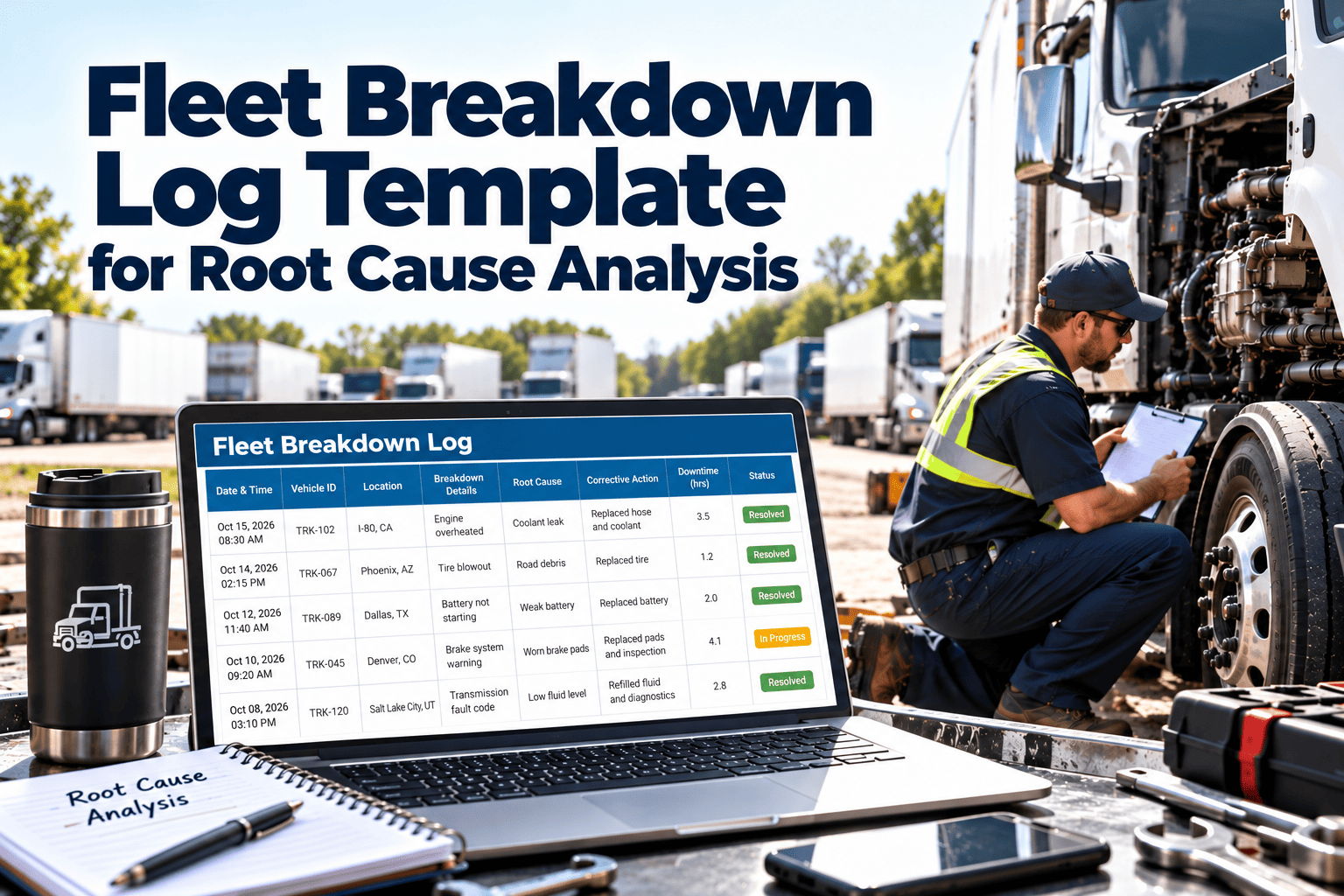
An Illustrative Completed Record
This example shows the level of detail that makes a log useful. It is not real data.
Checklist 3: Classify Every Failure So Patterns Appear
Use drop-down lists instead of free text for key fields.
- System selected from a list: engine, cooling, fuel, brakes, electrical, transmission, suspension, tires, body or auxiliary.
- Failure mode selected: leak, wear, fracture, overheating, short circuit, contamination, loose fastener or software fault.
- Cause category selected: missed PM, inspection gap, operator practice, part quality, repair quality, design or environment.
- Severity selected: delay only, towed, safety event, customer impact or cargo loss.
Keep Breakdown Evidence With the Vehicle
Record failures, repairs and corrective actions in one asset history, so every breakdown informs the next maintenance decision.
Choosing an RCA Method for Fleet Failures
| Method | Best used for | Watch out for |
|---|---|---|
| 5 Whys | Simple failures with a clear chain of cause | Stopping at the first convenient answer |
| Fishbone diagram | Failures with several possible contributors | Listing causes without testing them |
| Pareto analysis | Finding which failures cost the most or recur most | Poor classification in the log |
| Failure mode review | Recurring failures on one component type | Needs enough history to be meaningful |
| Fault tree | Safety events or complex multi-system failures | Takes time and skilled facilitation |
Checklist 4: Fishbone Prompts for Unclear Failures
When a failure is not obvious, ask these questions in each category.
- Machine: age, wear, design weakness or previous repairs considered.
- Method: PM or inspection step missing or unclear.
- Materials: parts and fluids correct and of acceptable quality.
- People: training, workload or communication reviewed.
- Measurement: warning signs, readings or alerts missed.
- Environment: heat, cold, dust, road quality, load or duty cycle checked.
Checklist 5: When a Breakdown Triggers Formal Review
Not every failure needs a full analysis. Set clear triggers so effort goes where it matters.
- Always review safety incidents and breakdowns causing cargo loss or major customer impact.
- Review repeat failure modes on the same vehicle or fleet group within a set period.
- Review repairs or downtime above a defined cost threshold.
- Review failures of new vehicles, new parts or recent repairs.
- Review a small routine sample of other failures to find hidden patterns.
Checklist 6: Corrective Actions That Stick
- Action updates the inspection or PM job plan.
- Part specification or supplier is changed where quality is the cause.
- A named owner and due date are assigned.
- A recheck is scheduled after a set interval.
- Actions such as "remind drivers" or "replace the part again" are not accepted alone.
Master Breakdown Log Checklist
Capture- Every record includes vehicle, date, location, odometer and conditions.
- Driver symptoms and warning signs are captured in the event stage.
- Photos, fault codes or readings are attached as evidence.
- Technician records system, component and failure mode from lists.
- Downtime start and return-to-service times are recorded.
- Parts, labor and cost are linked to the work order.
- Root cause category is assigned after review, not guessed at the roadside.
- Corrective actions have owners, due dates and follow-up checks.
- Repeat failures are reviewed on a regular schedule.
- Findings update inspection checklists and PM job plans.
Score your readiness
How Oxmaint Supports Breakdown Analysis
The template works best when it lives inside the maintenance workflow instead of beside it.
- Corrective maintenance work orders capture cause, work done, labor and parts.
- Asset history lets teams see previous repairs on the same vehicle.
- Preventive maintenance and inspection checklists can be updated after analysis.
- Inventory records show which parts are used most often.
- Reports help rank failures by frequency, downtime and cost.
Measures to Track From the Log
Breakdown Log and RCA FAQs
What should a fleet breakdown log include?
Event details, symptoms, diagnosis, repair, downtime, root cause and corrective actions.
Who should complete it?
Drivers cover the event, technicians the repair, and supervisors the analysis.
Do we analyze every breakdown?
No. Use triggers such as safety impact, repeat failure and high cost.
Can a CMMS replace a spreadsheet log?
It links logs to assets and work orders. Start with Oxmaint.
How do we start?
Begin with your most disruptive vehicles. Book a demo for guidance.
Turn Every Breakdown Into a Fix That Lasts
Use Oxmaint to connect breakdown records, work orders, asset history and preventive maintenance, and reduce repeat failures across your fleet.