Truck Fleet Inspection Checklist: Maintaining Safety and Compliance
By Horid Josh on March 17, 2026
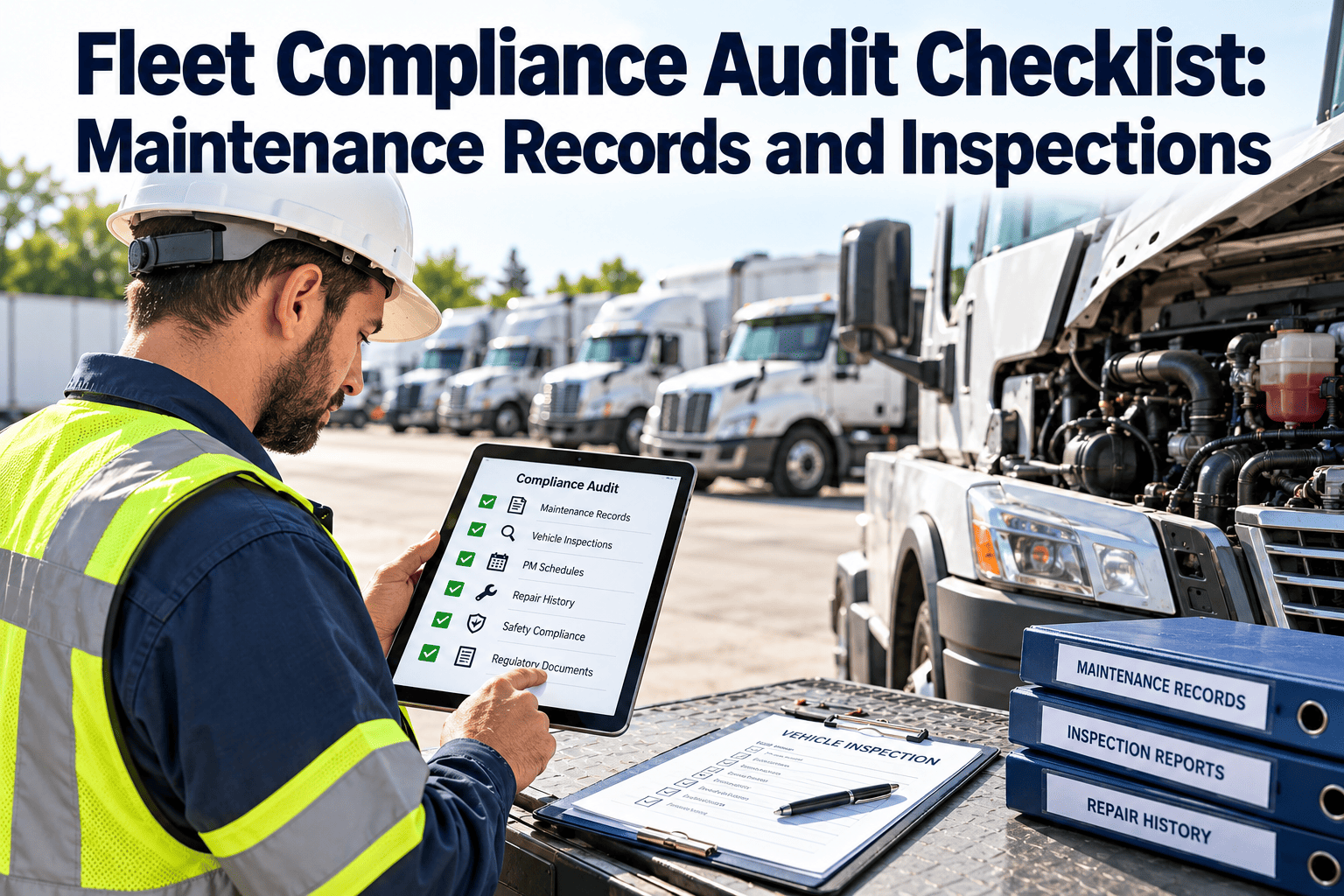
A single DOT out-of-service violation costs a commercial trucking operation between $16,000 and $25,000 in direct costs — fines, towing, driver downtime, and missed loads. The Federal Motor Carrier Safety Administration placed 5.1% of commercial vehicles inspected in 2024 out of service on the spot, with brake system defects and lighting violations accounting for 52% of all violations recorded. Every one of those violations was detectable by a thorough pre-trip inspection. The FMCSA's CSA scoring system means that violations accumulate into carrier safety ratings that affect insurance premiums, shipper contracts, and operating authority — making inspection compliance not just a safety matter but a business-critical financial issue for every commercial fleet operator. This checklist covers the complete truck fleet inspection framework across four phases: pre-trip driver inspection, post-trip driver inspection, preventive maintenance inspection, and annual DOT compliance inspection. Fleets using OxMaint's digital inspection platform execute every inspection task on mobile, generate audit-ready reports automatically, and build a continuous compliance record per vehicle that satisfies FMCSA documentation requirements without paper. Book a demo to see digital DVIR and inspection compliance tracking configured for your fleet.
4Inspection Phases
52Checklist Items
5.1%OOS Rate — 2024 FMCSA Data
$25KAvg. Cost Per OOS Violation
Priority:Critical OOS violation risk — must not be skippedHigh CSA points or compliance impactStandard Required before inspection sign-off
Est. 15–20 minutesCDL Driver — Required Before Every DispatchFMCSA 49 CFR 392.7 Mandatory
The pre-trip DVIR is a federal requirement under 49 CFR 392.7. Drivers must inspect their vehicle before each trip and certify that it is safe to operate. Failure to complete a DVIR generates a CSA violation in the Fatigued Driving BASIC and can result on-the-spot OOS orders at roadside checks. Complete every item — do not sign off on a vehicle with unresolved defects.
1.1 Engine Compartment and Fluid Levels
#
Inspection Item
Pass Criteria
Priority
Driver Sign-Off
1.1.1
Engine oil level — check dipstick with engine off and vehicle on level ground. Inspect for contamination, milky appearance, or metallic particles on dipstick.
Between Min and Max marks. No contamination. If low, top up and recheck. If contaminated, remove from service.
Critical
________
1.1.2
Coolant level — check surge tank or radiator cap (cold engine only). Inspect hoses for swelling, cracking, or soft spots. Check clamp tightness at hose ends.
Coolant at MIN or above in surge tank. Hoses firm and free of damage. Clamps tight.
Critical
________
1.1.3
Power steering fluid level — check reservoir with engine cold. Inspect power steering lines for seepage, chafing, or loose fittings at the pump and rack connections.
Fluid at correct level for cold engine. Lines intact with no active leakage.
High
________
1.1.4
Windshield washer fluid — check reservoir level. Verify spray nozzles functional and aimed correctly at windshield. Non-functional washers are a DVIR defect in winter operating conditions.
Reservoir has sufficient fluid. Both nozzles functional and aimed at windshield.
Standard
________
1.1.5
Belt and fan inspection — check serpentine belt or V-belt for cracking, fraying, glazing, or incorrect tension. Check fan blade for cracks, missing balance weights, or contact with shroud.
Belt in good condition with no cracking or glazing. Tension correct. Fan blades intact with no contact.
High
________
1.2 Brake System — OOS Violation Risk Category
#
Brake System Check
Pass Criteria and OOS Threshold
Priority
Driver Sign-Off
1.2.1
Air brake system pressure build-up — with engine running, note time for air pressure to build from 50 PSI to governor cut-out. Maximum build time is 3 minutes for a single vehicle.
Pressure builds from 50 PSI to governor cut-out (typically 120–135 PSI) within 3 minutes. Time recorded on DVIR.
Critical
________
1.2.2
Air brake low pressure warning — with key on and engine off, reduce air pressure by fanning brakes. Verify low-pressure warning activates at or above 60 PSI. Warning must be audible and/or visual.
Warning activates at or above 60 PSI. Audible and/or visual alert confirmed functional.
Critical
________
1.2.3
Parking brake — apply parking brake with wheels chocked. Attempt to drive forward gently against parking brake. Verify brake holds without slipping. Release and confirm full release before movement.
Parking brake holds vehicle stationary against gentle forward movement. Full release confirmed on indicator.
Critical
________
1.2.4
Slack adjuster check — with parking brake released and wheels chocked, manually check pushrod travel at each brake chamber. OOS threshold is 1 inch travel for type 30 chambers at 90 PSI application.
Pushrod travel within OOS threshold. Any chamber at or above 1 inch (type 30) must be adjusted before departure. Recorded per axle.
Critical
________
1.2.5
Brake hoses and chambers — visually inspect all brake hoses for cracking, chafing, or loose connections. Inspect brake chambers for cracks, loose mounting bolts, or rubber diaphragm damage.
All hoses intact and secured. No audible air leaks. Chambers mounted securely with no cracks.
Critical
________
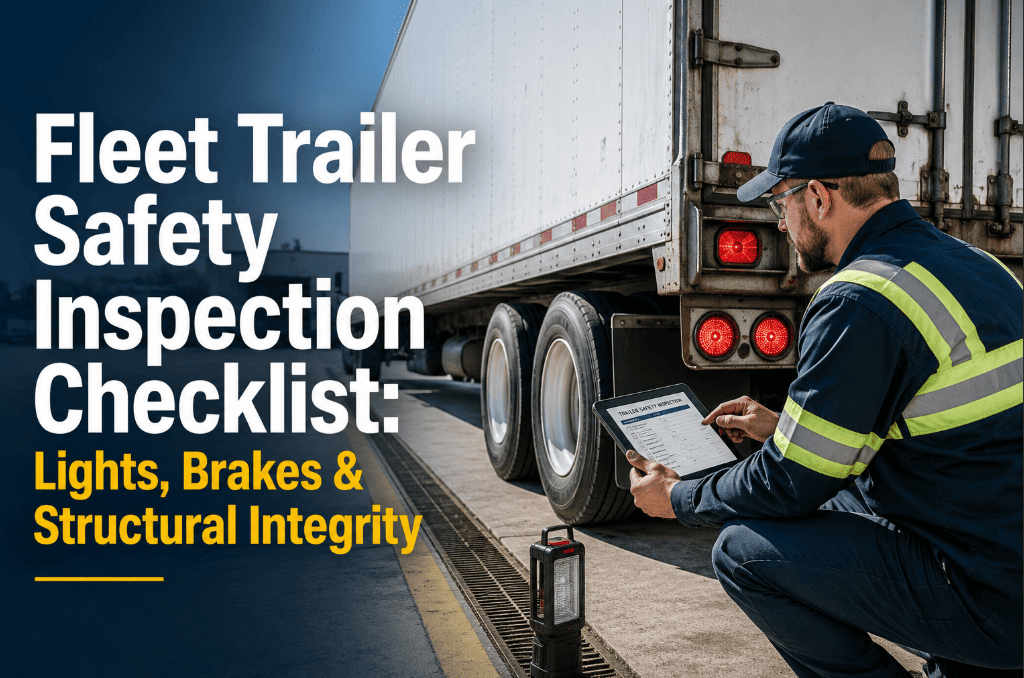
1.3 Lights, Signals, and Electrical Systems
#
Electrical and Lighting Check
Pass Criteria
Priority
Driver Sign-Off
1.3.1
Headlights — test low and high beam on both units. Check alignment visually — headlights aimed too high are a roadside violation. Check for cracked lenses or moisture intrusion causing reduced output.
Both low and high beams functional on all units. Lenses intact with no moisture. Alignment within normal range.
Critical
________
1.3.2
Brake lights and turn signals — with helper or reflective surface behind vehicle, test all brake lights and turn signals on tractor and trailer. Check marker lights and clearance lights on trailer.
All brake lights functional. Both turn signals flash at correct rate. All marker and clearance lights operational.
Critical
________
1.3.3
Hazard flashers — test all hazard warning lights functional at correct flash rate. Non-functional hazard lights are an OOS violation under FMCSA regulations for all CMVs.
All hazard lights functional. Flash rate normal. No single unit failure on 4-way hazard circuit.
Critical
________
1.3.4
Dashboard warning lights — start engine and confirm all warning lights extinguish within normal time. Note any illuminated MIL, ABS, brake, or airbag warning lights and escalate before departure.
No active warning lights after normal start-up warm-up period. Any active warning light is a DVIR defect requiring investigation before departure.
High
________
1.4 Tires, Wheels, and Coupling Devices
#
Tire, Wheel, and Coupling Check
Pass Criteria and OOS Thresholds
Priority
Driver Sign-Off
1.4.1
Tire tread depth — check all tires with tread depth gauge. OOS threshold is 2/32 inch on front steering axle tires and 1/32 inch on all other axle positions. Check inner dual tires on rear axles.
Steering tires above 4/32 recommended (2/32 OOS). Drive and trailer tires above 2/32 recommended (1/32 OOS). All measurements recorded on DVIR.
Critical
________
1.4.2
Tire inflation — check tire pressure on all positions using calibrated pressure gauge. Record pressure per position. Tires more than 20% under-inflated are an OOS violation. Check for visible sidewall damage, bulging, or separation.
All tires within 10% of rated inflation. No sidewall damage, bulging, or exposed cord. Pressure recorded per position on DVIR.
Critical
________
1.4.3
Wheel and lug nuts — check all lug nuts for correct torque visually (rust streaks indicate loose nuts), missing nuts, or damaged studs. Check wheel for cracks, bent flanges, or loose hub seals with oil leakage.
No rust streaks indicating loose lug nuts. No missing or damaged studs. Wheels free of cracks or oil leakage from hub seals.
Critical
________
1.4.4
Fifth wheel coupling — verify fifth wheel jaw is fully locked on kingpin with jaws fully closed. Apply tug test — apply tractor brakes and attempt to separate tractor from trailer. No separation movement confirms proper lock.
Fifth wheel jaw confirmed locked. Tug test shows no separation. Kingpin fully seated in throat. Safety latch engaged.
Critical
________
GATE 1All pre-trip items inspected. No unresolved defects. Driver signature on DVIR confirms vehicle safe to operate. Vehicles with unresolved critical defects must not depart until repairs are completed and re-inspected.
OxMaint Digital DVIR
Digital pre-trip DVIRs completed on mobile, automatically filed per vehicle, and flagged to maintenance when defects are reported — FMCSA-compliant records generated without paper. Book a demo to see digital DVIR compliance tracking live.
Est. 10–15 minutesCDL Driver — Required After Each TripFMCSA 49 CFR 396.11 Mandatory
The post-trip DVIR documents any defects found during the trip or at trip completion. Defects must be reported in writing — verbal reports do not satisfy 49 CFR 396.11. The signed post-trip DVIR must be retained for 3 months per FMCSA requirements. Any defect that affects safe operation must be repaired before the next dispatch.
2.1 End-of-Trip Condition Inspection and Defect Reporting
#
Post-Trip Check Item
Report Criteria and Action Required
Priority
Driver Sign-Off
2.1.1
Walk-around inspection after engine off — check all four corners of tractor and trailer for new damage, missing panels, dragging items, or loose cargo securing equipment not present at pre-trip.
All new damage or changes from pre-trip condition documented with description and location on post-trip DVIR. Photographs taken for significant damage.
High
________
2.1.2
Tire condition after trip — check all tires for heat damage, blowout indicators, sidewall bruising from curb strikes, or flat spots from emergency braking. Check for foreign objects embedded in tread.
Any tire damage found at post-trip documented with position and description. Tires with heat damage or sidewall bruising removed from service before next trip.
Critical
________
2.1.3
Fluid leak check — inspect under tractor and trailer for new fluid stains indicating oil, coolant, fuel, or air brake system leaks developed during the trip. Note location and approximate volume.
Any new fluid stains documented with system identification, location, and estimated severity. Active drips require maintenance notification before next dispatch.
Critical
________
2.1.4
Driver-reported mechanical observations — document any abnormal performance conditions experienced during the trip: unusual brake feel, steering pull, vibration, noise, or instrument gauge anomalies. All reported conditions carry over to the next pre-trip.
All in-trip observations documented in specific detail — not "brakes feel off" but "brake pedal fades at highway speeds above 65 mph." Maintenance notified of all safety-related observations before next dispatch.
Critical
________
2.1.5
DVIR certification — driver certifies in writing that the vehicle is either free of defects (Section A), has defects that have been reported (Section B — defects listed), or has defects listed that do not affect safe operation (Section B with safety certification). Incorrect certification is a federal violation.
Correct section signed per vehicle condition. If defects are listed, maintenance acknowledgement section must be signed before next dispatch. DVIR retained for 3 months minimum.
Critical
________
GATE 2Post-trip DVIR completed and signed. All defects reported in writing. Maintenance notified of any safety-affecting defects. Defects affecting safe operation must be repaired and re-inspected before next dispatch.
52% of OOS Violations — Preventable
Brake defects and lighting violations cause 52% of all commercial vehicle OOS orders. OxMaint routes defect reports from post-trip DVIRs directly to maintenance work orders — eliminating the inspection-to-repair gap that lets defects accumulate into violations. See defect-to-work-order routing live.
Est. 2–4 hoursCertified Diesel TechnicianTypically Every 10,000–25,000 Miles or Per OEM Schedule
The PM inspection is the structured maintenance-level inspection that goes beyond the driver's daily DVIR to assess wear rates, measure brake components to OOS thresholds, and identify developing failures before they generate violations or roadside breakdowns. All measurements must be recorded per unit in the CMMS asset history to enable trend analysis across service intervals.
3.1 Brake System Measurement and Assessment
#
PM Brake Inspection Item
Measurement Criteria and OOS Threshold
Priority
Tech Sign-Off
3.1.1
Brake lining thickness — measure lining thickness at the thinnest point on each shoe or pad per axle position. Record measurement against position code in CMMS. OOS threshold is 1/4 inch for drum brakes on steering axle, 1/8 inch on other positions.
Steering axle lining above 5/16 inch recommended (1/4 inch OOS). All other positions above 3/16 inch recommended (1/8 inch OOS). All measurements recorded per position.
Critical
________
3.1.2
Brake drum or rotor condition — measure drum diameter at wear zone and compare against maximum diameter stamped on drum. For disc brakes, measure rotor thickness and compare against minimum discard thickness cast into rotor.
Drum diameter at or below maximum marked on drum. Rotor at or above minimum discard thickness. Measurement and drum/rotor condition recorded per position in CMMS.
Critical
________
3.1.3
Automatic slack adjuster function — test each ASA for correct free stroke and automatic adjustment capability. Manually check pushrod travel at 90 PSI application. Replace any ASA that cannot maintain pushrod travel within OOS threshold automatically.
All ASAs within OOS threshold at 90 PSI. Pushrod travel recorded per position. Any ASA requiring manual adjustment noted for replacement — manual adjustment of ASAs is a violation indicator.
Critical
________
3.1.4
Air dryer function — drain air tanks at both drain valves and check for oil contamination in the air system. Excessive oil in desiccant dryer indicates cartridge replacement needed. Contaminated brake system air causes seal damage and brake chamber failure.
Minimal moisture from drain valves on desiccant-equipped systems. No oil contamination in drained air. Dryer cartridge replacement interval checked against CMMS history.
High
________
3.2 Steering, Suspension, and Structural Inspection
#
Steering and Suspension PM Item
Measurement Criteria and OOS Threshold
Priority
Tech Sign-Off
3.2.1
Steering play — with wheels straight ahead and vehicle on flat ground, measure steering wheel free play before resistance at the wheel. OOS threshold is 2 inches of free play measured at the steering wheel rim for vehicles with power steering.
Free play below 2 inches at steering wheel rim. Play recorded in CMMS. Trend increase of more than 0.5 inches since last PM triggers steering system inspection.
Critical
________
3.2.2
King pin wear — check front axle king pins for play using a dial indicator or pry bar test. OOS threshold is 1/4 inch longitudinal play or 3/8 inch lateral play on front steering axle pins.
King pin play below OOS threshold on both front axle positions. Measurements recorded in CMMS per position. Trend tracking reveals replacement schedule before OOS threshold is reached.
Critical
________
3.2.3
Leaf spring or air suspension inspection — check leaf springs for broken, cracked, or missing leaves. For air suspension, check air bags for cracks, rubbing, or loss of air ride height. Check shock absorbers for active leakage.
No broken or missing spring leaves. Air bags intact with no chafing. Shock absorbers dry with no active leakage. Condition rated and recorded per axle position in CMMS.
High
________
3.2.4
Frame and cross-member inspection — visually inspect frame rails and cross-members for cracks, repairs, or unauthorized modifications. Pay particular attention to gusset areas around fifth wheel mounting, cab mounts, and rear suspension brackets.
No active cracks or repairs in frame rails or cross-members. Any crack detected requires engineering assessment before vehicle returns to service. Condition recorded in CMMS asset history.
Critical
________
GATE 3All PM inspection items measured and recorded. All measurements within safe service limits or repairs completed. CMMS work order closed with findings. Vehicle available for dispatch after Gate 3 sign-off and any required repairs are completed.
CSA Score Management
OxMaint tracks brake lining thickness, king pin wear, and tire tread depth trends per vehicle across every PM — surfacing approaching OOS thresholds 1–2 service intervals before they become violations at roadside. See measurement trend tracking live.
Every 12 Months Per VehicleQualified Inspector Per 49 CFR 396.19Records Retained 14 Months Minimum
Annual inspections under 49 CFR 396.17 must be performed by a qualified inspector meeting the training and experience requirements of 49 CFR 396.19. The completed inspection report must be retained for 14 months. Vehicles that pass must have a copy of the inspection report or a decal in the cab. Failure to have a current annual inspection is an automatic OOS violation at roadside.
4.1 Annual Inspection Key Systems and Sign-Off Requirements
#
Annual Inspection System Check
Pass Criteria and Documentation Requirement
Priority
Inspector Sign-Off
4.1.1
Brake system — full brake system inspection per 49 CFR Part 393 Subpart C. Includes brake adjustment, lining condition, drum or rotor condition, hose and tubing condition, air system leakage test, and parking brake function test.
All brake system components within FMCSA service limits. Brake adjustment within OOS thresholds. Air leakage below 2 PSI/minute with brakes released and 3 PSI/minute with brakes applied. Inspector credentials verified and recorded.
Critical
________
4.1.2
Lighting — all required lighting per 49 CFR Part 393 Subpart B tested and documented. Includes headlights, tail lights, brake lights, turn signals, clearance lights, marker lights, and reflectors. All lamps must meet color and mounting requirements.
All required lamps functional and meeting color and mounting requirements. Reflectors clean and meeting retroreflective requirements. All lighting documented per position on annual inspection report.
Critical
________
4.1.3
Steering mechanism — full steering system inspection including steering column, gear box, pitman arm, drag link, tie rod ends, steering arm, and power steering pump and hoses. All components measured against OOS thresholds in Appendix G to Subchapter B of Chapter III.
All steering components within OOS thresholds. Steering wheel free play within limits. Power steering operational with no active leaks. All measurements and condition ratings documented on inspection report.
Critical
________
4.1.4
Tires and wheels — all tires measured for tread depth and checked for OOS conditions including regrooved tires on steering axles, exposed cord, bulges, separations, or flat tires. All wheels checked for cracks, missing lug nuts, and hub seal condition.
All tires above OOS minimum tread depths. No prohibited conditions present. Wheels free of cracks and hub seals intact. Tread depth and condition recorded per position on inspection report.
Critical
________
4.1.5
Annual inspection documentation and vehicle certification — inspector completes and signs the FMCSA-format annual inspection report. Original retained in fleet records for 14 months. Copy placed in vehicle cab or inspection decal affixed to vehicle. Inspector credentials attached to report.
Signed inspection report in CMMS against vehicle asset record with inspector credentials. Copy in vehicle cab or approved decal. Retention period set to 14 months from inspection date in CMMS. Next inspection due date scheduled automatically.
Critical
________
COMPLETEAll four inspection phases completed and signed. Annual inspection report filed in CMMS. Next annual due date auto-scheduled. Vehicle carries a current annual inspection certification and is compliant for commercial operation.
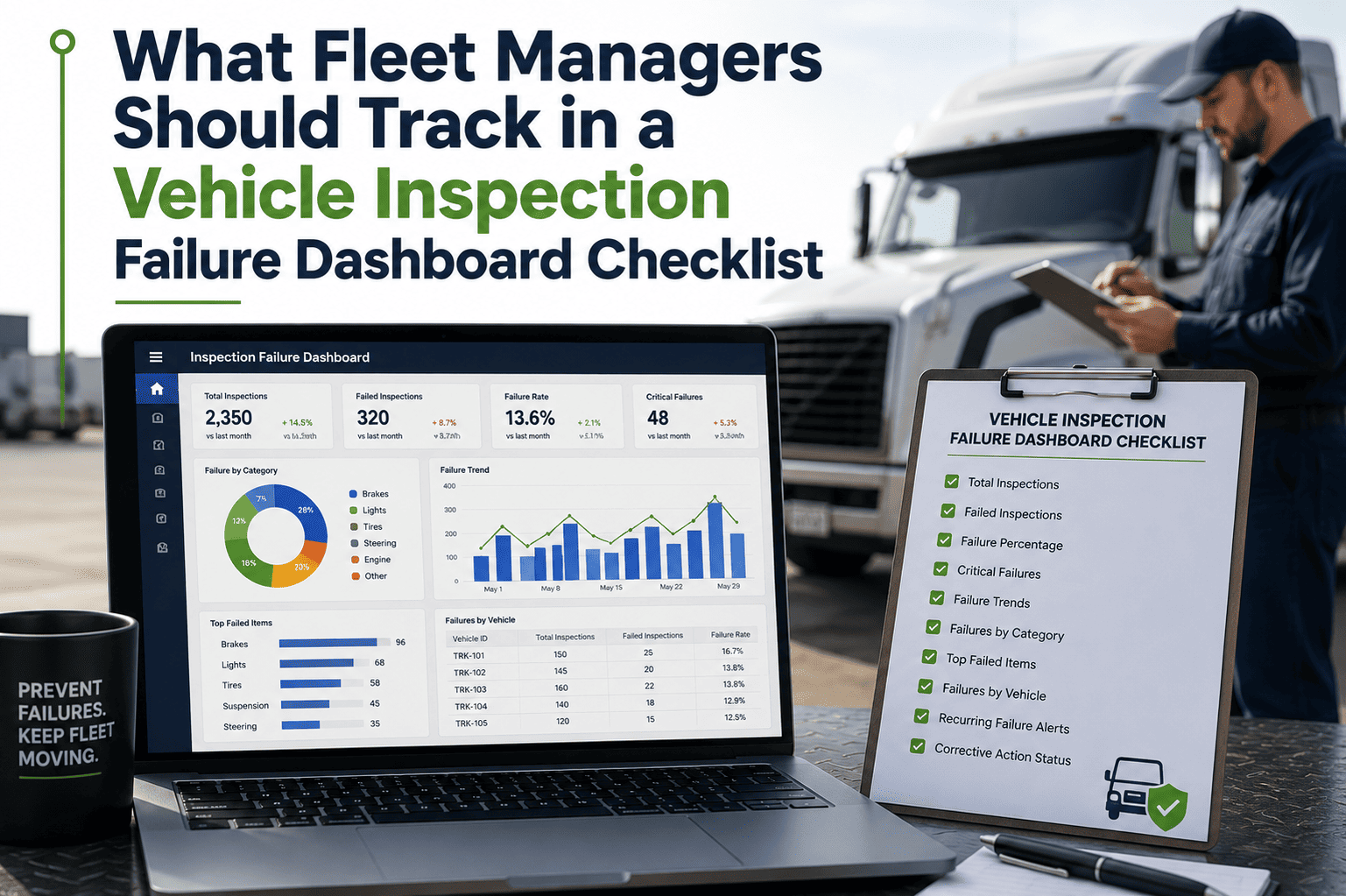
Truck Fleet Inspection KPIs Every Fleet Manager Should Track
Executing inspections correctly is only half the compliance program. Measuring the program's effectiveness across the fleet prevents violation patterns before they accumulate CSA points that affect insurance premiums and operating authority. OxMaint calculates every one of these KPIs automatically from your inspection and work order data.
100%
DVIR Completion Rate Target
Percentage of required pre- and post-trip DVIRs completed per dispatch. FMCSA requires 100% — any gap is a federal violation. Fleets below 95% are at high risk of CSA violations and carrier safety rating downgrades.
Percentage of fleet vehicles operating with an expired annual DOT inspection. Each vehicle without a current annual inspection is an automatic OOS violation at any roadside check — a single overdue vehicle can generate thousands in fines and towing costs.
Common without CMMS tracking: 8–15%Target: 0% with auto-scheduling
85%
Roadside Inspection Pass Rate
Percentage of roadside Level I inspections completed without any OOS violation. Industry benchmark is 85%+ pass rate. Fleets tracking brake and tire measurements across PM intervals achieve pass rates above 92% by addressing developing defects before they reach OOS thresholds.
Average time from defect reported on DVIR to work order closed. Safety-affecting defects must be repaired before next dispatch — a KPI of zero hours for critical defects and under 48 hours for high-priority defects maintains compliance without unnecessary vehicle downtime.
Paper DVIR fleets: 72+ hrs avgDigital DVIR target: under 24 hrs
Replace Paper DVIRs and Inspection Logs with OxMaint Digital Fleet Compliance.
Every pre-trip, post-trip, PM, and annual inspection completed on mobile. Defects automatically routed to maintenance work orders. Annual inspection due dates auto-scheduled per vehicle. Audit-ready compliance records generated without paper. FMCSA retention requirements met automatically. Free to start. Deploys in days.
Common questions from fleet managers and compliance directors implementing structured truck inspection programs. Sign up free or book a demo to see OxMaint's FMCSA-compliant inspection workflow configured for your fleet.
What are the FMCSA record retention requirements for pre-trip and post-trip DVIRs?
Under 49 CFR 396.11, post-trip DVIRs showing no defects must be retained for 3 months. DVIRs showing defects that were repaired must be retained for 3 months after the repair sign-off. Annual inspection reports must be retained for 14 months from the date of inspection. OxMaint automatically applies retention periods to all inspection records per vehicle — flagging records approaching deletion and maintaining audit-ready archives without manual management. Book a demo to see automated record retention configured for your fleet, or sign up free to start your compliant digital inspection program today.
Who qualifies to perform an annual DOT inspection under 49 CFR 396.19?
Annual inspection under 49 CFR 396.17 must be performed by a qualified inspector who meets the knowledge and experience requirements of 49 CFR 396.19 — typically a technician with at least 1 year of experience inspecting commercial motor vehicles plus working knowledge of the FMCSA regulations and OOS criteria. The inspector's name, address, and proof of qualifications must be attached to or part of the annual inspection report. OxMaint records inspector credentials against each annual inspection work order — providing the documentation chain that FMCSA audits require. Sign up free to configure annual inspection workflows, or book a demo for a compliance documentation walkthrough.
How does OxMaint route post-trip DVIR defects to maintenance work orders automatically?
When a driver reports a defect on the OxMaint mobile DVIR, the platform classifies the defect by system and severity, automatically creates a maintenance work order pre-populated with the defect description, vehicle asset record, and defect photos, and routes the work order to the assigned maintenance technician or shop. Safety-affecting defects trigger an immediate supervisor notification, and the dispatch system flags the vehicle as unavailable until the work order is closed and re-inspection sign-off is complete — eliminating the inspection-to-repair gap that allows defects to accumulate into violations. Book a demo to see the defect routing workflow live, or sign up free to activate digital DVIR for your fleet today.
Can OxMaint manage truck fleet inspection compliance across multiple depot locations?
Yes. OxMaint is a multi-site platform — a single deployment covers all depot locations with site-specific inspection team assignments, vehicle home-base routing, and compliance documentation per location. Fleet compliance managers see DVIR completion rates, PM inspection status, annual inspection due dates, and defect-to-repair closure times across all locations from a single portfolio dashboard. Cross-depot benchmarking identifies which locations are lagging on compliance metrics before CSA scores reflect the gap. Book a demo to see multi-depot inspection compliance management live, or sign up free to configure your fleet today.
Deploy This Truck Inspection Checklist Digitally with OxMaint.
Every inspection item in this checklist exists inside OxMaint as a configurable digital form — completed on mobile by drivers and technicians, defects automatically routed to maintenance, and annual due dates tracked per vehicle with auto-scheduling. FMCSA record retention applied automatically. CSA score protection built into every inspection cycle. Free to start, no credit card required.