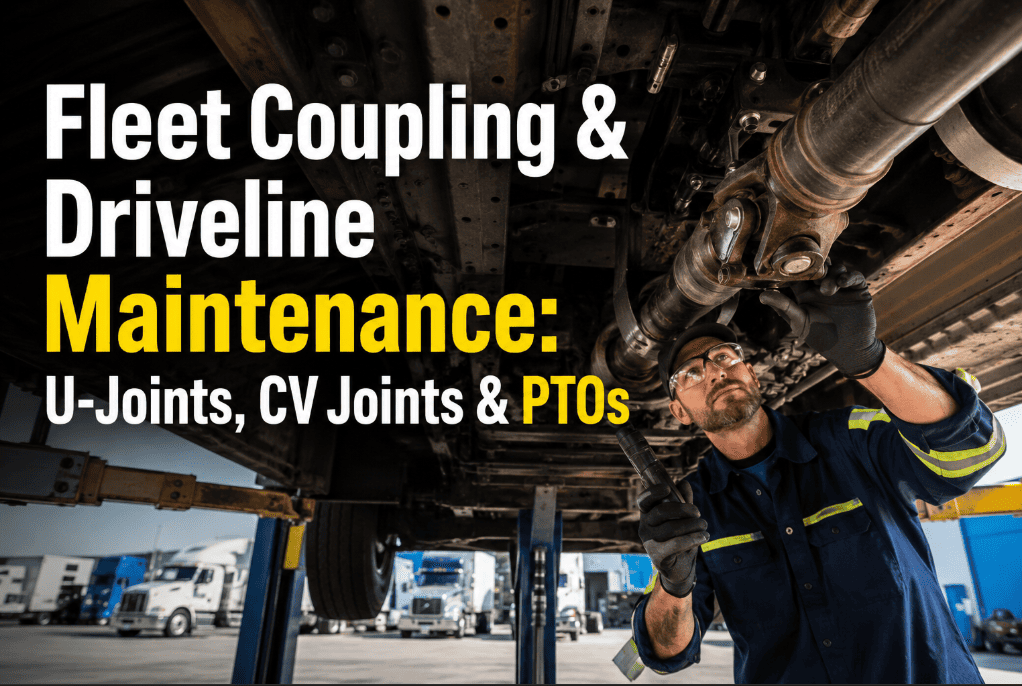
Driveline failures account for 8% of all fleet roadside breakdowns, and 71% of those failures trace back to missed lubrication intervals or ignored vibration symptoms that a structured PM schedule would have caught months earlier. U-joints, CV joints, drive shafts, and PTO assemblies operate under extreme torque loads and are among the most mechanically stressed components in any commercial vehicle — yet most fleet maintenance programs treat them as "inspect when something vibrates" rather than scheduling the greasing, inspection, and replacement intervals that OEMs specify. Oxmaint gives fleet teams automated driveline PM scheduling, component-level service tracking, and vibration-to-work-order workflows that prevent the $3,200 average roadside driveline repair before it happens. If your fleet's driveline maintenance is reactive, start a free trial or book a demo to see how component-level driveline tracking works for your fleet size.
Fleet Coupling and Driveline Maintenance: U-Joints, CV Joints, and PTOs
Driveline components operate under extreme torque and fail progressively — from vibration to noise to catastrophic separation. CMMS-scheduled greasing, inspection, and replacement intervals prevent the 8% of roadside breakdowns caused by driveline neglect.
Driveline Failures Are Predictable — and Preventable
Every driveline failure announces itself weeks or months before the roadside event — through vibration, noise, play in the joint, or discolored grease. The question is whether your PM program is structured to detect those signals during scheduled service or whether your technicians discover them during a tow call. Oxmaint schedules every greasing interval, every inspection checkpoint, and every replacement milestone by component, by vehicle, by mileage or hours — automatically. See the driveline PM workflow for your fleet — start a free trial or book a demo today.
The Four Critical Driveline Component Categories in Commercial Fleets
Each driveline component has different failure modes, different lubrication requirements, different inspection criteria, and different replacement cost profiles. Effective fleet PM treats each as a separately tracked component in the CMMS — not as a generic "driveline service" bundled into the standard PM checklist.
Driveline Maintenance Intervals Every Fleet Should Track in CMMS
The following intervals represent OEM consensus recommendations for Class 4–8 commercial vehicles. Your specific intervals should be adjusted based on operating conditions — severe duty, off-road, frequent PTO engagement, and cold-climate operations all shorten recommended service intervals by 20–40%.
| Component | Service Type | Standard Interval | Severe Duty Interval | CMMS Trigger |
|---|---|---|---|---|
| U-joints | Grease service | 25,000 miles | 15,000 miles | Mileage-based PM |
| U-joints | Play and wear inspection | 50,000 miles | 30,000 miles | Linked to PM-B service |
| CV joint boots | Visual inspection | Every PM service | Every PM service | PM-A checklist item |
| CV joints | Grease service | 30,000–50,000 miles | 20,000–30,000 miles | Mileage-based PM |
| Slip yoke | Lubrication | 25,000 miles | 15,000 miles | Combined with U-joint PM |
| Center bearing | Rubber and alignment check | 100,000 miles | 60,000 miles | PM-C service item |
| PTO unit | Oil level and condition | 500 operating hours | 300 operating hours | Hour-based PM trigger |
| PTO seals | External leak inspection | Every PM service | Every PM service | PM-A checklist item |
Six Driveline Failures That Cost Fleets Thousands Per Event
Grease starvation causes needle bearing failure inside the cap. The cross binds, vibration escalates rapidly, and the joint fractures under torque — often separating the drive shaft at highway speed. Average roadside recovery and repair: $3,200. Average in-shop prevention cost: $320.
A $45 boot replacement ignored during PM becomes a $1,800 CV joint assembly replacement within 30,000 miles. Contamination enters through the torn boot and destroys the ball races and cage. 89% of CV joint replacements trace back to boot failures that were visible during routine PM inspection.
A drive shaft that separates at speed becomes a projectile hazard — penetrating the road surface, damaging surrounding vehicles, and creating a catastrophic safety event. Every separation traces back to a failed U-joint, worn yoke, or fractured weld that was detectable during inspection weeks or months before the event.
PTO units that run past oil change intervals accumulate metal particles and moisture that accelerate gear tooth wear. By the time the operator reports unusual noise from the PTO, gear damage has already progressed to the point where a full overhaul ($1,200–$3,800) is required rather than a simple oil service ($85).
The rubber support element in the center bearing hardens with age and heat cycling, causing misalignment and vibration transmitted to the cab. Technicians often chase vibration complaints through wheel balance and tire inspections before checking the center bearing — wasting 1.5 to 3 diagnostic hours per complaint when the bearing was the root cause.
The slip yoke allows drive shaft length changes during suspension travel. Without lubrication, the splines wear and create driveline slack that produces a clunk during acceleration and deceleration. Advanced wear requires yoke and shaft replacement ($600–$1,400) rather than the $12 grease service that prevents it.
How Oxmaint Tracks Every Driveline Component Across Your Fleet
Oxmaint manages driveline maintenance at the component level — not the vehicle level. Every U-joint, CV joint, drive shaft, and PTO unit is tracked as a separate component within the vehicle asset hierarchy, with its own service intervals, inspection history, and replacement timeline. Fleets ready to eliminate reactive driveline repairs can start a free trial or book a demo to configure driveline PM schedules for your vehicle classes.
Register each driveline component individually within the vehicle hierarchy: Fleet, Vehicle, Drivetrain System, Component. Each component carries its own mileage trigger, hour trigger, inspection history, and replacement forecast — visible from the fleet dashboard.
Configure mileage-based PM triggers for U-joint greasing (25K mi), CV joint service (30–50K mi), slip yoke lubrication (25K mi), and center bearing inspection (100K mi). Oxmaint generates the work order automatically when the vehicle odometer reaches the trigger threshold.
PTO units operate independently of vehicle mileage — a refuse truck may run its PTO 6 hours per day while covering only 40 miles. Oxmaint tracks PTO hours separately from odometer readings, generating oil change and inspection PMs at the correct 500-hour intervals regardless of miles driven.
Technicians complete driveline inspection using digital checklists that prompt for U-joint play measurement, CV boot condition, slip yoke spline wear, center bearing rubber condition, and PTO seal leakage — with pass/fail recording, photo documentation, and digital sign-off per component.
Driver-reported vibration complaints convert to driveline diagnostic work orders with vehicle history, component service dates, and last inspection results attached — giving the technician diagnostic context before the vehicle enters the bay.
Oxmaint tracks cumulative mileage and service history per component to forecast replacement timing across the fleet — enabling bulk U-joint procurement, scheduled replacement campaigns, and budget forecasting that prevents the reactive parts premium on emergency orders.
Reactive Driveline Maintenance vs. CMMS-Managed Component Tracking
What Fleets Measure After Implementing Component-Level Driveline PM
Mileage-triggered greasing and component inspection catch every failure precursor during scheduled service — not at highway speed
In-shop U-joint replacement at $320 vs. $3,200 roadside recovery and repair — a 10:1 cost ratio on every prevented event
Planned procurement at bulk pricing replaces emergency orders — and early component replacement prevents cascading damage to adjacent components
Every greasing, every inspection, every replacement — documented by component, by vehicle, by technician, and exportable for warranty claims
Frequently Asked Questions
How does Oxmaint handle vehicles with multiple drive shafts and U-joints?+
Can PTO hours be tracked separately from engine hours in Oxmaint?+
What is the best way to track CV boot condition across a large fleet?+
Does Oxmaint support driveline-specific parts inventory tracking?+
Every U-Joint, CV Joint, and PTO in Your Fleet Should Have a PM Schedule
Driveline failures are preventable with structured greasing intervals, component-level inspection, and lifecycle tracking. Oxmaint makes that standard achievable for every vehicle in your fleet — first driveline PMs scheduled in week one.