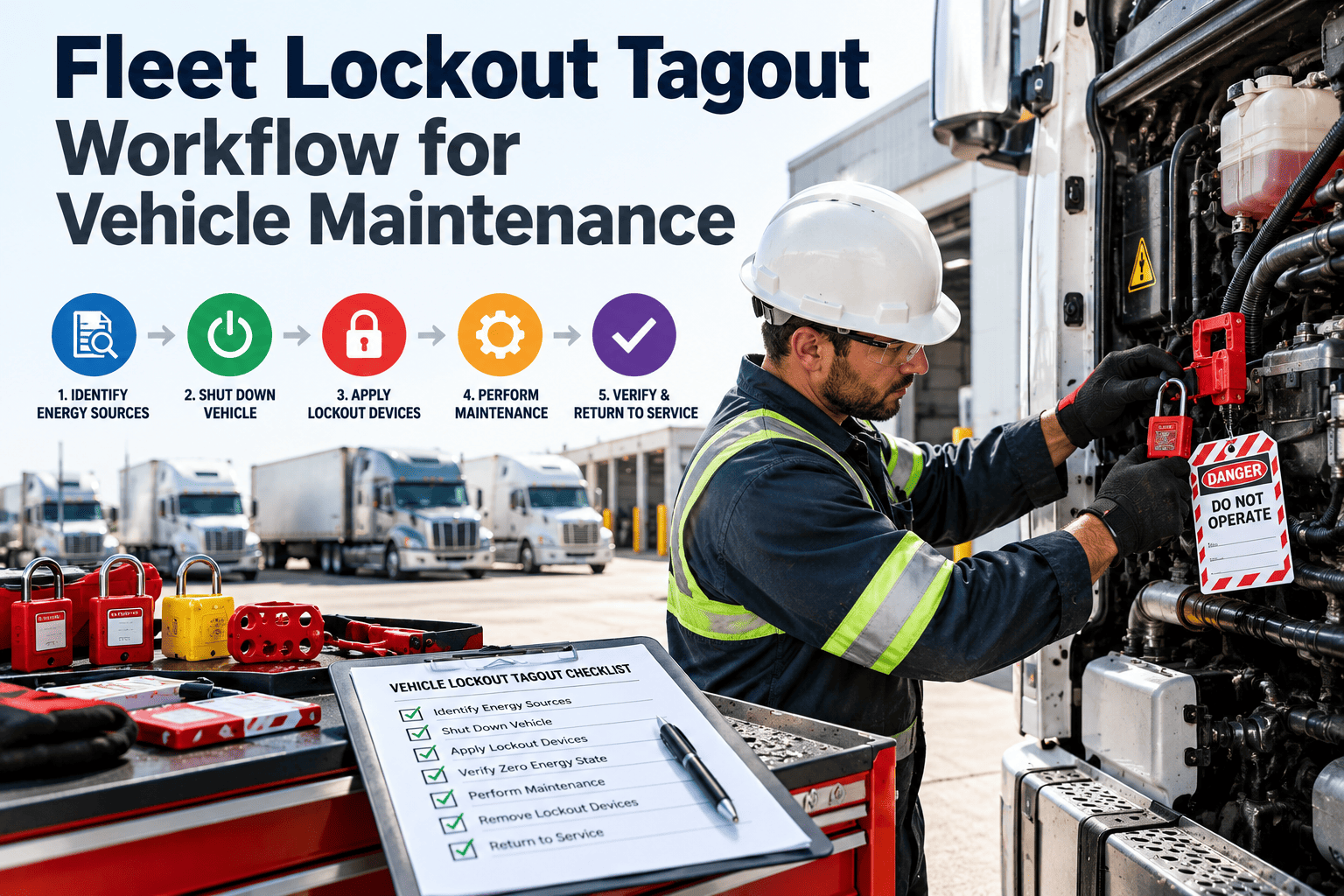
A fleet lockout tagout workflow for vehicle maintenance controls hazardous energy before a technician reaches under a lift, into a hydraulic body or near a battery system. Vehicles store energy in many forms, from compressed air and hydraulic pressure to raised loads and high-voltage packs. When the isolation steps live on a poster or in a technician's habits, they get skipped under time pressure. This guide shows how to build a repeatable workflow, and how a maintenance work order system can carry the procedure, sign-offs and records.
Fleet Lockout Tagout Workflow for Vehicle Maintenance
Turn hazardous energy control into a step-by-step workflow that technicians follow on every job, with procedures, sign-offs and records attached to the work order.
Hazardous Energy in a Fleet Shop
Lockout tagout is built around one idea: a machine or vehicle system must not start up or release energy while someone is servicing it. Vehicles have more energy sources than many teams list.
| Energy Source | Where It Appears | Typical Control Approach |
|---|---|---|
| Electrical | Battery systems, starters, charging circuits, shop power and high-voltage packs in electric vehicles | Disconnect and lock out the source; follow OEM procedures and qualified-person rules for high voltage |
| Hydraulic | Vehicle lifts, liftgates, dump bodies, booms and presses | Lower to rest, close valves, relieve pressure and block or support loads |
| Pneumatic | Air brake systems, air suspension and air tools | Drain or vent stored air and isolate supply lines |
| Mechanical and gravity | Raised bodies, suspended loads, springs, drivelines and PTO shafts | Mechanically block, pin or support; disengage the PTO |
| Thermal and fluid | Hot coolant, exhaust components, fuel and pressurized lines | Allow cooling, relieve pressure and control spill hazards |
| Engine and starting systems | Remote start, keyless systems and auto-start equipment | Remove keys or fobs, disable the start circuit and secure the vehicle |
Confirm which standards apply to your operation. In the United States, the OSHA standard on control of hazardous energy, 29 CFR 1910.147, is the usual reference for general industry shops.
The Six-Step Sequence in the Bay
What Goes Wrong Without a Workflow
- Procedures stored in a binder nobody opens
- Steps differ from technician to technician
- Lock and tag use not recorded
- Shift handoffs rely on verbal updates
- Annual reviews done late or not at all
- Procedure attached to the asset and the job
- Checklist steps completed in sequence
- Lock and tag use captured on the work order
- Handoff notes visible to the next shift
- Review reminders scheduled automatically
Put the Procedure Where the Work Happens
Attach lockout steps and sign-offs to the work order so every technician sees them before the job starts.
Common Vehicle Maintenance Jobs and Their Isolation Points
Mapping jobs to hazards helps technicians see which steps matter before they start.
| Job | Main Hazard | Key Isolation and Verification |
|---|---|---|
| Air brake service | Stored compressed air and unexpected brake application | Chock wheels, drain or vent air, confirm pressure is released |
| Liftgate or body hydraulic repair | Pressurized fluid and falling loads | Lower to rest or block, relieve pressure, verify no movement |
| Under-vehicle service on a lift | Lift drop or vehicle shift | Engage lift locks, support the vehicle, confirm stability |
| Battery and electrical work | Arcing, shorts and unintended start | Disconnect the battery, remove keys, verify de-energized circuit |
| High-voltage EV service | High-voltage shock | Follow OEM shutdown steps, use qualified personnel and verify zero voltage |
| PTO and driveline work | Rotating shafts starting unexpectedly | Disengage PTO, secure the start system, block the driveline |
| Air suspension service | Sudden height change | Vent air, support the frame, confirm no residual pressure |
Devices and tag standards
- Personal padlocks, keyed individually
- Hasps for group lockout
- Valve and plug lockouts
- Battery disconnect covers
- Durable and legible in shop conditions
- Show name, date and reason
- Clearly warn against operation
- Attached with a secure method
- Blocks, pins and stands for gravity loads
- Chocks for wheels
- Barriers around the work area
- Signs for affected employees
Roles: Authorized, Affected and Other Employees
OSHA training expectations differ by role, so the workflow should too.
- Apply locks and tags and perform the service
- Trained on energy types and isolation methods
- Verify zero-energy state before work
- Hold their own personal lock and key
- Operate or use the vehicle or equipment
- Understand what a lock or tag means
- Never remove or bypass a device
- Notified before and after servicing
- Work near the service area
- Know not to start or move locked-out units
- Recognize tags and lock signs
- Report missing or damaged devices
Restart and Lock Removal Sequence
Restoring energy is as risky as isolating it. Treat it as its own checklist.
Group Lockout and Shift Handoff
Jobs that span shifts or involve several technicians are where gaps appear most often.
- Each authorized person applies a personal lock, so no one depends on someone else's.
- A lead or supervisor coordinates the group and confirms all locks are in place.
- A shift handoff note states which energy sources remain isolated and why.
- Locks are removed only by the person who applied them, with a documented exception process.
- The incoming technician reviews the status before resuming work.
Training Timeline by Role
Building the Procedure Library
Written procedures should match the equipment, not just the policy.
- Scope and purpose of the procedure
- Vehicle or equipment identification
- List of every energy source and its location
- Exact steps to shut down, isolate and release energy
- Locations of lock points and required devices
- Steps to verify zero-energy state
- Steps for safe restart and lock removal
- Sign-off fields for the technician and supervisor
Periodic inspections and retraining
- OSHA calls for periodic inspection of energy control procedures at least once a year.
- Retrain when procedures change, equipment changes or inspections reveal gaps.
- Keep training records with the employee and procedure revision.
Integrating LOTO With PM and Corrective Work Orders
The workflow works best when it is not a separate system from daily jobs.
- Flag high-risk job types so the lockout checklist is required before work starts.
- Embed vehicle-specific energy sources in the PM template for each asset type.
- Prevent a work order from moving to in-progress until required steps are acknowledged.
- Capture photos or notes when a procedure cannot be followed, so the gap is fixed.
- Use the same asset record for procedures, history and future reviews.
Risk Matrix: Which Jobs Need Extra Controls
Not all jobs carry the same exposure. Use the matrix to decide where to add a second-person check.
Special Situations and Exceptions
Real shops hit edge cases. Decide in advance how they are handled.
- Locks may need temporary removal to test a repair
- Follow a defined clear, test and re-lock sequence
- Record the test in the work order
- Apply the same steps with portable devices
- Block and chock the vehicle
- Document the job on mobile
- Coordinate locks across teams
- Confirm contractors use their own devices
- Hold a pre-job briefing
Leadership and culture
- Supervisors model the procedure, even for quick jobs.
- Technicians can stop work without penalty when steps are unclear.
- Near misses are reviewed for learning, not blame.
- Production pressure never overrides the isolation sequence.
- Walk through each procedure on the actual vehicle or equipment
- Observe an authorized employee performing the steps
- Check lock points and devices for wear or damage
- Compare procedures with equipment changes since the last review
- Record deficiencies, owners and due dates
Hybrid and Electric Vehicle Considerations
Electrified vehicles add hazards that standard shop habits may not cover.
- High-voltage systems require OEM-specific shutdown steps and qualified personnel.
- Insulated tools and protective equipment may be required for the task.
- Service disconnects and warning labels vary by manufacturer, so procedures must be vehicle-specific.
- Capacitors and stored energy need time and verification before work begins.
- Charging equipment and cables should be isolated and inspected like any other energy source.
Shift handoff note contents
- Vehicle or equipment ID and work order number
- Energy sources still isolated and where
- Locks and tags still applied, with owners
- Work completed and work remaining
- Any hazards found during the job
Records That Support an Audit
| Record | Purpose | Where to Keep It |
|---|---|---|
| Written procedures by asset type | Show the correct steps for each job | Asset record or attached document |
| Completed lockout checklist | Prove steps were performed in order | Work order |
| Lock and tag assignments | Show who applied and removed devices | Work order or shop log |
| Training and retraining | Show who is authorized and trained | Technician or training record |
| Periodic inspection results | Show annual review and corrections | Scheduled inspection work order |
| Incident and near-miss notes | Drive procedure improvements | Work order notes and reports |
Make Every Lockout Provable
Keep procedures, checklists and sign-offs in one system so audits become a report instead of a scramble.
Phased Rollout of the Workflow
KPIs for a Lockout Tagout Program
| Measure | What It Reveals |
|---|---|
| Checklist completion on flagged jobs | Whether the workflow is followed in practice |
| Procedure coverage by asset type | Gaps in written procedures |
| Training currency | Employees overdue for training or retraining |
| Overdue annual inspections | Slippage in program maintenance |
| Near misses reported | Culture of reporting and learning |
| Observed deviations | Where procedures need revision |
Gaps Commonly Found During LOTO Reviews
- Generic procedures that do not list the vehicle-specific energy sources.
- Missing lock points on newer or modified equipment.
- Technicians relying on a switch rather than physical isolation.
- No documented process for removing a lock when the owner is absent.
- Contractors or temporary staff working without training.
- Annual reviews that check paperwork but never observe the work.
How Oxmaint Supports Lockout Tagout Workflows
Oxmaint is a maintenance management platform, and it supports LOTO by structuring the work, not by replacing your safety program.
- Asset records with procedures and documents attached to each vehicle or shop equipment type.
- Work orders with checklist steps and technician sign-offs.
- Mobile workflows so steps are completed at the vehicle.
- Scheduled preventive maintenance to trigger annual procedure reviews.
- Compliance records and reports that support audits and incident reviews.
Frequently Asked Questions
Build a Safer Maintenance Workflow Today
Give your technicians a clear lockout sequence, give supervisors visibility, and keep every record ready for review.