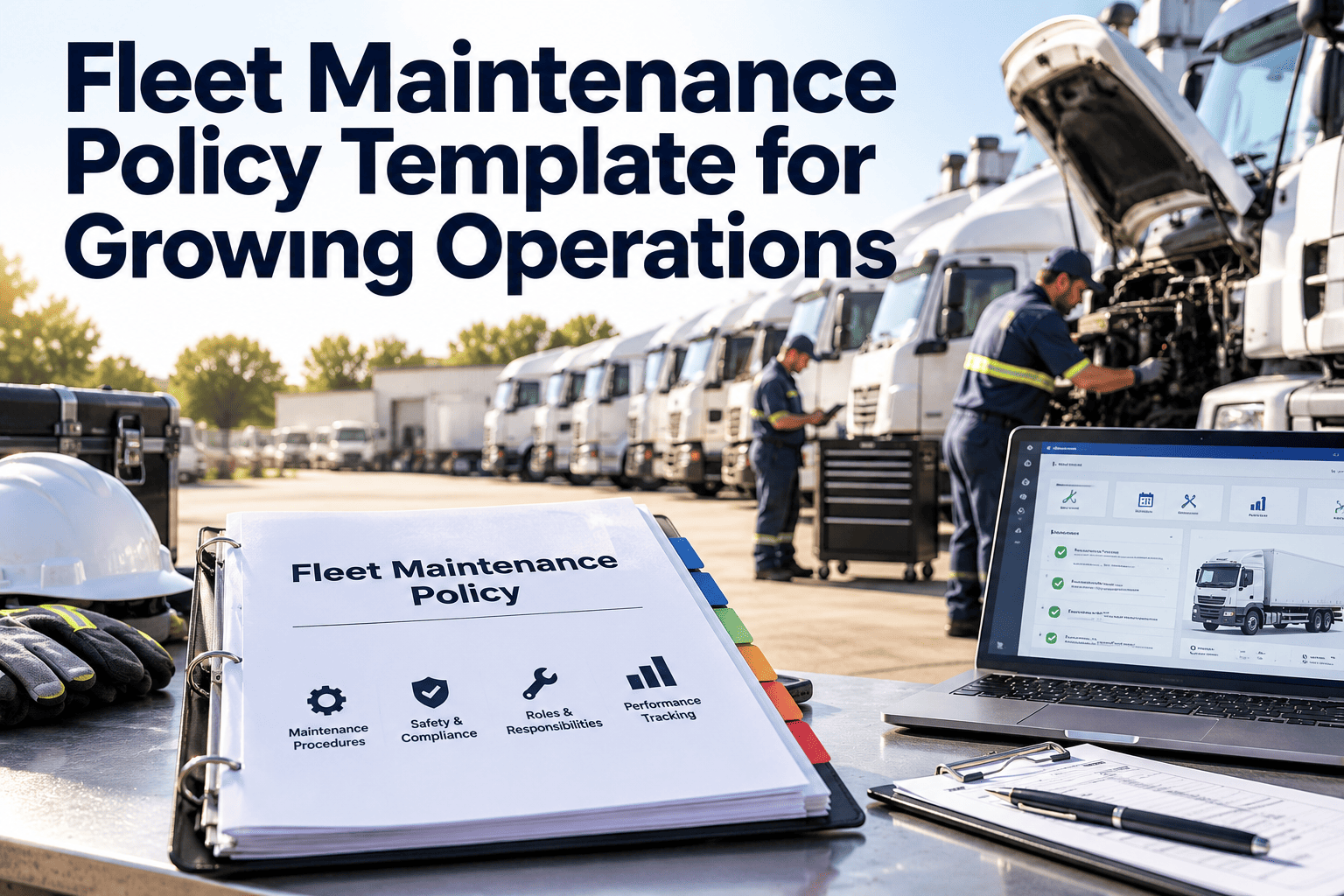
A fleet of ten vehicles can run on habits and a good lead technician. A fleet of sixty cannot. As units, drivers, depots and vendors multiply, unwritten rules start to conflict, and the same defect gets handled three different ways on the same day. A written fleet maintenance policy gives growing operations one shared standard for inspections, preventive maintenance, repair approvals, parts and records. This guide provides a practical template and checklist, and shows how a fleet maintenance software platform can enforce the policy in daily work instead of leaving it in a binder.
Fleet Maintenance Policy Template for Growing Operations
Move from tribal knowledge to a documented, enforceable maintenance policy that scales from a single yard to multiple sites without losing control of cost, safety or compliance.
Signs Your Informal Process Has Been Outgrown
Growth exposes weak process before it exposes weak people. Each symptom below maps to a policy section that removes the ambiguity.
| What you see on the floor | What is usually missing | Policy section that fixes it |
|---|---|---|
| Different depots service the same truck type at different intervals | A common PM standard by asset class | Preventive maintenance standards |
| Drivers report defects verbally and nothing is recorded | A required reporting channel and response time | Defect reporting and priorities |
| Large repairs are approved by whoever answers the phone | Spending thresholds and approvers | Repair authorization |
| Parts are bought at retail because stock is unknown | Min and max levels and a purchasing rule | Parts and inventory control |
| Audit requests take days to answer | Record standards and retention rules | Records and compliance |
| New hires learn by shadowing, with uneven results | Defined roles and training expectations | Roles and responsibilities |
Policy Anatomy: Twelve Clauses With Template Wording
Replace the bracketed placeholders with your own values. Keep each clause short enough that a driver can read it.
Purpose and scope
This policy sets the minimum maintenance standard for all [owned, leased and rented] vehicles, trailers and equipment operated by [company name], at every location.Roles and responsibilities
Drivers inspect and report. Technicians repair and verify. The fleet manager owns the schedule, budget and policy. Safety reviews compliance.Asset records
Every asset must have a unique ID, class, location, odometer or hour reading, and documented ownership before it enters service.Inspection standards
Drivers complete the assigned checklist before each [shift or trip]. Vehicles with unresolved safety defects must not be dispatched.Preventive maintenance
PM is scheduled by [miles, engine hours or calendar days], whichever comes first, and completed within [percent or days] of the due point.Defect reporting and priority
All defects are logged in [system name] on discovery. Priority is assigned using the defect scale in this policy.Repair authorization
Repairs above [amount] require approval from [role]. Emergency safety repairs may proceed and must be reviewed within [hours].Parts and inventory
Stocked parts are issued against work orders only. Reorder points are reviewed every [quarter].Vendors and outsourced work
External shops must be on the approved list, quote before work and return itemized invoices linked to the work order.Records and retention
Inspection, repair and PM records are kept for [period], or longer where regulation requires, and must be retrievable by asset.Performance measures
The fleet manager reports [KPIs] monthly, and results are reviewed with operations and safety.Review and revision
This policy is reviewed at least [annually] and after any significant incident, regulation change or fleet expansion.Policy Readiness Checklist
Use these three groups to confirm the policy is complete and ready to publish.
Content complete
People aligned
System ready
Who Owns What: Responsibility Matrix
| Activity | Driver | Technician | Fleet manager | Safety lead |
|---|---|---|---|---|
| Pre-trip inspection | Performs | Supports | Reviews | Audits |
| Defect logging | Performs | Performs | Reviews | Informed |
| Preventive maintenance | Delivers vehicle | Performs | Owns schedule | Informed |
| Repair approval | Not involved | Requests | Approves within limit | Consulted on safety items |
| Return to service | Informed | Signs off | Verifies | Consulted |
| Policy updates | Gives feedback | Gives feedback | Owns | Approves |
Defect Priority Matrix for the Policy
Set response targets that match your operation, then apply them without exceptions.
Preventive Maintenance Tiers by Asset Class
The intervals below are placeholders. Base real values on manufacturer guidance, operating conditions and your own failure history.
| Tier | Applies to | Interval trigger | Typical scope |
|---|---|---|---|
| Tier A: Service | All powered units | [miles, hours or days] | Fluids, filters, lubrication, safety inspection |
| Tier B: Intermediate | Medium and heavy units | [multiple of Tier A] | Brake measurement, suspension, steering, electrical checks |
| Tier C: Major | Heavy units and trailers | [longer interval] | Component wear review, alignment, coolant and driveline service |
| Annual or periodic | Regulated units | [12 months or as required] | Formal inspection with documented sign-off |
| Condition-based | Critical assets with data | Threshold alerts | Action when readings or fault codes cross limits |
Repair Authorization Ladder
Work Order Records Every Repair Should Capture
A policy is only as strong as the records behind it. Require these fields so every repair can be audited, costed and learned from.
At creation
During repair
At closure
Policy Mistakes Growing Fleets Make
Optional Clauses for Maturing Fleets
Add these once the core policy is stable and the data supports them.
- Condition-based maintenance: where meters, telematics or fault codes are available, readings that cross defined limits create a work order automatically.
- Repair or replace review: assets that exceed [cost percentage] of replacement value in repairs over [period] trigger a lifecycle review.
- Warranty recovery: eligible repairs are flagged and claims filed within the supplier's time limit.
- Root cause review: repeat failures on the same component require a short documented analysis.
- Driver accountability: preventable damage and repeated missed inspections are reviewed with supervisors.
Vendor and Outsourced Maintenance Rules
Growing fleets rarely do every job in house. A clear vendor section keeps outsourced work as controlled as work done in your own shop.
What Changes in Day-to-Day Operations Once the Policy Is Live
Before the policy
- Service timing depends on who remembers.
- Defects surface only when a truck breaks down.
- Repair costs are explained after the invoice arrives.
- Records sit in spreadsheets, texts and paper folders.
After the policy
- Schedules trigger service before it becomes overdue.
- Inspection findings become tracked work orders.
- Approvals and costs are visible before work starts.
- History is searchable by asset, site, vendor or defect.
Turn Your Policy Into Daily Practice
Load schedules, approvals, checklists and priorities into one system so the policy runs itself every day.
Adjusting the Policy as the Fleet Grows
Small, single site
- Keep the policy to a few pages.
- Focus on inspections, PM schedules and defect logging.
- Let one manager approve most repairs.
Scaling, several asset classes
- Add class-specific PM tiers and checklists.
- Introduce approval thresholds and an approved vendor list.
- Start measuring downtime and repeat defects.
Multi-site or regional
- Separate the central policy from site procedures.
- Standardize asset naming, parts numbers and reporting.
- Audit sites against the same scorecard.
Compliance Items to Confirm With Your Own Advisors
Requirements vary by country, vehicle weight and operation type. In the United States, commercial fleets commonly review the following.
- Driver vehicle inspection reporting and review of prior defects under 49 CFR 396.11 and 396.13.
- Systematic inspection, repair and maintenance duties under 49 CFR 396.3, including records by vehicle.
- Annual inspection requirements and inspector qualifications under 49 CFR 396.17 and 396.19.
- Brake inspector qualifications and parts standards under 396.25 and Part 393.
- Any state, provincial, insurer, customer or environmental rules that apply to your fleet.
Thirty, Sixty and Ninety Day Rollout Plan
Days 1 to 30
- Audit current practice and records.
- Clean up the asset register.
- Draft the policy and review with stakeholders.
Days 31 to 60
- Finalize values and approvals.
- Configure schedules, checklists and work order rules.
- Train a pilot depot and collect feedback.
Days 61 to 90
- Expand to all sites.
- Publish the first KPI report.
- Schedule the first policy review.
KPIs That Prove the Policy Is Followed
How Oxmaint Helps Enforce the Policy
- Asset management keeps class, location, meter readings and full service history in one record.
- Preventive maintenance scheduling triggers tasks by mileage, hours or calendar date.
- Mobile inspections give drivers the right checklist and turn failures into defects.
- Work orders carry priority, assignment, approvals, labor and parts for each repair.
- Inventory tracking supports reorder levels and parts issued against work orders.
- Dashboards and reports show PM compliance, backlog and cost trends for policy reviews.
Fleet Maintenance Policy FAQs
How long should a fleet maintenance policy be?
Long enough to cover the twelve clauses and short enough that people read it, often five to ten pages. Put detailed steps in separate procedures.
Who should approve the policy?
The fleet manager owns it, with sign-off from operations, safety and finance. Technician input keeps it practical.
When should we move from spreadsheets to software?
When missed services, lost records or slow audits appear, or when a second site is added. You can start free and load assets first.
How do we handle rented or leased vehicles?
Include them in scope and follow contract maintenance terms. Track inspections and repairs against each unit so responsibility stays clear.
Can the template be adapted to our exact fleet?
Yes. Adjust clauses, intervals and thresholds, or book a demo to see how workflows can mirror your policy.
Communicating the Policy to Drivers and Technicians
- Explain the reason behind each rule, not just the rule, so crews see how it protects them and the fleet.
- Give drivers a one-page summary covering inspections, defect reporting and what happens next.
- Give technicians a short guide to work order standards, approvals and return-to-service sign-off.
- Hold a brief refresher at each depot after the first month, using real defects and repairs as examples.
- Record training attendance so the policy rollout itself is documented.
Grow the Fleet Without Losing Maintenance Control
Put your policy to work with scheduled maintenance, inspection workflows, approvals and records that scale with every new asset.