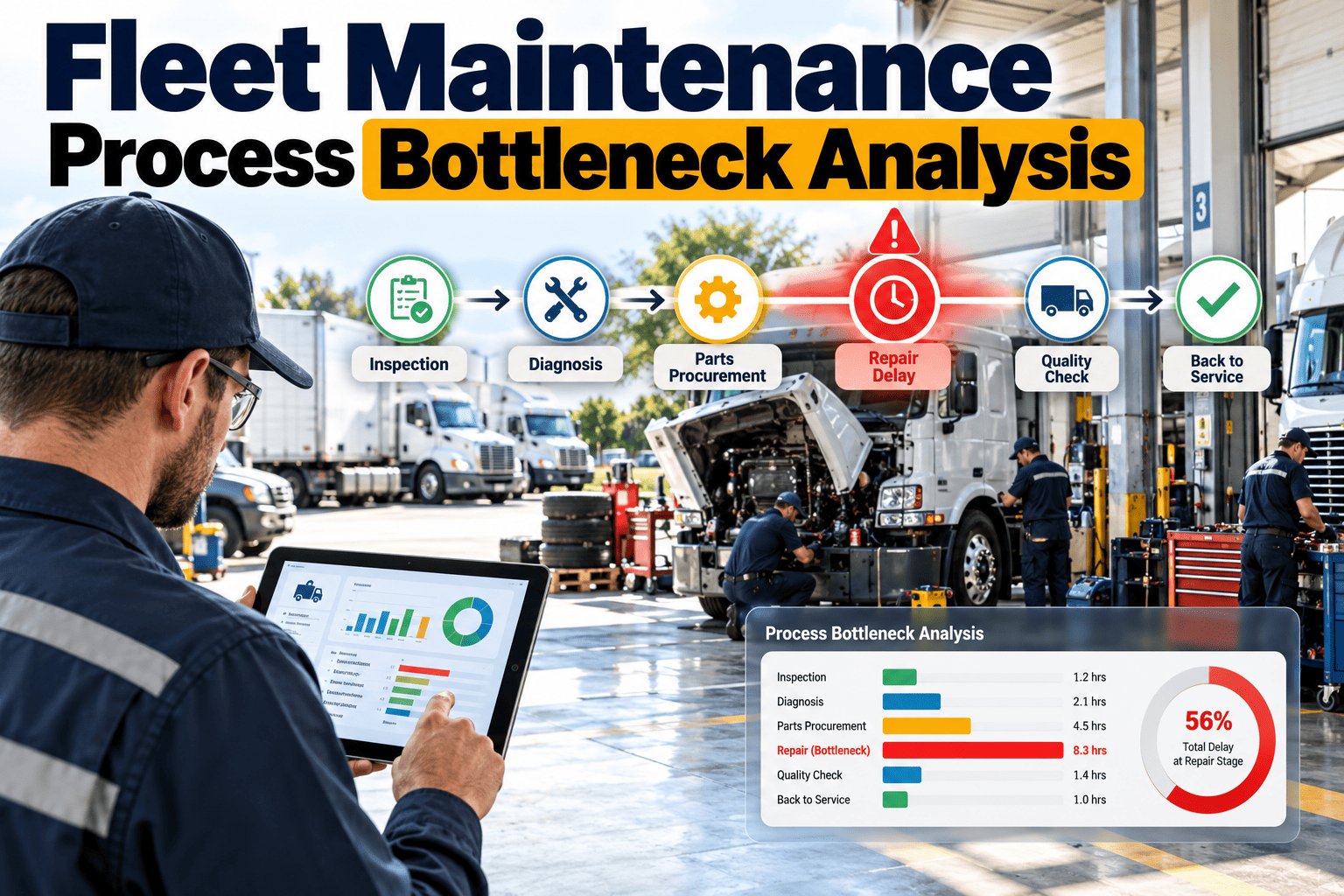
Most fleet maintenance delays are not caused by slow technicians. They come from vehicles waiting in queues for triage, scheduling, approval, parts, or sign-off while the wrench time itself is short. Finding the single stage that limits flow does more for uptime than pushing every team to work harder. Using work order status data to map where jobs wait is the fastest way to locate that constraint.
Fleet Maintenance Process Bottleneck Analysis
Trace a repair from defect report to release, measure the wait at each handoff, and fix the stage that holds back every vehicle behind it.Touch time versus queue time
A repair that takes three hours of labor can still keep a vehicle out for three days. The difference is queue time, and queue time is where bottlenecks live.
Touch time
Hands-on diagnosis, repair, and testing. Improved through training, tooling, and clear job instructions.Queue time
Waiting between steps. Improved through scheduling, approvals, parts availability, and faster handoffs.Symptoms that point to a bottleneck
| Symptom you see | Likely constrained stage | First question to ask |
|---|---|---|
| Defects reported but work orders open late | Triage and intake | Who reviews inspection defects, and how often? |
| Vehicles parked while bays sit empty | Scheduling and approvals | What is the delay from estimate to approval? |
| Many jobs marked waiting on parts | Parts and inventory | Which parts cause the most waiting? |
| Technicians idle, then overloaded | Work assignment | Is work released in batches instead of steadily? |
| Repairs done but vehicles not released | QA and closeout | Who signs off, and are they available? |
| Same defects return | Diagnosis quality | Are repair notes and history reviewed first? |
Root cause map: four places delay hides
- Skill gaps on specific systems
- One approver for all spending
- Uneven shift coverage
- Unclear job ownership
- Common items out of stock
- No min and max levels
- Slow vendor deliveries
- Parts not reserved to jobs
- Paper handoffs between teams
- No priority rules for jobs
- Approvals with no time limit
- Preventive work competing with breakdowns
- No timestamps at handoffs
- Free-text statuses
- Missing asset history
- Reports built by hand
See where your repairs actually wait
Track status changes on every work order and find your constraint with evidence, not instinct.Five-step bottleneck method
This approach follows the theory of constraints: find the limiting step, exploit it, and only then expand capacity.
Identify the constraint
Measure average and longest wait by stage. The stage with the biggest queue and the most aged jobs is your candidate.Exploit it fully
Remove waste at the constraint. Keep it supplied with ready work and never let it idle for missing information or parts.Subordinate everything else
Pace upstream stages to the constraint so work does not pile up, hide, and age in front of it.Elevate if needed
If waiting persists, add capacity: another approver, more stocked parts, an extra bay shift, or a second vendor.Repeat
Once one constraint eases, another stage becomes the limit. Review monthly.Metrics that expose flow problems
Common fixes by constraint
Before and after flow improvement
- Defects discovered but queued informally
- Approvals by phone and email
- Parts ordered after the vehicle arrives
- Delay attributed to technicians
- Defects become work orders immediately
- Approvals tracked with time limits
- Parts reserved at scheduling
- Delay located by stage with data
How Oxmaint helps you find and remove bottlenecks
Oxmaint maintenance management software gives each handoff a status and a timestamp, so queues become visible.
Map the process before you measure it
You cannot find a constraint in a process nobody has drawn. Spend an hour walking one vehicle through the real path, not the official one.
Follow a recent job
Pick a completed work order and list every handoff from the first defect report to the release signature.Name each status
Give every step a clear status such as reported, triaged, scheduled, waiting on parts, in repair, in QA, and closed.Note who owns each handoff
Every wait has an owner. If nobody owns it, that gap is already a likely cause of delay.Add timestamps
Record when each status starts and ends. Without time data, the map shows steps but not queues.Compare official and real flow
Workarounds, side agreements, and phone approvals show where the written process does not match practice.Triage and intake bottlenecks
Delay often starts before any technician sees the vehicle. Defects wait in driver reports, emails, and notebooks.
Scheduling and bay capacity
A shop can look busy and still be constrained by scheduling rather than by labor or space.
Signs of a scheduling constraint
Bays empty in the morning and overloaded by afternoon, technicians waiting for the next assignment, and vehicles arriving without an appointment or a prepared job.Signs of a capacity constraint
Bays full all day, a steady queue of ready vehicles, and overtime that never clears the backlog even when jobs are well planned.Parts and inventory constraints
Parts availability is the most common constraint in fleet shops, and the one most often hidden by the label waiting on parts.
- Fast-moving items run out
- No reorder point is set
- Counts differ from shelf reality
- Special order parts take days
- Single source suppliers
- Orders placed late in the job
- Wrong part ordered
- Unit records missing specifications
- Returns and reorders
- Parts taken for other jobs
- No reservation against work orders
- Unrecorded shop usage
Approval and authorization delays
Vehicles can sit fully diagnosed and ready to repair while an estimate waits for a signature.
| Approval pattern | Typical delay | Practical remedy |
|---|---|---|
| Single approver for all spending | Jobs stall when that person is away | Name a backup approver for each shift |
| Approval by phone or email | Requests get buried or forgotten | Approve inside the work order with a timestamp |
| Every repair needs sign-off | Routine jobs wait as long as major ones | Pre-approve routine repairs under a set limit |
| Estimates arrive incomplete | Approvers ask questions and restart the clock | Standardize what an estimate must include |
Quality check and release delays
A finished repair that is not released is lost availability with no repair left to do.
A hypothetical bottleneck reading
The numbers below are invented to show how to read stage data. Use your own records to build the real version.
| Stage | Average wait | Open jobs | Reading |
|---|---|---|---|
| Triage | 3 hours | 4 | Healthy |
| Scheduling | 5 hours | 6 | Acceptable |
| Approval | 20 hours | 11 | Candidate constraint |
| Parts | 34 hours | 15 | Primary constraint |
| Repair | 7 hours | 5 | Healthy |
| QA and release | 4 hours | 3 | Healthy |
Keep bottlenecks from simply moving
Fixing one stage often exposes the next. Plan for that so improvements last.
Preventive maintenance can relieve or create bottlenecks
Preventive work reduces emergencies, but poorly timed services can also swamp a shop in a single week.
How preventive work helps
Planned services can be scheduled, staged with parts, and spread across the month. Fewer breakdowns mean fewer interruptions to the queue.How it can hurt
When many vehicles come due on the same date, services pile into one week and crowd out repairs. Smooth the due dates by staggering intervals.Outsourced stages and vendor handoffs
When repairs leave your shop, you lose direct control of the queue. Track the vendor stages as carefully as the internal ones.
Skills and staffing constraints
Sometimes the constraint really is people, but it is rarely the total headcount. It is usually a specific skill.
Inspection workload and compliance deadlines
Regulated fleets must complete required inspections and keep records. When those tasks bunch up, they create a bottleneck of their own.
Spread deadlines
Avoid having many vehicles come due for annual inspection in the same few weeks.Prepare records ahead
Gather maintenance history and open defects before the inspection so the vehicle is not held for missing paperwork.Clear defects early
Fix known defects before the inspection date so failures do not trigger rework and rescheduling.Questions for a bottleneck review workshop
Bring dispatch, technicians, parts staff, and supervisors into one room. Each group sees a different part of the queue.