People who search for fleet maintenance help are rarely browsing. They are dealing with missed services, rising repair costs, failed inspections or a spreadsheet that has stopped working. A content strategy that matches those moments earns trust long before anyone asks for a demo. This article lays out a search strategy built around high-intent topic clusters for fleet maintenance, from the problems people type into search to the evaluation questions that follow, and shows where Oxmaint fleet maintenance software fits naturally into that journey.
Fleet Maintenance Search Strategy: High-Intent Content Cluster
Plan fleet maintenance content around real buyer intent, connect it into topic clusters, and measure what moves readers toward action.
What High-Intent Means in Fleet Maintenance Search
High intent does not only mean someone is ready to buy. It means the search shows a specific problem, a defined task or a decision in progress.
- A query like "fleet preventive maintenance checklist" shows a task to complete now.
- A query like "how to reduce fleet breakdowns" shows a problem with a cost attached.
- A query like "fleet maintenance software features" shows a comparison under way.
Broad terms still matter for awareness, but specific problem and task searches are where useful content earns action.
The Intent Ladder: Four Types of Fleet Searches
Understanding the problem
Examples: why fleet vehicles break down, what causes high repair cost.
Completing a task
Examples: inspection checklist, breakdown log template, PM schedule format.
Evaluating options
Examples: spreadsheet versus CMMS, features to look for in fleet software.
Ready to try or ask
Examples: demo requests, trial, pricing questions, setup guidance.
Who Is Searching and Why
Different roles search for different things, so one article rarely serves them all.
| Searcher | Typical pain | Content that helps |
|---|---|---|
| Fleet manager | Downtime, cost, compliance and reporting | KPI guides, cost control, readiness dashboards |
| Maintenance supervisor | Backlog, technician capacity, parts delays | Capacity planning, skill matrices, work order workflows |
| Technician or planner | Unclear job instructions, repeat failures | Checklists, logs, root cause templates |
| Operations or dispatch lead | Route failures and late service | Readiness gates, customer impact content |
| Owner or finance lead | Spend without visibility | Fuel, repair and lifecycle cost content |
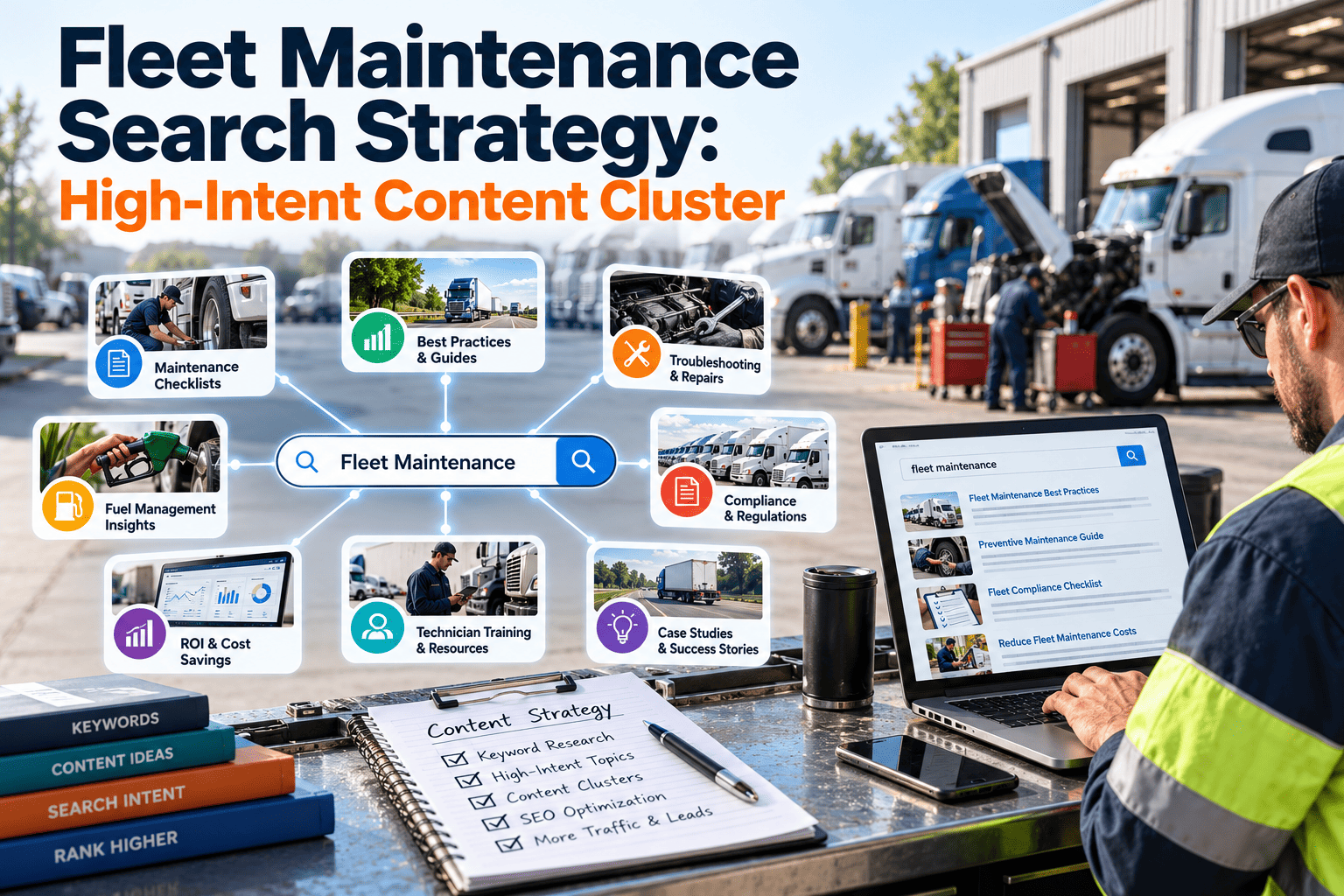
Cluster Architecture: One Pillar, Several Spokes
A cluster groups related pages around a central topic so readers and search engines can see depth and relationships.
Pillar page
A broad guide to fleet maintenance management, covering the whole lifecycle at a high level.
Task pages
Templates and checklists for a single job.
Problem pages
Guides to a specific pain such as repeat failures.
Comparison pages
Decision support for tools and methods.
See Fleet Maintenance Workflows in Action
Explore how inspections, preventive maintenance, work orders and asset history work together in one maintenance system.
Topic Groups for a Fleet Maintenance Cluster
Build clusters from the work fleet teams actually do. These groups map to common maintenance responsibilities.
| Topic group | Example spoke topics | Dominant intent |
|---|---|---|
| Work orders and shop operations | Demand versus technician capacity, skill matrices, work order priorities | Learn and do |
| Breakdown and reliability | Breakdown logs, root cause analysis, route failure prevention | Learn and do |
| Fuel and cost control | Fuel logs with maintenance fields, cost per mile, repair spend | Do and compare |
| Inspections and compliance | Pre-trip checklists, inspection records, audit readiness | Do |
| Preventive maintenance | PM intervals, schedules, meter-based triggers | Learn and do |
| Parts and inventory | Reorder points, critical spares, parts reservation | Learn and compare |
| Software selection | Spreadsheet versus CMMS, implementation steps, feature checklists | Compare and act |
Keyword Layers: Primary, Secondary and Long-Tail
Primary
The core topic, such as fleet maintenance software or fleet preventive maintenance.
Secondary and semantic
Related terms such as work orders, asset history, inspections, PM schedule, downtime and repair cost.
Long-tail
Specific phrases that mirror a task or problem, such as a breakdown log for root cause analysis.
Use these terms where they fit the sentence. Writing for the reader first keeps pages useful and avoids stuffing.
Choosing the Right Format for Each Intent
Best for task searches. Readers want a usable list, so make the steps clear and specific.
Best for logs and forms. Show the fields, explain why each exists and give a worked example.
Best for problems. Explain causes, impact and a practical path to improvement.
Best for evaluation. Compare approaches fairly, including when a spreadsheet is enough.
Quality Standards Before Publishing
Fleet professionals can spot generic advice quickly. Use these checks to keep every page credible.
- The page answers the exact search intent in its title.
- Advice reflects real shop, dispatch and compliance work.
- Claims are accurate and supported, with no invented statistics or case studies.
- Examples are labeled as illustrative when they are not real data.
- Regional rules are described carefully, because requirements vary by location.
- The page is informative first, with product mentions relevant to the topic.
Internal Linking Inside the Cluster
Links tell readers where to go next. Plan them as paths, not decoration.
Use descriptive anchor text that tells the reader what they will find, rather than generic phrases.
Where Oxmaint Belongs in the Story
Product mentions work best when they solve the problem the page just described.
| Page topic | Relevant Oxmaint capability |
|---|---|
| Preventive maintenance schedules | PM scheduling and reminders |
| Breakdown and root cause | Corrective work orders and asset history |
| Inspections and compliance | Mobile inspections and records |
| Capacity and scheduling | Work order assignment and reporting |
| Parts delays | Inventory tracking and reservation |
| Cost visibility | Reports and dashboards |
Measuring Whether the Cluster Works
Rankings alone do not show value. Track signals across the full journey.
A 90-Day Plan for the Cluster
Research queries, group them by intent and role, and pick the pillar topic.
Publish the highest-value task and problem pages first.
Add comparison pages and connect internal links across the cluster.
Review search data, update weak pages and publish the pillar.
Fleet Maintenance Search Strategy FAQs
What is a high-intent content cluster?
It is a group of linked pages that answer related, specific searches around one central topic.
Which fleet pages should we publish first?
Start with task pages such as checklists and logs, because they match clear needs.
How many pages make a cluster?
Enough to cover the topic well, often a pillar with several focused spokes.
Should every page mention software?
Only where relevant. See how it fits workflows in Oxmaint.
How do we connect content to demos?
Offer a clear next step on useful pages. You can book a demo to see workflows live.
Turn Fleet Maintenance Questions Into Action
Bring inspections, preventive maintenance, work orders and asset history together in Oxmaint, and give fleet teams the workflow behind the answers they search for.