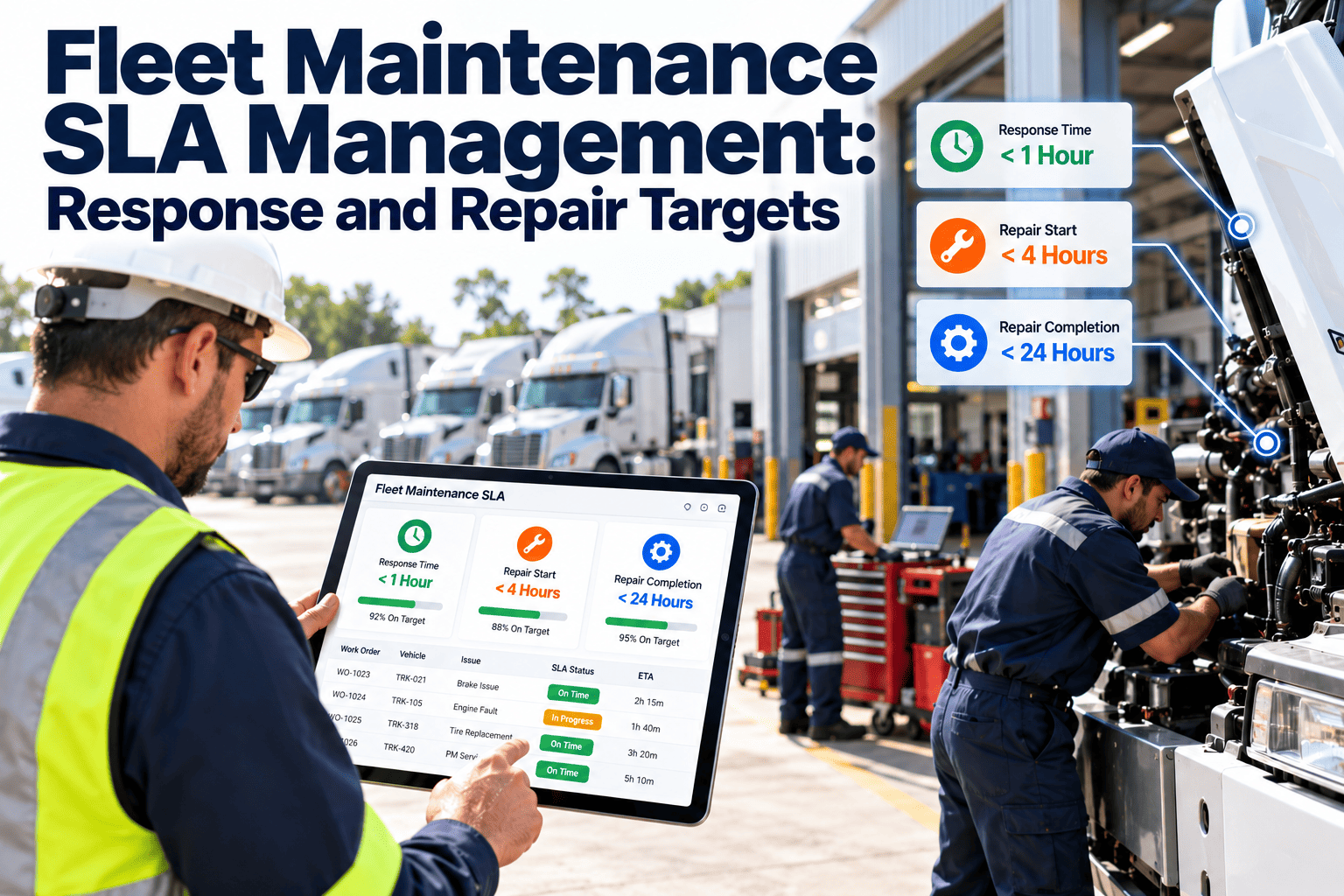
When a driver reports a failed brake light or a leaking air line, three questions follow: how fast will someone respond, how long will the repair take, and who is accountable if it slips. Without written targets, every request is urgent to the requester and routine to the shop, and delays become a matter of opinion. A maintenance service level agreement defines response and repair targets by priority, so the shop, operations, and drivers share one set of expectations. Fleets can track response and repair targets on every work order and see breaches while there is still time to act.
Fleet Maintenance SLA Management: Response and Repair Targets
Set clear response and repair targets by priority, measure them from work order timestamps, and escalate before a missed target becomes a missed delivery.
What a Fleet Maintenance SLA Should Cover
An SLA is a measurable promise between the maintenance team and the people who depend on it. Keep it short enough to be used daily.
Step One: Define Priority Levels Operations Can Recognize
Targets below are examples only. Set yours from your duty cycle, shop capacity, and regulatory obligations.
| Priority | Definition | Example Defects | Example Response Target | Example Repair Target |
|---|---|---|---|---|
| P1 Critical | Unsafe or immobilized vehicle, service-critical | Brake failure, steering fault, breakdown on route | Immediate acknowledgment | Same shift where possible |
| P2 High | Compliance or safety defect, vehicle can still move | Lighting, tire damage, air leak | Within the hour | Before next dispatch |
| P3 Standard | Functional defect without safety impact | HVAC fault, minor leak, worn wipers | Within the shift | Within a few days |
| P4 Planned | Cosmetic or scheduled work | Body marks, upgrades, non-urgent adjustments | Within a few days | Next planned visit |
Every priority needs one owner who can change it, so urgency does not inflate until everything is P1.
Step Two: Decide When the Clock Runs and When It Pauses
Clock Runs
- Report logged and waiting for acknowledgment
- Vehicle waiting in the queue for a bay
- Technician diagnosing or repairing
- Parts ordering delays caused by shop process
Clock Pauses, With a Reason Code
- Vehicle not yet delivered to the shop by operations
- Waiting for customer or insurer approval
- Supplier lead time on agreed special-order parts
- Sublet repair at an external provider
Pauses without reason codes turn SLA reports into negotiation material. Require a code every time.
Measure Response and Repair Targets Straight From Your Work Orders
Timestamp every status change so SLA results come from records, not recollection.
Step Three: Build the Escalation Ladder
An escalation path should trigger before a breach, not after. Warn at a set share of the target time.
The SLA Measures Worth Reporting
Reading Breaches: Root Cause Before Blame
| Breach Cause | What It Usually Signals | Corrective Action |
|---|---|---|
| Parts not available | Stocking gaps or slow ordering | Review min and max levels for fast-moving parts |
| No technician free | Capacity or scheduling mismatch | Rebalance PM load and reactive demand |
| Slow approval | Unclear authority limits | Define approval thresholds by cost band |
| Long diagnosis | Skill or information gap | Provide history, procedures, or expert support |
| Vehicle delivered late | Dispatch and shop coordination gaps | Agree delivery windows with operations |
Protecting SLAs From Preventive Maintenance Conflicts
- Reserve a share of weekly capacity for planned work so urgent jobs do not consume it all.
- Schedule PMs on calendars visible to operations, so vehicles arrive on time.
- Combine inspection findings into one visit where safe, to limit repeated downtime.
- Review recurring P1 failures and convert them into preventive tasks.
Oxmaint supports SLA work through prioritized work orders, status tracking, scheduling, inventory, mobile updates, and reports. To see target tracking on your priorities, book a demo.
Fleet Maintenance SLA Questions
How the Clocks Work in Practice
The same work order can generate a response result and a repair result. Timestamps at each status change make both measurable.
| Event | Response Clock | Repair Clock |
|---|---|---|
| Defect reported by driver or inspection | Starts | Starts |
| Request acknowledged and assigned | Stops | Continues |
| Vehicle waiting for operations to release it | Not applicable | Paused with reason code |
| Technician diagnosing or repairing | Not applicable | Continues |
| Waiting for customer or insurer approval | Not applicable | Paused with reason code |
| Waiting for parts the shop failed to order | Not applicable | Continues |
| Quality check passed and vehicle released | Not applicable | Stops |
Write these rules into the agreement itself, so no one argues about the clock after a breach.
Internal Operations Versus External Customers
Fleets often serve two audiences. Drivers and dispatchers depend on the shop, and some fleets also repair vehicles for outside customers under contract.
Internal SLA
- Written between maintenance and operations
- Focus on availability and safety-critical defects
- Reviewed in regular operations meetings
- Consequences are escalation and improvement actions
External Contract SLA
- Written into a commercial agreement
- Defined penalties or credits for missed targets
- Strict evidence requirements for every clock event
- Legal review of wording before signing
What the Written Agreement Should Contain
Staffing and Capacity: Can the Shop Actually Meet the Targets?
A target is a promise on capacity. Check it against the shop's real labor, bays, and parts before signing it.
- Estimate the weekly volume of each priority from past work orders.
- Reserve technician time for P1 and P2 work, and protect the rest for planned tasks.
- Check bay availability for the longest repair types, not just the average ones.
- Plan for shift gaps, leave, and peak seasons that increase failures.
- Cross-train technicians so one absence does not stall a priority queue.
If volume exceeds capacity, change the targets or the staffing. Do not hide the gap in the reporting.
Parts Availability as an SLA Risk
After-Hours Defects and Roadside Breakdowns
| Situation | Who Responds | What Gets Recorded |
|---|---|---|
| Breakdown on route | On-call technician or roadside provider | Time of call, location, response time, and tow decision |
| Defect found at shift start | Duty technician or supervisor | Priority, assignment, and release before dispatch |
| Overnight yard defect | Next shift lead, or on-call for P1 | Handover note and priority confirmation |
| Weekend failure | On-call rota with agreed response limits | Call-out time, arrival time, and resolution |
- Publish the on-call rota and contact route to every driver and dispatcher.
- Define which defects justify a call-out and which can wait for the next shift.
Keeping Requesters Informed
Many SLA complaints are really communication complaints. A short, regular status update avoids repeated calls.
A Monthly SLA Review Routine
- Review response and repair compliance by priority, and note the trend against the previous months.
- List every breach with its cause code, and group them to find the biggest recurring cause.
- Check whether pauses were used correctly, with reason codes and approval records.
- Review the priority mix to confirm that urgency is not inflating.
- Agree two or three improvement actions, assign owners, and set a review date.
- Share a one-page summary with operations so both sides see the same results.
Common SLA Pitfalls and How to Avoid Them
| Pitfall | What Happens | Safeguard |
|---|---|---|
| Targets set without capacity data | Constant breaches and a loss of credibility | Test targets against historical volume and staffing |
| Too many priority levels | Reporters guess, and classification becomes inconsistent | Use three or four levels with clear examples |
| Unlimited clock pauses | Reports look good while vehicles sit idle | Require reason codes and review pause totals |
| Measuring only averages | A few very late jobs disappear in the mean | Report the share on target and the longest open jobs |
| Rushing repairs to hit a target | Reopened work and comebacks increase | Track reopened jobs next to repair compliance |
Starting Small: A First SLA for Safety-Critical Defects
A fleet does not need a full agreement on day one. Begin with the defects that matter most and expand once the data is reliable.
- Cover only P1 and P2 defects, and agree one response target and one repair target for each.
- Record timestamps for report, acknowledgment, start of work, and release on every work order.
- Run for a few months without penalties, and review the baseline openly.
- Adjust targets to what is achievable, then add P3 and P4 work.
- Add escalation rules once the team trusts the data.
How Oxmaint Supports SLA Management
Linking SLA Breaches to Preventive Maintenance
Repeated urgent failures are a signal that planned work is missing. Use breach data to improve the schedule, not only to assign blame.
- List the components behind the most frequent P1 and P2 defects each quarter.
- Add inspection or replacement tasks for those components to the preventive plan.
- Check whether breaches cluster on specific vehicle classes, routes, or seasons.
- Compare breach counts before and after a preventive change to confirm it worked.
- Retire tasks that no longer prevent failures, so scheduled work stays focused.
The best SLA result is a request that never needs to be made, because the failure was prevented.
Make Response and Repair Promises You Can Measure and Keep
Give your shop, drivers, and operations team one set of targets and one record of results.