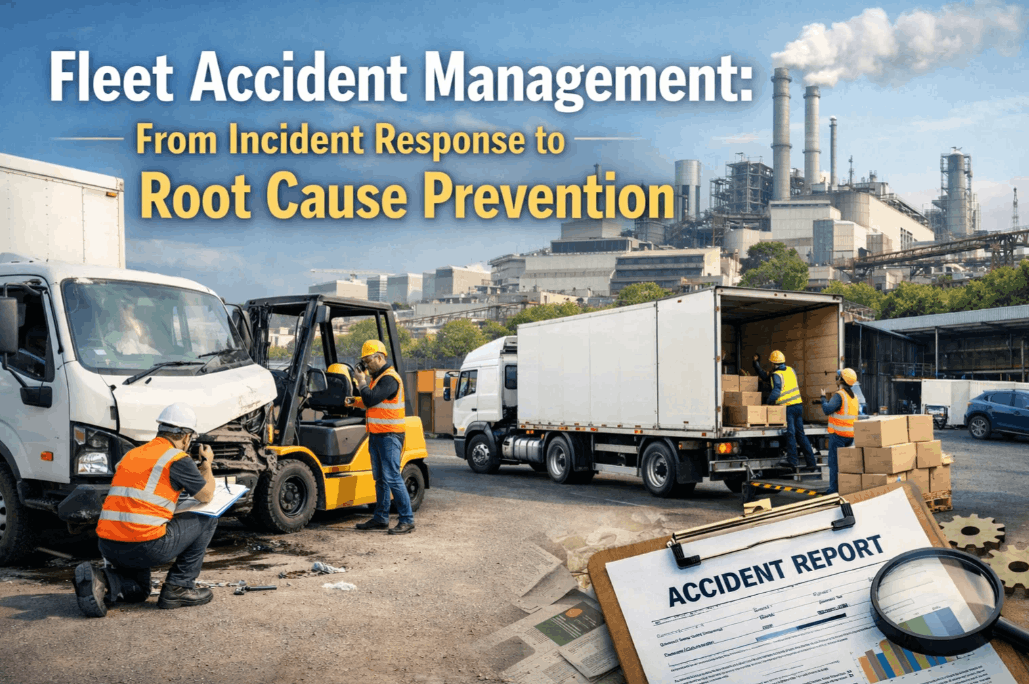
Every minute after a commercial vehicle accident is legally and financially consequential — evidence degrades, witnesses disperse, and the absence of documented facts creates gaps that opposing counsel, insurers, and regulators fill with their own narrative. A fleet driver who secures the scene correctly, photographs every critical element within the first 15 minutes, and completes a structured incident report before the tow truck arrives protects the carrier, protects themselves, and creates the evidentiary foundation that determines liability outcomes in 90% of commercial accident cases. Oxmaint's incident reporting module puts a structured accident documentation checklist on every driver's mobile device — completed records sync to the fleet management platform in real time, triggering safety officer review, insurance notification, and vehicle inspection work orders automatically.
Accident Response — Time-Phased Action Matrix
Accident response is not a flat list of tasks — it is a time-phased sequence where the wrong action at the wrong time is as costly as no action at all. The matrix below organises every required action by the time window in which it must be completed, so drivers and safety officers know exactly what happens when, in what order, and what cannot wait.
How Technology Strengthens Accident Response
Paper accident forms completed under stress produce incomplete records with illegible handwriting and missing critical fields. Four technologies are transforming how commercial fleets capture, process, and act on accident scene data — reducing documentation errors, accelerating insurance notification, and turning every incident into structured safety intelligence. Oxmaint integrates all four into a single mobile-first incident reporting platform.
1. Scene Safety and Injury Assessment Checklist
Nothing in an accident response checklist matters more than the first item: are there injuries, and is the scene safe? A driver who bypasses safety assessment to start photographing creates a second incident. Life safety actions must be completed before any documentation task begins — no exceptions. Oxmaint's guided mobile checklist enforces scene safety steps before unlocking documentation sections.
Personal safety check — exit vehicle only when safe
Assess for oncoming traffic, fire, or fuel spill before exiting. If unsafe, stay belted and call 911 immediately. Priority — do first
Injury assessment — all parties involved
Ask every person if they are injured — adrenaline masks pain. Note each person's stated condition in the incident report. Priority — before photos
Emergency services — 911 call with location and injury status
Call 911 for any injury, fuel spill, road blockage, or hazmat load. Provide GPS location and stay on the line until units are confirmed. Priority — call if any doubt
Warning triangles and hazard lights — scene protection
Activate hazard lights immediately. Deploy triangles at 10 ft, 100 ft, and 200 ft per FMCSA §393.95. OOS — not deployed
Hazardous materials check — placard verification and spill assessment
If carrying a placarded load, check for spill or breach. Evacuate 300 ft and report UN code to 911 if any hazmat is suspected. Priority — if placard load
2. Photo Documentation and Scene Evidence Checklist
Photographs taken in the first 15 minutes after an accident are the single most valuable evidence asset in any subsequent insurance or legal proceeding. Road marks, debris positions, tyre tracks, and fluid trails disappear within hours — other vehicles are moved, weather washes away physical evidence, and the scene that was objectively documented by camera is the only version that cannot be later disputed. Upload scene photos directly to the Oxmaint incident report from the driver's mobile device — time-stamped and GPS-tagged automatically.
Wide-angle scene overview — all vehicles in frame
Photograph from all 4 compass directions showing every vehicle, road markings, and surrounding environment — before anything is moved. Critical — before any movement
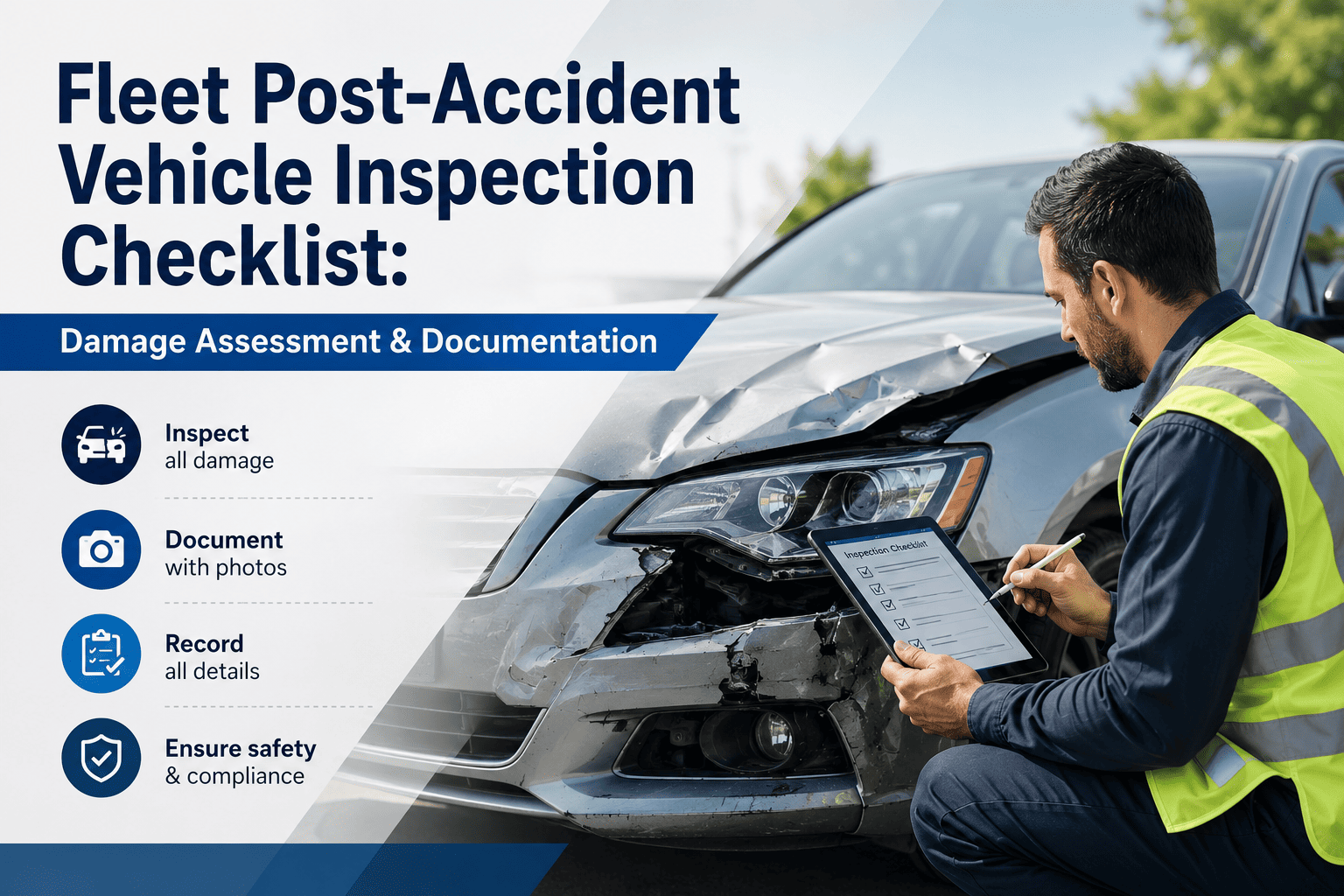
All vehicle damage — close-up per panel and bumper
Photograph every damaged panel, bumper, and glass area on all vehicles including adjacent undamaged areas to establish damage boundaries. Critical — all vehicles
Road markings, skid marks, and debris — before contamination
Photograph all tyre marks, debris, and gouge marks immediately with a reference object for scale — this evidence disappears within hours. Critical — time sensitive
Road environment — signs, signals, sight lines, and conditions
Photograph all traffic signs, signals, road surface, and the sight line from each driver's perspective. Note weather and lighting conditions. Document — before departure
Dashcam footage — download or flag for preservation
Immediately flag dashcam footage to prevent overwrite and upload or note status in the Oxmaint incident report for remote extraction. Critical — do not overwrite
AI Camera Vision tip: Oxmaint's mobile incident report uses AI to analyse photos uploaded from the scene — automatically classifying damage severity, identifying impacted vehicle zones, and flagging any photos that are too blurry or too dark to serve as evidence, prompting the driver to retake before leaving the scene. See Oxmaint's AI-assisted accident photo documentation.
3. Witness, Police and Insurance Notification Checklist
The three information streams — witness statements, police report reference, and insurer notification — must all be captured at the scene or within the policy-specified notification window. Each has a different deadline and different consequences for non-compliance. Missing a single witness name costs more in legal fees to reconstruct than the 30 seconds it takes to record it correctly at the scene. Capture all party details, witness information, and police report data in Oxmaint's structured incident form.
Other party details — complete vehicle and driver information
Record name, licence, insurance details, plate, and VIN for all other parties. Photograph their licence, insurance card, and registration. Document — before parties leave
Witness identification — all parties present at scene
Collect full name and phone number from every witness before the scene clears. Ask "What did you see?" and record their exact words. Document — time critical
Police report — officer name, badge number, and report number
Record officer name, badge number, department, and case number before they leave. Retrieve the full report online within 3–5 days using the case number. Document — before officer leaves
Do not admit fault or make liability statements
Never say "I'm sorry" or "it was my fault." Provide factual information only — what happened, not who caused it. Legal — no exceptions
Insurance notification — within policy time window
Notify your safety officer immediately — most policies require insurer notification within 24–72 hours. Oxmaint triggers this automatically on report submission. OOS — missed window
4. CMMS Incident Reporting and Post-Accident Compliance Checklist
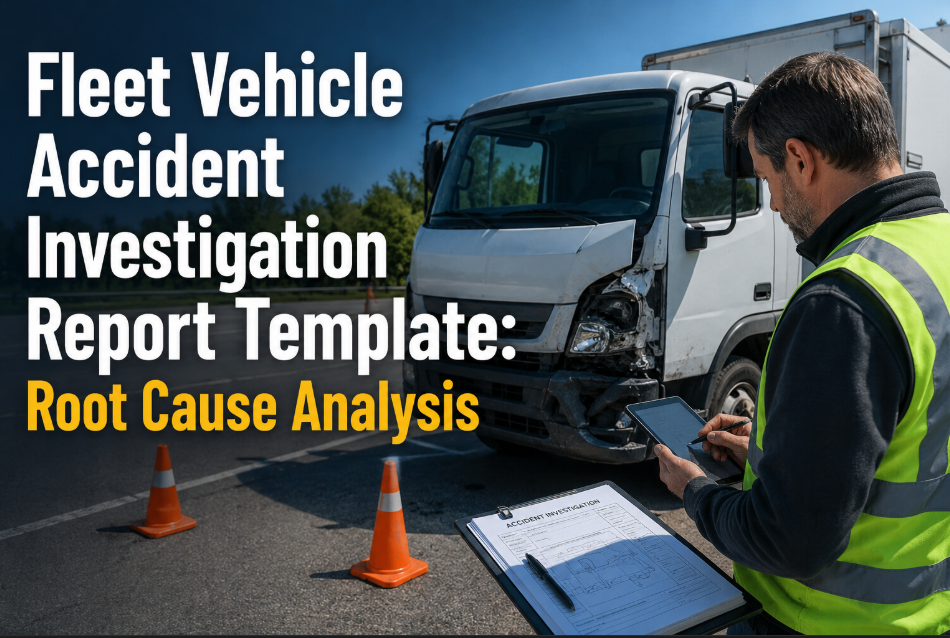
The accident scene is the beginning of a compliance process, not the end. Every DOT recordable accident triggers a mandatory set of carrier actions — drug and alcohol testing, DOT accident register update, vehicle inspection, and in some cases FMCSA reporting — each with its own deadline and consequences for non-compliance. A carrier whose incident reporting is systematic misses none of these steps. Oxmaint's incident report triggers all post-accident compliance tasks automatically from a single submission.
DOT recordable accident determination — criteria check
Recordable if: any fatality, medical treatment away from scene, or vehicle towed. Record the determination — misclassifying a recordable accident is a separate FMCSA violation. Violation — misclassification
Post-accident drug and alcohol test — within time limits
Alcohol test within 8 hours, drug test within 32 hours of any DOT recordable accident. Missing either window is a violation — the test is not discretionary. Violation — missed window
DOT accident register — entry within required period
Enter date, location, driver CDL, injuries, fatalities, and tow status within 24 hours. Register must be retained 3 years and produced on demand. Deficiency — no register entry
Post-accident vehicle inspection — before returning to service
Any towed or police-attended vehicle must be mechanically inspected before re-dispatch. Oxmaint generates the inspection work order automatically from the incident report. OOS — until inspected
HOS review — driver hours at time of accident
Immediately preserve ELD records for the 8 hours before impact. A HOS violation at time of accident significantly increases carrier liability exposure. Deficiency — records not preserved
OBD / EDR tip: Oxmaint automatically extracts OBD pre-impact data — speed, brake application timing, ABS engagement, and steering inputs — from telematics providers when an incident report is filed, attaching the objective data to the incident record before the driver has left the scene. Book a demo to see automated OBD incident data capture in Oxmaint.
Before Oxmaint, our drivers completed paper accident forms that were often illegible, missing witnesses, and filed days later. We had three liability cases where the absence of scene photos cost us significantly in settlements. Since deploying Oxmaint's mobile incident checklist, every accident report includes GPS-tagged photos, all party details, and an automatic post-accident drug test referral — submitted from the scene within 20 minutes of impact.
Frequently Asked Questions
The most common questions from fleet drivers, safety officers, and compliance managers about accident documentation requirements and post-accident procedures.
A DOT recordable accident results in a fatality, off-scene medical treatment, or a towed vehicle. Misclassifying a recordable as non-recordable is a separate FMCSA violation — document the determination either way.
No. A refusal equals a positive result under §382.303 — the driver is immediately removed from safety-sensitive duties and cannot return until the return-to-duty process is complete.
Three years from each accident date. Must include date, location, driver CDL, injuries, fatalities, and tow status. Produce on demand during any compliance review.
Only if creating immediate danger — photograph the original position first. Vehicle position is primary evidence for impact speed and angle that cannot be reconstructed later.
In order of frequency: witness contact details, skid mark photos, dashcam footage preservation, other party's insurance policy number, and road environment documentation. All five must be captured in the first 15 minutes.
Oxmaint automatically determines recordability, schedules the post-accident drug test, notifies the insurer, generates a vehicle inspection work order, and creates the DOT accident register entry — all from a single incident report submission.