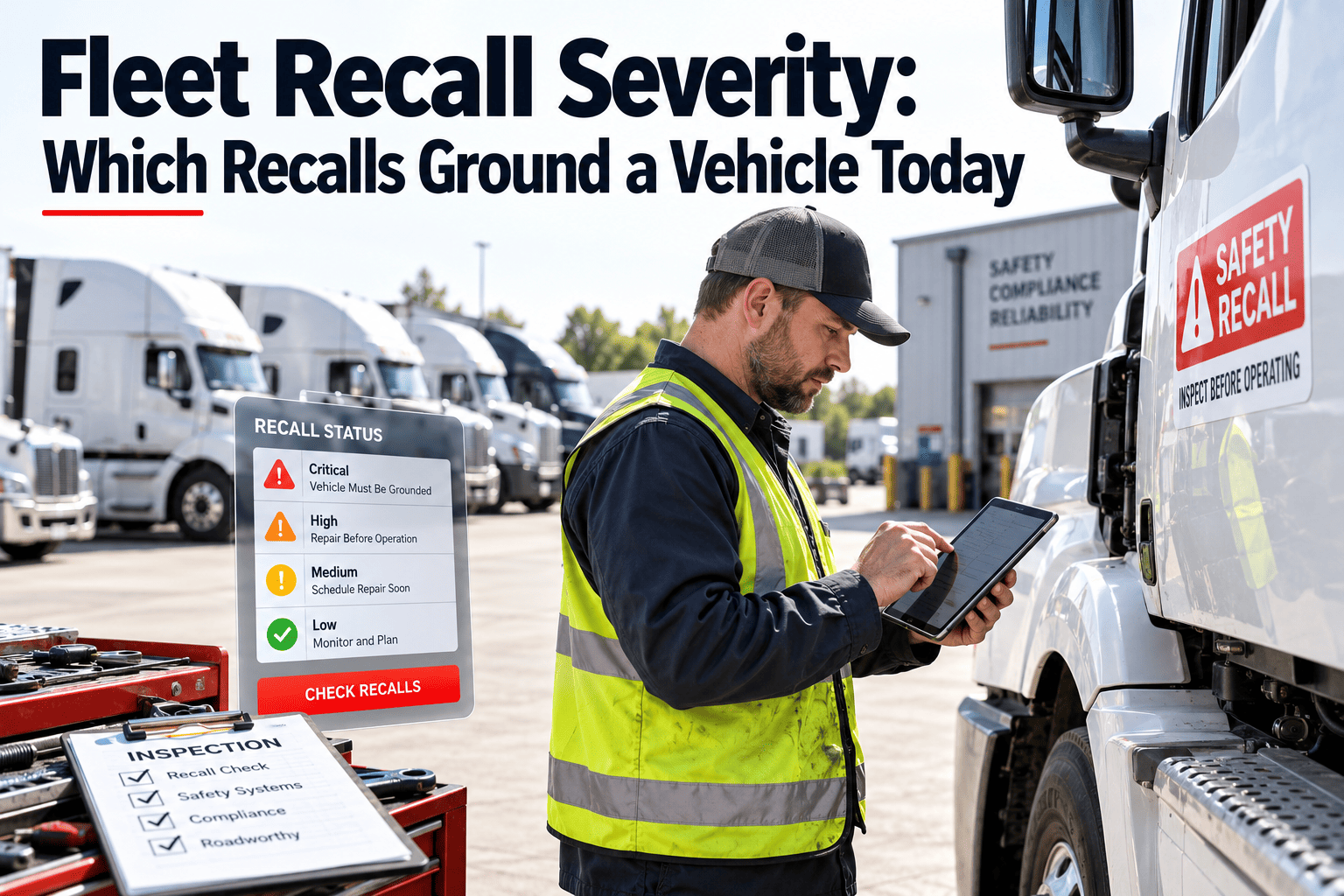
A safety recall notice lands in the inbox and the first question is rarely "what's the defect" — it's "can this truck still run its route today." Most fleets answer that question inconsistently, driver by driver, dispatcher by dispatcher, because the recall itself does not say it in plain language. NHTSA and OEMs use a specific vocabulary — Do Not Drive, Park Outside, Stop Sale, Stop Drive — and each one carries a different operational consequence. Getting that translation wrong either grounds a healthy truck for no reason or keeps a genuinely dangerous one on the road, which is why fleets need a written grounding policy rather than a judgment call made at 6 a.m. in the yard.
Not every recall grounds a vehicle. But some absolutely should — today.
NHTSA and OEMs already tell you how serious a recall is through the language on the notice itself. The problem is that most fleets never turn that language into a consistent grounding decision. This is the classification framework that does.
Why fleets treat every recall the same — and why that's expensive either way
A recall notice for a $4 sensor bracket and a recall notice for a steering-column bolt often arrive looking almost identical: a PDF, a NHTSA campaign number, a paragraph of legal language. Nothing on the page visually signals urgency, so fleets default to one of two bad habits.
Over-grounding
Every open recall — including cosmetic trim, infotainment, or paperwork-only compliance recalls — takes a vehicle out of rotation "to be safe." Utilization drops, spare-fleet costs rise, and drivers lose trust in the policy because it grounds trucks that clearly aren't broken.
Under-grounding
Recalls get logged into a spreadsheet and scheduled for "next PM visit," including ones explicitly marked Do Not Drive by the manufacturer. The vehicle keeps running routes for weeks while a known failure mode — steering loss, fire risk, brake failure — sits unresolved.
Both failure modes trace back to the same root cause: there is no written mapping between NHTSA's own severity language and a fleet's dispatch decision. Building that mapping once, and encoding it into whatever system tracks asset compliance, removes the judgment call entirely, and it means the answer to "can this truck run today" is the same regardless of who reads the notice first or what time it arrives.
What NHTSA and OEM recall language actually means for dispatch
Every recall notice contains signal words that map directly to an operational action. Here is what each one legally and practically requires.
Do Not Drive
Reserved for the small share of recalls — typically under 3% of all campaigns — where NHTSA or the OEM determines the failure mode is severe enough that continued operation is unsafe under any condition. Steering loss, brake failure, and structural defects fall here. Ground the vehicle immediately, before its next dispatch, regardless of route criticality.
Park Outside / Fire Risk
Applies to defects that can ignite a fire even when the vehicle is parked and off. The vehicle should not be driven and should not be stored in an enclosed garage or near structures until repaired. Treat this as a same-day yard relocation plus a grounding, not just a grounding.
Stop Sale / Stop Drive
A federal stop-sale bars delivery of new, undelivered units with an open recall. A dealer- or OEM-issued stop-drive on used or in-service vehicles means the unit should not be resold or redeployed until the remedy is complete. For an active fleet vehicle, this functions the same as Do Not Drive for routing purposes.
Standard Safety Recall
A confirmed safety-related defect or FMVSS non-compliance without an elevated warning. The vehicle can typically keep running while the repair is scheduled at the next practical service window, but the open campaign should still be visible on every work order and dispatch screen until closed.
Compliance / Non-Safety Recall
Labeling errors, owner's manual corrections, or paperwork-only non-compliance findings. No operational restriction applies. Log it, schedule the remedy opportunistically, and do not let it consume grounding-policy attention that belongs on Tiers 1 through 3.
The five-step process from recall notice to dispatch decision
A written workflow removes the guesswork the moment a recall notice hits the shop, regardless of who is on duty when it arrives.
Ingest the notice against the VIN
Match the NHTSA campaign number to the exact vehicle record, not just the make and model, since recall scope is often limited by build date or component supplier.
Read the severity language literally
Search the notice text for the five tier keywords above. Do not infer severity from the component name alone — a "steering" recall can be Tier 1 or Tier 4 depending on the actual failure mode described.
Apply the tier to a dispatch hold
Tier 1–3 triggers an immediate dispatch block on the asset record. Tier 4–5 logs the campaign as an open compliance item without blocking the route.
Route the vehicle to remedy
Confirm parts availability before promising a return date. A "Remedy Not Available" status from the OEM means the grounding may extend for weeks — plan a spare-vehicle swap rather than a same-day fix.
Certify and clear the hold
The dispatch block should only lift once a technician certifies the repair against the specific campaign number — not simply because the vehicle "was in the shop."
Severity-to-action matrix
A quick reference fleets can print, post, or build directly into dispatch software rules.
| Notice Language | Failure Type | Dispatch Action | Timeframe |
|---|---|---|---|
| Do Not Drive | Steering, brake, structural loss | Immediate ground, no exceptions | Before next dispatch |
| Park Outside / Fire Risk | Combustion or battery ignition | Ground plus outdoor relocation | Same day |
| Stop Drive / Stop Sale | OEM- or dealer-issued hold | Ground until remedy confirmed | Before next dispatch |
| Standard Safety Recall | Confirmed defect, no elevated warning | Log and schedule | Next service window |
| Compliance / Non-Safety | Labeling, documentation | Log only | Opportunistic |
Turn recall notices into automatic dispatch holds
See how a written severity policy attaches to every VIN in your fleet before the next notice arrives.
Three root causes of inconsistent recall grounding
Fleets rarely lack the recall data. They lack a system that connects the notice to the person deciding whether the truck leaves the yard.
Recall data lives outside the maintenance record
Notices arrive by email or OEM portal and get read once, then forgotten, because they never attach to the vehicle's actual asset or work order history.
Dispatch and maintenance use different systems
A grounding decision made in the shop doesn't automatically block the vehicle in the dispatch board, so a driver can still be assigned a truck under a Do Not Drive order.
No single owner of the severity call
Without a documented policy, the grounding decision defaults to whichever technician or dispatcher happens to open the notice first — and their risk tolerance varies.
A 90-vehicle delivery fleet closes the gap between notice and hold
A regional delivery fleet running 90 last-mile vans received a Do Not Drive campaign affecting 14 units for a fuel-line defect. Under the old process, notices were logged manually and scheduled for the next quarterly PM — a six-week gap during which the affected vans kept running routes. After mapping recall severity language to an automatic dispatch hold tied to each VIN's asset record, the same campaign triggered an immediate block on all 14 units within hours of the notice being logged, with spare vehicles reassigned from the yard reserve. Parts lead time on the fuel-line kit was nine days; every affected van was grounded for that window instead of continuing to run for six weeks, and the closure was certified against the specific NHTSA campaign number rather than a general "recall work" note.
Checklist for a written recall grounding policy
Define the five severity tiers and the exact dispatch action tied to each one.
Attach every open campaign to the specific VIN, not the fleet-wide model list.
Connect the grounding hold to the dispatch board so a blocked vehicle cannot be assigned a route.
Require technician certification against the campaign number before a hold clears.
Track parts lead time separately from labor time, since remedy delays are often the real grounding duration.
Report open Tier 1–3 campaigns on a standing dashboard, not a quarterly review.
Where recall notices actually come from — and why relying on one is risky
Fleets typically receive recall information through more than one channel, and each has gaps that make single-source monitoring unreliable.
OEM dealer notices
Manufacturers notify registered owners directly, but fleet vehicles registered under a leasing company or management entity may not receive the notice at the address actually running the truck.
NHTSA VIN lookup
The public database is authoritative but passive — it only helps if someone actively checks each VIN on a regular cadence rather than waiting for a notice to arrive.
The safest approach combines both: a scheduled VIN-level check against the NHTSA database, cross-referenced with any direct OEM notices, so a recall never depends on a single notification reaching the right inbox.
What inconsistent grounding actually costs a fleet
The financial exposure runs in both directions, and neither is trivial once it compounds across a full fleet year.
Over-grounding costs
Idle spare-vehicle capacity, missed delivery windows, and driver downtime add up quickly when low-severity compliance recalls are treated with the same urgency as a Do Not Drive order.
Under-grounding costs
A failure that a Do Not Drive notice was warning about becomes an insurance claim, a liability exposure, and — in the worst case — a driver injury the fleet had explicit warning to prevent.
Audit and compliance costs
Fleets under DOT or corporate safety audit that can't produce a documented grounding decision for an open Do Not Drive campaign face findings that extend well beyond the recall itself.
Making severity tiers operational, not just documented
A written policy only works if it's enforced at the moment of dispatch, not rediscovered during an audit. Oxmaint's asset management module attaches every open recall campaign directly to the vehicle record, so a Tier 1 or Tier 2 notice can trigger a dispatch-blocking work order automatically rather than relying on someone remembering to check. Mobile inspection workflows let technicians certify recall remedies against the exact campaign number, and compliance dashboards surface every open Do Not Drive or Stop Drive hold across the fleet in one view — closing the gap between the notice landing in an inbox and the truck actually staying in the yard.
How grounding urgency differs across fleet types
The same severity tier carries different operational weight depending on what the fleet actually does, so the grounding policy should account for route type, not just recall language. A last-mile delivery fleet with dense daily routes can typically absorb a Tier 1 grounding by pulling a spare van from the yard within hours, while a long-haul carrier mid-route when a Do Not Drive notice posts faces a harder call: the driver may need to stop at the nearest safe location rather than complete the leg, even if that means an unplanned overnight and a load transfer. Fleets running regulated cargo — hazmat, food-grade, medical — should treat Tier 2 Park Outside and fire-risk notices with additional urgency given the compounding liability if a parked-vehicle fire damages cargo or a facility, not just the vehicle itself.
Fleet recall severity — common questions
What percentage of recalls carry a Do Not Drive warning?
Historically fewer than 3% of NHTSA safety recalls carry an elevated Do Not Drive or Park Outside flag. The remainder are standard safety or compliance recalls that don't require immediate grounding.
Is a Stop Sale the same as a Do Not Drive order?
No. Stop Sale applies to undelivered new vehicles and bars a dealer from delivering them. Stop Drive applies to vehicles already in service and functions like Do Not Drive for operational purposes.
Can we keep running a vehicle under a standard safety recall?
Generally yes, provided the notice doesn't carry an elevated warning. Schedule the remedy at the next practical service window and keep the open campaign visible on the vehicle's record.
What if the OEM has no remedy available yet?
A "Remedy Not Available" status still requires honoring the grounding order. Plan for an extended hold and use a spare vehicle rather than waiting for parts before deciding on dispatch.
How do we track recalls automatically across a mixed fleet?
Connect each VIN to a maintenance platform that ingests recall data and applies severity-based dispatch rules. Get Started to see how the workflow attaches to your existing asset records.
Stop deciding recall severity by gut feel
Give every technician and dispatcher the same written severity policy, enforced automatically at the moment of dispatch.
Free trial · No credit card