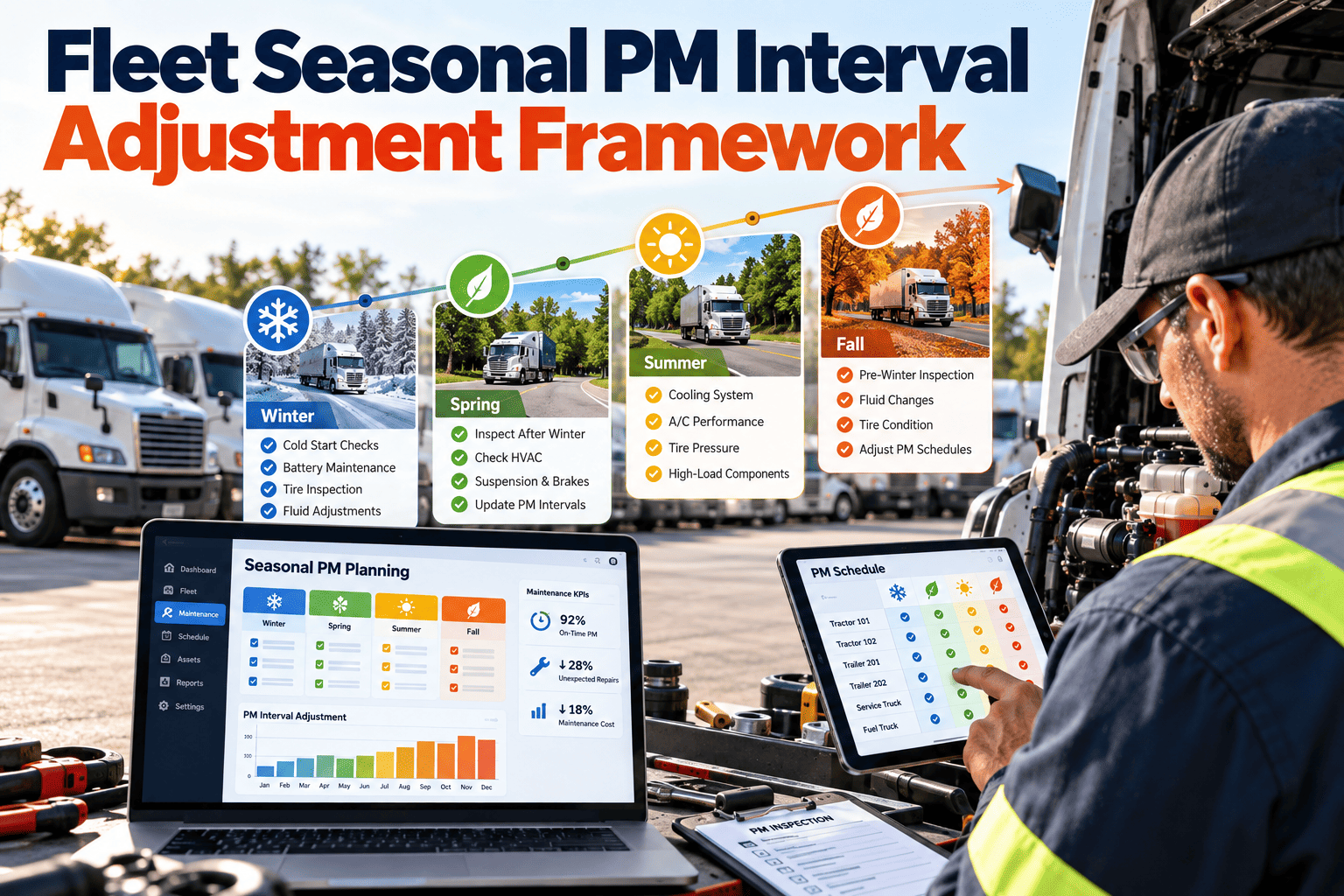
A fleet seasonal PM interval adjustment framework gives maintenance teams a structured way to change service timing, task content and inspection depth as weather and workload change. A truck that idles through January snow and a truck that hauls through July heat do not wear the same way, yet many fleets service both on one fixed schedule. The result is early failures in some seasons and wasted labor in others. This guide shows how to build adjustments from real data, and how a preventive maintenance software workflow keeps every change documented.
Fleet Seasonal PM Interval Adjustment Framework
Match service intervals and PM task lists to the seasons your vehicles actually work in, using usage data, failure history and manufacturer guidance.
Why One Fixed PM Interval Fails Across the Year
Calendar and mileage intervals assume every mile is equal. Seasonal conditions break that assumption quickly.
- Same task list in every month and every region
- Intervals set once and rarely reviewed
- Cold-start and heat failures treated as bad luck
- Seasonal prep done from memory, if at all
- Changes made by habit, with no record of why
- Tasks and timing tied to climate and duty cycle
- Intervals reviewed against failure and usage data
- Seasonal failure patterns tracked by system
- Readiness PM scheduled ahead of each season
- Every change logged with its reason and result
What the mismatch costs
- Road calls spike when batteries, cooling systems or tires meet their first stress event unprepared.
- Shops get overloaded in the weeks before and after seasonal peaks.
- Low-risk tasks consume hours that could address real seasonal risks.
- Warranty and compliance records become harder to defend when intervals change without documentation.
Seasonal Stress Map by Vehicle System
Start by listing which systems are stressed by which season. This table is a planning guide, so confirm details against your OEM service documentation.
| System | Cold-Weather Stress | Hot-Weather Stress | Adjustment to Consider |
|---|---|---|---|
| Batteries and charging | Higher cranking demand and reduced capacity | Heat shortens battery life and accelerates internal wear | Add load testing and terminal checks before each season |
| Cooling system | Coolant concentration and freeze protection | Overheating, weak hoses, clogged radiators | Test coolant, inspect hoses and clean cores before heat |
| Tires | Pressure drops as temperature falls | Heat build-up and blowout risk at low pressure | Add pressure and tread checks to inspections |
| Fuel and DEF | Diesel gelling and frozen DEF, which freezes near 12 degrees Fahrenheit | Fuel and DEF degrade faster when stored warm | Review fuel additives, filter changes and DEF handling |
| Brakes and air system | Moisture can freeze in air lines and valves | Fade and heavy wear in hilly or stop-heavy duty | Inspect air dryers, drain schedules and friction wear |
| HVAC and defrost | Defroster and heater performance for visibility | A/C load affects operator safety and comfort | Check blower, refrigerant performance and cabin filters |
| Wipers and lighting | Ice, slush and short daylight hours | Dust, insects and glare | Replace wipers and verify lamps ahead of peak seasons |
| Undercarriage and body | Road salt and brine corrosion | Dust and sun damage to seals | Wash, inspect and treat corrosion-prone areas |
Regional Climate Profiles and PM Emphasis
Climate zone is the first segmentation layer. A single national schedule rarely fits every depot.
| Profile | Typical Conditions | PM Emphasis | Review Trigger |
|---|---|---|---|
| Cold-winter regions | Snow, ice, road salt, long cold starts | Batteries, block heaters, fuel and DEF, air dryers, corrosion control | Rise in no-start calls or frozen-system repairs |
| Hot and dry | High ambient heat, dust, sun exposure | Cooling, A/C, belts, hoses, tires, air filters | Overheating events or early filter loading |
| Hot and humid | Heat with moisture and storms | Electrical connections, corrosion, A/C drains, cooling | Repeat electrical faults after wet weather |
| Coastal and salt-exposed | Salt air and spray year-round | Undercarriage, brake hardware, wiring, frame and body inspection | Corrosion findings at each PM |
| Mild or mixed | Moderate swings with occasional extremes | Baseline PM with light seasonal checks | Seasonal clustering of failures |
Duty-cycle factors that matter as much as the calendar
- Engine hours exceed what mileage suggests
- Use hours or idle time as the PM trigger
- Watch fluid condition and emissions system health
- Frequent braking and low-speed loading
- Shorten brake and tire inspections
- Review transmission and cooling load
- High mileage with steady loads
- Mileage intervals work well
- Add seasonal tire and brake checks
- Sit for weeks or months
- Use calendar triggers
- Add return-to-service inspections
The Five-Layer Adjustment Framework
Work through the layers in order. Each one narrows the decision before you touch an interval.
Schedule Seasonal PM Before the Season Starts
Build seasonal rules, templates and reminders in one maintenance system so readiness work is planned instead of rushed.
Worked Example: Setting a Seasonal Modifier
This is a hypothetical walk-through to show the logic, not a customer case study.
Interval Modifiers: What to Tighten and What to Leave Alone
Not every task needs to move. Adjust the ones the data supports, and respect manufacturer limits.
- Battery and charging system checks
- Coolant tests and hose inspections
- Tire pressure and tread checks
- Air dryer and drain inspections
- Fuel filter and water separator service
- Tasks tied to warranty requirements
- Items with stable, low failure history
- Safety inspections with regulated timing
- Tasks where OEM sets a hard limit
- Low-use units with verified low wear
- Tasks that repeatedly find nothing
- Items covered by condition monitoring
- Only where OEM guidance allows it
Rules worth writing down
- Never extend an interval past the manufacturer limit or warranty requirement.
- Use engine hours or idle hours for vehicles that spend long periods stationary.
- Change one variable at a time so results can be traced.
- Record the reason for each modifier in the asset or PM template.
Pre-Season Checklists You Can Template
Readiness PMs work best as short, repeatable checklists attached to the asset type.
- Load test batteries and clean terminals
- Test block heaters and glow or intake heaters
- Check coolant freeze protection
- Inspect air dryers and drain valves
- Verify heater, defroster and wipers
- Confirm fuel additive and DEF plan
- Inspect radiators, hoses and belts
- Test A/C performance and cabin filters
- Check coolant level and condition
- Verify tire pressure, tread and sidewalls
- Inspect battery charging output
- Clean or replace air filters in dusty areas
Low-Use and Seasonal Equipment: Storage and Return to Service
Plows, spreaders, mowers and similar units sit idle for months. They need their own seasonal rhythm.
- Battery condition and charge state
- Fluid levels and signs of condensation or contamination
- Hydraulic hoses, fittings and cylinders for cracking or leaks
- Belts, tires and moving parts for age-related damage
- Lighting, safety devices and operator controls
- A short test run with findings logged before the equipment is released
- At season end, clean, lubricate and record condition so problems are fixed during downtime.
- Schedule major repairs in the off-season, when bays and parts are easier to secure.
Seasonal Readiness Timeline
Readiness work works best when it starts early enough to schedule parts and bay time.
Decision Ladder: When to Shorten an Interval
Escalate gradually. Each rung needs evidence before moving to the next.
Track the system in work order history and inspection findings.
Insert a quick check at the next regular PM.
Apply a tighter interval only to the affected vehicle group.
Revise the PM task list or parts used.
Consult the OEM, engineering or the warranty team.
Parts and Inventory Planning for Seasonal PM
A readiness PM fails if the parts are not on the shelf. Forecast seasonal demand from last year's work orders.
- Batteries and terminals
- Wiper blades and washer fluid
- Coolant and fuel additives
- Heater and defroster components
- Belts and hoses
- A/C service parts and cabin filters
- Coolant and radiator hardware
- Tires and valve stems
Telling drivers and technicians what changed
- Explain which checks were added and why, so inspections stay thorough.
- Update driver inspection forms with seasonal items such as defroster and wiper tests.
- Ask for feedback on the first season of any new rule.
Data That Justifies a Seasonal Change
- Odometer, engine hours and idle hours per vehicle
- Route region, terrain and operating temperature range
- Failure codes with dates, grouped by system
- Road call records and the conditions at the time
- PM findings that repeat in the same season each year
- Oil or fluid analysis results, where available
- Parts consumption trends such as batteries, filters and wipers
Seasonal Risk Priority Matrix
Use it to decide which systems earn extra attention first.
Measuring Whether the Framework Works
Every modifier is a hypothesis. Measure it against a clear baseline.
| KPI | Why It Matters | Data Source |
|---|---|---|
| Seasonal road calls by system | Shows whether readiness PMs reduce roadside failures | Work orders and failure codes |
| PM compliance in peak weeks | Reveals whether seasonal work gets done on time | PM work orders |
| Repeat repairs after seasonal PM | Tests whether tasks addressed real causes | Asset history |
| Labor hours per PM type | Confirms added checks are worth the time | Work order labor |
| Parts stockouts before peaks | Shows readiness of the seasonal parts plan | Inventory records |
Governance: who approves an interval change
- Keep a change log with the date, reason, owner and expected effect.
- Review adjustments at least once a year, after the season ends.
- Share findings with drivers and technicians so rules make practical sense.
Common Mistakes in Seasonal PM Planning
- Changing intervals fleet-wide when only one region or duty class shows the problem.
- Skipping documentation, which makes later audits and reviews harder.
- Starting readiness work too late to get parts and bay capacity.
- Ignoring idle hours for vehicles that sit running at the curb.
- Treating seasonal prep as a one-time event instead of a yearly cycle.
- Reviewing failures but never feeding the findings back into task lists.
How Oxmaint Supports Seasonal PM Adjustment
Oxmaint maintenance management software keeps seasonal rules tied to assets, schedules and work orders.
- Preventive maintenance schedules by mileage, hours or calendar, with seasonal templates.
- Asset records that group vehicles by class, region and duty cycle.
- Work orders that capture findings, parts and labor for each seasonal PM.
- Mobile inspection workflows so technicians record readiness checks at the vehicle.
- Reports and dashboards that compare road calls and PM findings across seasons.
- Inventory tracking to stock batteries, wipers, filters and coolant before demand rises.
Frequently Asked Questions
Plan Every Season With Confidence
Turn seasonal knowledge into scheduled PM templates, clear records and measurable results across your fleet.