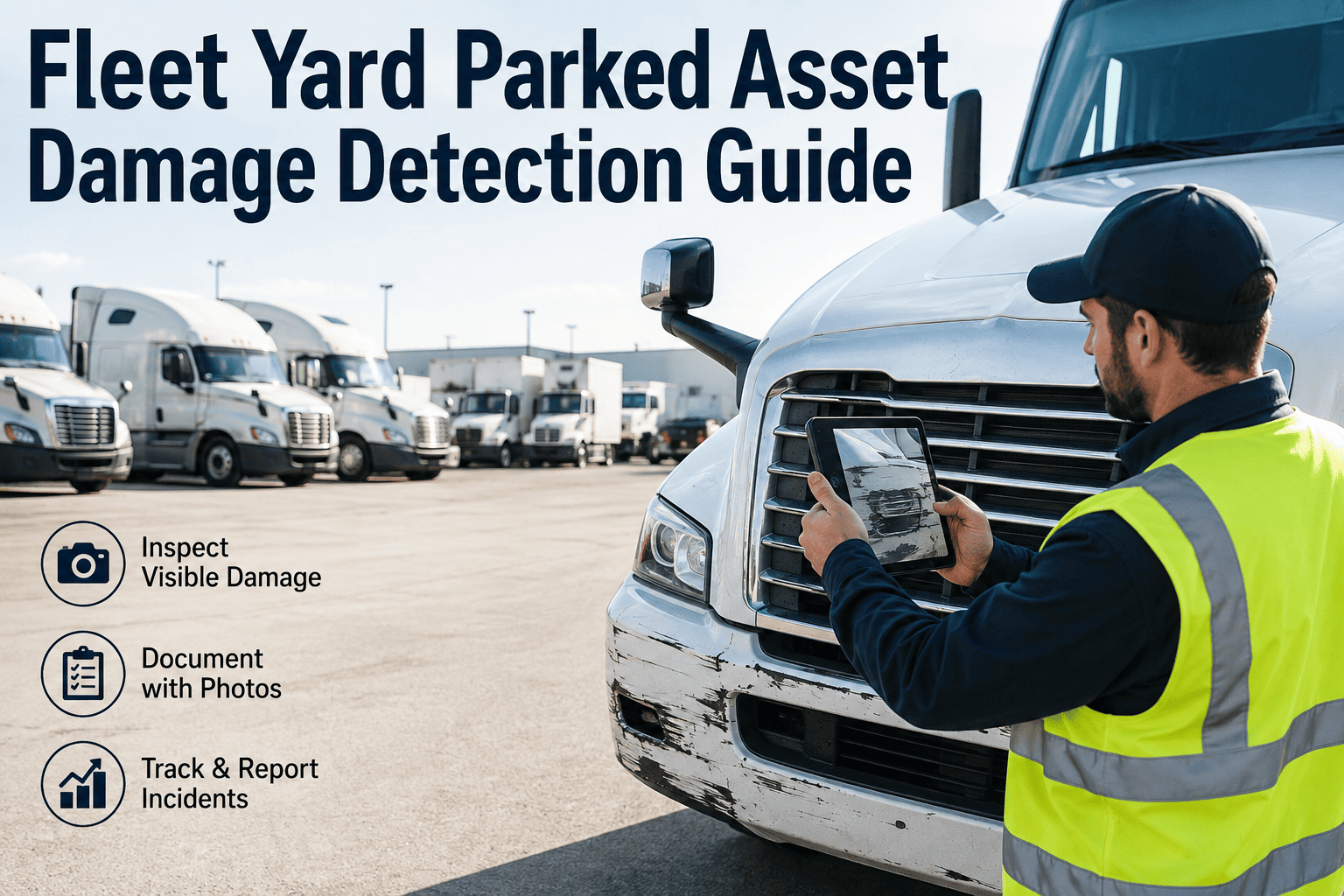
Parked asset damage detection is the process of finding, documenting and assigning responsibility for damage that happens to vehicles and equipment while they sit in the yard between trips — before the next driver pulls out and the damage becomes an unattributable mystery repair. Yard damage is uniquely expensive because it has no witness, no timestamp and no owner: a dented trailer door, a cracked mirror or a torn air line surfaces days later as a disputed repair, a missed delivery or an FMCSA out-of-service violation. Fleets that run structured yard inspections typically recover damage costs 3–5x more often than fleets that rely on driver reports alone, because condition evidence exists before and after each parking event. This guide breaks down how parked asset damage happens, what a defensible yard inspection workflow looks like, and how a CMMS turns scattered photos and paper notes into repair orders with accountability attached. OxMaint gives fleet teams the asset condition tracking, mobile inspection checklists and damage documentation workflow to make every yard incident attributable — Start Free Trial and see it on your own yard.
Who damaged that truck? If you can't answer in 60 seconds, you're paying for it.
Industry estimates put 20–30% of fleet damage in the "no fault found" category — and most of it happens while assets are parked. Without timestamped condition records, every yard incident becomes a write-off your maintenance budget absorbs.
How much does undetected yard asset damage actually cost a fleet?
A single unwitnessed yard incident averages $1,500–$4,500 in body and component repair — but the true cost multiplies when the damage is discovered mid-route as a breakdown, a failed roadside inspection or a missed customer window.
Consider a regional carrier running 120 tractors and 200 trailers out of two yards. If just two unattributed incidents surface per month at a conservative $2,500 average, that's $60,000 a year absorbed by the maintenance budget — before counting the downtime, the rental substitutions and the customer penalties when a damaged trailer fails en route. Fleets that implement structured parked asset damage detection typically cut those mystery-repair write-offs by 40–60% in the first year, simply because every parking event has a documented before-and-after condition record.
The 6 most common parked asset damage zones in a fleet yard
Over 80% of yard damage clusters in six predictable zones. A detection workflow that checks these zones on every parking event catches the vast majority of incidents within hours, not weeks.
Tight yard maneuvering and overnight shunting clip mirrors and corner panels. These are the #1 source of "nobody saw it" claims — and the easiest to photograph at check-in.
Dock impacts and forklift strikes bend hinges and tear seals. Undetected, a torn seal becomes a cargo-claim rejection or a failed inspection weeks later.
Curb strikes during yard repositioning sidewall tires and bend rims. A sidewall gash found at the next pre-trip means a road call at 3x the shop cost.
Cracked lenses and dead markers are the top vehicle-defect violation category in FMCSA roadside data — and most were broken in the yard, not on the highway.
Dropped trailers and careless coupling tear air lines and 7-way connectors. Undetected, they surface as brake violations or a trailer that won't release.
Hydraulic leaks and bent platforms sit unnoticed for days. A reefer door left unlatched in the yard can destroy a $40K temperature-sensitive load.
How to build a parked asset damage detection workflow that holds up in a dispute
Fleets that resolve damage claims successfully share one trait: a timestamped condition record exists for every parking event. Here is the five-step workflow that makes yard damage attributable instead of arguable.
Every asset entering the yard gets a 6-zone photo walkaround on a mobile device — under 3 minutes per unit. Photos auto-attach to the asset record with date, time, GPS and the person who captured them. This is your "before" evidence.
Record the yard slot or zone where each asset is parked. When damage is found, location history narrows the responsible window and the neighboring assets — turning a yard-wide mystery into a two-vehicle question.
Long-dwell assets (trailers parked 7+ days) get a recurring inspection task — weekly at minimum. A CMMS auto-generates these work orders so a trailer sitting for a month doesn't accumulate three undocumented incidents.
Before any asset leaves the yard, the driver or yard jockey confirms condition against the check-in baseline. New damage is flagged on the spot — while the responsible party and the timeframe are still identifiable.
Flagged damage auto-creates a repair work order carrying the before/after photos, location history, timestamps and responsible-party notes. That evidence pack is what converts a disputed claim into a recovered cost.
Why clipboard yard checks fail — and what a CMMS changes
Most fleets already "do yard checks." The difference between a paper walkaround and managed detection is whether the evidence survives long enough — and connects tightly enough — to assign responsibility and recover cost.
| Capability | Paper / Spreadsheet Yard Checks | OxMaint Managed Detection |
|---|---|---|
| Condition evidence | Photos on personal phones, lost within days | Timestamped photos auto-attached to the asset record, retained permanently |
| Damage-to-repair link | Damage noted on a form; repair tracked elsewhere (or never) | Flagged damage auto-creates a work order with the full evidence pack attached |
| Accountability window | Damage found days later; responsible window unknowable | Check-in/check-out records narrow the window to hours and a specific yard slot |
| Long-dwell assets | Parked trailers forgotten for weeks; damage stacks up | Recurring sweep inspections auto-generated for assets idle 7+ days |
| Cost recovery | Disputes default to "no fault found" — fleet absorbs the cost | Defensible before/after evidence supports 3–5x higher recovery rates |
| Audit & insurance readiness | Reconstructing an incident takes days of digging | Complete incident timeline exportable in minutes for insurers and auditors |
Turn yard damage detection into managed, defensible evidence with OxMaint
OxMaint is an AI-powered CMMS and EAM platform that gives fleet operations the four capabilities parked asset damage detection actually depends on — each with a measurable outcome.
Technicians and yard staff run the 6-zone photo checklist from any phone or tablet. Every image is timestamped, geo-stamped and permanently linked to the asset — cutting evidence loss to zero and check-in time to under 3 minutes per unit.
Recurring inspection work orders auto-generate for every parked asset on your cadence — daily for active units, weekly for long-dwell trailers. Nothing sits uninspected for weeks, so damage is caught within one inspection cycle instead of one quarter.
Flagged damage converts to a repair work order in one tap, carrying photos, location history and timestamps with it. Fleets report 40–60% fewer mystery-repair write-offs because every incident arrives with accountability attached.
Dashboards show damage frequency by yard zone, shift and asset type, plus recovered vs. absorbed cost. Most fleets identify their top two damage hotspots within 30 days — and fix the root cause instead of paying for the symptom.
See OxMaint running parked asset damage detection on your yard — book a 30-minute demo
We'll walk your actual check-in, sweep and damage work-order workflow live, and show you the evidence pack that turns disputed damage into recovered cost.
Parked asset damage detection: common questions
Parked asset damage detection is a structured process for finding and documenting damage that occurs while vehicles and equipment sit in the yard between trips. It combines check-in condition photos, periodic yard sweep inspections and pre-departure verification so every incident has a timestamped before-and-after record — making damage attributable instead of a disputed write-off.
Active assets should get a condition check at every check-in and check-out — each parking event. Long-dwell assets like stored trailers need a recurring sweep at least weekly, since damage accumulates unnoticed over time. A CMMS like OxMaint auto-generates these recurring inspection work orders so no parked asset goes uninspected past your set threshold — Start Free Trial to set your cadence.
Yes — fleets with timestamped condition evidence recover damage costs 3–5x more often than those relying on driver reports. A defensible evidence pack (before/after photos, parking location, timestamps, responsible-party notes) converts "no fault found" disputes into successful claims against the responsible party, their insurer or a third-party yard contractor.
Cover the six high-frequency damage zones: bumpers/mirrors/cab corners, trailer doors and seals, tires and rims, lights and lenses, air lines and gladhands, and liftgates or reefer units. Each zone needs a photo plus a pass/flag rating. Keep the full walkaround under 3 minutes per unit — longer checklists get skipped under yard time pressure.
A CMMS timestamps and permanently stores every photo against the asset record, auto-schedules sweep inspections for idle assets, and converts flagged damage directly into a repair work order with the evidence attached. Paper forms lose photos, disconnect damage from repair, and can't narrow the accountability window — which is exactly what insurers and disputes require. Book a Demo to see the full workflow.
Stop paying for damage nobody owns
Put timestamped condition evidence, automated yard sweeps and instant damage work orders on every parked asset — and make your next yard incident attributable in minutes, not weeks.