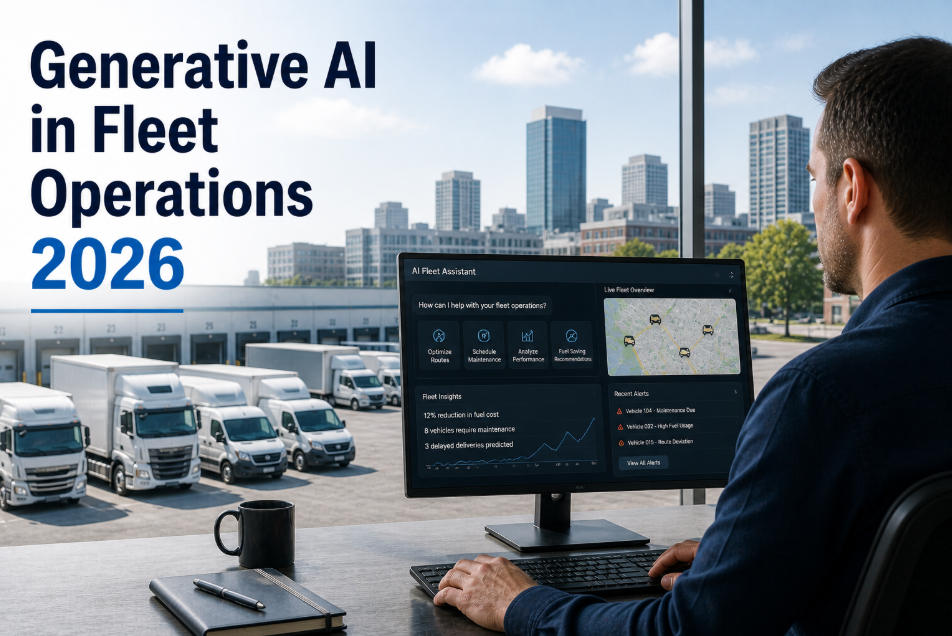
Generative AI is transforming fleet operations from a technology buzzword into deployed production systems delivering measurable ROI in 2026 — automated maintenance report generation saving fleet managers 8–12 hours per week, AI dispatch optimization reducing empty miles by 18–24%, conversational chatbots providing instant answers to driver questions, and anomaly detection flagging unusual vehicle behavior before it becomes a breakdown. Unlike traditional rule-based automation that follows rigid if-then logic, generative AI uses large language models to understand context, generate human-quality text, analyze unstructured data, and make recommendations based on patterns humans would miss. The difference is not incremental — it is the gap between a dispatch system that assigns the nearest available vehicle and an AI that considers driver hours-of-service compliance, vehicle maintenance schedules, fuel efficiency on specific routes, customer delivery time windows, and return trip optimization simultaneously. This guide breaks down eight real-world generative AI use cases deployed in commercial fleet operations today, the specific technologies powering each application, measured productivity gains, and implementation considerations including data requirements and integration complexity. If your fleet operations still rely entirely on manual processes and human judgment, start a free trial with OxMaint or book a demo to see generative AI working in fleet management workflows.
Generative AI Fleet 2026
Real-World Use Cases
Generative AI in Fleet Operations 2026
Eight deployed use cases where generative AI automates fleet workflows — from maintenance report generation to driver coaching to dispatch optimization — with measured productivity gains and ROI data.
8-12 hrs
Weekly time savings from AI-automated maintenance reporting
18-24%
Reduction in empty miles with AI dispatch optimization
67%
Faster incident investigation with AI video analysis and automated summaries
92%
Driver question resolution rate with AI chatbot before escalating to human dispatcher
Generative AI Built Into Fleet CMMS Workflows
OxMaint includes AI-powered maintenance report generation, natural language work order creation, automated root cause analysis, conversational fleet data queries, and intelligent parts recommendations. Free for 30 days — see generative AI working on your fleet data.
What Makes Generative AI Different from Traditional Fleet Software
Fleet management software has included automation for years — automatic PM scheduling, rule-based dispatch, threshold alerts for fuel consumption or idle time. Generative AI differs fundamentally because it creates new content and recommendations rather than following predefined rules. A traditional dispatch system assigns jobs using fixed logic: assign to nearest vehicle with capacity and required equipment. Generative AI dispatch considers hundreds of variables simultaneously — driver skill certifications, vehicle maintenance schedules, traffic predictions, customer preferences, fuel efficiency by route, return trip opportunities — and generates optimized dispatch recommendations that maximize fleet utilization while minimizing cost. Traditional maintenance software flags when odometer reaches PM interval. Generative AI reads technician notes from past repairs, analyzes failure patterns across similar vehicles, and generates a maintenance report explaining why three vehicles need transmission inspections even though they have not reached scheduled interval yet. The shift is from automation that executes predefined rules to AI that reasons about complex situations and generates human-quality insights. To see this difference in practice, start a free trial and ask OxMaint's AI assistant to analyze your fleet maintenance patterns, or book a demo to see AI-generated maintenance reports.
Eight Real-World Generative AI Use Cases in Fleet Operations
These eight use cases represent deployed generative AI applications in commercial fleet operations as of 2026 — not research projects or future possibilities, but production systems delivering measured productivity gains and ROI. Each use case includes the specific AI technology powering the application, measured impact, and implementation complexity.
The Problem:
Fleet managers spend 8–12 hours per week manually compiling maintenance reports for executive leadership, regulatory compliance, or insurance audits — aggregating data from CMMS, synthesizing technician notes, calculating downtime trends, and writing executive summaries explaining maintenance performance.
The AI Solution:
Generative AI reads CMMS data, work order histories, technician notes, and parts usage then generates complete maintenance reports in natural language. Fleet manager specifies report parameters — date range, vehicle subset, metric focus — and AI produces formatted report with executive summary, key findings, trend analysis, and recommendations in under 2 minutes.
Technology:
Large language models (GPT-4, Claude) with retrieval-augmented generation pulling data from fleet databases
Measured Impact:
92% time reduction in report generation — 8–12 hours manual work replaced by 30 minutes of AI generation plus human review
The Problem:
Drivers report vehicle issues via phone, text, or verbal handoff to dispatchers who then create formal work orders in CMMS — a process requiring 5–10 minutes per work order translating driver descriptions into structured data fields (asset ID, problem category, priority, symptom description).
The AI Solution:
Driver sends text or voice message describing issue: "Unit 247 making grinding noise when braking, worse at highway speeds." AI parses message, identifies vehicle, categorizes problem as brake system issue, assigns appropriate priority, generates detailed work order with recommended diagnostic steps, and routes to maintenance scheduler automatically.
Technology:
Natural language processing with named entity recognition for vehicle identification, classification models for symptom categorization
Measured Impact:
78% reduction in work order creation time — immediate entry from driver report without dispatcher intermediary
The Problem:
Human dispatchers optimize routes and vehicle assignments based on limited variables — distance, driver availability, vehicle capacity. They cannot simultaneously consider dozens of factors like maintenance schedules, fuel efficiency by route, driver skill certifications, customer delivery windows, and return trip backhaul opportunities.
The AI Solution:
Generative AI analyzes all available jobs, vehicles, and drivers considering 50+ variables simultaneously. Generates optimized dispatch plan that minimizes total miles, maximizes vehicle utilization, avoids dispatching vehicles near PM intervals, respects driver hours-of-service limits, and identifies backhaul opportunities reducing empty miles.
Technology:
Reinforcement learning models trained on historical dispatch data, constraint optimization algorithms, multi-objective optimization
Measured Impact:
18–24% reduction in empty miles, 12% improvement in on-time delivery performance, 16% increase in fleet utilization
The Problem:
Answering simple fleet data questions requires navigating CMMS interfaces, building custom reports, or requesting IT assistance. Manager wants to know "Which vehicles have had brake work in the last 90 days?" — requires 15 minutes of report building or waiting hours for IT response.
The AI Solution:
Fleet manager types or speaks question to AI assistant in natural language. AI translates question into database query, retrieves data, and generates answer with context: "14 vehicles had brake service in the last 90 days. 3 required emergency repairs, 11 were scheduled PM. Unit 142 has had brakes serviced twice suggesting possible underlying issue." Response time: under 10 seconds.
Technology:
Text-to-SQL models converting natural language to database queries, LLMs generating contextual answers from query results
Measured Impact:
90% reduction in time to answer fleet data questions — instant answers vs. 15-minute manual report building
The Problem:
When multiple vehicles experience similar failures, identifying root cause requires manually reviewing work orders, comparing failure symptoms, analyzing common factors, and hypothesizing causes — a process taking hours or days and often incomplete because patterns span months of data.
The AI Solution:
AI analyzes work order histories across entire fleet identifying failure clusters — five transmissions failed between 45K–52K miles in vehicles operating on Route 7. Generates root cause hypothesis: "Route 7 includes steep grade climbs causing excessive transmission temperature. Recommend transmission cooler upgrades for vehicles assigned to this route." Provides supporting evidence from sensor data and technician notes.
Technology:
Clustering algorithms identifying failure patterns, causal inference models, LLMs generating explanations and recommendations
Measured Impact:
Identifies root causes 4–6x faster than manual analysis, prevents repeat failures across fleet saving $15K–$40K per avoided failure
The Problem:
Reviewing dashcam footage after accidents or driver complaints requires watching hours of video to find relevant moments, document what happened, identify contributing factors, and write incident reports — consuming 2–4 hours per investigation.
The AI Solution:
AI analyzes dashcam video identifying key events — sudden braking, close following distance, lane departures, pedestrian interactions. Generates timestamped incident summary with screenshots of critical moments and natural language description: "At 10:42 AM, vehicle approached intersection. Pedestrian entered crosswalk from right side outside driver's field of view. Driver braked 1.2 seconds after pedestrian entered roadway. No contact occurred."
Technology:
Computer vision models detecting objects and events in video, LLMs generating narrative summaries from detected events
Measured Impact:
67% faster incident investigation, 82% reduction in time spent reviewing footage, improved documentation quality
The Problem:
Driver coaching requires fleet managers to manually review telematics data identifying harsh braking, speeding, excessive idle time, then schedule coaching sessions and deliver generic feedback. Time-intensive process reaches each driver quarterly at best resulting in delayed behavior correction.
The AI Solution:
AI monitors telematics data in real-time and generates personalized coaching messages delivered to drivers immediately after incidents. Example: "At 2:15 PM today on Highway 95, you braked harder than necessary approaching stopped traffic. Anticipating traffic flow earlier allows smoother braking reducing brake wear and fuel consumption. Your smooth braking score this week: 82/100, up from 78 last week." Positive reinforcement for improvements, specific actionable guidance for issues.
Technology:
Real-time telematics analysis, natural language generation for personalized coaching, sentiment analysis ensuring supportive tone
Measured Impact:
24% improvement in driver safety scores, 14% reduction in fuel consumption, 18% decrease in brake maintenance costs
The Problem:
Drivers call or text dispatchers with routine questions — "What is the load limit for Unit 312?", "Where is the nearest approved fuel stop on I-80?", "When is my next scheduled PM?" Dispatchers spend 15–20% of their day answering repetitive questions that could be automated.
The AI Solution:
AI chatbot integrated with driver mobile app answers questions instantly by querying fleet databases, policy documents, and vehicle specifications. Handles 90%+ of routine inquiries automatically. Complex questions requiring human judgment escalate to dispatcher with full conversation context. Available 24/7 including nights and weekends when dispatcher availability limited.
Technology:
Conversational AI with retrieval-augmented generation accessing fleet documentation, intent classification for routing complex queries
Measured Impact:
92% driver question resolution without human dispatcher involvement, 15–20% dispatcher productivity gain reallocated to higher-value coordination
Generative AI Technology Stack for Fleet Operations
Understanding the technology layers powering these use cases helps evaluate vendor solutions and plan implementation. This table maps common fleet AI applications to the specific AI technologies required for each.
| Use Case |
Primary AI Technology |
Data Requirements |
Implementation Complexity |
| Maintenance Report Generation |
Large language models (GPT-4, Claude) |
CMMS work order history, parts data, technician notes |
Low — API integration only |
| Natural Language Work Orders |
NLP with named entity recognition |
Historical work orders for training classification models |
Low — text-to-structured-data pipeline |
| Dispatch Optimization |
Reinforcement learning, constraint optimization |
6–12 months dispatch history, route data, fuel consumption |
High — requires custom model training |
| Conversational Data Queries |
Text-to-SQL, LLMs for answer generation |
Fleet database schema, sample queries for training |
Medium — database integration and query validation |
| Root Cause Analysis |
Clustering algorithms, causal inference, LLMs |
12–24 months work order history with failure details |
Medium — pattern detection plus explanation generation |
| Video Analysis |
Computer vision (YOLO, EfficientDet), LLMs |
Dashcam footage, event labels for training |
High — video processing infrastructure required |
| Driver Coaching |
Real-time analytics, natural language generation |
Telematics data stream, coaching guidelines |
Medium — real-time processing and personalization |
| AI Chatbot |
Conversational AI, retrieval-augmented generation |
Fleet policy docs, vehicle specs, FAQ history |
Low to Medium — document indexing and intent routing |
ROI Timeline — When Generative AI Pays Back Initial Investment
Generative AI ROI varies by use case based on time savings, error reduction, and operational efficiency gains. This comparison shows typical payback periods for different fleet AI applications based on 50–200 vehicle commercial fleets.
Automated Maintenance Reports
Time Savings: 8–12 hours per week
Implementation Cost: $2,000–$5,000
Payback Period: 1–2 months
Natural Language Work Orders
Time Savings: 45–60 minutes per day
Implementation Cost: $3,000–$8,000
Payback Period: 2–3 months
AI Dispatch Optimization
Cost Savings: $1,200–$2,400 per vehicle per year
Implementation Cost: $15,000–$40,000
Payback Period: 6–12 months
Conversational Data Queries
Time Savings: 5–8 hours per week
Implementation Cost: $5,000–$12,000
Payback Period: 3–4 months
Root Cause Analysis
Cost Avoidance: $25,000–$80,000 per year
Implementation Cost: $8,000–$18,000
Payback Period: 2–6 months
Video Analysis
Time Savings: 3–5 hours per incident
Implementation Cost: $12,000–$30,000
Payback Period: 6–10 months
Driver Coaching
Cost Savings: $800–$1,400 per vehicle per year
Implementation Cost: $6,000–$15,000
Payback Period: 4–8 months
AI Chatbot
Time Savings: 10–15 hours per week
Implementation Cost: $4,000–$10,000
Payback Period: 2–3 months
How OxMaint Delivers Generative AI for Fleet Operations
OxMaint integrates generative AI into standard fleet CMMS workflows — not as a separate AI platform requiring different login and data export, but as intelligent capabilities embedded in work order management, reporting, and decision support.
Feature 01
AI Maintenance Report Generator
Fleet manager clicks "Generate AI Report" button, selects date range and vehicle subset, chooses report focus (downtime analysis, parts spending, compliance status). AI queries CMMS database, analyzes work orders and technician notes, generates executive summary with key findings, trend analysis with visualizations, and recommended actions. Report outputs as formatted PDF or editable Word document in under 2 minutes.
Feature 02
Natural Language Work Order Creation
Driver texts issue description to dedicated phone number or speaks to mobile app: "Truck 45 pulling left when braking." AI parses message, identifies vehicle, categorizes as brake system issue, creates work order with recommended priority and diagnostic steps, routes to maintenance scheduler, and sends confirmation text to driver with work order number and estimated service date.
Feature 03
Conversational Fleet Data Assistant
Fleet manager types question into chat interface: "Which vehicles are overdue for PM?" AI translates to database query, retrieves data, generates answer: "7 vehicles are overdue for PM: Units 23, 47, 89, 102, 145, 201, 234. Average days overdue: 12. All have been notified but not yet scheduled. Would you like me to create priority work orders for these?" One-click action creates all work orders automatically.
Feature 04
AI Root Cause Pattern Detection
AI continuously monitors work orders identifying failure clusters. When pattern detected — four alternators failed on vehicles under 30K miles in past 60 days — system generates alert with hypothesis: "Unusual alternator failure cluster detected. Common factor: all vehicles operate on Route 12 with frequent short trips preventing full battery recharge. Recommend battery health monitoring and potential charging system upgrades." Provides supporting data and recommended preventive actions.
Feature 05
Intelligent Parts Recommendations
Technician opens work order for brake repair. AI analyzes vehicle history, similar repairs on other vehicles, parts inventory, and supplier pricing then recommends: "Based on this vehicle's usage pattern and previous brake life, recommend OEM brake pads (Part #12345, $127, 2 in stock) instead of standard economy pads. OEM pads last 40% longer on high-stop-density routes reducing labor cost from more frequent replacement." Provides cost-benefit analysis for upgrade parts.
Feature 06
Automated Work Order Summary Generation
When complex work order with multiple technician notes and updates closes, AI generates summary for historical record: "Transmission issue diagnosed as torque converter failure. Root cause: towing loads exceeding vehicle rating causing excessive heat. Transmission replaced under warranty. Driver counseled on proper load limits. Recommend reviewing all vehicles assigned to this customer for similar overload patterns." Summary improves searchability and knowledge transfer to future technicians.
Frequently Asked Questions
Does generative AI require expensive hardware or can it run on existing fleet management systems?+
Most generative AI for fleet operations runs via cloud APIs — your fleet CMMS sends data to AI service provider (OpenAI, Anthropic, Google) via API, receives AI-generated results, and displays them in your existing interface. No local GPU servers or specialized hardware required. All processing happens in cloud. This API-based architecture means generative AI capabilities integrate with existing fleet management platforms through software updates — no hardware procurement, no data center buildout, no IT infrastructure changes. Cost model is pay-per-use based on API calls and data processed typically $200–$800 per month for 50–200 vehicle fleets. Want to see generative AI working with your existing fleet data —
start a free trial and connect your CMMS to see AI-generated insights immediately.
How accurate are AI-generated maintenance reports and recommendations — can we trust them for decision-making?+
AI-generated content accuracy depends on data quality and use case complexity. Factual data summarization — "14 vehicles had brake service in Q1" — achieves 95%+ accuracy because AI queries structured databases directly. Trend analysis and pattern detection — "brake wear rate increasing on Route 7 vehicles" — achieves 85–92% accuracy validated against manual analysis. Causal inference and recommendations — "recommend transmission cooler upgrades" — require human validation because AI suggests hypotheses rather than proven causation. Best practice: treat AI-generated reports and recommendations as high-quality first drafts requiring human review rather than final authoritative outputs. OxMaint highlights AI-generated content with confidence scores and supporting data allowing fleet managers to validate conclusions before acting. Over time, as AI learns from human feedback on which recommendations prove effective, accuracy improves toward 90%+ on recommendations.
What happens to our fleet data when using cloud-based generative AI — is it secure and private?+
Enterprise AI providers (OpenAI Business, Anthropic Enterprise, Google Cloud AI) offer data privacy guarantees: your fleet data is not used to train public AI models, data is encrypted in transit and at rest, data retention policies allow deletion on request, and API calls are logged for audit purposes but content is not accessible to provider staff. OxMaint uses Azure OpenAI Service which provides additional compliance certifications including SOC 2, ISO 27001, and HIPAA for customers requiring healthcare-grade data protection. For fleets with strict data sovereignty requirements — government contractors, defense logistics — on-premises AI deployment is possible using open-source models like Llama or Mistral hosted on your infrastructure, though this significantly increases implementation complexity and cost. Most commercial fleets find enterprise cloud AI acceptable after reviewing provider security documentation and data processing agreements.
Can generative AI work with small fleets under 25 vehicles or does it require large datasets?+
Generative AI use cases split into data-hungry applications requiring large datasets and data-light applications working with minimal history. Data-light: maintenance report generation, natural language work orders, conversational queries, and chatbots work effectively with small fleets because they operate on current data and general language understanding rather than pattern detection requiring statistical significance. A 10-vehicle fleet generates sufficient work orders for AI report generation and natural language processing. Data-hungry: dispatch optimization, root cause analysis, and failure prediction require enough historical data to identify statistically valid patterns — typically 50+ vehicles with 12–24 months history. Small fleets benefit most from deploying data-light generative AI use cases first achieving 60–70% of maximum ROI, then adding predictive capabilities as fleet grows or historical data accumulates. Ready to see which generative AI capabilities apply to your fleet size —
book a demo and we will assess your data availability and recommend highest-ROI starting points.
Generative AI with OxMaint
AI That Writes Reports, Answers Questions, and Recommends Actions
OxMaint embeds generative AI into fleet CMMS workflows — automated maintenance reports, natural language work orders, conversational data queries, root cause analysis, and intelligent parts recommendations. No separate AI platform to learn. Free for 30 days.
8-12 hrs
Weekly time savings from AI reports
92%
Driver questions resolved by AI chatbot
67%
Faster incident investigation
1-3 mo
Typical ROI payback period