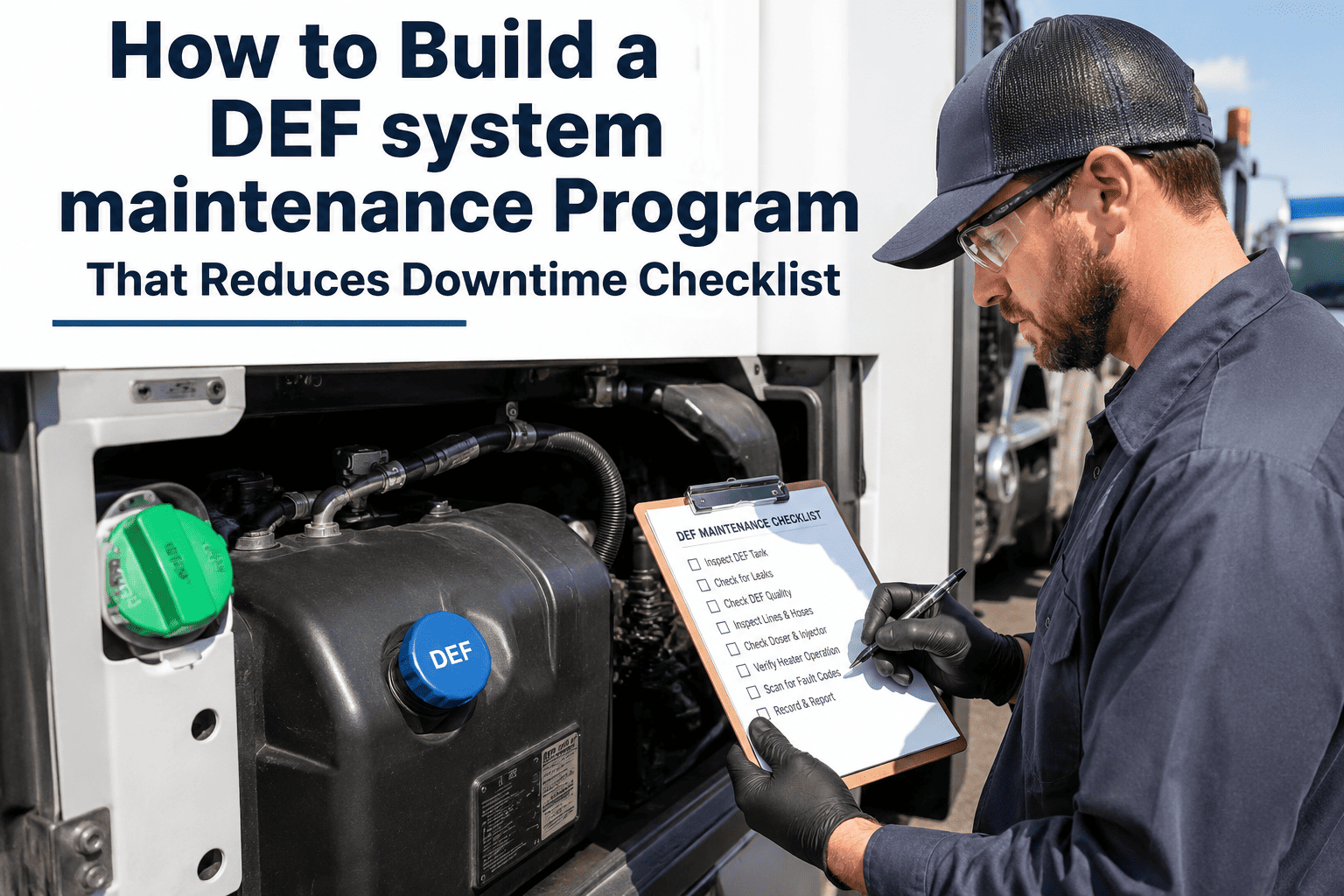
A DEF system that fails on the highway is not a maintenance issue — it is a stranded truck, a derated engine, a delayed delivery, and a customer call that nobody on your team wants to take. SCR system failures cost fleet operators thousands per incident in unexpected downtime, emergency tow charges, and missed delivery windows, with the average DEF-related roadside event resolved at 2–3x the cost of a depot repair. The component that finally fails — a crystallised injector, a contaminated tank, a corroded NOx sensor — is almost never the root cause; it is the symptom of a maintenance programme that treated DEF as a fluid to top up rather than a system to manage. Building a DEF maintenance programme that actually reduces downtime is a four-phase exercise spanning fluid quality control, scheduled inspection cadence, fault code response, and operator training. Sign Up Free to build your DEF programme in Oxmaint, or Book a Demo.
Build a DEF Maintenance Programme That Holds Up at 200,000 Miles
Oxmaint structures DEF system maintenance into scheduled fluid quality tests, component inspections at every PM, fault code triage with technician workflows, and operator training records — all linked to each truck's full service history for root-cause analysis when symptoms repeat.
Why DEF Programmes Fail (and What to Build Instead)
Most fleets do not lack a DEF maintenance programme — they have one that addresses symptoms rather than causes. Crystallised injectors get cleaned; the contaminated tank that crystallised them stays in service. Failed sensors get replaced; the fluid that killed them stays in the supply line. A working programme attacks the four root-cause categories before they cascade into roadside failures.
The 4-Phase DEF Maintenance Programme Roadmap
A programme that actually reduces downtime is built in four phases — each delivering a specific capability before the next phase begins. Skipping ahead from Phase 1 to Phase 3 produces a fleet that responds well to faults but generates them at the same rate.
Fluid Quality Control & Storage Standards
Establish DEF quality as the foundation. ISO 22241-certified fluid only, stored in HDPE, polypropylene, or stainless containers — never aluminium, carbon steel, copper, or zinc. Storage temperature range of 10–77°F preserves shelf life; sustained exposure above 86°F accelerates urea decomposition and reduces shelf life from 18 months to 6.
Scheduled Inspection & Component PM Cadence
Layer scheduled inspections on top of the quality baseline. Visual crystallisation checks at every PM, sensor predictive replacement at interval, filter changes every 200,000 miles or 6,500 hours, and DEF consumption monitoring against the 2–3% of fuel-consumption baseline. Deviations are early warning of injector or NOx-sensor faults weeks before code activation.
Fault Code Triage & Technician Workflow
Convert the DTC list into a workflow. P20EE catalyst efficiency, P207F reductant quality, P204F system performance — each has a defined first-step diagnostic that prevents technicians from replacing parts before testing fluid. Triage rules eliminate the most expensive failure mode in DEF service: a $400 sensor replaced because the technician skipped a $10 refractometer check.
Operator Training & Behavioural Controls
Close the loop with the driver. Most contamination incidents start with an operator topping up from an unmarked container, ignoring a warning lamp until derate, or letting a tank run empty in cold weather. Training is not a one-time event — it is recurring certification with documented evidence, supported by in-cab procedures and reporting workflows that surface issues early.
Programme Readiness Checklist
Use this checklist to gate-check your DEF maintenance programme before declaring it operational. Every gap is a fault waiting to surface as a roadside event.
ISO 22241-certified DEF supply with documented batch traceability
Single-source DEF from a certified supplier with batch numbers tied to delivery receipts. No bulk DEF from uncertified sources, no top-ups from generic containers — contamination from this category is the single largest driver of repeat SCR faults.
Refractometer in use at delivery and at every 25,000-mile interval
Quality verified on every drum or tote at delivery; concentration tested in-vehicle every 25,000 miles via a sample drawn from the tank. Acceptable range: 31.8–33.2% urea by weight. Out-of-spec results require immediate fluid replacement before any further service.
DEF filter replacement scheduled at 200,000 miles or 6,500 hours
Filter intervals loaded as PM triggers in Oxmaint at the vehicle asset level — not held in a service binder. Missed filter changes cause restricted flow, low pump pressure faults, and progressive injector contamination that mimics fluid quality failures.
NOx sensor predictive replacement at 120,000 miles
Sensors replaced before failure to avoid in-service downtime. Failed sensors generate misleading fault codes that drive expensive part replacements elsewhere in the system. Predictive replacement is consistently cheaper than reactive over a fleet-wide interval.
DEF consumption tracked against fuel consumption baseline
Healthy consumption sits at 2–3% of fuel use. Consumption above 4% indicates a leak or stuck-open injector; consumption below 1.5% indicates a clogged injector or dosing failure. Both produce different fault codes but the same root signal — measurable from telematics or fuel records.
Cold-weather readiness verified before first sub-32°F night
Tank, line, and injector heater operation confirmed; tank levels above 25% on units expected to sit overnight; in-cab driver reminders active. DEF freezes at 12°F; uncovered cold-weather failures generate disproportionate winter callout volume in untrained fleets.
Fault code triage procedures published and trained on technician workstations
P20EE, P207F, P204F, P0401 and other DEF/SCR codes each have a documented first-step procedure that begins with fluid quality and upstream diagnostics. Procedure adherence audited monthly by service writers reviewing closed work orders against the standard path.
Operator training recorded against driver profile with annual renewal
Initial DEF training plus annual recertification logged in Oxmaint driver records. Drivers without current training cannot be assigned to long-haul routes. Training currency is the single best predictor of contamination-incident rate at the operator level.
Frequently Asked Questions
The four-phase roadmap above runs 16 weeks end-to-end: 4 weeks each for fluid quality, scheduled cadence, fault triage, and operator training. Book a Demo to see how Oxmaint compresses Phase 1 and 2 into the first month.
P20EE (catalyst efficiency), P207F (reductant quality), P204F (system performance), and P0401 (EGR flow). These four account for the majority of SCR-related derate events and most can be prevented by fluid quality control and predictive sensor replacement.
Every 25,000 miles in-vehicle, and on every drum or tote at delivery. Concentration must hold at 32.5% urea (31.8–33.2% acceptable range). Outside that range, the SCR generates fault codes that mimic component failures and waste diagnostic labour.
Yes — Oxmaint links to fleet telematics platforms to pull DEF consumption rates, fault code occurrences, and mileage data automatically. Sign Up Free to see the telematics integration options.
Replacing components — typically NOx sensors or injectors — before testing fluid quality. A $10 refractometer test catches the actual fault in roughly 70% of cases where a $400+ part would otherwise be replaced unnecessarily.
Cut DEF Downtime in Half — Start Building the Programme Today
Oxmaint loads the four-phase DEF maintenance programme into your fleet's PM workflow: fluid quality batch logs, scheduled component inspections, fault code triage rules, and operator training records all linked to each truck's full service history.