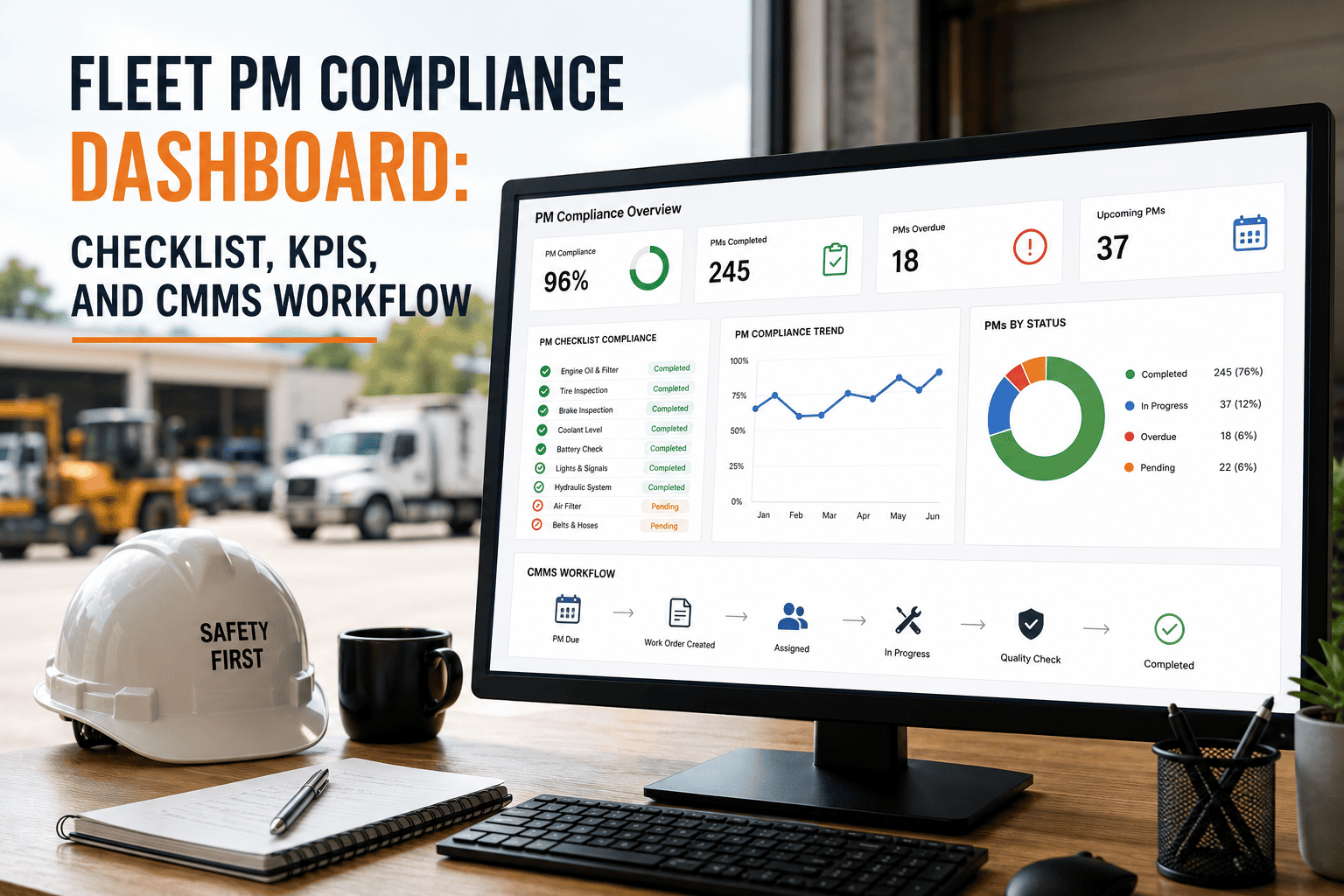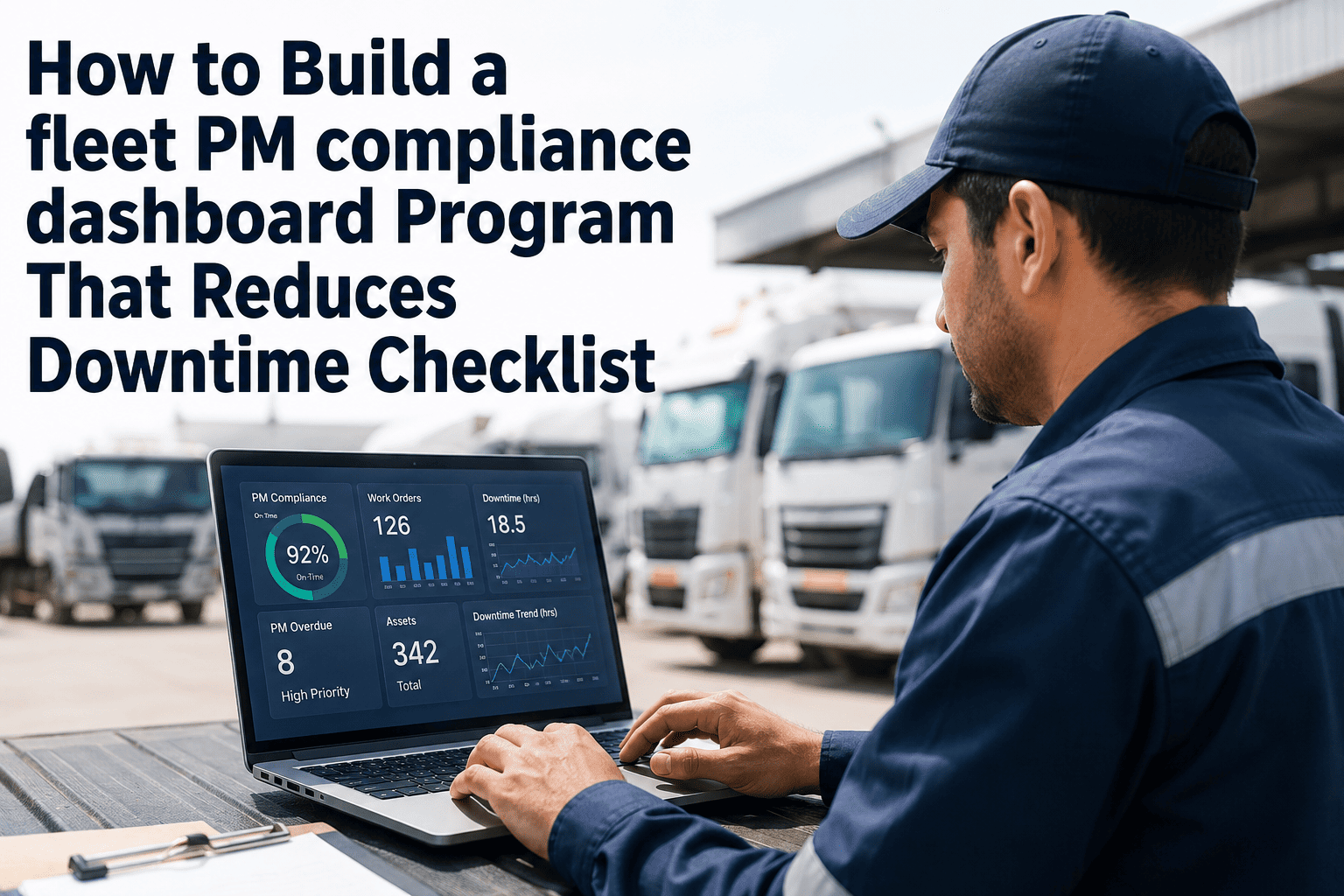
Fleet maintenance teams that track PM completion rates in a spreadsheet while their vehicles accumulate mileage past service intervals are not running a compliance programme — they are running a reactive maintenance operation with a compliance label. A fleet PM compliance dashboard programme converts raw maintenance data into real-time visibility: which vehicles are overdue, which PMs are scheduled for the next two weeks, which components are generating repeat failures, and whether the fleet's overall compliance rate is moving toward 100% or drifting below the threshold where breakdowns become inevitable. This checklist gives fleet maintenance managers and operations directors a structured framework for building, launching, and sustaining a PM compliance dashboard programme that connects maintenance scheduling, parts availability, technician workload, and vehicle utilisation into a single compliance picture — one that reduces unscheduled downtime and keeps your fleet ahead of DOT inspection exposure. If you are ready to replace manual tracking with a connected CMMS dashboard, OxMaint delivers fleet PM compliance dashboards with real-time overdue alerts, technician scheduling, and one-click compliance reports built for fleet operations at scale.
How to Build a Fleet PM Compliance Dashboard Programme That Reduces Downtime
A structured checklist for fleet maintenance managers to design, implement, and sustain a PM compliance dashboard — covering data foundations, KPI selection, CMMS configuration, technician workflow, and continuous improvement.
What a PM Compliance Dashboard Actually Solves
Without a dashboard, PM overruns accumulate silently. A vehicle 800 miles past its oil change interval looks identical to a compliant vehicle until it breaks down on the road.
Shops that schedule PMs only when drivers report issues are always behind the maintenance curve. Dashboard-driven scheduling moves PMs ahead of the failure point.
When PM completion rates are not measured, there is no baseline to improve from. A dashboard creates a number that the team owns and is responsible for moving upward each month.
Data Foundation: What Your Dashboard Needs Before It Can Work
A PM compliance dashboard is only as accurate as the data it draws from. Fleets that skip the data foundation phase build dashboards that show confident numbers that do not reflect operational reality — vehicles are marked as compliant because their last PM was logged, not because the interval was calculated correctly. Before configuring any dashboard, the underlying asset register, PM interval library, and odometer data pipelines must be verified.
OxMaint connects your telematics, odometer feeds, and asset register into a single PM compliance dashboard — so every vehicle's due date is calculated in real time and overdue alerts reach your maintenance manager before a compliance gap becomes a breakdown.
KPI Selection: The Six Metrics That Drive PM Compliance Improvement
A dashboard that displays 40 metrics tells the maintenance manager everything and nothing simultaneously. The highest-performing fleet maintenance programmes select a small number of leading and lagging indicators that together describe the full compliance picture — and they review those metrics weekly rather than monthly, so trend identification happens while there is still time to correct course before the month closes with a compliance gap.
CMMS Configuration: Building the Dashboard Workflow
The PM compliance dashboard is the output of a correctly configured CMMS workflow — not a reporting layer added on top of a disorganised maintenance process. Configuration decisions made at this phase determine whether the dashboard reflects the true compliance status of the fleet or reflects what was entered into the system by whoever had access last week. Structured work order categories, mandatory completion fields, and technician role assignments are the difference between a dashboard and a display.
Technician Workflow: Translating Dashboard Data into Shop Floor Execution
A PM compliance dashboard that the shop foreman reviews on Monday morning and does not act on until Wednesday has already created a two-day window where overdue vehicles are being dispatched. The transition from dashboard data to technician assignment must be same-day for overdue vehicles and same-week for approaching-due vehicles. The workflow design decisions at this phase determine whether the dashboard drives maintenance scheduling or documents maintenance history.
Parts and Inventory Integration: Eliminating Parts-Driven Downtime
Parts stockouts are the most common cause of preventable PM delays in fleet maintenance operations. The vehicle arrives in the shop on schedule, the technician is available, and the PM cannot be completed because the correct oil filter is not in stock. Parts-driven PM delays do not appear in technician efficiency metrics — they appear as PM compliance gaps and unscheduled downtime. Integrating parts inventory into the PM dashboard converts stockouts from surprises into scheduled replenishment events.
Continuous Improvement: Monthly Dashboard Review and Programme Refinement
A PM compliance dashboard that reaches 95% completion rate and then stops being reviewed is a programme that will drift back to 85% within three months as staff changes, vehicle population changes, and operational pressure accumulates. The monthly dashboard review is not a celebration of past performance — it is the identification of the gap between current performance and 100%, and the assignment of specific actions to close that gap before the next review cycle.
PM Compliance Dashboard: Metrics, Targets, and Review Cadence
| Metric | Calculation | Target | Review Cadence | Owner |
|---|---|---|---|---|
| PM Completion Rate | PMs completed / PMs scheduled | 100% | Weekly | Shop Foreman |
| Overdue Vehicle Count | Vehicles past PM due by 10%+ of interval | 0 | Daily | Fleet Manager |
| PM Lead Time | PMs scheduled 7+ days ahead / Total PMs | 90%+ | Weekly | Shop Foreman |
| Unscheduled Downtime Rate | Unscheduled hours / Available hours | Below 5% | Monthly | Fleet Manager |
| Repeat Failure Rate | Same-fault WOs within 90 days / Total WOs | Below 3% | Monthly | Maintenance Director |
| Parts Fill Rate | PM WOs completed without parts delay / Total PM WOs | 95%+ | Monthly | Parts Manager |
Frequently Asked Questions
What is a fleet PM compliance dashboard and how is it different from a maintenance report?
A PM compliance dashboard is a real-time operational tool that shows current compliance status — which vehicles are overdue right now, which PMs are due this week, and what the fleet-wide completion rate is today. A maintenance report is a retrospective document that describes what happened last month. The dashboard drives daily scheduling decisions; the report documents historical performance. Fleets running on reports are always responding to last month's data. Fleets running on dashboards are preventing next week's breakdown. OxMaint delivers real-time PM compliance dashboards configured for your fleet's specific intervals and vehicle classes.
How do I calculate a realistic PM interval for each vehicle class in my fleet?
Start with the OEM-recommended service interval for the engine and drivetrain, then adjust based on your operating environment: urban stop-and-go operation typically requires a 20–25% shorter oil change interval than highway operation. Review your last 12 months of repair orders for each vehicle class and identify any component failures that occurred before the scheduled PM. Any component failing before its service due date indicates the interval is too long for your operating conditions. Book a demo to see how OxMaint's interval library supports class-specific and route-specific PM configuration.
What CMMS data is required before a PM compliance dashboard will show accurate numbers?
You need four data inputs: a complete asset register with current odometer for every vehicle, a PM interval defined for every vehicle class, a telematics or manual odometer feed that updates at least daily, and a PM completion history showing the mileage at which each vehicle's last PM was performed. Missing any one of these produces a dashboard that shows inaccurate compliance status — typically by showing compliant vehicles that are actually overdue because the odometer data or last-service record is stale.
How does PM compliance dashboard data connect to DOT inspection readiness?
A vehicle operating past its PM interval is more likely to have a defect identified at a roadside DOT inspection than a vehicle maintained on schedule. Fleet PM compliance rate directly correlates with the Vehicle Maintenance BASIC score in the FMCSA's CSA SMS system. Fleets that maintain 95%+ PM completion rates consistently show lower Vehicle Maintenance BASIC percentile rankings, which reduces DOT intervention risk and supports insurance premium negotiations. Your PM dashboard is also the audit trail that demonstrates to a DOT investigator that the fleet has a functioning preventive maintenance programme.
How often should a fleet PM compliance dashboard be reviewed and by whom?
Overdue vehicle count should be reviewed daily by the shop foreman and fleet operations manager. PM completion rate and upcoming PM queue should be reviewed weekly by the maintenance manager. Fleet-wide compliance trend, repeat failure rate, and unscheduled downtime rate should be reviewed monthly by the fleet director. Quarterly, the PM interval library should be validated against actual failure data. Each role needs a different view of the same underlying data — not a single report distributed to everyone.
From Overdue Alerts to Closed Work Orders — All in One Dashboard
OxMaint gives fleet maintenance teams a real-time PM compliance dashboard with vehicle-level overdue tracking, technician workload scheduling, parts availability integration, and automated compliance reports — so your shop foreman starts every day with a clear list of what needs to happen before a vehicle leaves the yard overdue.