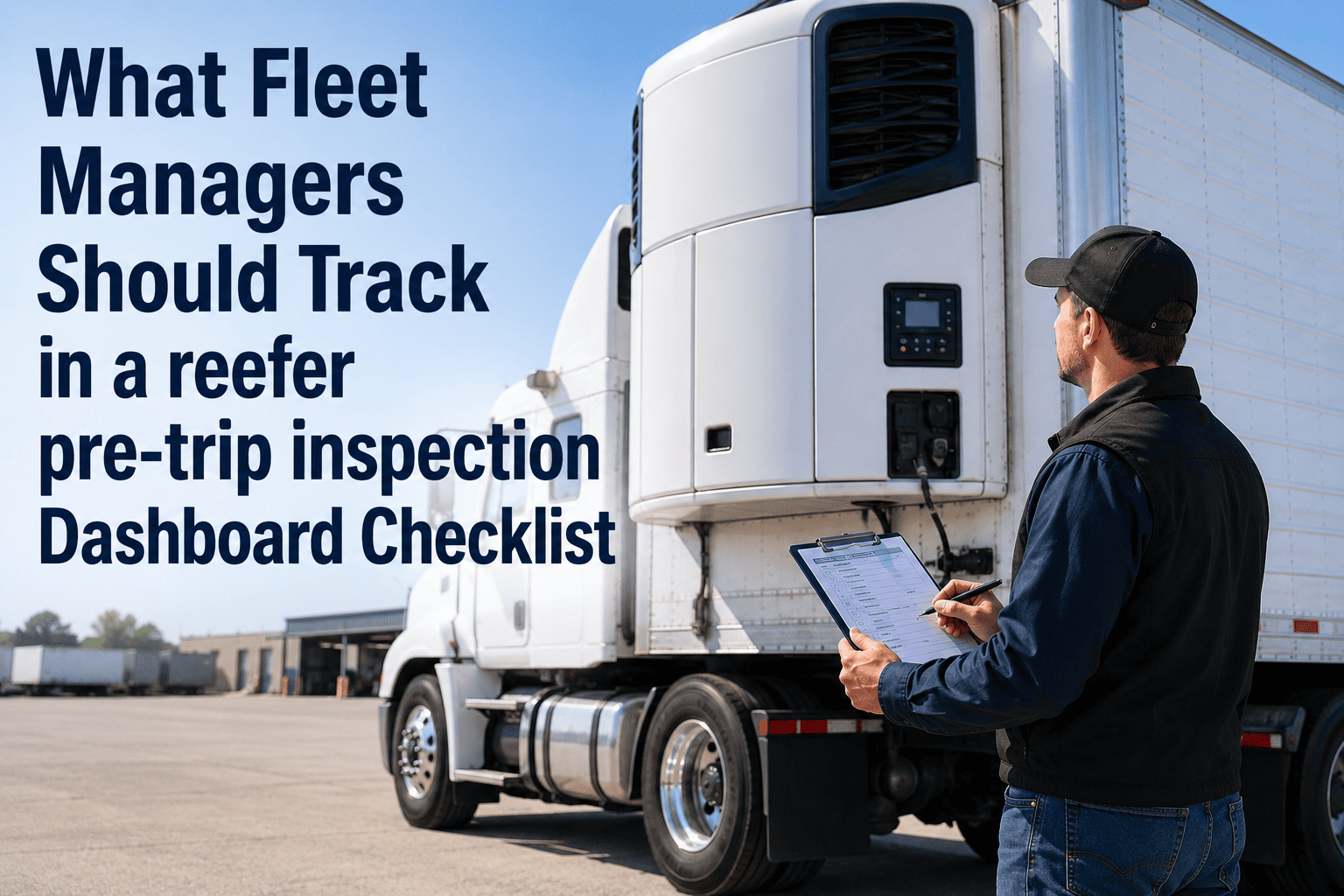
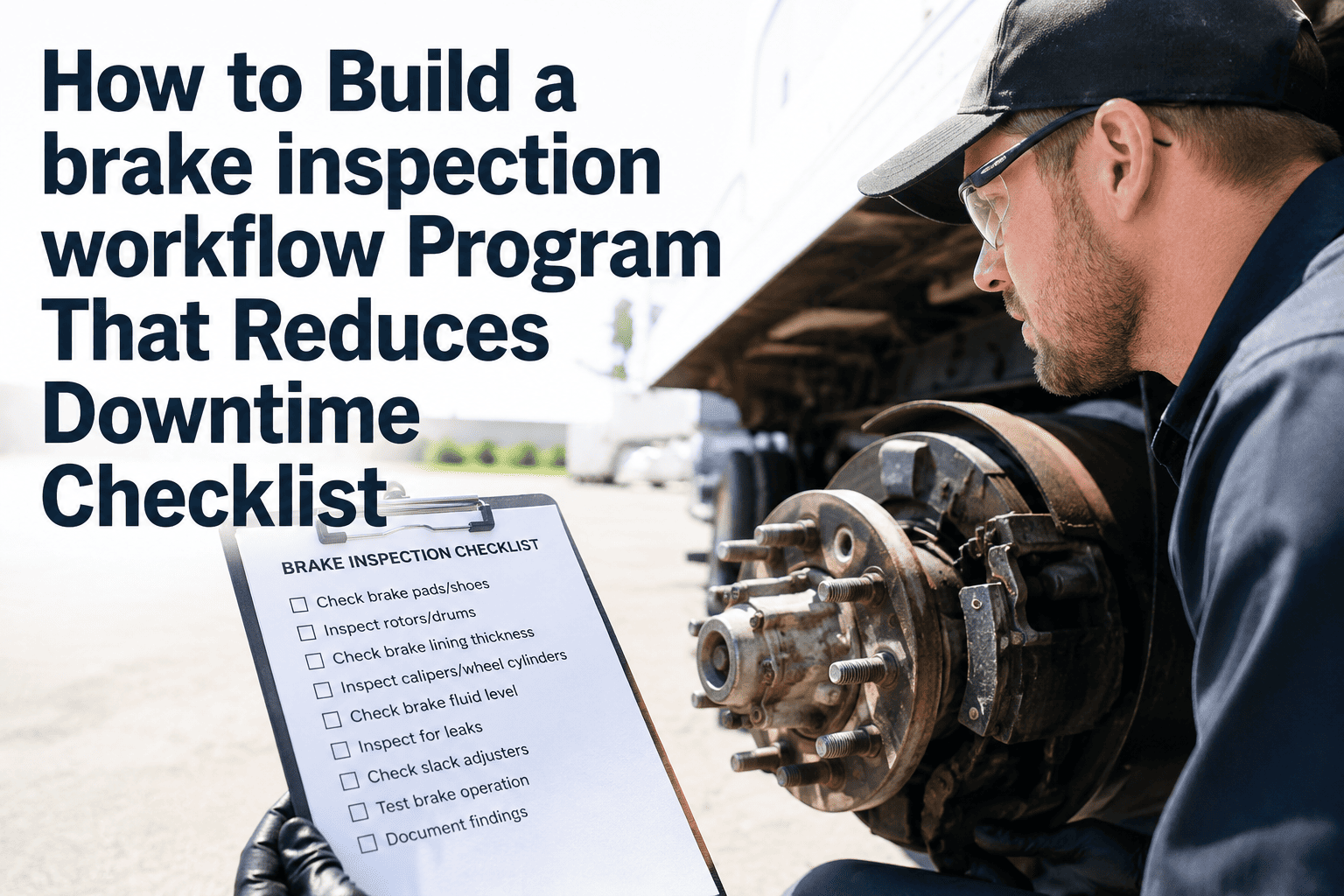
Most reefer downtime does not start on the highway — it starts in the yard, in the thirty seconds a driver skips because the trailer "looked fine" yesterday. A compressor that trips three hours into a run almost always showed a warning sign at pre-trip: a slow pull-down, a sticky door seal, a belt that was already glazing. Fleets that build a real reefer pre-trip inspection program convert those warning signs into scheduled repairs instead of 2 a.m. roadside calls and spoiled loads. This page lays out the full four-phase checklist framework, the component-by-component inspection points within each phase, and the workflow that closes the loop, all built around OxMaint's Inspection Management module.
Refrigerated Fleet · Inspection Management · Program Checklist
Reefer Pre-Trip Inspection Program Checklist — Build It to Reduce Downtime
A complete, four-phase checklist for designing a reefer pre-trip inspection program: standardized scope, dual-power performance testing, alarm and sensor governance, and the corrective work order rule that actually prevents repeat breakdowns.
$80K–$200K
Typical spoiled cargo value from a single reefer mechanical failure in transit
2 AM rule
Most reefer alarms trigger overnight, when repair options and response time are most limited
1,500–3,000 hrs
Belt service interval before cracking and fraying risk rises sharply between inspections
Phase 1 — Standardize the Inspection Scope
Program Foundation · Every Yard, Same Checklist
One digital checklist used identically at every location — structural items (door seals, air chute, drain lines, interior cleanliness) separated from mechanical and electrical items (belts, compressor start-up, control box, sensor response) so a missed item is traceable to a specific inspector role and step
Record: checklist version, location, inspector ID · Role: Fleet Maintenance Manager
Inspector role assignment defined per checklist section — driver completes structural and exterior walk-around, maintenance technician completes mechanical, electrical, and refrigeration performance items, with no item left without a named responsible role
Record: role-to-item mapping · Role: Fleet Maintenance Manager
Pass/fail criteria written into each checklist item rather than left to inspector judgment — for example, belt tension, alarm code severity, and pull-down time deviation each given a defined numeric or visual threshold before the program goes live
Record: threshold values per item · Role: Fleet Maintenance Manager
Checklist completion required before dispatch release — trailer cannot be marked dispatch-ready in OxMaint until every required item is recorded, removing the option to skip sections under time pressure
Record: completion timestamp, dispatch-ready flag · Role: Driver / Yard Technician
Phase 2 — Dual-Power Performance Testing
Shore Power + Road Engine · Before Every Dispatch
Unit started and run on shore power first to confirm the electric standby motor and control system initialize correctly, firmware version checked, and any startup error code investigated before proceeding to the road-engine check
Record: shore power start result, error codes · Role: Maintenance Technician
Diesel engine started independently to verify fuel pump function, mechanical drive engagement, and on-road cooling capacity — shore power alone does not validate these systems and a program limited to shore-power checks misses the failure mode most likely to occur in transit
Record: engine start confirmation, fuel pump check · Role: Maintenance Technician
Pull-down time recorded and compared against the trailer's own historical baseline rather than a generic fleet average, since each unit's normal pull-down time varies with age, ambient conditions, and prior maintenance — a widening gap from baseline is the leading early signal of compressor or condenser degradation
Record: pull-down time, ambient temperature, baseline delta · Role: Maintenance Technician
Setpoint stability confirmed over a hold period before release — temperature display checked against an independent reference reading, and any drift beyond the defined tolerance band treated as a failed item rather than a borderline pass
Record: setpoint vs. reference reading · Role: Maintenance Technician
Refrigerant sight glass and condenser coil condition checked visually for bubbling, low charge indication, or dust and debris buildup that would reduce cooling efficiency during the trip
Record: sight glass reading, coil condition photo · Role: Maintenance Technician
OxMaint turns Phases 1 and 2 into a single mobile inspection form — dual-power testing, pull-down baselines, and pass/fail thresholds all captured automatically against the trailer's own history.
Phase 3 — Alarm, Sensor, and Structural Governance
Treat Every Alarm as Data, Not Noise
All active alarm codes reviewed and root-caused before dispatch — door alarms, defrost-cycle flags, and sensor mismatch warnings investigated individually, never cleared with a simple reset, and logged against the trailer so repeat codes on the same unit trigger an automatic deeper diagnostic
Record: alarm code, root cause, resolution · Role: Maintenance Technician
Temperature probe accuracy verified against an independent reference instrument, with any sensor reading more than the defined tolerance off from reference flagged for calibration or replacement before the trailer leaves the yard
Record: probe reading vs. reference, tolerance result · Role: Maintenance Technician
Door seals, hinges, and air chute inspected for gaps, dry rot, or disconnection — a torn or detached air chute prevents uniform airflow to the rear of the trailer and is treated as a dispatch-blocking defect, not a minor note
Record: seal condition photo, chute integrity · Role: Driver
Interior walls, floor, and drain lines checked for cracks, exposed insulation, standing water, or blocked drains — any structural damage to insulated panels logged with a photo since it directly affects the trailer's ability to hold setpoint under load
Record: interior condition photo, drain status · Role: Driver
Belt condition checked on alternator, water pump, and compressor drives for cracking, fraying, or glazing, with hour count compared against the 1,500 to 3,000 hour typical replacement window so a belt approaching end of life is scheduled rather than run to failure
Record: belt condition, engine hour count · Role: Maintenance Technician
Phase 4 — Corrective Work Order Closure
Close the Loop Before the Trailer Leaves the Yard
Any failed checklist item automatically generates a corrective work order in OxMaint at the moment it is flagged, removing the dependency on a technician remembering to write it up separately after the inspection is complete
Record: linked work order ID, severity, due date · Role: Automatic / Maintenance Technician
Severity assigned at the point of flagging — critical defects (refrigeration failure risk, brake or coupling issues) block dispatch immediately, while lower-severity items get a defined repair window measured in days, not an open-ended "next time" note
Record: severity level, dispatch-block flag · Role: Maintenance Technician
Repair completion verified and closed against the same trailer record the defect was logged on, with parts used, labor time, and a post-repair confirmation check recorded before the work order is marked complete
Record: parts used, labor time, post-repair check · Role: Maintenance Technician
Trailer-level defect history reviewed monthly for repeat patterns — a unit showing the same defect across two or more inspection cycles escalated to a full maintenance review rather than another routine repair
Record: repeat defect count, escalation flag · Role: Fleet Maintenance Manager
Inspection Coverage by Component Group
Frequently Asked Questions
How long does it take to roll out a reefer pre-trip program across a fleet?
Most fleets standardize the checklist and train drivers within two to three weeks. The harder part is making corrective work orders automatic rather than manual —
OxMaint configures that workflow during setup so it runs from day one.
Should pre-trip inspection be checked on shore power or the road engine?
Both. Shore power confirms the electric standby motor; the diesel engine confirms fuel pump and on-road cooling capacity. A downtime-reducing program logs both checks separately against the trailer record.
What is the most common reason a reefer program fails to reduce downtime?
Defects get noted but never converted into scheduled repairs. The checklist is completed, but nothing forces the corrective action to happen before the next trip out.
Can OxMaint track belt and component replacement intervals automatically?
Yes.
Book a demo to see how OxMaint schedules preventive replacement work orders based on engine hours and inspection findings, rather than relying on a driver to remember.
Does a documented pre-trip program help with insurance claims?
Yes. Reefer breakdown claims are commonly denied when maintenance and inspection records are incomplete. A documented, timestamped pre-trip history is one of the strongest pieces of evidence a fleet can produce.
OXMAINT INSPECTION MANAGEMENT · REFRIGERATED FLEET
Turn Pre-Trip Inspection Into a Program, Not a Habit
From structural checks to belt wear to sensor accuracy, OxMaint logs every reefer pre-trip inspection against the trailer asset record and automatically opens a corrective work order the moment something fails — so downtime gets prevented in the yard, not discovered on the highway.