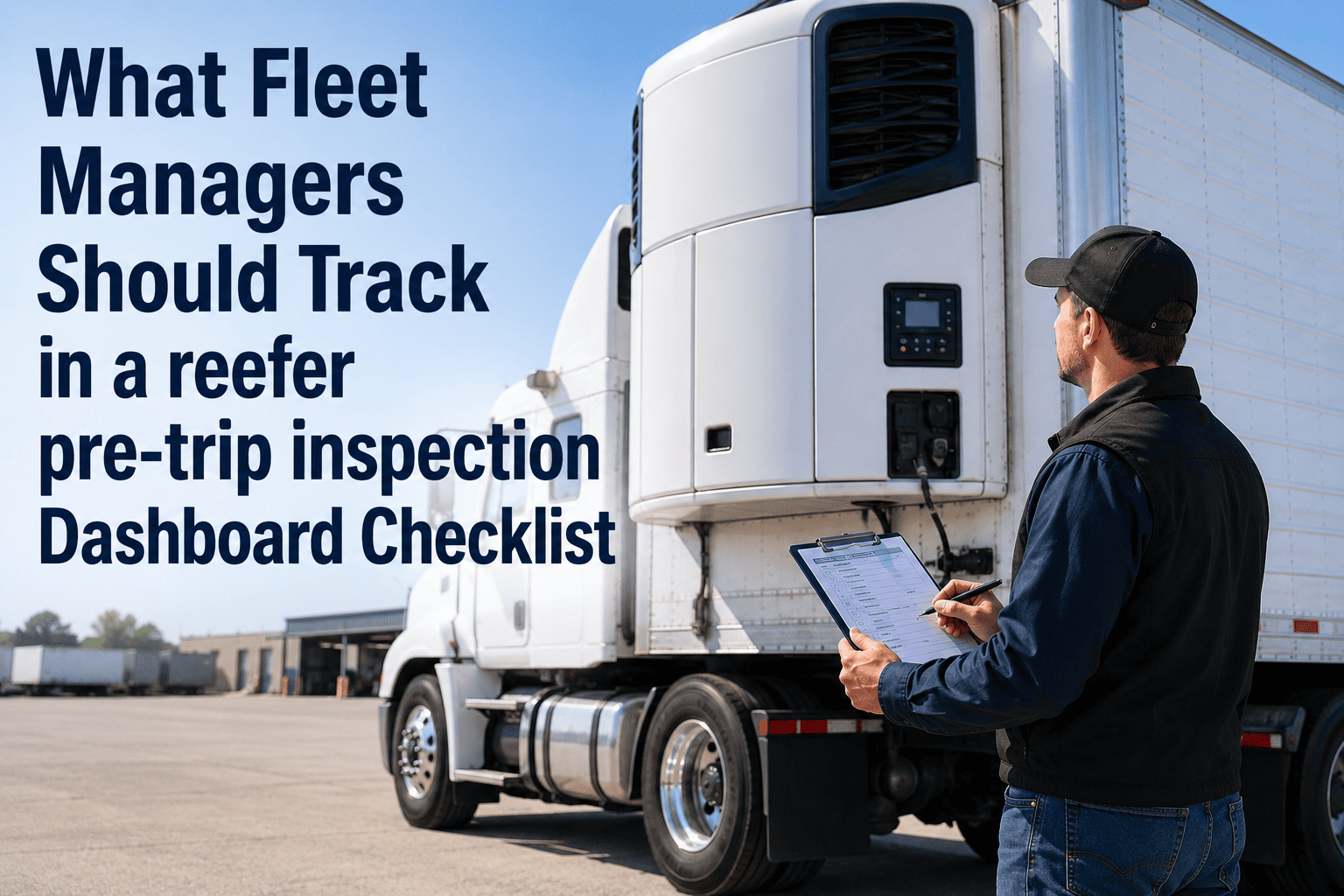
A reefer pre-trip inspection only protects cargo if three things happen together: the checklist is actually completed in full, the right numbers get tracked over time, and a failed item turns into a scheduled repair automatically. Most fleets have one of these three. Few have all three connected — which is exactly why temperature excursions and roadside breakdowns keep recurring on the same handful of trailers. This page lays out the complete checklist across five inspection groups, the KPIs worth watching weekly, and the CMMS workflow that ties them together using OxMaint's Inspection Management module.
Refrigerated Fleet · Inspection Management · CMMS Workflow
Reefer Pre-Trip Inspection: Checklist, KPIs, and CMMS Workflow
The exact checklist items inspectors should confirm across power, structure, brakes, and documentation, the KPIs maintenance managers should be watching weekly, and the work order workflow that connects a failed inspection item to a completed repair.
$100K–$500K
Cargo insurance limit shippers require for high-value reefer loads
#1 cause
Incomplete maintenance records are the leading reason breakdown claims get denied
15-sec test
Standard listening duration for a brake chamber air-leak check during pre-trip
Power cycle and setpoint confirmation — unit started on both shore power and road engine, set temperature confirmed against dispatch requirement, pull-down time recorded and compared against the trailer's historical baseline in OxMaint
Record: pull-down time, setpoint · Role: Driver / Yard Technician
Refrigerant sight glass and condenser coil check — sight glass observed for bubbling or low-charge indication, condenser coil inspected for dust, debris, or airflow restriction that would reduce cooling efficiency
Record: sight glass reading, coil photo · Role: Maintenance Technician
Compressor and fan noise check — unit run through a startup cycle while listening for unusual vibration, grinding, or fan imbalance that often precedes a mechanical failure days before it actually occurs
Record: noise/vibration observation · Role: Maintenance Technician
Belt and drive condition — alternator, water pump, and compressor belts visually checked for cracking, fraying, or glazing; tension confirmed; any belt nearing its service-hour interval flagged for replacement before departure
Record: belt condition, hour count · Role: Maintenance Technician
Alarm and sensor verification — all active alarm codes reviewed and resolved before dispatch, temperature probes checked against a reference reading, repeat alarm codes on the same trailer escalated for deeper diagnostic rather than reset and released
Record: alarm codes, resolution status · Role: Maintenance Technician
Wiring harness and connection inspection — power cable, plug, and harness checked for chafing, exposed conductors, or corrosion at the connection points most exposed to road vibration and moisture
Record: harness condition photo · Role: Maintenance Technician
Door seal, hinge, and air chute inspection — gaskets checked for gaps or cracking, air chute confirmed intact and connected for rear-of-trailer airflow, hinges checked for smooth operation and airtight closure
Record: seal condition, chute integrity photo · Role: Driver
Interior walls, floor, and drain line check — panels examined for cracks or exposed insulation, floorboards checked near the rear for water ingress damage, drain lines confirmed clear of blockage
Record: interior condition photo, drain status · Role: Driver
Exterior body and lighting check — bottom rail, top rail, and side panels inspected for damage, all tail, brake, turn signal, clearance, and marker lights tested and confirmed functioning
Record: light function, body damage photo · Role: Driver
Tire and wheel inspection — tread depth and inflation checked on every axle, sidewalls examined for cuts or bulges, lug nuts confirmed torqued and free of rust streaks indicating loosening
Record: tread depth, inflation, lug nut status · Role: Driver
Brake chamber and slack adjuster check — brake chambers tested for air leaks during a sustained application, slack adjuster travel checked, shoes inspected for excessive wear or contamination
Record: leak test result, slack adjuster travel · Role: Driver
Coupling and kingpin verification — fifth wheel locking mechanism confirmed engaged, kingpin and mounting bolts checked, glad hand seals inspected for leaks at the air line connections
Record: coupling engagement confirmation · Role: Driver
Fuel, refrigerant, and fluid levels — diesel fuel level confirmed sufficient for trip duration plus reserve, engine oil and coolant levels confirmed within range before the trailer leaves the yard
Record: fluid levels, fuel reserve · Role: Maintenance Technician
Maintenance log review — upcoming service intervals reviewed to confirm nothing is overdue, prior open defects on the trailer record checked and confirmed closed before this dispatch
Record: service interval status, prior defect closure · Role: Maintenance Technician
Final sign-off and dispatch release — completed checklist reviewed and signed by the inspector, trailer marked dispatch-ready in OxMaint only once every required item across all five groups carries a passing record
Record: signature, dispatch-ready timestamp · Role: Maintenance Technician
01
Pre-Trip Completion Rate
Percentage of dispatches with a fully completed checklist before departure, tracked per yard and per driver.
02
Mean Time to Corrective Close
Average time between a failed checklist item being flagged and the corrective work order being completed.
03
Repeat Defect Rate
Share of trailers showing the same defect across two or more consecutive pre-trip inspections.
04
In-Transit Alarm Frequency
Number of temperature or system alarms triggered after dispatch, tied back to the pre-trip record for that trip.
05
Dispatch-Block Rate
Percentage of trailers held back from dispatch due to a critical checklist failure, tracked over time to confirm trends are improving.
06
Documentation Completeness
Share of inspections with full photo evidence and signatures attached, ready to support an insurance or compliance review.
OxMaint tracks all six KPIs automatically from the same mobile inspection form your drivers and technicians already use — no separate spreadsheet, no manual rollup at week's end.
| Step |
What Happens |
Who Acts |
OxMaint Record |
| 1 |
Inspector flags a failed or borderline checklist item on mobile |
Driver or Technician |
Inspection record with photo |
| 2 |
System creates a corrective work order with severity-based due date |
Automatic |
Work order linked to trailer asset |
| 3 |
Critical defects block dispatch until the order is closed |
Automatic |
Dispatch-ready flag withheld |
| 4 |
Maintenance technician completes the repair and closes the order |
Maintenance Technician |
Completion timestamp, parts used |
| 5 |
Trailer history updates, KPI dashboard reflects the closed defect |
Automatic |
Updated trailer compliance record |
What KPI best predicts a reefer breakdown before it happens?
Repeat defect rate is the strongest leading indicator — a trailer flagged for the same issue twice is significantly more likely to fail in transit than one with no repeat findings.
Can OxMaint generate a KPI report automatically each week?
Yes.
Start a free trial to see the dashboard pull completion rate, corrective close time, and alarm frequency without manual data entry.
How does a CMMS workflow reduce reefer downtime specifically?
By guaranteeing every flagged defect becomes a tracked work order with a due date, rather than a note that depends on someone remembering to act on it later.
Should pre-trip checklist completion be tracked per driver or per trailer?
Both. Per-trailer tracking reveals equipment trends; per-driver tracking reveals whether the checklist is being completed thoroughly across the team.
What happens if a corrective work order is not closed before next dispatch?
In OxMaint, the trailer can be flagged as not dispatch-ready until the linked work order is closed, preventing a known defect from going back on the road.
Book a demo to configure this rule.
OXMAINT INSPECTION MANAGEMENT · REFRIGERATED FLEET
One Checklist. Six KPIs. Zero Lost Work Orders.
OxMaint connects your reefer pre-trip checklist directly to a CMMS workflow — every defect becomes a work order, every KPI updates automatically, and every trailer's history is one search away when an auditor or insurer asks for proof.