A defect that the driver notices at the end of a trip and the shop learns about two days later is one of the most expensive defects in a fleet. The post-trip inspection is the moment the vehicle is still warm, the driver still remembers what felt wrong, and the problem can be described accurately. This checklist shows fleet teams what to inspect at trip end, how to describe and rank each defect, and how to turn it into a work order in fleet maintenance software before the next driver takes the unit.
Fleet Inspections & Compliance · Post-Trip Defect Capture
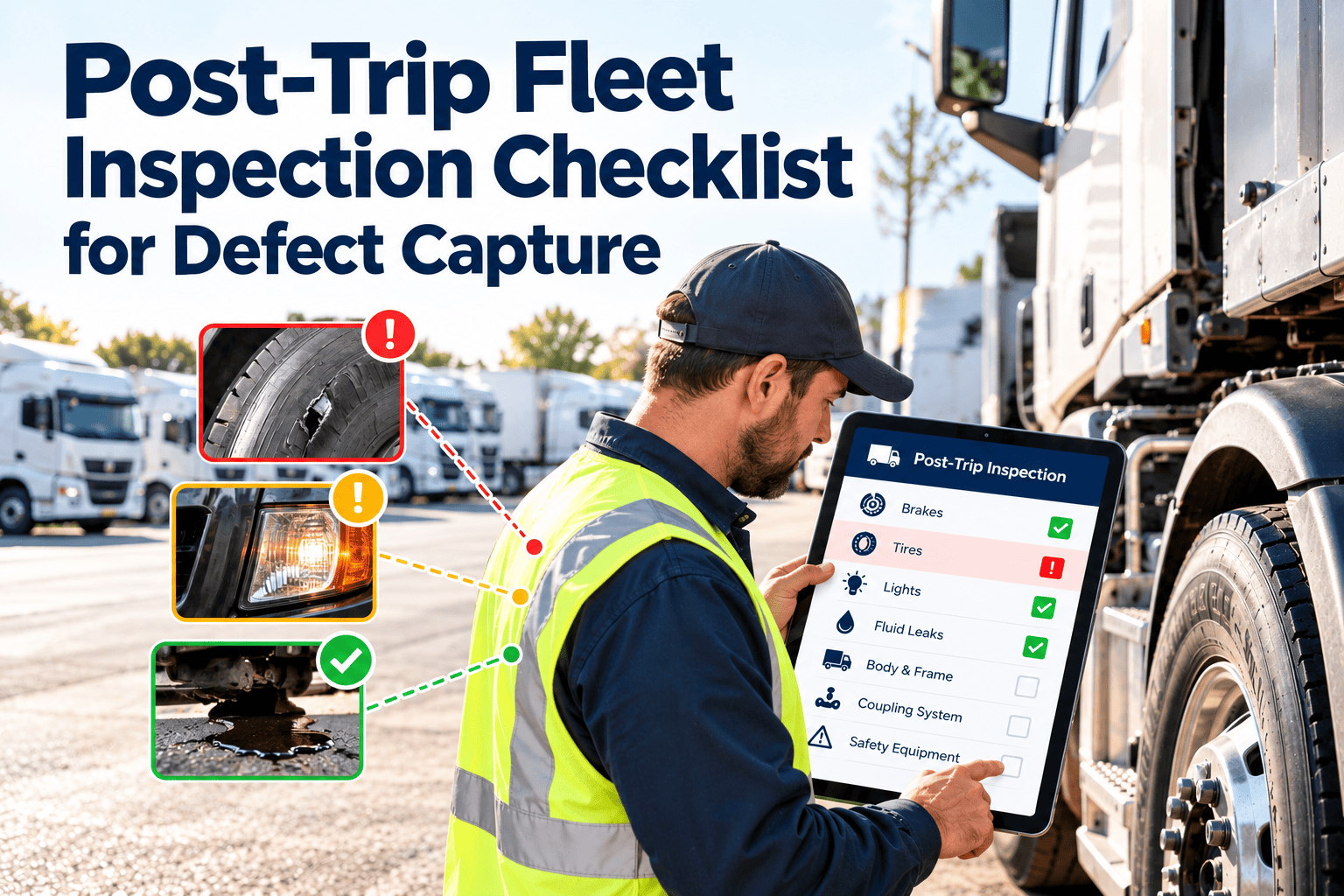
Post-Trip Fleet Inspection Checklist for Defect Capture
A trip-end inspection framework that turns driver observations into ranked, photo-backed defects and work orders, so repairs start before the next dispatch and nothing is lost between shifts.
8Checklist Categories
43Check Points
4Frequency Codes
1Park and secure
2Walk around
3Capture defect
4Rank severity
5Create work order
6Repair and release
Post-Trip Inspection and Defect Capture Checklist
Work through the categories in order at the end of every trip. Tick each item and record every exception as a defect with a photo. Frequencies are defaults to adjust for your duty cycle.
TEvery tripWWeekly auditMMonthly reviewEEvent triggered
01Cab, Controls and Gauges
Steering feels normal through full lock, with no excessive free play, pulling, vibration or unusual noise. Any change from earlier in the trip goes into the defect note.TEvery trip · Driver
Service brake pedal feel is recorded. A soft, low or delayed pedal, or a pull to one side, is a defect even if the vehicle stopped normally.TEvery trip · Driver
Parking brake holds and releases correctly, and the dash indicator matches the actual brake status.TEvery trip · Driver
Air pressure gauges show normal build-up and no rapid pressure loss with the engine off and the brakes applied.TEvery trip · Driver
Warning lamps for ABS, engine, coolant, oil, DEF and tire pressure are reviewed, and any lamp that appeared during the trip is recorded with the time and fault code if known.TEvery trip · Driver
Horn, wipers, washers, defroster, mirrors and seat belt work. A cracked windshield or damaged mirror is noted with its location.TEvery trip · Driver
02Lighting and Reflectors
Headlights on low and high beam, turn signals, hazard flashers and brake lights are checked with a second person or a reflective surface.TEvery trip · Driver
Marker, clearance and identification lights and rear reflectors are present, clean and working. Damaged lenses are recorded by position.TEvery trip · Driver
The trailer 7-way connector and cable are inspected for corrosion, loose engagement and chafed insulation after coupling and uncoupling.TEvery trip · Driver
Intermittent lighting faults are written as intermittent, with the conditions when they occurred, because a bare "light out" note cannot be reproduced in the shop.EEvent triggered · Driver
Reflective tape on trailers is inspected for peeling or dirt, and missing sections are logged.WWeekly audit · Fleet inspector
03Brakes and Air System
After shutdown, listen for air leaks at brake chambers, glad hands, air lines and valves. Use soapy water on suspected leak points where practical.TEvery trip · Driver
Glad hand seals and air lines are checked for cuts, chafing, kinking and contact with hot surfaces.TEvery trip · Driver
Brake chamber pushrod stroke and slack adjuster travel are checked where the driver is trained and equipped. Any brake out of adjustment is recorded by axle and side.WWeekly audit · Technician
Drums and rotors are checked for heat discoloration, one-sided heat or dragging, and visible lining wear.TEvery trip · Driver
Air tanks are drained, and the amount of moisture or oil found is noted, because heavy contamination points to a dryer or compressor problem.WWeekly audit · Technician
04Tires, Wheels and Rims
Each tire is checked for inflation with a gauge or tire pressure monitoring data. A visibly low or hot tire is recorded by position.TEvery trip · Driver
Tread and sidewalls are inspected for cuts, bulges, exposed cord, uneven wear and embedded objects, with tire position and a photo.TEvery trip · Driver
Wheels and lug nuts are checked for missing nuts, rust trails, loose nuts, cracked rims and wheel-end leaks.TEvery trip · Driver
Hubs are checked carefully for abnormal heat after the trip, and any hot wheel end is reported at once as a possible bearing problem.TEvery trip · Driver
Dual tire pairs are compared for matching size and pressure, and mismatches are recorded.WWeekly audit · Fleet inspector
05Coupling, Frame and Trailer Interface
Fifth wheel jaws, locking mechanism, release handle and mounting are inspected for wear, cracks or damage when the trailer is dropped.TEvery trip · Driver
Kingpin and upper coupler are checked visually for wear, damage and grease condition at drop.TEvery trip · Driver
Landing gear operates correctly and is fully raised when moving. Damaged legs or cranks are recorded.TEvery trip · Driver
Frame rails, crossmembers, suspension and mounts are viewed for cracks, bends, broken springs, damaged air bags and shock leaks.TEvery trip · Driver
Trailer doors, latches and the rear impact guard are checked for damage, and any impact during the trip is described.TEvery trip · Driver
06Fluids, Leaks and Engine Bay
Walk around and look under the vehicle for new wet spots, and record the location and fluid colour.TEvery trip · Driver
Engine oil, coolant, power steering, transmission and DEF levels are checked per policy, and any top-up volume is entered.TEvery trip · Driver
Belts, hoses, clamps and the battery area are scanned for cracks, looseness, corrosion or a burning smell.WWeekly audit · Technician
Exhaust and aftertreatment areas are checked for leaks, soot or loose mounts, and any regeneration or derate event during the trip is noted.TEvery trip · Driver
Fuel tanks, caps and lines are checked for leaks or damage, and any fuel odour is reported.TEvery trip · Driver
07Body, Cargo and Emergency Equipment
The fire extinguisher is present, charged and secured, and warning triangles and spare fuses are present as required.TEvery trip · Driver
Cargo securement devices are inspected after unloading, and damaged straps or chains are tagged and removed from use.TEvery trip · Driver
Body, bumpers, steps, grab handles and fenders are examined for new damage, and damage events are photographed with time and place.TEvery trip · Driver
Any incident, near miss or contact event is reported to the supervisor before the vehicle is parked for the night.EEvent triggered · Driver
Trip paperwork and loose items are cleared so the next driver receives a ready vehicle.TEvery trip · Driver
08Defect Capture, Handover and Sign-Off
Each defect is written with the component, position (left or right, axle number), symptom and when it happened, and not as a general comment.TEvery trip · Driver
At least one photo is attached for every visible defect, with a short video or audio note for noises and intermittent faults.TEvery trip · Driver
Odometer or engine hours are recorded with the report so the defect has a meter reference.TEvery trip · Driver
The driver marks severity: safe to operate, repair before next trip, or out of service, using the fleet severity guide.TEvery trip · Driver
The report is signed and submitted from the vehicle or yard before the driver leaves, and a work order is created for every defect.TEvery trip · Driver
The dispatcher or shop supervisor reviews new defects in the same shift and confirms the unit status for the next dispatch.TEvery trip · Shop supervisor
The next driver reviews the previous report and sees a maintenance sign-off before accepting the unit.TEvery trip · Next driver
Capture Every Defect Before the Driver Goes Home
Move the post-trip checklist into Oxmaint as a mobile inspection with photos, severity ranking and automatic work orders, so a defect noted at 6 p.m. is in the shop queue at 6:01.
Why Defects Go Missing at Trip End
Most missed defects are not missed by the inspection. They are lost between the driver, the paper form and the shop.
1The driver is tired and the form is longAt the end of a long shift, a lengthy paper form is rushed. Short mobile prompts for the high-risk items get better answers.
2Notes are vague"Brakes feel off" cannot be diagnosed. The technician needs component, side, symptom and conditions.
3No photo or evidenceWithout a picture, a crack, leak or tire cut has to be found again, which costs bay time and invites disputes.
4Paper never reaches the work orderA form in a tray is not a work order. Defects wait for someone to re-enter them, if they are entered at all.
5Repeat defects are invisibleWithout a history by unit and component, the same intermittent fault is reported and cleared several times without a root cause fix.
Defect Severity Matrix: Rank, Respond, Dispatch
A shared severity guide removes guesswork at the point of capture. The classes below are examples to align with your safety policy and applicable regulations.
Class 1Safety critical
Typical defectsAir leak with pressure loss, brake out of adjustment, cracked wheel, steering looseness, missing lug nut
ResponseImmediate work order, shop supervisor alerted
Dispatch decisionOut of service until repaired and verified
Class 2Compliance risk
Typical defectsInoperative lights, damaged reflectors, cracked mirror, missing extinguisher, worn tires near limit
ResponseRepair before next trip
Dispatch decisionDo not dispatch until cleared
Class 3Reliability risk
Typical defectsMinor fluid weep, noisy bearing, intermittent warning lamp, slow door latch
ResponseScheduled within a set window
Dispatch decisionMay dispatch with monitoring
Class 4Cosmetic or comfort
Typical defectsSeat wear, trim damage, minor dents without sharp edges
ResponsePlanned at next service
Dispatch decisionMay dispatch
Weak Note Versus Useful Note
Good defect descriptions save diagnostic time. Train drivers with real examples from your fleet.
| Weak note | Useful note | What the technician gains |
|---|
| Brakes feel funny | Left rear trailer axle drags after a long downgrade. Hub hot to the touch. Pedal feel normal. | Starting point for a dragging brake or hub bearing check |
| Light out | Right rear stop lamp out intermittently when the trailer cable is moved. Cab indicator normal. | Points to connector or wiring and not a bulb |
| Tire problem | Drive axle outer right tire has a 40 mm cut in the sidewall. Photo attached. Pressure 20 psi below set. | Immediate classification and a repair or replacement decision |
| Leaking | Fresh oil on the ground under the transmission, dripping at the rear seal. Found at 18:10. | Fluid, location and time to confirm the leak source |
| Noise | Metallic knock from front left over bumps at low speed. Not present on smooth road. Audio attached. | Suspension and steering components to check first |
Paper Defect Reports Versus Digital Defect Capture
The difference is in speed, traceability and follow-through.
Paper process- Form handed in at the end of the shift, if remembered
- Handwriting unclear, defects lost in a stack
- Shop re-enters data hours or days later
- No photos, no severity, no timestamps
- Repeat defects hidden in separate files
Digital process- Inspection submitted from the vehicle in minutes
- Structured fields and photos improve clarity
- Work order created automatically with severity
- Timestamps and driver signature stored
- Component history shows repeat defects instantly
Compliance Context for Post-Trip Reports
Requirements vary by country and operation. In the United States, FMCSA rules are a common reference for interstate carriers.
49 CFR 396.11Drivers prepare a written vehicle inspection report at the end of each day for each vehicle operated, covering listed parts such as brakes, steering, lights, tires, coupling devices and emergency equipment. Defects must be described.
49 CFR 396.13Before driving, the driver reviews the last report and confirms that reported defects have been repaired or do not need repair for safe operation.
49 CFR 396.3Motor carriers keep inspection, repair and maintenance records for each vehicle, including the dates and nature of work. Confirm retention periods with current rules.
KPIs That Show Whether Defect Capture Works
Track a few measures weekly, and review them with drivers and shop leads.
| Metric | How to measure | Direction |
|---|
| Post-trip completion rate | Reports submitted divided by trips completed | Near 100% |
| Defect-to-work-order time | Minutes from defect entry to work order creation | Falling |
| Photo attachment rate | Visible-defect reports with photos divided by all visible-defect reports | Rising |
| Defect closure time | Hours from report to maintenance sign-off, by severity class | Falling |
| Repeat defect rate | Same component defects on the same unit within a set period | Falling |
| Out-of-service events from missed defects | Roadside or breakdown events tied to a defect not previously reported | Zero |
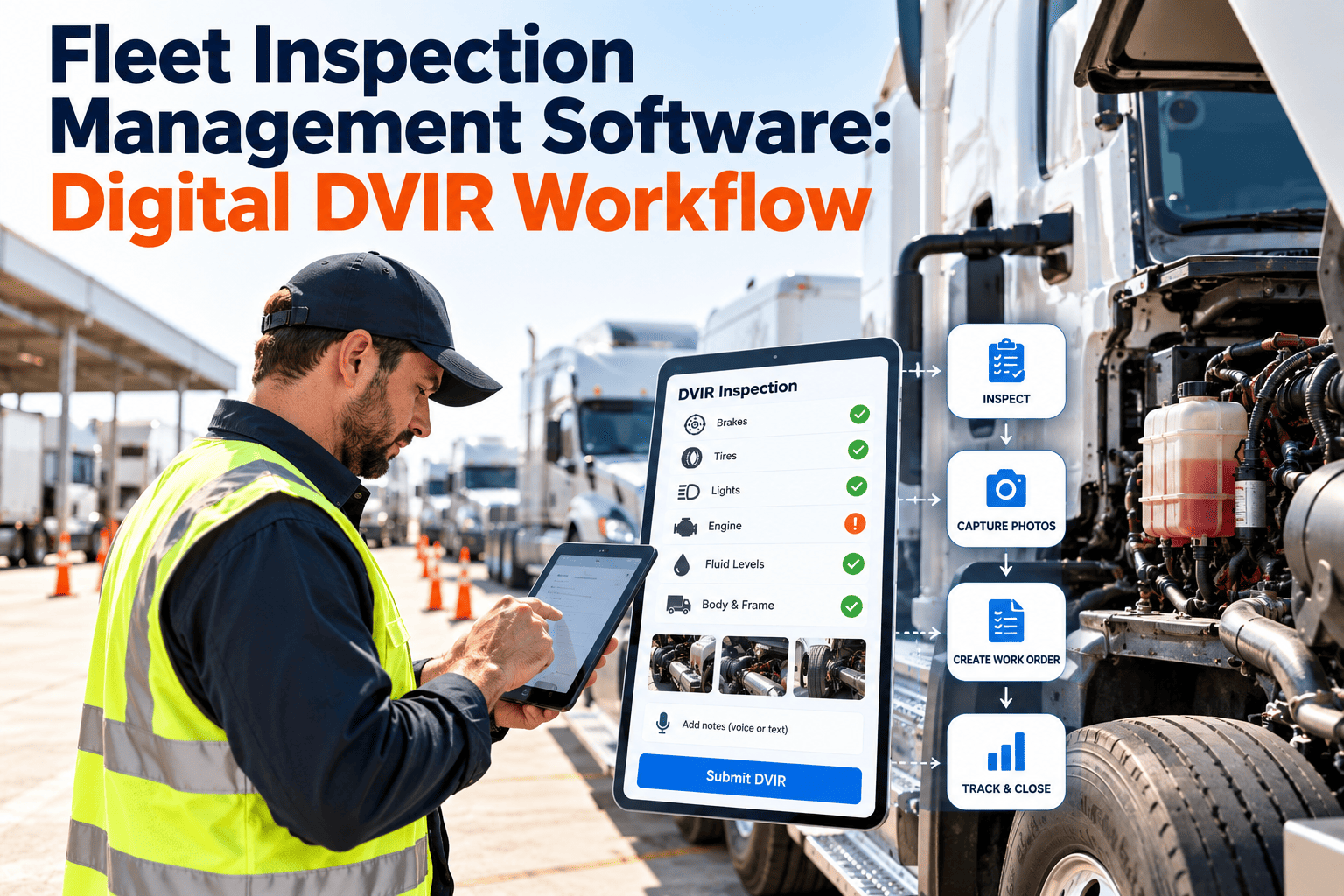
How a Defect Record Travels in Oxmaint
Each step creates data that supports preventive maintenance and fleet asset management.
| Step | What is captured | Who acts | System result |
|---|
| Inspection | Checklist answers, photos, odometer, severity | Driver | Timestamped report on the unit record |
| Triage | Severity class and out-of-service flag | Dispatcher or shop supervisor | Unit status updated for dispatch |
| Work order | Defect text, photos and parts needs | Planner | Corrective work order with priority and due date |
| Repair | Labor, parts used and findings | Technician | Parts deducted from inventory and history updated |
| Verification | Test result and sign-off | Supervisor | Report closed and next driver sees the clearance |
| Analysis | Trends by unit, component and driver | Fleet manager | Dashboards guide PM intervals and repeat fixes |
Frequently Asked Questions
What should a post-trip inspection include?
It should cover brakes, steering, lights, tires, coupling, leaks, emergency equipment and cargo gear, followed by a clear defect report with photos.
Is a DVIR required after every trip?
FMCSA rules require a written report at the end of each driving day for each vehicle operated. Confirm current requirements for your operation.
How can drivers write better defect notes?
Ask for component, position, symptom and conditions. Photos and short audio notes help. Book a demo to see structured defect forms.
How does a CMMS use post-trip defects?
It converts each defect into a work order, keeps history by unit and flags repeat issues. Get started with a pilot route.
When should a defect take a vehicle out of service?
Any safety-critical defect, such as air loss or a brake out of adjustment, should stop dispatch until repaired and verified. Define the classes in your policy.
Make Every Trip End With a Clean Defect Record
Bring post-trip inspections, defect photos, work orders and repair history into one fleet CMMS, and give every driver a clear way to report what they find.






.png)