.png)
Every commercial motor vehicle operating on U.S. highways, Canadian roads, UK HGV routes, or Australian heavy vehicle corridors must complete a Driver Vehicle Inspection Report before departure and after return — and FMCSA under 49 CFR Part 396.11 makes no allowance for incomplete records. A missed brake check, undocumented lighting defect, or skipped coupling inspection is not just a compliance gap: it is a direct liability in any post-accident review, a DOT out-of-service trigger at the next roadside stop, and a leading indicator of the preventable crashes that cost U.S. fleets over $91,000 per incident on average. Oxmaint's digital DVIR platform enforces every inspection item in sequence, captures GPS-stamped driver sign-off, and feeds defect records directly into the mechanic work order queue — eliminating the paper log gaps that generate FMCSA citations and DOT audit findings across commercial fleets of every size.
DVIR Trip Cycle — What Gets Inspected and When
The DVIR is not a single event — it is a continuous loop that surrounds every duty day. Pre-trip inspection happens before the first wheel turns. En-route monitoring runs throughout operation. Post-trip reporting captures defects discovered during the duty day. Mechanic review clears or holds the vehicle before next dispatch. Missing any phase breaks the compliance chain.
How Technology Is Transforming the DVIR Process
The traditional paper DVIR is a point-in-time snapshot — legally required but operationally limited. Four technologies now extend the inspection beyond what the driver observes at the yard, creating a continuous vehicle health record that surrounds the DVIR with real-time data from every mile driven. Oxmaint integrates all four into the same DVIR workflow your drivers already use.
How to Use This DVIR Checklist
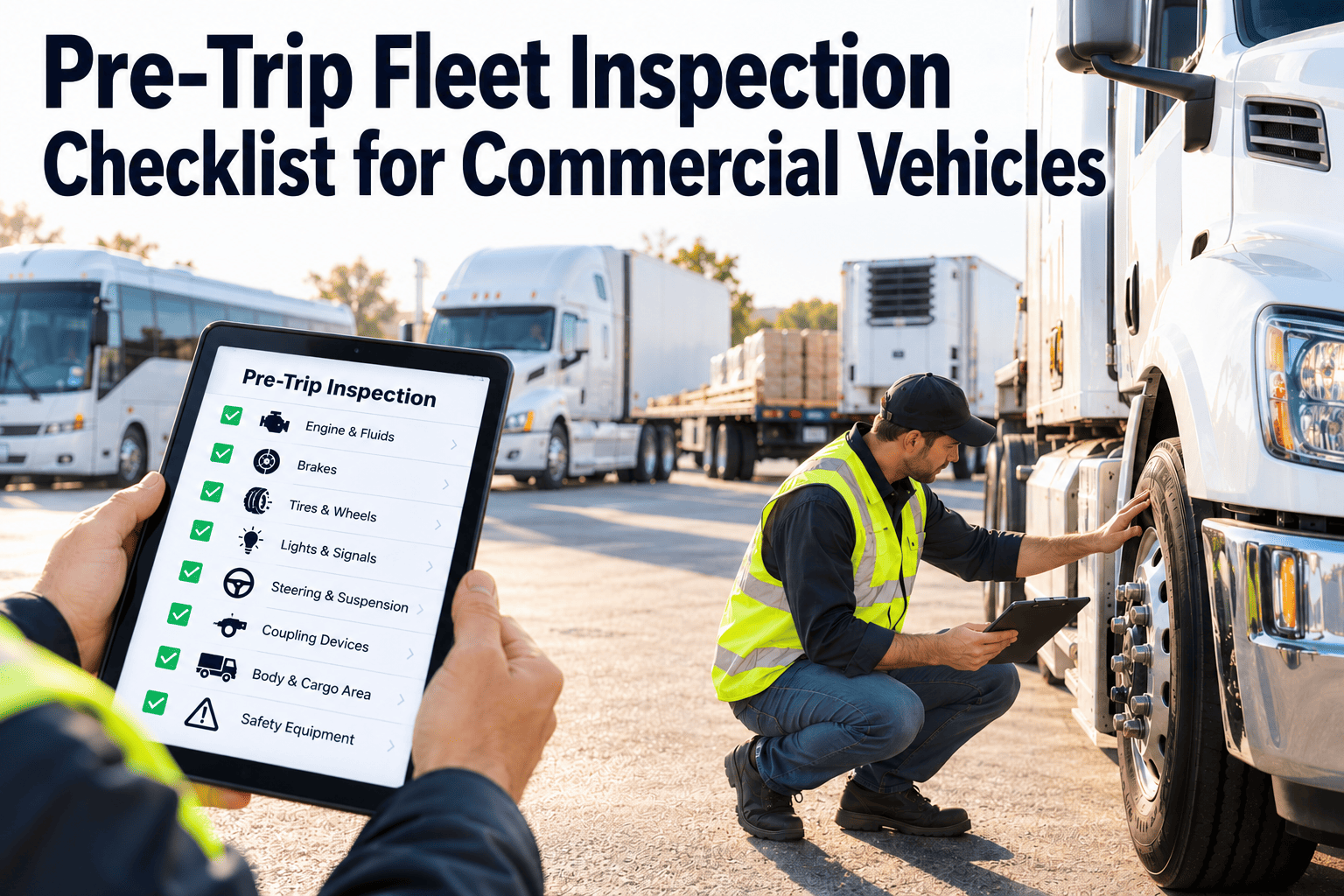
Complete all pre-trip zones before the vehicle moves. Record the actual observed condition for each item — not the expected condition. Any defect affecting safe operation must be documented and the vehicle must not depart until a qualified mechanic certifies the repair. The post-trip DVIR is required at end of every duty day even when no defects are found.
1. Brake Systems Checklist
Brake violations are the single most common DOT out-of-service finding — cited in 34% of all CMV inspections that result in an OOS order. Every brake item below must be completed before departure. Track brake inspection records and defect history with Oxmaint.
Service brake application test — 5 mph stop
Apply service brakes at 5 mph — vehicle must stop smoothly with no pull, grab, or delayed response. Any pedal fade, spongy feel, or pull to one side indicates an air or hydraulic system fault requiring immediate investigation. OOS if failed
Air brake reservoir pressure build and hold
Primary and secondary circuits must build to governor cut-out (120–135 psi) and hold within 5 psi over 2 minutes with no brake application. Pressure loss above 5 psi/min indicates a leak requiring repair before dispatch. OOS if failed
Brake pad / lining thickness
Minimum 1/4" on non-steering axles; 1/8" on steering axle (measured with gauge — visual estimate not acceptable under FMCSA §393.47). Worn pads that fail during DOT inspection generate an immediate OOS order. OOS if at/below limit
Brake drums and rotors
Inspect for cracks, severe scoring, or heat discolouration. Cracked drums are an immediate OOS condition under §393.47. Measure rotor thickness — below minimum spec requires replacement before the vehicle moves. OOS — cracked drum
Brake hoses, lines, and chambers
Inspect for leaks, chafing, or loose connections — air audible at any connection is OOS. Check brake chambers are not loose, bottomed out, or missing push rod cotter pins. Any brake line with visible corrosion, crimping, or wear requires replacement. OOS — air leak
Parking brake hold test
Apply parking brake fully — vehicle must hold stationary on level ground with service brake released. For air brake vehicles, verify low-air warning activates above 60 psi and spring brakes apply automatically when pressure drops to 20–45 psi. OOS if fails hold
OBD Integration tip: Brake controller fault codes (C-codes) from ABS modules appear in OBD data before the driver notices a pedal change. Oxmaint auto-creates brake inspection work orders from ABS DTCs — before the pre-trip inspection finds the defect at the yard. See how it works.
2. Tires and Wheels Checklist
Tire failures are the most common cause of commercial vehicle breakdowns and a leading cause of fatal truck crashes. Tread depth, pressure, sidewall condition, and wheel fasteners must all be checked at every pre-trip — not estimated, not assumed.
Tire tread depth — all positions including spare
Minimum 4/32" on steering axle tires; 2/32" on all other positions. Measure with a tread depth gauge — visual estimate is not acceptable under FMCSA §393.75. Tires at or below the limit at any position are OOS. OOS — below limit
Cold inflation pressure — all positions
Under-inflation by 20% or more is OOS. Use a calibrated gauge — TPMS dashboard alerts do not substitute for physical check since TPMS sensors can fail silently. A tire at 20% under-inflation generates 30°F more heat and loses 25% of its tread life. OOS — 20%+ under
Sidewall condition — all tires
Any sidewall bulge is immediate OOS regardless of inflation pressure — a bulged sidewall indicates internal structure failure and can blow out without warning at highway speed. Check for cuts exposing cords, embedded objects, and weather cracking on all tires. OOS — any bulge
Wheel nuts and rim condition
Check all wheel nuts for tightness with a calibrated torque wrench — loose, spinning, or missing nuts are OOS under §393.205. Inspect rims for cracks, bends, or weld repairs. Verify lock rings on multi-piece rims are fully seated with no visible gap. OOS — loose nuts
Steering axle tire type verification
Recapped or regrooved tires are prohibited on the steering axle of any CMV under FMCSA §393.75 — regardless of tread depth or condition. Verify tire sidewall markings confirm original manufacture, not recap. OOS — steer axle recap
3. Lights, Reflectors and Visibility Checklist
Lighting violations are the most frequently cited category at DOT roadside inspections — accounting for over 40% of all driver and vehicle citations. Every lamp circuit must be physically verified, not assumed to be working because no warning light appeared on the dash. Log lighting defects and track repair status with Oxmaint.
Headlights — low and high beam
Both low and high beams must illuminate. Aim must be within DOT specification. A single inoperable headlight is OOS between sunset and sunrise or in reduced visibility conditions under FMCSA §393.9. OOS — low/poor visibility
Brake lights — all stop lamps
All stop lamps must illuminate on brake application at any time of day or night. A single inoperable brake light on a CMV is OOS at any time under §393.9 — the most commonly cited lighting violation at DOT inspections. OOS — any time
Turn signals and hazard flashers
Left and right indicators must flash at correct rate front and rear. Verify hazard flasher operates independently from the turn signal circuit. A hyperflashing rate or non-flashing indicator indicates a circuit fault requiring investigation. OOS — non-functional
Clearance and marker lamps
All amber front clearance and red rear marker lamps must operate. Side marker lights required on vehicles over 80" wide. Missing or inoperable marker lamps are among the most common after-dark OOS citations at weigh stations. OOS if inoperable
Mirrors and windshield
All required mirrors must be properly adjusted and securely mounted — cracked or missing mirrors are OOS under §393.80. Windshield cracks longer than 1/4" in the critical vision area (left of centre, below top 5") are OOS under §393.60. Both wiper blades must make full contact across their sweep. OOS — cracked/missing
AI Camera Vision tip: Automated lighting circuit checks using drive-through camera arrays at depot exit can verify all exterior lamp operation at throughput speed — flagging failures before the driver departs the yard. Book a demo to see AI lighting verification in action.
4. Coupling Devices and Trailer Checklist
Coupling failures are catastrophic — a fifth wheel separation at highway speed has no recovery option. Every coupling component must be physically verified, not assumed secure because the trailer has not separated before. The tug test is mandatory, not optional.
Fifth wheel locking jaw — tug test
Verify fifth wheel locking jaws are fully closed around the kingpin. Apply tractor power forward against locked trailer brake and confirm no separation at the coupling. The tug test is an FMCSA-required verification step — checking the release handle position alone is not sufficient. OOS — failed tug test
Kingpin play and fifth wheel mounting
Maximum allowable play between kingpin and locked jaws is 1/2" measured at the apron under §393.70. Check all fifth wheel mounting bolts are present and tight — fifth wheel must not rock or move laterally on its mounting platform under tug test load. OOS — above 1/2" play
Safety chains / cables
Must be crossed under the tongue, attached to the towing vehicle frame, and have no broken links or hooks. Safety chains must have sufficient ground clearance at full drop — chains dragging on the road surface during operation are a serious secondary hazard. OOS — missing/broken
Glad hands (air lines) — supply and control
Both glad hand connections must be locked, free from leaks, and correctly connected — supply (red) and control (blue) lines must not be swapped. Cross-connected glad hands are a critical brake circuit error that results in trailer brake failure under emergency application. OOS — swapped/leaking
Trailer electrical connector and landing gear
All 7-way plug circuits must function — running lights, brake lights, turn signals, brake controller, and reverse. Landing gear must be cranked fully retracted with pins locked and crank stored. Symmetrically raised legs with no bent pads or cracked cross-members confirms structural integrity. Defect — electrical fault
5. Steering, Horn and Engine Checklist
Steering and engine defects that develop during a route are invisible to the driver until a symptom appears — often too late for a controlled response. Pre-trip steering and engine checks catch the developing conditions before they become mid-route emergencies.
Steering wheel free play
Maximum 2" of free play on a 20" wheel for power-assisted steering vehicles — measured with wheels straight ahead and engine running. Any play exceeding this is OOS under §393.209. Excess steering play delays vehicle response in emergency manoeuvres by a critical fraction of a second. OOS — above limit
Horn operation
Must be audible from the driver's position at all times — inoperable horn is OOS under §393.81. This applies to city horn on straight trucks and air horn on CMVs. Check both systems if fitted. A horn that operates intermittently is a defect requiring investigation before departure. OOS if inoperable
Engine oil, coolant, and power steering fluid levels
Check all fluid levels cold before engine start. Low oil or coolant requires investigation for leak source — not just top-up — before departure. A vehicle dispatched with an active fluid leak that causes engine failure en route creates carrier liability for the failure and any resulting incident. Defect — low level
Fuel tank, cap, and fuel lines
Fuel tank must be securely mounted, cap must seal fully, and no fuel leaks visible at fittings, lines, or seams. A fuel leak is OOS and a fire hazard — fuel leaking onto a hot exhaust component is a direct cause of cab fires in commercial vehicles. OOS — any leak
Exhaust system — leaks and routing
No leaks in manifold, pipes, or muffler inside the cab or in locations where exhaust could contact fuel lines. Any exhaust leak allowing fumes into the cab is OOS under §393.83 — carbon monoxide build-up inside a sealed cab is a direct driver incapacitation risk. OOS — cab ingress
OBD + CMMS Integration: Engine fault codes (P-codes from ECM and C-codes from ABS) generated during the previous duty cycle are pulled automatically into the next pre-trip DVIR via OBD integration — ensuring DTCs don't go unnoticed between driver handovers. See Oxmaint's OBD-to-DVIR integration.
6. Emergency Equipment and Documentation Checklist
Emergency equipment and documentation deficiencies are the fastest path from a DVIR inspection to a full DOT enforcement action. Every item below is legally required on every CMV dispatch under FMCSA §393.95 and §396.11 — none are optional. Manage DVIR documentation retention and compliance records with Oxmaint.
Fire extinguisher — charge and accessibility
Must be properly mounted, fully charged (check gauge indicator), and accessible from the driver's position. Minimum 2 B:C rating for CMVs not transporting hazmat. A missing or discharged extinguisher is OOS under §393.95(a) — and represents a direct safety gap in the event of a cab or load fire. OOS — missing/discharged
Warning triangles, flares, or fusees — three required
Three warning devices required, stored in accessible location, and appropriate for the road type. Missing or expired warning devices are OOS under §393.95. Without warning devices, a breakdown on a high-speed road creates immediate secondary collision risk for other traffic and the driver. OOS — missing devices
Previous DVIR on board and reviewed
The most recent DVIR must be in the vehicle and reviewed by the driver before signing the current pre-trip. Driver must check whether any open defects from the previous cycle have been cleared by mechanic sign-off. Dispatching without reviewing the previous DVIR is a §396.11 violation. OOS — DVIR missing
Vehicle registration and operating authority
Registration must be current and legible. MC/DOT number must be correctly displayed on the vehicle. Expired registration or missing operating authority subjects the vehicle and driver to an immediate OOS order and potential carrier enforcement action at the roadside. OOS — expired
CDL, medical certificate, and HOS records
CDL must be valid for vehicle class and all required endorsements. Medical examiner's certificate must be current (2-year maximum). ELD or paper log must be current and available for inspection. Log falsification carries civil penalties up to $16,000 per violation plus potential criminal liability under 49 U.S.C. §521. OOS — expired CDL/medical
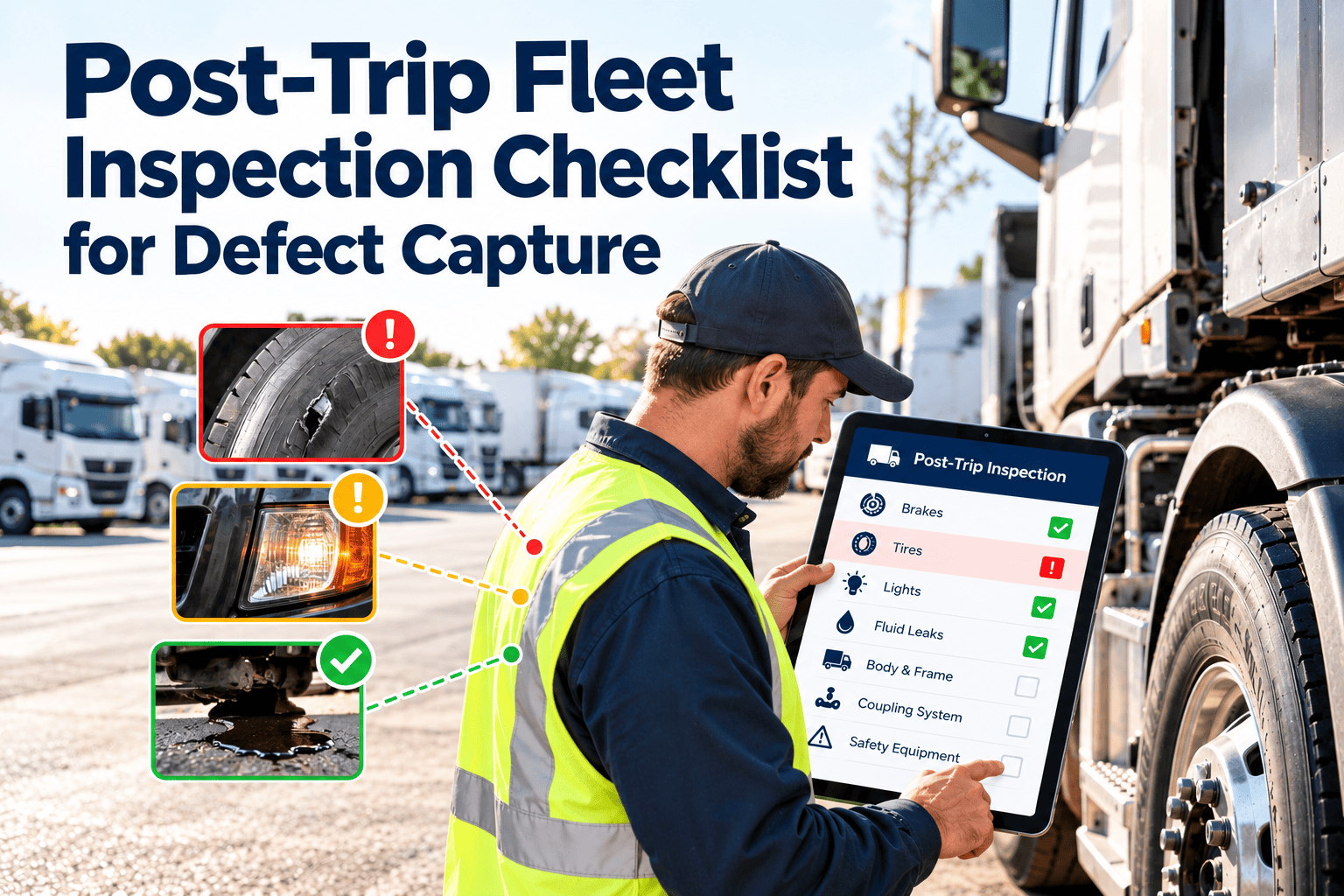
Required at the end of every duty day under §396.11. Report any defect discovered during operation — or declare "no defects found" with driver signature. Both are legally required records. A post-trip DVIR that is simply not completed is a §396.11 violation regardless of vehicle condition.
Brake performance change during trip
Any change in pedal feel, pull, noise, or stopping distance vs. pre-trip condition — document location and nature of change.
Tire damage or pressure loss during trip
Impact damage, slow leak, or TPMS alert that occurred during operation — note position and condition at parking.
Warning lights or OBD fault codes displayed
Any instrument panel warning that appeared during the trip — engine, ABS, SRS, transmission, or emissions system.
Lighting or electrical fault discovered
Lamp failure, circuit fault, or intermittent electrical issue observed while operating the vehicle during the duty period.
Fluid leak or unusual smoke observed
Any drip or puddle under vehicle after parking, or visible exhaust smoke change from pre-trip baseline condition.
No defects found — vehicle satisfactory
Driver declares no defects or deficiencies discovered during this duty period. Driver signature and timestamp required to complete this legally required DVIR record.
We reduced our DOT out-of-service rate from 18% to under 4% in six months after switching to digital DVIR on Oxmaint. The system flags incomplete zones before drivers can submit — paper DVIRs never did that. Our CSA score improved across every BASIC category within two quarters.
DVIR Compliance Impact — Key Metrics
Fleets using digital DVIR with CMMS pass DOT roadside inspections at 94%+ vs. 71% on paper-based programs.
Carriers with structured digital DVIR programs average 60% fewer roadside out-of-service orders vs. paper DVIR fleets.
Digital DVIR records retrievable in 30 seconds during DOT roadside inspection vs. 20+ minutes for paper-based searches.
Maximum FMCSA civil penalty per DVIR violation for carriers with a pattern of non-compliance — eliminated with digital enforcement.
Frequently Asked Questions
The most common questions from fleet managers and drivers about DVIR requirements, FMCSA compliance, and digital inspection records.
Any driver operating a CMV subject to FMCSA jurisdiction — vehicles over 10,001 lbs GVWR, 9+ passenger vehicles for compensation, or hazmat placarded vehicles. Applies to both owner-operators and company drivers on every duty day.
Yes. A "no defects" declaration with driver signature is a required FMCSA record under §396.11 — it must be completed and retained. Carriers cannot skip the DVIR simply because nothing was found during the inspection.
The original DVIR must remain in the vehicle for the duration of the trip and the following day. Carriers must retain DVIR records for 3 months minimum. Records involving reported defects and mechanic certification of repair must be retained for 12 months.
Only if a qualified mechanic certifies in writing that the defect does not affect safe operation, or that repairs have been completed. Safety-critical defects — brake, steering, or lighting OOS conditions — must be repaired before dispatch without exception.
Yes. FMCSA allows electronic DVIRs under §396.11(d) provided the system captures driver identity, timestamp, vehicle ID, and driver electronic signature. Oxmaint's DVIR module meets all requirements and is accepted at DOT roadside inspections and CSA reviews.
FMCSA civil penalties range from $1,270 to $16,000 per violation depending on severity and pattern. Falsification carries criminal liability under 49 U.S.C. §521 and can result in driver disqualification and carrier authority revocation.