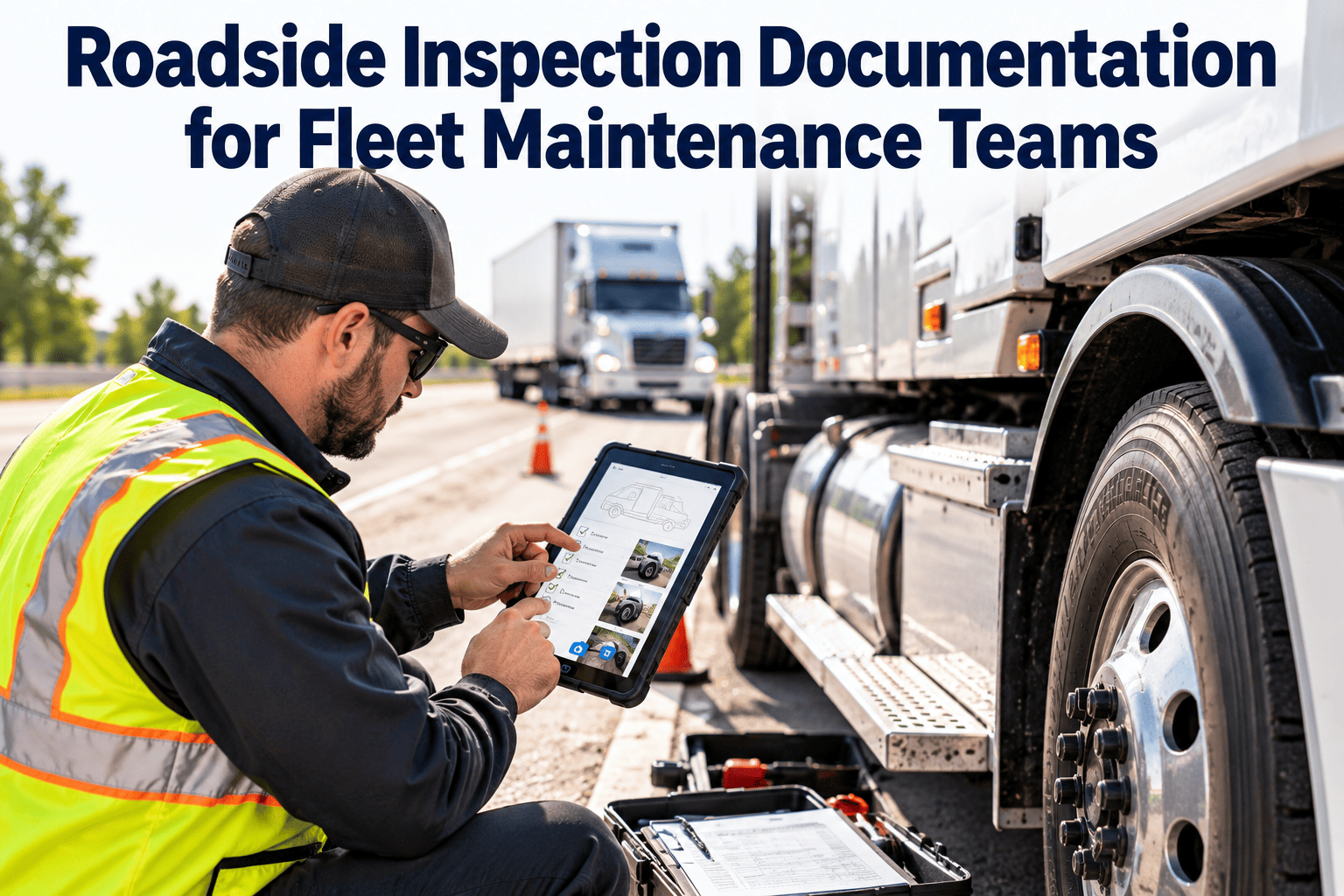
A roadside inspection rarely turns on the truck alone. It turns on what the driver can hand over and what the carrier can produce afterward. When an officer asks for an inspection report, a driver vehicle inspection report, or proof of the last repair, missing paperwork can turn a clean truck into a violation. Fleet maintenance teams that keep records tied to each vehicle answer those requests in minutes rather than days. Below is a practical way to build that discipline with fleet maintenance software.
Roadside Inspection Documentation for Fleet Maintenance Teams
Turn scattered inspection reports, repair receipts and driver defect notes into one vehicle record that is ready before the officer walks up to the cab.
Why documentation decides the outcome
What the officer sees
- The vehicle, its condition and any visible defects.
- The driver, their credentials and their inspection habits.
- The records the driver can produce on request.
What the carrier is judged on
- Whether defects were found and repaired before the trip.
- Whether repairs were certified and dated.
- Whether the pattern across the fleet shows control or chaos.
Inspection outcomes flow into a carrier's safety record, so a repeated paperwork gap costs more than a single fine. Insurers, shippers and brokers increasingly look at the same data.
The inspection levels your records must support
The Commercial Vehicle Safety Alliance defines several levels under the North American Standard Inspection program. Three come up most often for fleet maintenance teams.
| Level | Focus | Documents likely requested | Maintenance takeaway |
|---|---|---|---|
| Level I | Full driver and vehicle inspection, including under-vehicle checks | Driver credentials, inspection reports, repair records, annual inspection proof | Every component the officer can reach should have a documented history |
| Level II | Walk-around inspection of what is accessible without going under the vehicle | Driver credentials, driver vehicle inspection reports, annual inspection proof | Tires, lights, coupling devices and cargo securement need pre-trip evidence |
| Level III | Driver-focused review of credentials and required paperwork | Licence, medical card, hours of service, inspection report copies | Maintenance paperwork must be in the cab, not only in the office |
Requirements vary by jurisdiction, so confirm the rules that apply to your operating area and vehicle class.
The records that matter, and how long to keep them
In the United States, the Federal Motor Carrier Safety Regulations set out what motor carriers keep. The table below summarizes the common items. Always verify current text and state or provincial rules.
| Record | Typical reference | Retention guide |
|---|---|---|
| Driver vehicle inspection report | 49 CFR 396.11 | Three months from report date |
| Annual inspection report | 49 CFR 396.21 | Fourteen months from report date |
| Inspection, repair and maintenance records | 49 CFR 396.3 | One year where the vehicle is housed, plus six months after it leaves your control |
| Proof of annual inspection carried on the vehicle | 49 CFR 396.17 | Report copy or decal, kept current |
What each vehicle record should carry
- Unit number, make, model, year and identification number.
- Nature and date of every inspection, repair and maintenance action.
- Component lubricated, repaired or replaced, with the odometer reading.
- Parts used, labor and the technician who performed the work.
- Defect certification: the defect was repaired or judged not needed for safe operation.
Where documentation breaks down
Paper reports that never reach maintenance
A driver notes a defect on a paper form. The shop hears about it days later, if at all.
Repairs done, but not tied to the defect
The invoice exists, yet nobody can show it closed the exact item the driver reported.
Annual inspection dates tracked in spreadsheets
One missed cell means a unit is on the road with an expired inspection.
No pattern view across the fleet
Repeat brake, lighting or tire findings stay invisible until a roadside event exposes them.
Give every truck a record an officer can read in one minute
Set up vehicle histories, inspection checklists and work orders in one place, and see how fast your first unit's file comes together.
From defect to documented repair: the workflow
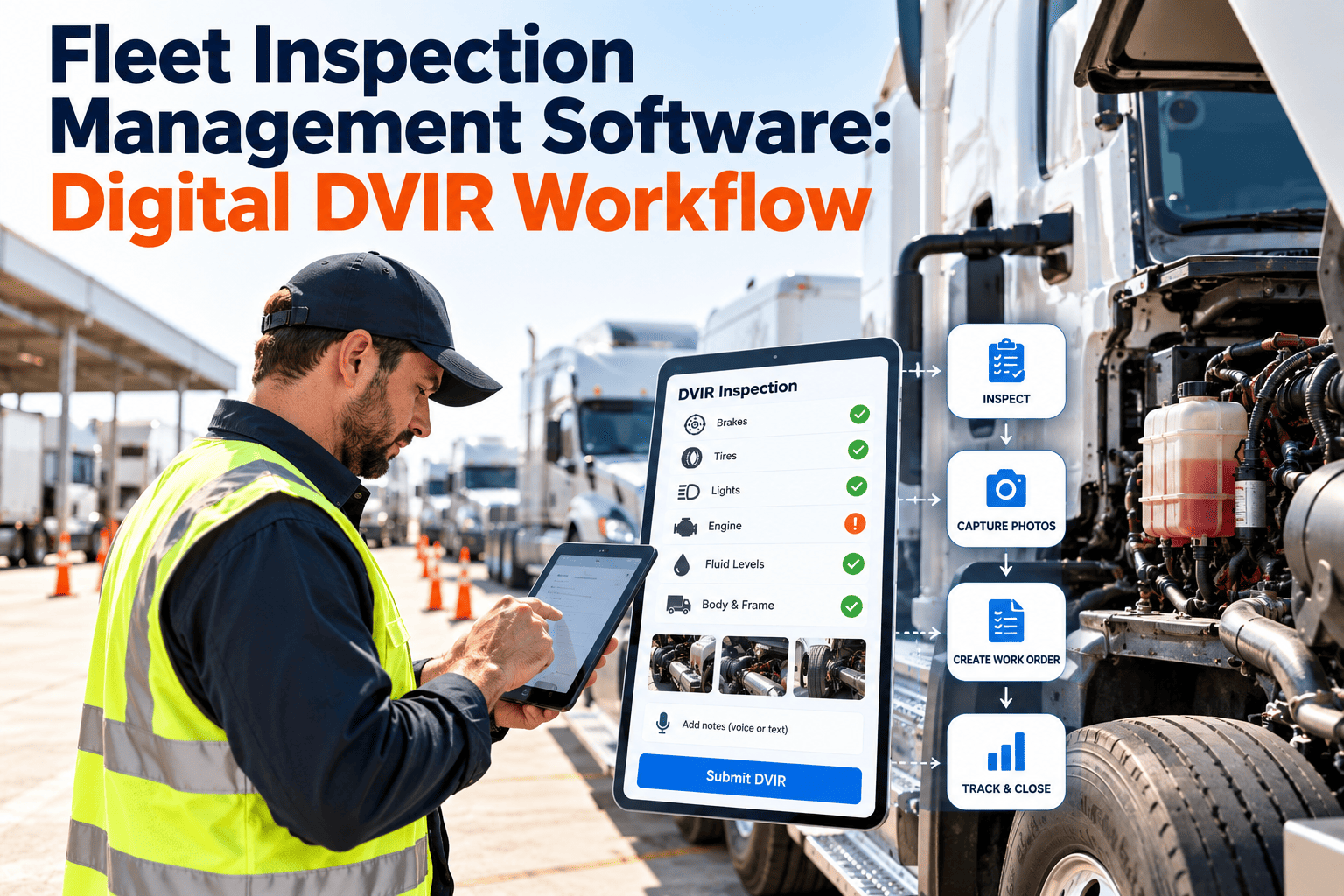
The strongest roadside defense is a closed loop. Each step below leaves a timestamped entry on the vehicle record.
Driver inspects
Pre-trip and post-trip checks are completed on a mobile checklist, with defects logged as they are found.
Defect becomes a work order
A reported defect creates a corrective work order tied to the unit, with priority set by severity.
Technician repairs
Labor, parts and notes are recorded against the order, and parts are drawn from inventory.
Repair is certified
A supervisor reviews the work and signs off, closing the loop back to the original driver report.
Record is retrievable
The whole chain is searchable by unit, date, defect or technician when someone asks for proof.
Before and after: one vehicle file
Scattered records
- Inspection forms in a cab folder and a filing cabinet.
- Repair invoices in email and vendor portals.
- Annual inspection dates in a spreadsheet.
- Retrieval takes phone calls and guesswork.
Unified vehicle record
- Checklists, defects and repairs on one timeline.
- Work orders linked to the defect that triggered them.
- Automatic reminders before inspections come due.
- Retrieval takes a search, from the shop or the road.
Preventive maintenance is your best roadside preparation
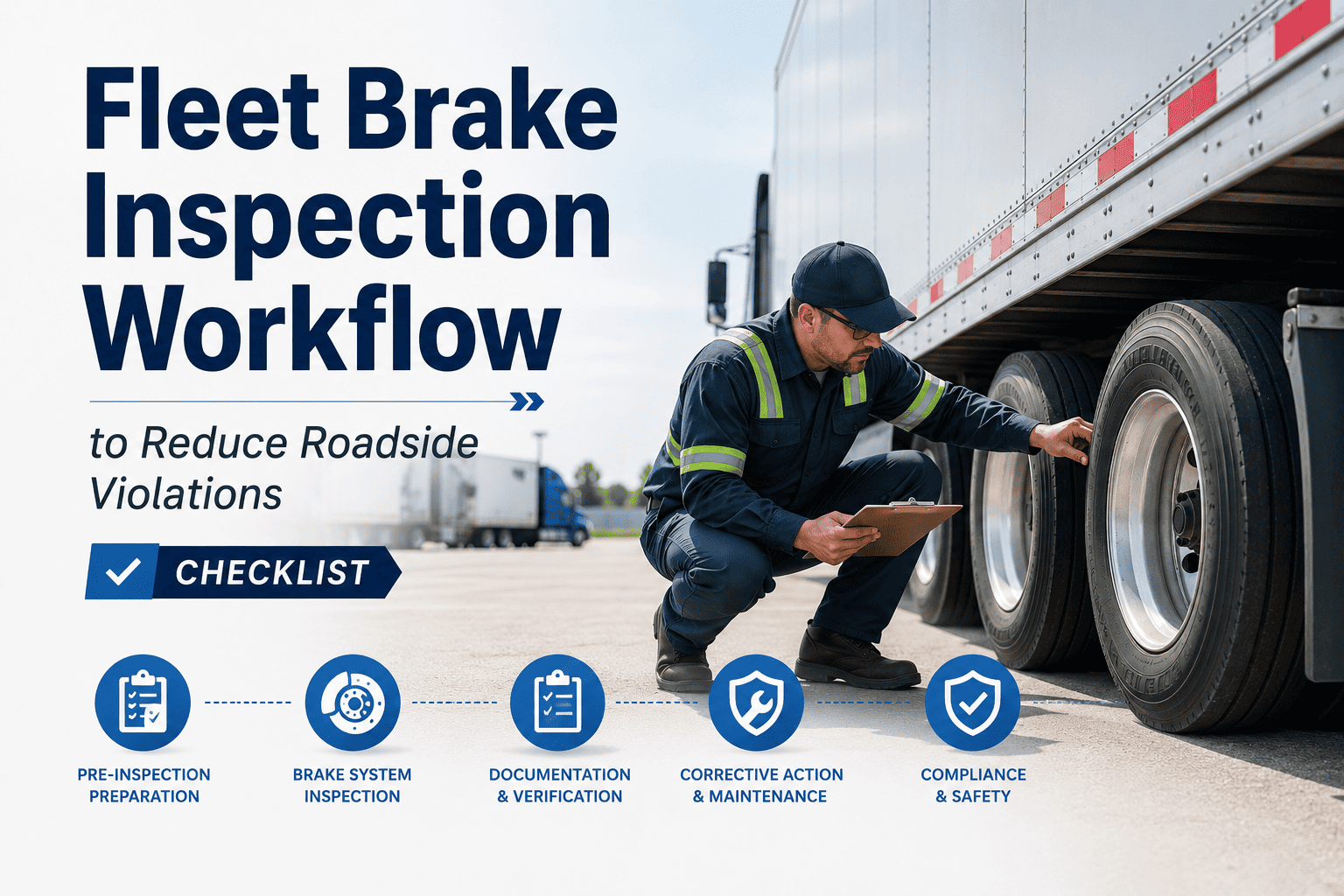
Documentation proves what was done. Preventive maintenance reduces what needs to be proven. Brakes, tires, lighting and coupling systems account for a large share of out-of-service findings in CVSA reporting, which is why they deserve fixed intervals.
Build inspection-aligned PM schedules
- Set preventive maintenance by mileage, engine hours or calendar days for each vehicle class.
- Add brake measurements, tire tread and pressure checks, light function and air system leak checks to every service.
- Schedule annual inspections as recurring tasks with lead-time alerts.
- Track repeat defects by unit so a recurring issue triggers root cause work, not another patch.
Prepare for CVSA Roadcheck-style scrutiny
CVSA announces an annual International Roadcheck with a special focus area that changes each year. Review the current focus and add the matching checks to your driver checklists before the event window opens.
Roadside readiness scorecard
Track these measures monthly. They show whether documentation is holding up, and none of them require guesswork.
The bars above illustrate the layout of a scorecard, not measured results. Fill them with your own data.
Responding after an inspection
Log the inspection report against the unit and open work orders for any cited defects.
Complete and certify repairs, attach parts and labor, and file the corrective evidence required by your jurisdiction.
Check whether a violation was recorded correctly. In the United States, the DataQs system allows carriers to request review of data they believe is wrong.
Review findings by category to update PM tasks, driver coaching and vendor performance.
How Oxmaint supports inspection documentation
| Roadside need | Maintenance workflow | Oxmaint capability |
|---|---|---|
| Prove pre-trip checks happened | Mobile driver checklists with defect capture | Inspections and mobile workflows |
| Show defects were repaired | Defect converts to a corrective order and closes with notes | Work orders |
| Stay ahead of annual inspection dates | Recurring tasks with lead-time alerts | Preventive maintenance and scheduling |
| Produce a unit's history quickly | Searchable timeline of services and parts | Asset management and reporting |
| Control parts behind repairs | Issue parts to orders, track stock | Inventory management |
Frequently asked questions
What should a driver carry for a roadside inspection?
Licence, medical certificate, registration, and the inspection paperwork your jurisdiction requires, including recent vehicle inspection reports.
Can digital records replace paper in the cab?
Electronic records are generally accepted when they can be produced on request. Confirm local rules, then book a demo to see mobile access in practice.
How do we prove a defect was repaired?
Link the repair work order, parts and certification to the original defect report so one search shows the full chain.
How do we avoid missed annual inspections?
Set recurring inspection tasks with lead-time alerts. You can start a trial and configure them per unit.
Does documentation alone reduce violations?
It proves compliance, but fewer violations come from preventive maintenance and fast defect repair supported by good records.
Be ready before the next inspection lane opens
Bring checklists, defects, repairs and retention into one maintenance-first system, and let your records speak for the fleet.