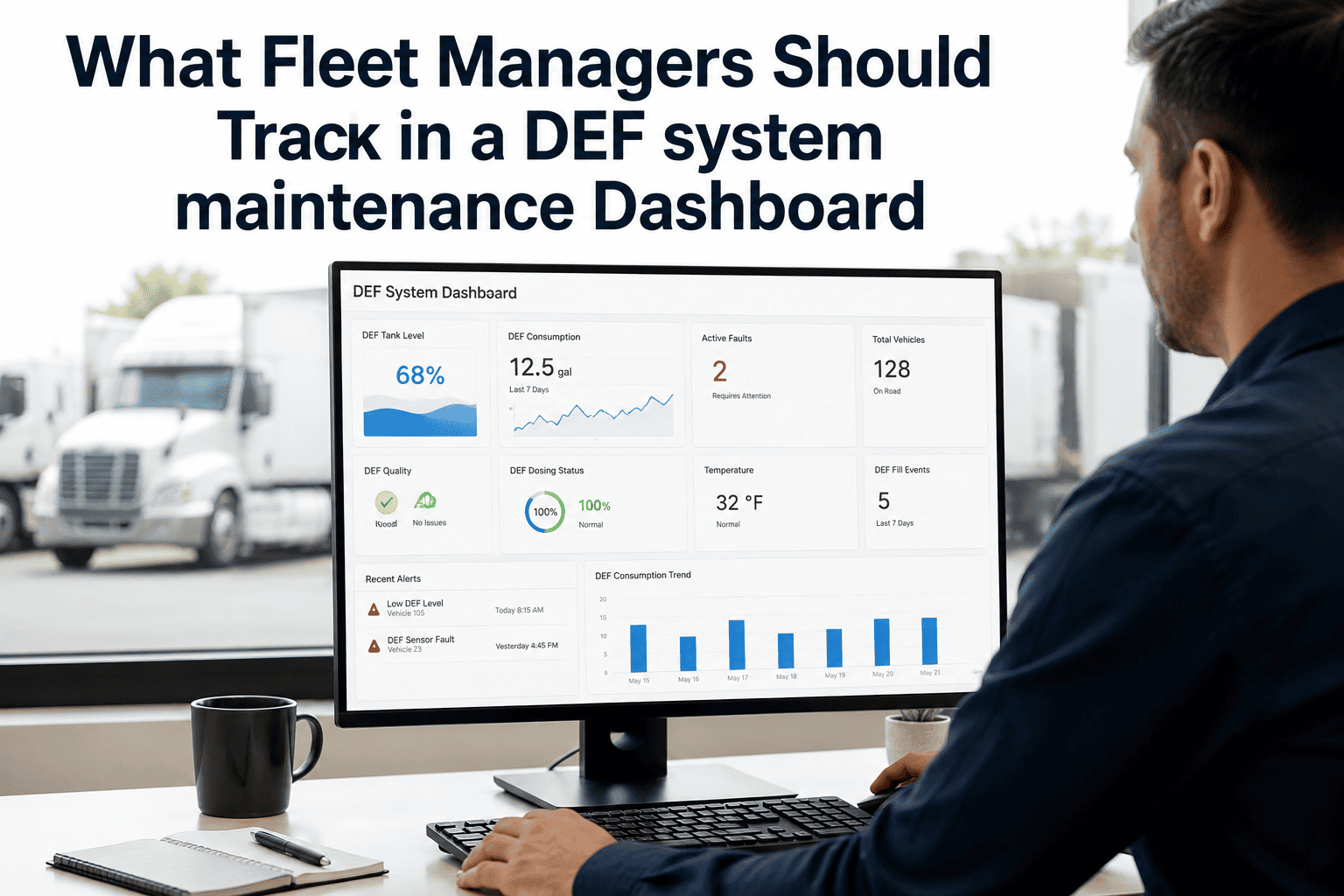
The first sign of a DEF problem should never be a dashboard warning light on the highway. By then the truck is already heading toward derate and a stranded load. A DEF dashboard earns its place when it shows the leading signals, fluid quality, sensor health, refill discipline, and regen frequency, early enough to schedule a fix instead of react to a failure. Across a fleet, a single sensor fault can take a truck off the road and ripple costs through the whole network, which is exactly the surprise the right dashboard removes. See the signals worth tracking, then start a free trial or book a demo.
What Fleet Managers Should Track in a DEF System Maintenance Dashboard
A DEF dashboard that only shows fluid level is already too late. Track the leading signals that predict derate, and turn emissions repairs from a roadside surprise into a scheduled work order.
Six DEF Signals A Dashboard Should Surface Before Derate
Fluid level is a lagging indicator, useful but not predictive. The signals below are the ones that warn you a DEF system is heading for trouble while there is still time to act, each tied to a specific failure mode that ends in derate, limp mode, or an expensive SCR repair.
Low or poor-quality fluid causes faulty readings and SCR damage. Tracking quality catches contamination before it crystallizes and clogs injectors.
A single sensor fault can take a truck off the road. Surfacing sensor codes early lets you replace before a derate strands the load mid-route.
Frequent regens are an early aftertreatment warning. A rising regen count flags a clogging filter before fuel economy and performance drop further.
A clogged aftertreatment filter can cut fuel efficiency by around 5 percent. Watching economy per unit exposes DEF trouble that codes miss.
Track clean-fill compliance per refill. One contaminated fill can damage the system, so the log is the audit trail that protects the SCR.
Show which units are due for their 6-12 month DEF inspection so service is scheduled on time rather than triggered by a warning light.
Turn DEF Signals Into Scheduled Work Orders
Oxmaint tracks fluid quality, sensor faults, regen frequency, and inspection due dates on one dashboard, then converts a rising-risk signal into a work order before the system faults. Frequent regens and a creeping fuel-economy drop become a flagged action, not a roadside derate hundreds of miles from a shop.
Reactive DEF Tracking vs Predictive DEF Tracking
The value of a DEF dashboard is entirely in timing. A reactive view tells you a truck failed; a predictive view tells you a truck is about to. This is the difference between a scheduled fix and a stranded load.
| Signal | Reactive Dashboard | Predictive Dashboard |
|---|---|---|
| Fluid quality | Found at derate | Tracked before contamination spreads |
| Sensors | Warning light on the road | Fault codes surfaced for early swap |
| Regen frequency | Not monitored | Rising trend flagged as aftertreatment risk |
| Fuel economy | Buried in the fuel bill | Per-unit drift exposes hidden DEF trouble |
| Inspections | Remembered, or not | Due-status driven, scheduled on time |
| Outcome | Derate and stranded load | Scheduled work order, truck keeps earning |
A DEF Dashboard Built To Predict, Not React
Oxmaint surfaces every leading DEF signal in one view, fluid quality, sensor faults, regen frequency, economy drift, refill compliance, and inspection due dates, and converts rising risk into scheduled work orders before derate hits. Inspections run on a fixed 6-12 month cycle per unit, and corporate sees fleet-wide DEF health while each yard manages its own. Keep loads moving with a free trial or a demo.
Fluid quality, sensor faults, regen frequency, and economy drift sit on one dashboard so DEF risk is visible per unit, fleet-wide.
A rising-risk signal converts into a work order before the system faults, replacing roadside derates with planned service.
Every unit shows its DEF inspection due date so service is scheduled on time rather than triggered by a warning light.
Clean-fill compliance and service history log per vehicle, protecting the SCR system and keeping the fleet audit-ready.
What Each DEF Signal Should Trigger
A dashboard signal earns its place only if it ends in a decision. Each DEF reading maps to a clear next step, an inspection, a part swap, or a fluid check, so the dashboard drives work rather than just displaying status. Here is how the leading signals translate into action before derate.
| Signal On Dashboard | What It Indicates | Action It Triggers |
|---|---|---|
| Quality reading off-spec | Contaminated or degraded fluid | Drain, refill clean, trace the source |
| Sensor fault code | Failing or failed DEF sensor | Schedule swap before derate strands the unit |
| Regen count rising | Aftertreatment beginning to clog | Inspect and clean ahead of performance loss |
| Economy trending down | Hidden DEF or filter restriction | Pull the unit for a DEF system inspection |
| Refill not logged clean | Contamination-control gap | Verify procedure, audit the fill point |
| Inspection overdue | Slipped 6-12 month cycle | Generate the scheduled inspection work order |
The Cost Gap Between Catching DEF Early And Late
The same DEF issue costs wildly different amounts depending on when the dashboard catches it. Early, it is a scheduled task during planned downtime. Late, it is a roadside derate with recovery, towing, and a missed delivery stacked on top. This is the gap a predictive dashboard closes.
A rising regen count or quality dip becomes a scheduled inspection during planned downtime, with the truck back on its route the same day.
A dash warning means the fault is already active. The fix is larger, the downtime is unplanned, and the unit comes off schedule unexpectedly.
A single sensor fault takes the truck off the road and derails a delivery, with cascading costs rippling across the whole network.
A DEF violation found at a roadside or audit check, under split Vehicle Maintenance scoring, can move the fleet toward an audit trigger.
Frequently Asked Questions
Why track more than DEF fluid level?+
What signal warns of DEF trouble earliest?+
How does a sensor fault strand a truck?+
How does the dashboard turn signals into action?+
Does it track inspection schedules too?+
See DEF Trouble Before The Warning Light Does
A dashboard that shows fluid level tells you what already happened. One that tracks quality, sensors, regens, and economy tells you what is about to. Surface the leading signals, schedule the fix, and keep every truck earning instead of stranded in derate.