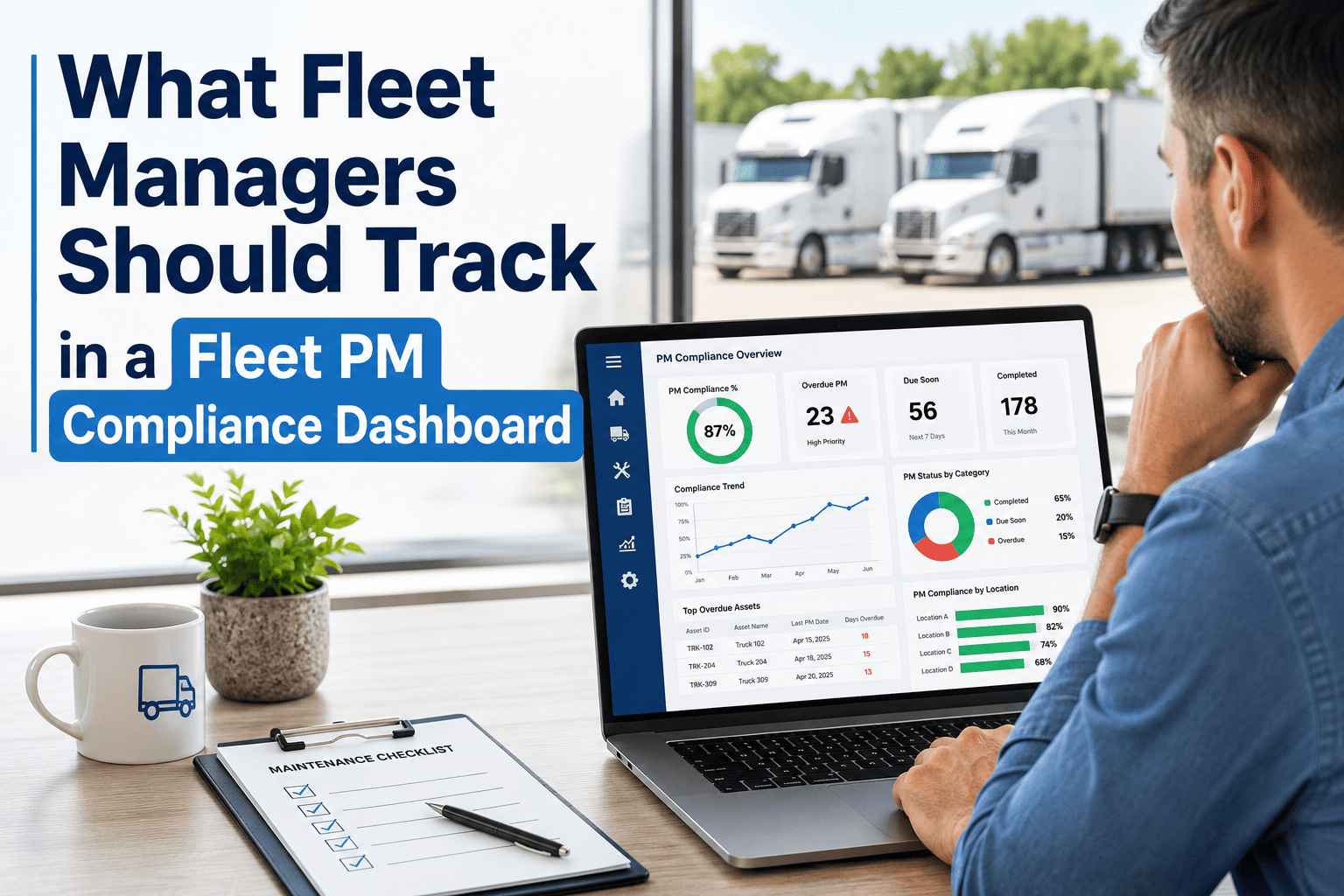
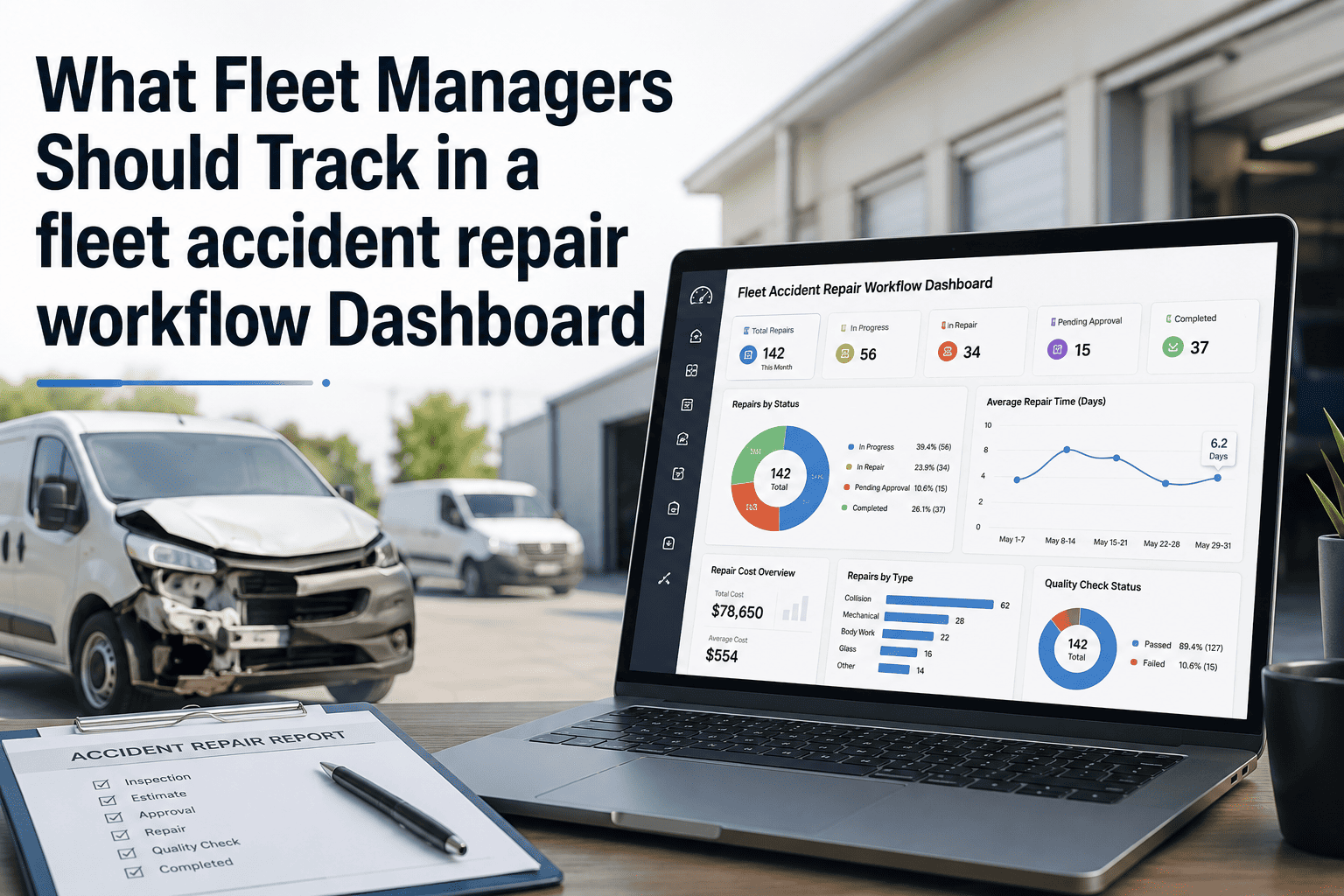
Most fleet managers know their vehicles need regular preventive maintenance — the breakdown happens in knowing whether that maintenance is actually happening, on time, every time, across every vehicle in the fleet. A fleet PM compliance dashboard is the operational tool that closes the gap between what the schedule says and what the maintenance team actually executed. The dashboard turns thousands of individual work orders, inspection records, and service intervals into one live number: your PM compliance rate. When that number drops, you know where, which vehicle, and how long before a roadside inspection turns into an out-of-service order. Fleets with structured PM dashboards consistently report lower breakdown rates, lower cost per mile, and cleaner DOT audit outcomes than those operating from manual schedules and spreadsheet tracking. If you want to see what structured PM compliance visibility looks like for your fleet, book a demo today.
Fleet PM Dashboard · Tracking Guide · 2026
What Fleet Managers Should Track in a Fleet PM Compliance Dashboard
Your PM dashboard is only as powerful as the metrics inside it. This guide covers every data point, KPI, and alert that transforms a maintenance log into a real-time compliance command center — and shows exactly where most fleet dashboards fall short.
Core KPIs
The 5 Numbers Every Fleet PM Dashboard Must Show at a Glance
PM Compliance Rate
PMs Completed On Time / PMs Due
Target: 95% or higher
The single most important number in fleet maintenance. Anything below 90% is an audit risk. Below 80%, you are operating a reactive fleet.
Mean Time Between Failures
Operating Hours / Number of Breakdowns
Rising MTBF = improving PM quality
Tracks whether your PM program is actually preventing failures or just generating paperwork. A rising MTBF means your PMs are working.
PM Schedule Adherence
Scheduled PMs Performed Within Window / Total Scheduled PMs
Target: within 5% of trigger mileage
Separate from completion rate — this measures timing. A PM completed 3,000 miles late is technically done but practically worthless for compliance.
Open Work Order Age
Average Days Work Orders Remain Open
Safety-critical WOs: 0 days open
The aging of open work orders tells you where your maintenance process stalls. Old open WOs on safety-critical components are immediate audit flags.
Cost Per Mile
Total Maintenance Cost / Total Miles Driven
Benchmark by vehicle class and age
Rising cost per mile before a scheduled PM interval suggests the PM frequency is too low. Falling cost per mile after PM frequency increases confirms the adjustment worked.
Dashboard Fields
Complete Tracking Checklist: What Goes Into Every PM Record
A PM compliance dashboard is only defensible in an audit if the underlying records are complete. Every PM event in your dashboard should capture all of these fields — missing any one of them creates a documentation gap that auditors flag.
Vehicle Identification
Current Odometer / Engine Hours
PM Service Details
PM Type (A, B, C, or Custom)
Service Trigger (Mileage / Time)
Scheduled Date and Actual Date
Variance from Schedule (Days / Miles)
Next PM Due Date and Mileage
Parts and Labor
Supplier and Purchase Date
Labor Hours by Technician
Total Cost (Parts + Labor)
In-House vs. Third-Party Shop Flag
Accountability Chain
Work Order Creator (Named Individual)
Certifying Mechanic Signature
Manager Authorization (Return-to-Service)
Smart Alerts
Alerts Your PM Dashboard Should Trigger Automatically
Critical
Vehicle Past PM Due Date
Any vehicle operating beyond its PM interval trigger without a completed service record. Immediate action required — dispatch restriction should activate automatically.
Alert: Immediately at trigger + 0 days
Critical
Safety-Critical Work Order Open
Any open work order classified as brake, steering, lighting, or tire-related that has not been completed and certified. Vehicle should not dispatch until closed.
Alert: At creation + every 12 hours
Warning
PM Due Within 500 Miles / 7 Days
Early warning to schedule service before the interval expires. Gives maintenance teams time to book shop time and order parts without rush procurement costs.
Alert: At 500 miles or 7 days remaining
Warning
Repeat Defect on Same Component
The same component flagged as a defect within 60 days of a previous repair. Indicates either repair quality issues or an underlying problem not addressed in the original work order.
Alert: At second defect report within 60 days
Info
PM Compliance Rate Below 95%
Fleet-wide or location-level PM compliance dropping below the 95% threshold. Not an emergency, but a leading indicator that requires management attention before it becomes one.
Alert: Weekly compliance report threshold
Info
Record Retention Approaching Minimum
Repair or inspection records approaching the 14-month or 2-year FMCSA minimum retention period. Ensures nothing is deleted prematurely from the compliance archive.
Alert: 30 days before minimum retention limit
OxMaint Fleet PM Dashboard
Every KPI, tracking field, and alert above is pre-configured in OxMaint. No spreadsheet setup. No custom programming. Live compliance visibility from day one.
AI Predictive Maintenance
Beyond Tracking: How AI Turns Dashboard Data Into Predictions
1
Data Collection
Every PM record, defect report, part replacement, and fault code feeds into OxMaint's AI engine — building a failure pattern model unique to your fleet.
2
Pattern Recognition
AI identifies which vehicles are trending toward a component failure before any defect is reported — based on mileage rate, historical repair intervals, and load patterns.
3
Proactive Work Order
A pre-emptive work order is generated and assigned before the vehicle misses a PM window — ensuring the dashboard always shows a complete, compliant maintenance record.
4
Compliance Score Stays Green
Because potential failures are addressed proactively, your PM compliance rate stays above the 95% target — and your DOT audit history shows systematic, predictive maintenance intent.
Common Questions
Fleet PM Dashboard Tracking — What Fleet Managers Ask Most
What is a good PM compliance rate for a commercial fleet?+
Industry benchmark is 95% or higher for fleets with strong safety and audit performance. Below 90% is considered a reactive maintenance posture and significantly increases breakdown and DOT audit risk. OxMaint's dashboard shows your rate in real time so you always know where you stand.
Start a free trial to see your current compliance baseline.
How does OxMaint calculate PM compliance rate?+
OxMaint calculates PM compliance as the percentage of scheduled PMs completed within the defined service window — not just eventually completed. A PM done 2,000 miles late counts as non-compliant in the rate calculation, reflecting true operational discipline rather than just eventual completion.
Book a demo to see the calculation methodology.
Can the OxMaint PM dashboard track both mileage-based and time-based service intervals?+
Yes. OxMaint supports mileage triggers, engine-hour triggers, calendar-based triggers, and combination triggers — whichever comes first. For mixed fleets with vehicles that accumulate hours differently than miles, this flexibility ensures no vehicle slips through a gap between the two interval types.
Does OxMaint track PM compliance separately for in-house vs. third-party repairs?+
Yes. Work orders in OxMaint are tagged as in-house or external shop at creation. This allows you to compare PM compliance rates, costs, and completion times between your internal team and outside vendors — a valuable data point for vendor management decisions.
Start your trial to configure your shop assignments.
How does OxMaint handle vehicles that are temporarily out of service during a PM window?+
Vehicles placed in a documented out-of-service or inactive status in OxMaint have their PM windows paused, not skipped. When the vehicle returns to active status, the remaining service window resumes — preventing phantom compliance credits for vehicles that were not actually operating during the measurement period.
OxMaint · Fleet PM Compliance Dashboard
Stop Guessing Your PM Compliance Rate. Track It in Real Time.
OxMaint gives fleet managers every KPI, field, and alert covered on this page — in a single dashboard that is live from the moment a work order is created. No spreadsheet setup. No manual calculation. Just a real-time compliance score and the records to back it up when auditors arrive.