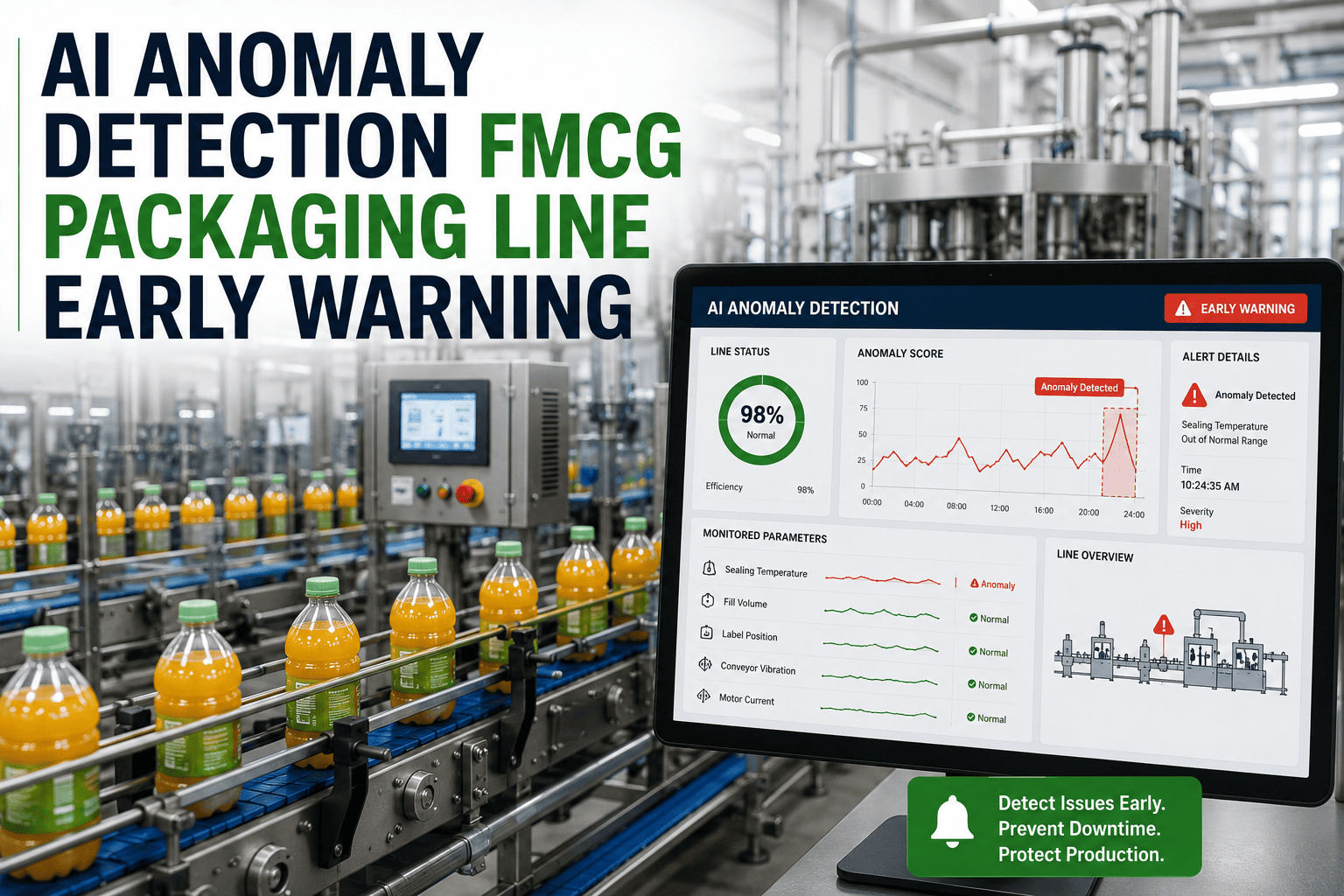
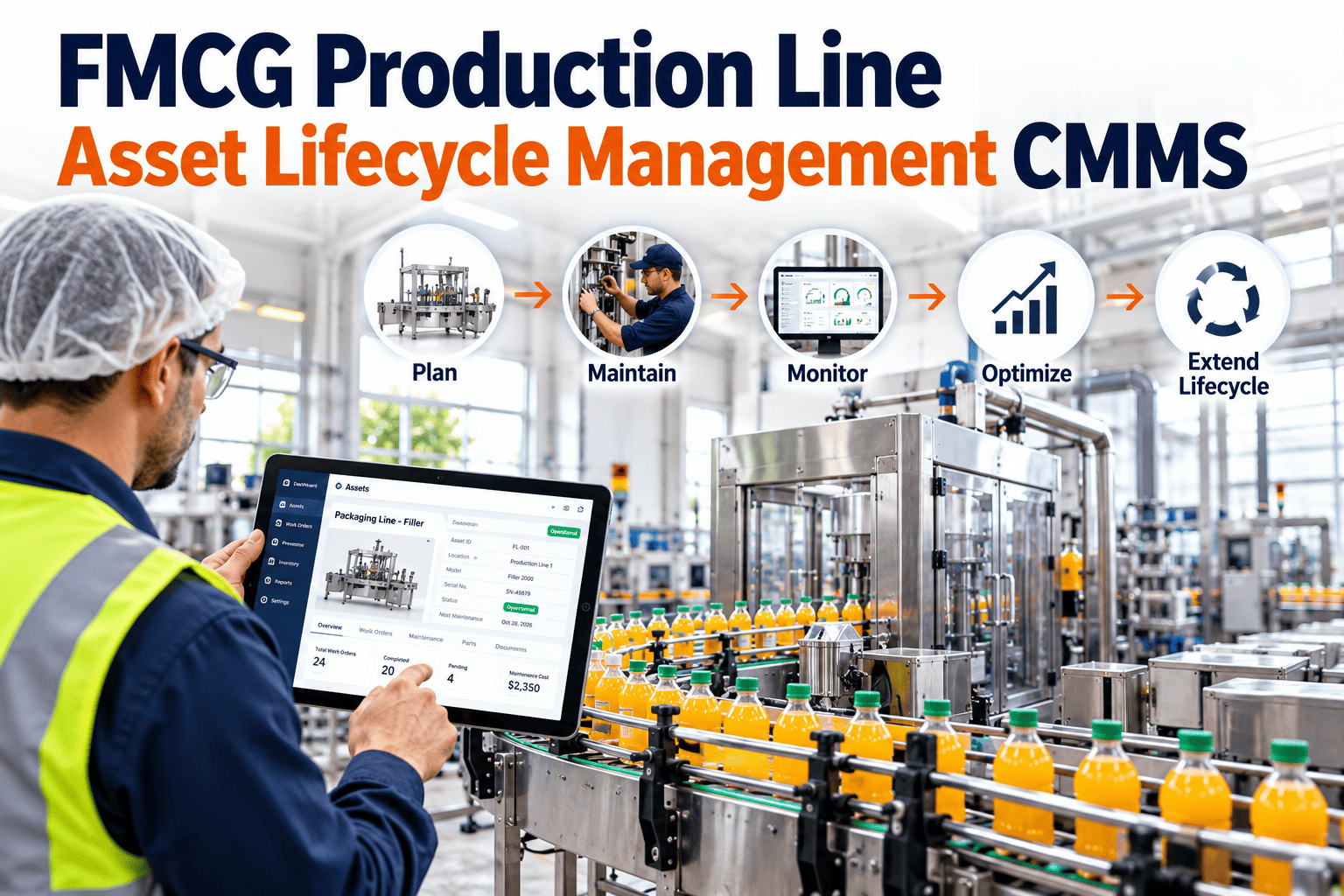
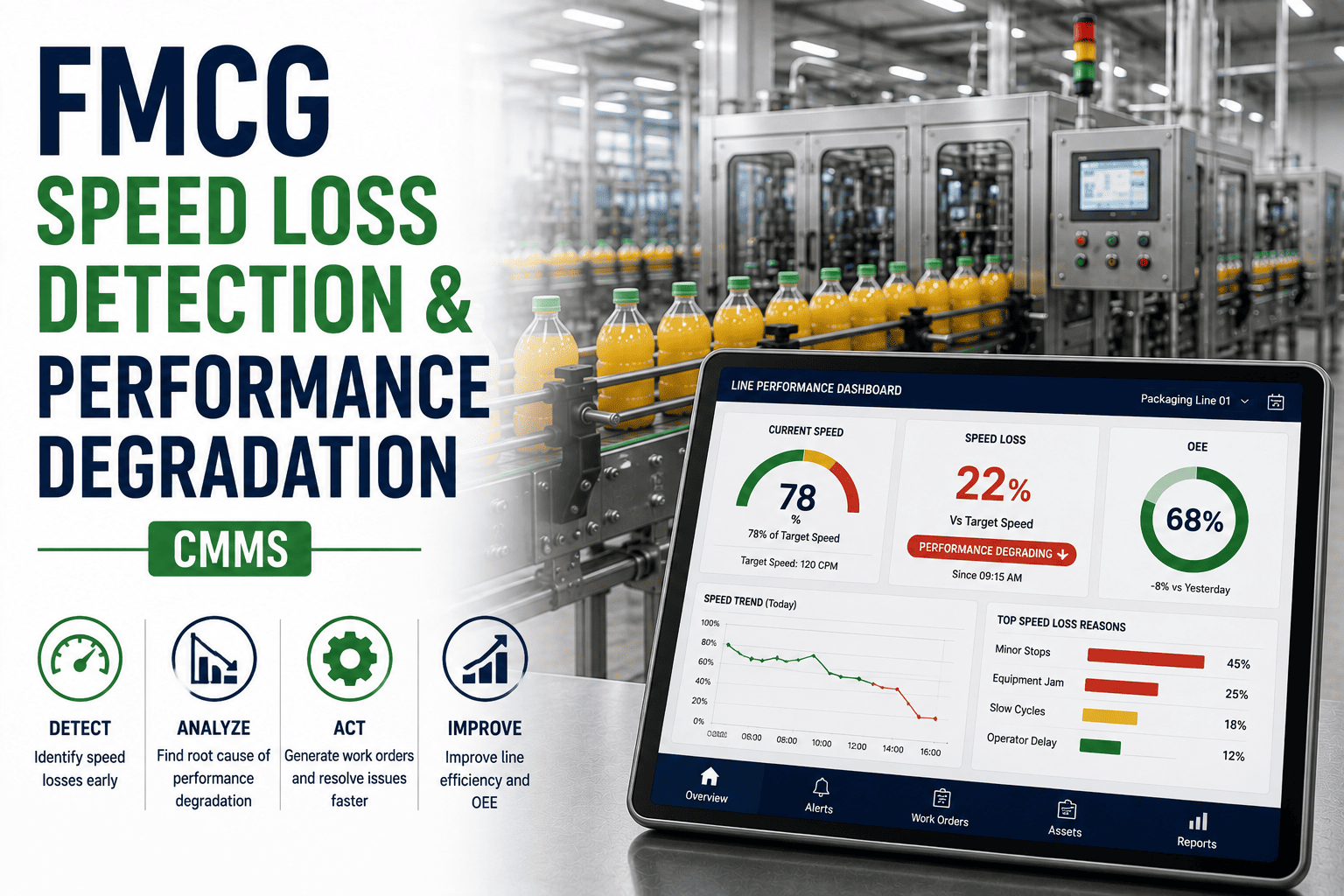
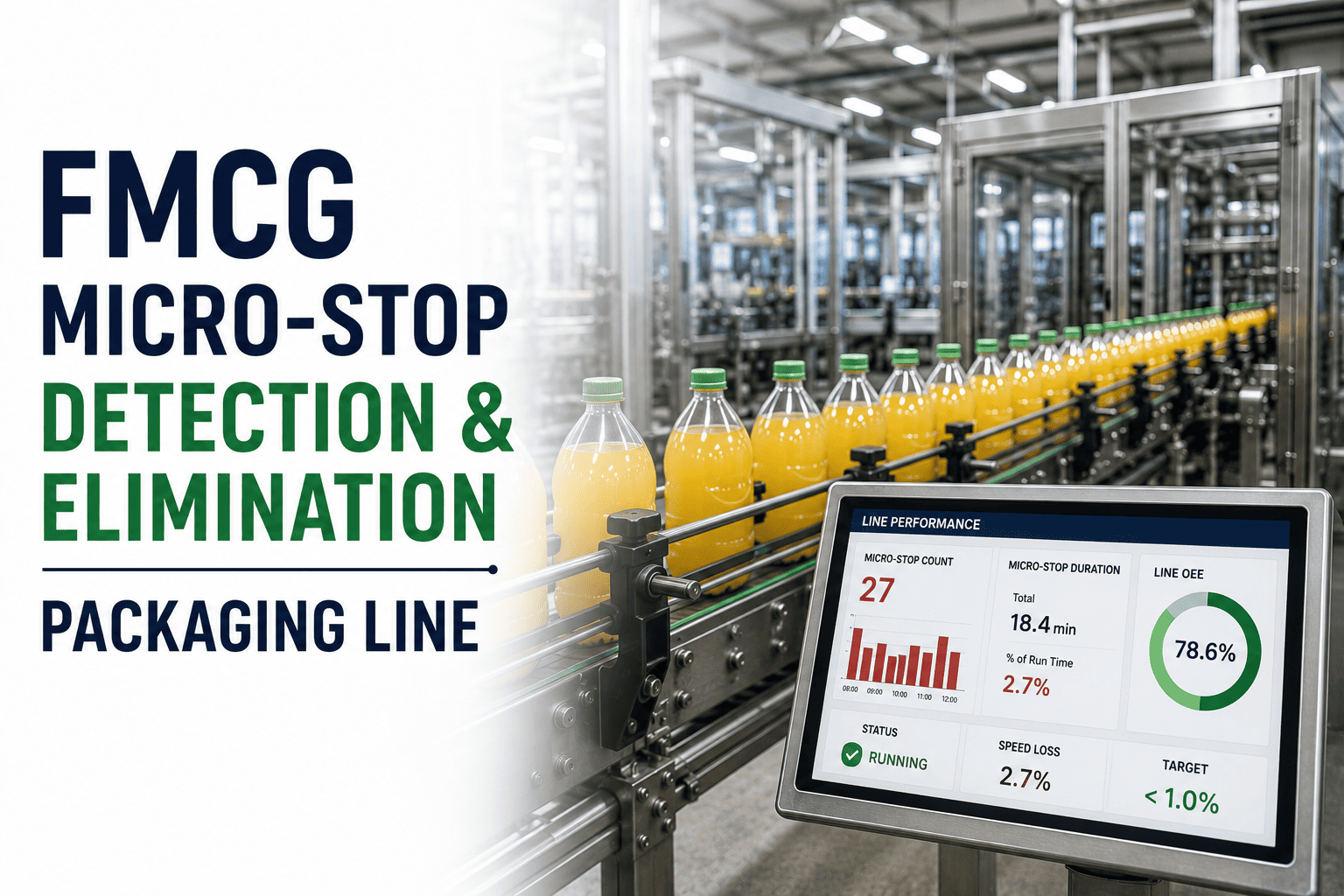
A fixed threshold alarm only fires once a reading crosses a line someone drew months ago. By then the bearing is already failing, the motor is already straining, the changeover is already slipping. AI anomaly detection catches the drift before it crosses that line, the small shift in vibration or current that says something is changing while the line still looks fine on every gauge. Sign up to turn early anomaly signals into work orders before a packaging line goes down.
What This Guide Covers
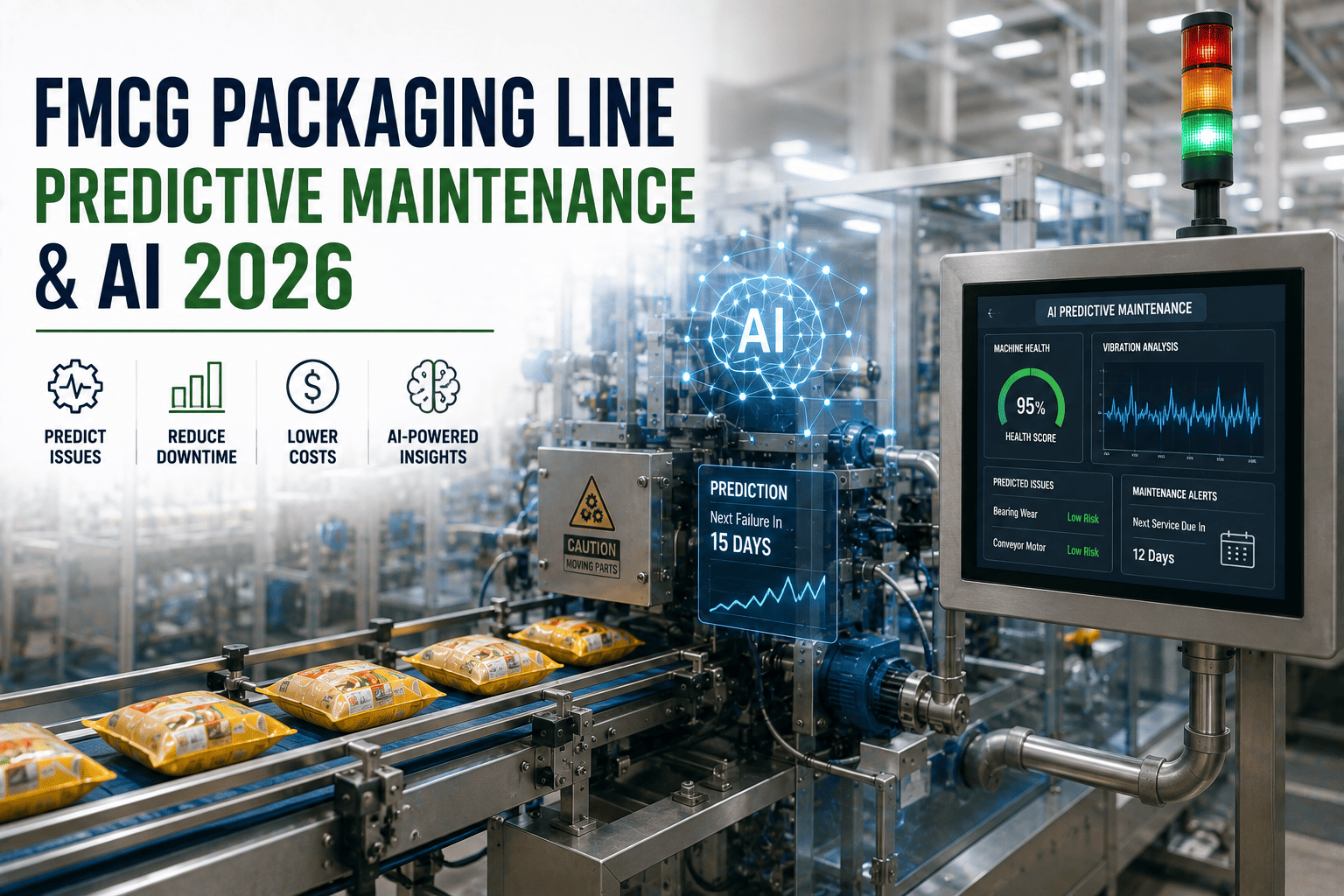
AI anomaly detection on FMCG packaging lines catches early warning signals that humans and fixed thresholds miss, from subtle vibration shifts to temperature drift and current profile changes. This guide covers anomaly detection architecture, baseline model training, deviation scoring, alert workflow and false alarm management, and the CMMS integration that turns anomaly detection into real pre-failure maintenance action.
Signals That Carry An Early Warning
| Signal Type |
What The Drift Reveals |
| Vibration signature |
A subtle shift in the frequency pattern often precedes bearing or gear wear by weeks, well before amplitude alone would trip a threshold |
| Temperature drift |
A slow rise relative to normal load and ambient conditions flags friction or cooling issues before a hard temperature limit is reached |
| Motor current profile |
Changes in the current draw shape during a cycle can point to mechanical binding or belt slip long before a trip occurs |
| Cycle time variation |
Small increases in cycle-to-cycle variability often show up before a jam or stoppage, hidden inside normal-looking throughput |
How Anomaly Detection Becomes A Work Order
1
Baseline Behavioral Modeling
The model learns what normal actually looks like across product changes and shift patterns, not just one static setpoint
2
Deviation Scoring
Live readings are scored against the baseline continuously, catching a drifting pattern instead of waiting for a hard limit
3
Alert Workflow And False Alarm Management
Alerts route to the right technician with severity and confidence attached, so a low-confidence blip doesn't get treated like a failure
4
CMMS Work Order Integration
A confirmed anomaly creates a work order automatically, closing the gap between detection and actual maintenance action
Turn Early Warning Signals Into Tracked Work Orders
OxMaint ties baseline modeling, deviation scoring, and confirmed alerts directly to a real work order your team can act on. Sign up for a free trial to start catching anomalies before they become downtime, or book a demo to see how it maps to your lines.
What A CMMS Adds To Anomaly Detection
Model Training History
Baseline updates and retraining events stay logged by asset, keeping the model current as products and lines change
Alert-To-Work-Order Log
Every alert stays linked to the work order it triggered, showing exactly how fast a signal turned into action
False Alarm Feedback Loop
Technician feedback on dismissed alerts feeds back into the model, cutting noise so real signals stand out
Pre-Failure Catch Record
Every anomaly caught before failure builds a running record of avoided downtime tied directly to the alert
An Alert Nobody Trusts Gets Ignored
A model that fires constantly on harmless variation trains technicians to swipe past it, which defeats the purpose just as surely as no detection at all. The programs that actually work are the ones that tune for confidence and route alerts by severity, not the ones chasing every statistical blip on the line.
Frequently Asked Questions
Q
What is a baseline behavioral model in plain terms?
It's a learned picture of what normal operation actually looks like for a specific asset across its real range of products, speeds, and conditions, so the system can flag a meaningful deviation instead of comparing everything to one fixed number.
Q
How is false alarm rate actually kept under control?
Confidence scoring and technician feedback on dismissed alerts both feed back into the model, so alerts that turn out to be harmless variation get tuned out over time instead of repeating indefinitely.
Q
How is anomaly detection actually different from a fixed threshold alarm?
A fixed threshold only reacts once a reading crosses a static line, while anomaly detection compares live behavior against a learned normal pattern, so it can flag a meaningful drift well before any single reading would trip a conventional alarm.
Catch The Drift Before The Line Goes Down
OxMaint turns baseline modeling, deviation scoring, and confirmed anomaly alerts into tracked, actionable work orders. Sign up for a free trial to start catching early warning signals on your lines, or book a demo to see it built around your packaging assets.