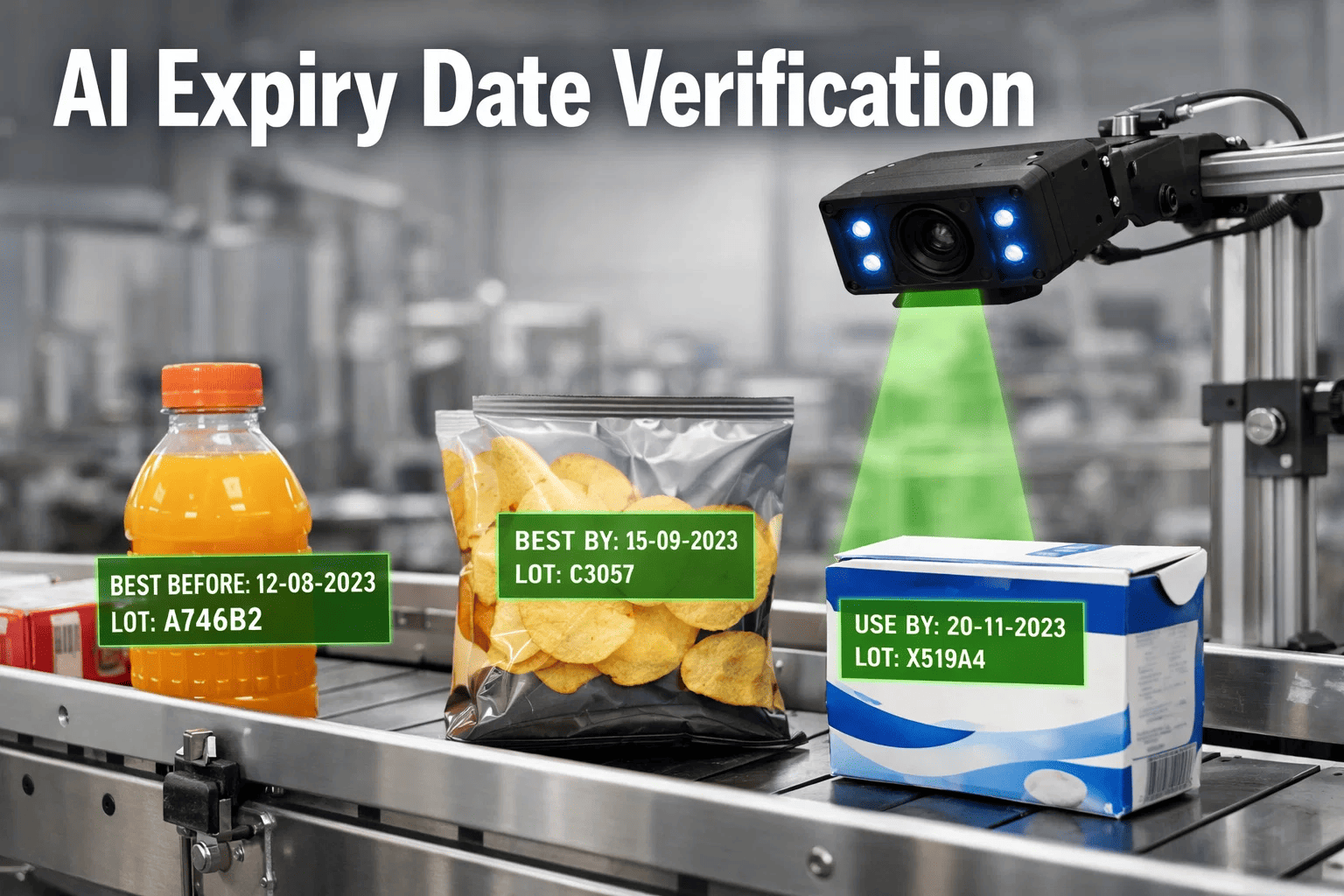
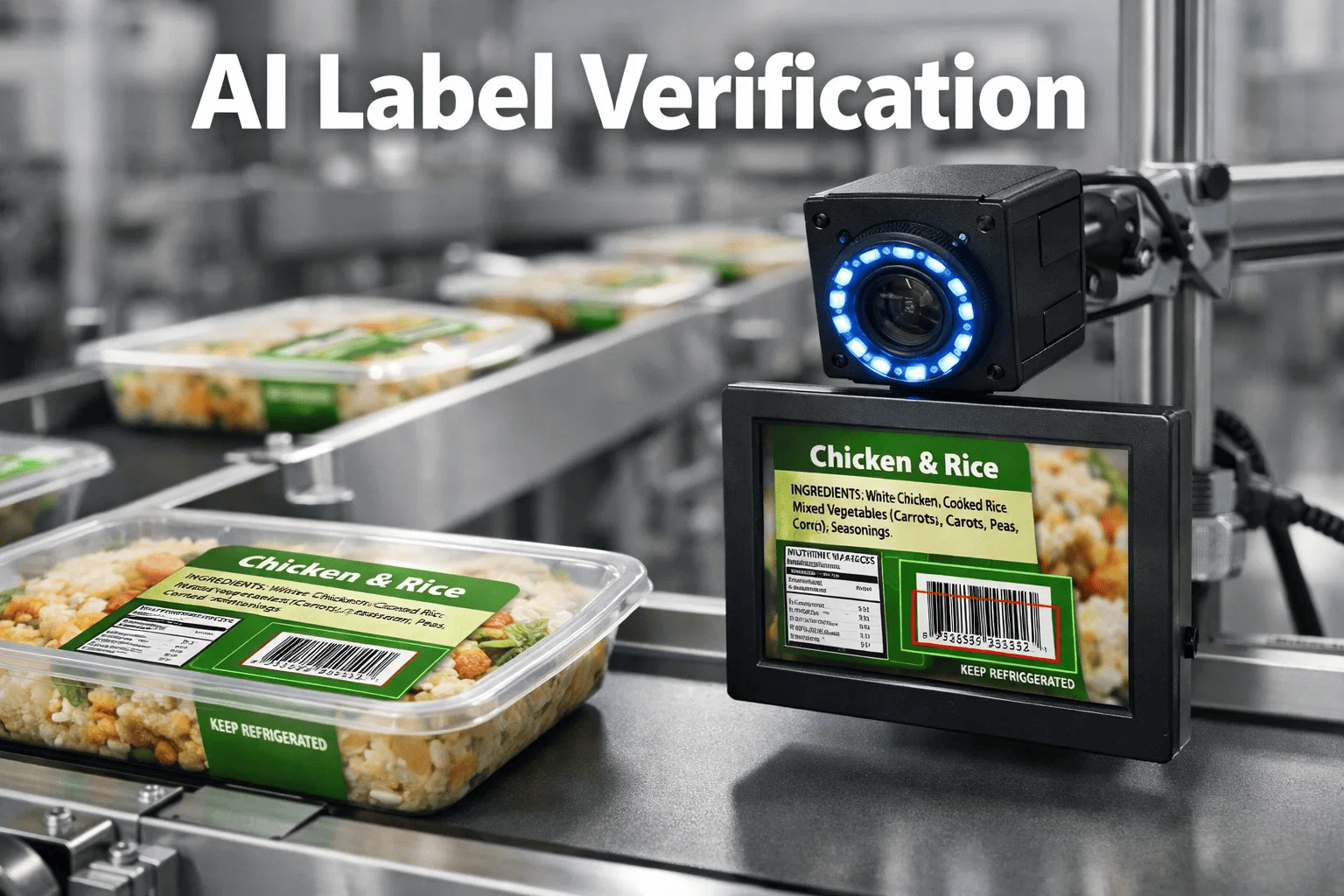
A dairy processor in Wisconsin received an FDA warning letter after an investigator pulled 36 containers of Greek yogurt from a retail shelf and found that 11 carried date codes printed three days past the lot's actual production date. The error was not intentional — a thermal inkjet printer on Line 4 had lost synchronization with the production database after a mid-shift restart, and the operator who restarted the line did not verify the date code against the current batch record.
Nobody caught it because the facility relied on operators reading codes visually at 280 containers per minute. The warning letter cited failure to maintain accurate labeling as required under 21 CFR 101, and the retailer pulled the entire yogurt SKU from 340 stores pending investigation.
That single date code error cost the facility $1.2 million in product withdrawal, retailer penalties, and corrective action documentation — for a defect that an AI vision system would have flagged on the first misprinted container. Schedule a consultation to see how Oxmaint integrates AI date code verification with maintenance workflows that prevent printer failures before they produce misprints.
Why Date Code Verification Is the Highest-Stakes Packaging Checkpoint
Every food and beverage product leaving your facility carries a date code that consumers, retailers, and regulators treat as a binding commitment about product safety and shelf life. A best-by date printed two months too late means consumers eat degraded product. A lot code that does not match the batch record makes traceability impossible during a recall. A use-by date rendered illegible by a failing printer head creates the same regulatory exposure as no date at all.
Manual date code verification — operators reading printed codes against batch records at production speed — fails at a rate that most quality managers would find unacceptable if they measured it. Studies of human visual inspection at line speeds above 200 units per minute show miss rates of 15–35% for date code errors including wrong dates, missing characters, partial prints, and illegible codes.
AI vision systems eliminate this gap by reading, interpreting, and cross-referencing every code on every unit at full speed. Sign up for Oxmaint to connect AI date code verification with the maintenance workflows that keep printers producing accurate codes.
Date Code Defect Categories and AI Detection Methods
AI vision systems classify date code defects into distinct categories, each requiring specific detection algorithms and triggering different corrective actions. Understanding these categories is essential for configuring inspection thresholds and interpreting system output for both quality and maintenance teams.
Detection Approach
- OCR reads printed date and compares against production database
- Cross-references batch record, lot code, and production schedule
- Flags any mismatch between printed and expected date values
- Detects post-restart synchronization failures within one unit
Detection Approach
- Presence detection confirms code exists in expected print zone
- Validates minimum character count against format template
- Distinguishes between absent code and code outside print zone
- Triggers immediate reject and printer status alert
Detection Approach
- Character quality scoring against minimum legibility thresholds
- Contrast measurement between print and substrate
- Individual character formation grading for partial prints
- Trend analysis detecting gradual printhead degradation
Detection Approach
- Position verification against defined print zone coordinates
- Format validation for date structure (MM/DD/YY vs DD/MM/YY)
- Character spacing and alignment measurement
- Rotation and skew detection from product handling variability
The Complete Date Code Verification Checklist
Effective AI date code verification covers every failure mode from printer hardware through database connectivity to final package inspection. This checklist provides the framework for implementing comprehensive verification that satisfies both regulatory requirements and operational quality standards. Book a demo to see how Oxmaint structures date code verification workflows with automatic escalation from defect detection to maintenance action.
Printer Health and Pre-Production Verification
AI monitors print quality scores over time to detect gradual printhead degradation — scheduling cleaning or replacement before quality drops below legibility threshold
Automated tracking of consumable levels with predictive depletion alerts — preventing mid-run exhaustion that produces fading or missing codes on hundreds of units
Pre-production check confirming printer is receiving correct date, lot, and batch data from production database — catching synchronization failures before the first unit prints
AI captures and verifies first printed unit against batch record — automated pass/fail with image archive providing documented evidence of pre-production verification
Verify print trigger timing and encoder signal integrity — ensuring codes print in the correct position at the correct moment regardless of line speed variation
Inline AI Verification During Production
AI reads and interprets every date code at full production speed — comparing each reading against the expected value from the batch record database in real time
Each character receives an individual quality grade based on formation completeness, contrast, and edge definition — trending scores detect degradation before codes become illegible
Verifies code placement within defined tolerances and confirms date format matches product-specific template — catches positioning drift from encoder or handling changes
Units failing any verification parameter are rejected immediately with defect classification, image capture, and timestamp — maintaining complete traceability of every rejected unit
AI identifies clustering of defects by type, time, or position indicating systematic equipment issues — generating CMMS work orders when patterns indicate printer maintenance is required
Changeover and Post-Event Verification
Automated confirmation that date format, shelf life calculation, and lot code structure update correctly when switching between products — preventing carryover from previous SKU
Mandatory re-verification after any line stop, printer restart, or system interruption — catching the database synchronization failures that cause most wrong-date incidents
Automatic verification that date codes update correctly at midnight during overnight production runs — a common failure point when printer systems and production databases handle date transitions differently
Confirms print quality remains within specification when packaging material changes — different substrates absorb ink differently affecting legibility and OCR readability
Automated summary report capturing total units verified, reject count by category, quality score trends, and any maintenance alerts generated — audit-ready production record
CMMS Integration and Corrective Actions
When AI detects defect patterns indicating printer maintenance — clogged nozzles, degrading print quality, positioning drift — the system generates a CMMS work order with defect data attached
Quality score trending predicts when printhead replacement will be needed — scheduling maintenance during planned downtime rather than discovering the failure during production
Ink and ribbon consumption data feeds into spare parts inventory system — ensuring replacement consumables are available when predicted depletion triggers reorder alerts
Every date code defect event links to an equipment root cause category — building the failure history that drives preventive maintenance schedule optimization over time
After maintenance action, the system monitors subsequent print quality to confirm the repair resolved the issue — closing the work order only when quality scores return to baseline
AI Verification by Printing Technology
Different date code printing technologies present distinct failure modes and verification challenges. AI vision systems require technology-specific inspection parameters to achieve reliable accuracy across the printing methods found in FMCG packaging lines.
Key Performance Metrics for Date Code Verification
Tracking the right metrics ensures your AI verification system delivers sustained accuracy and provides the evidence trail that regulators and retailers expect for date code compliance. Sign up for Oxmaint to track these date code KPIs in real time with dashboards that connect print quality data to maintenance performance.
Percentage of units with correctly printed and verified date codes. AI verification should maintain near-perfect accuracy with zero wrong-date escapes.
Average character formation quality across all printed codes. Declining scores predict printhead failure 2–5 shifts before codes become illegible.
Good product incorrectly rejected by the verification system. Excessive false rejects waste product and indicate detection thresholds need optimization.
Misprinted units that pass through verification undetected. Monitored through downstream audits and customer complaint correlation.
Time from AI defect alert to completed maintenance action. Measures how quickly print quality issues translate into corrective equipment actions.
Percentage of production time that printers operate within quality specifications. Predictive maintenance driven by AI quality data should maximize uptime.
Regulatory Framework for Date Code Compliance
Date codes on food and beverage products operate under multiple overlapping regulatory and retailer requirements. AI verification systems must be configured to enforce the most stringent applicable standard for each product and market combination.
From Defect Detection to Equipment Intelligence
The true value of AI date code verification extends beyond catching misprints. When connected to a CMMS, every quality deviation becomes equipment intelligence that drives predictive maintenance, extends printer life, and reduces both defect rates and maintenance costs over time. Without this connection, vision systems catch defects but never fix their source — creating an expensive filter that treats symptoms while the underlying equipment problems persist.
Oxmaint closes this loop by routing AI defect data to maintenance workflows automatically. When print quality scores decline on Line 3's thermal inkjet, the system does not wait for an operator to notice and submit a request. It generates a work order with quality trend data, defect images, and suspected root cause attached — before the printer produces codes that fail verification. Schedule a consultation to see how Oxmaint transforms date code quality data into the maintenance intelligence that prevents printer failures.
Frequently Asked Questions
Can AI vision systems read date codes on all packaging substrates?
Modern AI vision systems handle the full range of FMCG substrates including clear film, metallic foil, corrugated board, glass, and flexible pouches. The key is proper lighting configuration — dark field, bright field, or diffuse depending on the substrate and ink combination. Systems are trained on product-specific profiles that account for substrate variability, and most achieve reliable OCR performance above 99.5% across substrate types when properly configured.
How does AI handle multiple date formats on the same line?
AI systems maintain product-specific verification profiles that load automatically during changeovers. Each profile defines the expected date format, character count, position tolerances, and shelf life calculation for that SKU. When the production schedule changes, the system loads the correct profile and verifies the first printed unit against it before production continues. This eliminates the format carryover errors common when operators manually update printer parameters.
What happens when AI detects a sudden spike in date code defects?
The system triggers a tiered response based on defect severity and frequency. Minor quality degradation generates a maintenance alert. A sustained increase above threshold triggers an automatic CMMS work order with defect classification, trend data, and images. Critical failures — wrong date or missing code — can trigger automatic line stops to prevent mass defect production, depending on configured severity levels.
What ROI should we expect from AI date code verification?
Most FMCG facilities achieve ROI within 6–10 months. The calculation includes avoided recall costs (averaging $890K per event), reduced product waste from false rejects and quality holds, labor reallocation from manual inspection, and lower maintenance costs through predictive printer servicing. Facilities with recent date-code-related quality incidents typically see faster payback as the risk mitigation value alone justifies the investment.
How does the CMMS connection improve printer maintenance specifically?
Without CMMS integration, printer maintenance happens on fixed calendars or after failures. With Oxmaint, print quality data drives condition-based maintenance — printhead cleaning triggers from quality scores rather than arbitrary schedules, ribbon or ink reorders trigger from actual consumption rates rather than calendar estimates, and root cause data from defect patterns identifies whether issues originate from the printer, substrate, or environmental conditions.