AI Expiry Date & Code Verification for FMCG (OCR Guide)
By Jack Edwards on April 16, 2026
A confectionery manufacturer in Germany printed 620,000 units of a seasonal product with an expiry date of 14.03.2025 — but the inkjet coder ribbon had run out mid-batch and the automated alert had been silenced by an operator who intended to reset it and forgot. The plant's manual date code check verified the first 40 units after the ribbon change. The 580,000 units produced in the 4-hour window between ribbon failure and detection shipped with no date code at all. The batch was quarantined at the distribution centre at a cost of €340,000 in product write-off, re-labelling, and BRC audit preparation. An AI OCR date code verification system would have flagged the absence of a readable code on unit 41 and stopped the line within the same second. Start a free OxMaint trial and connect your coding equipment inspection data to your production asset records — or book a demo to see how AI OCR verification integrates with OxMaint maintenance management.
AI Vision & Quality · Code Verification
AI Expiry Date & Code Verification for FMCG Production
Verify expiry dates, lot codes, and batch codes using AI OCR at 100% coverage and line speed — catching print failures, missing codes, and date errors before they become traceability incidents or regulatory violations.
OCR read accuracy achievable with AI date code verification at line speed
€340K
Typical batch quarantine cost when missing date codes reach distribution
1 unit
First unit with missing or unreadable code detected and flagged by AI OCR
5 yr
EU lot code traceability record retention requirement under Regulation 178/2002
What AI Date Code Verification Reads — and Why OCR Outperforms Manual Checking
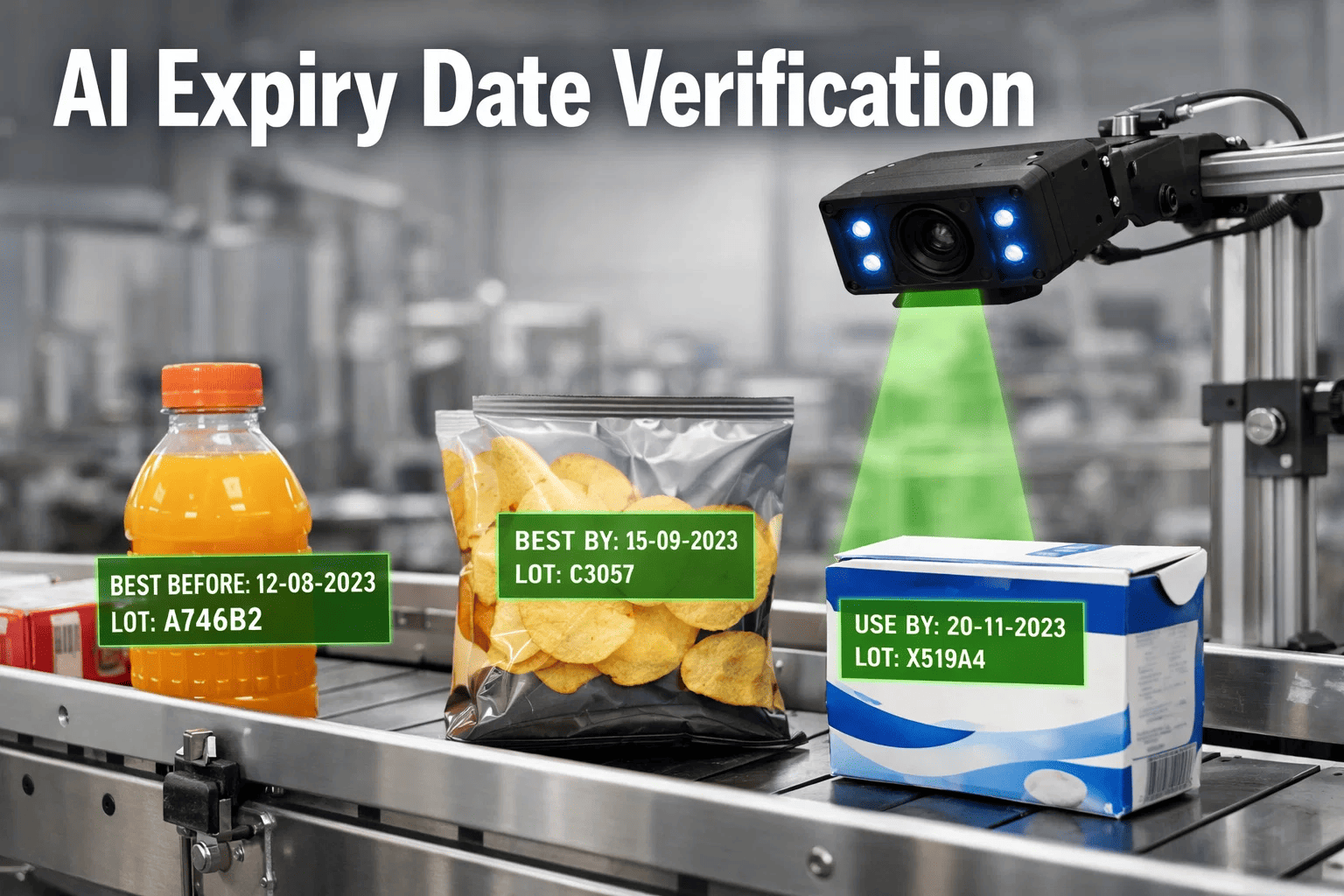
AI OCR date code verification uses machine vision cameras and trained optical character recognition models to read every date code and lot code on every unit at line speed — comparing the result against the expected code format, date value, and active batch parameters. Manual checking samples 1–2 units per 15–30 minutes. AI OCR reads and verifies every unit. At 500 units per minute, that means 30,000 verifications per hour versus 2 by manual inspection.
Expiry Dates
Best before, use by, and sell by dates verified against active batch parameters — format, day/month/year sequence, and plausibility range check
Lot Codes
Production lot codes cross-referenced against active batch record — format validation and alphanumeric accuracy per unit for EU traceability compliance
Country of Origin Codes
Origin codes and production site identifiers verified for accuracy — particularly relevant for products with multiple sourcing locations or co-manufacturing arrangements
QR and DataMatrix Codes
2D codes decoded and content verified against expected data string — URL format, serial number format, and embedded lot and date information validated per unit
The 6 Date Code Failure Modes That Drive Batch Quarantine and Regulatory Action
Every date code failure traces back to a specific equipment event or process gap. Identifying the pattern reveals which asset needs the maintenance action — and which process needs the corrective intervention.
F1
No Code Printed
Cause: Ribbon/ink exhaustion, nozzle blockage, printer power failure, or automatic print-stop not reset after ribbon change
Regulatory risk: Full batch traceability failure — mandatory recall in EU under Reg. 178/2002
F2
Faint or Illegible Code
Cause: Print head wear, substrate incompatibility, ink viscosity change, or low print energy setting on thermal transfer printer
Regulatory risk: Traceability gap — Trading Standards violation in UK, €500K+ potential EU fine
F3
Wrong Date Printed
Cause: Operator entry error in printer controller, batch parameters not updated after changeover, or printer clock drift after power interruption
Cause: Print head not fully seated, substrate contamination at print zone, product speed too high for printer setting, or curing/drying system PM overdue
Traceability gap — retailer rejection and potential batch quarantine
F5
Duplicate Code on Wrong SKU
Cause: Printer batch parameters not updated after changeover — previous product's date or lot code printing on new SKU. Particularly high risk on short changeover sequences.
Traceability cross-contamination — full batch recall trigger at retail
F6
Format Compliance Failure
Cause: Regional format requirement not applied — DD/MM/YYYY required but MM/DD/YYYY printed due to US-format template in use, or country-specific format not configured per market destination.
Market rejection — particularly for export products and multi-market SKUs
How OxMaint Connects Code Verification to Coder Equipment Maintenance
AI OCR detects the code failure. OxMaint identifies the printer or coder asset responsible, creates the work order, and tracks the resolution — turning code quality events into maintenance intelligence, not just production stoppage records.
Coder Asset Registry by Line Position
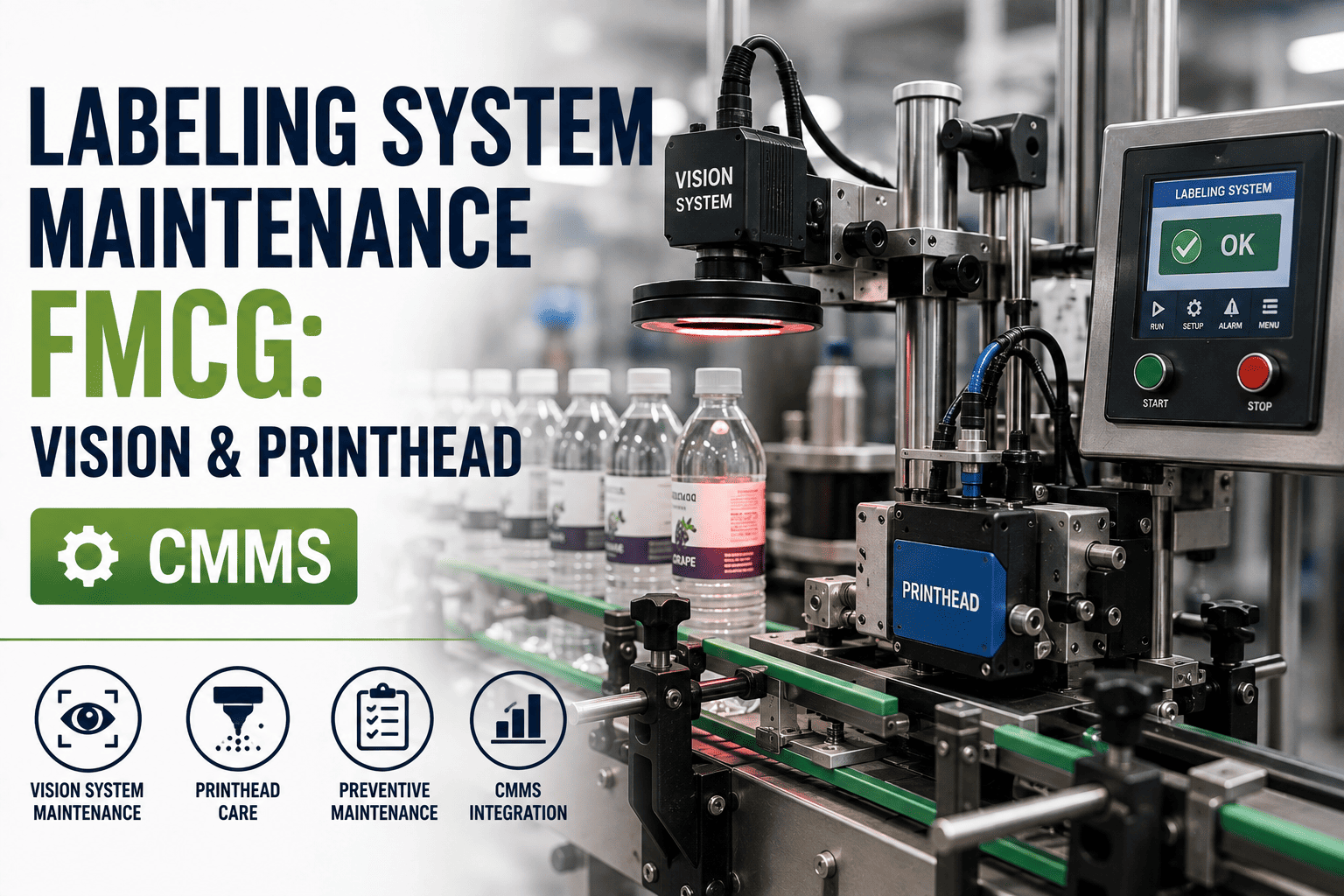
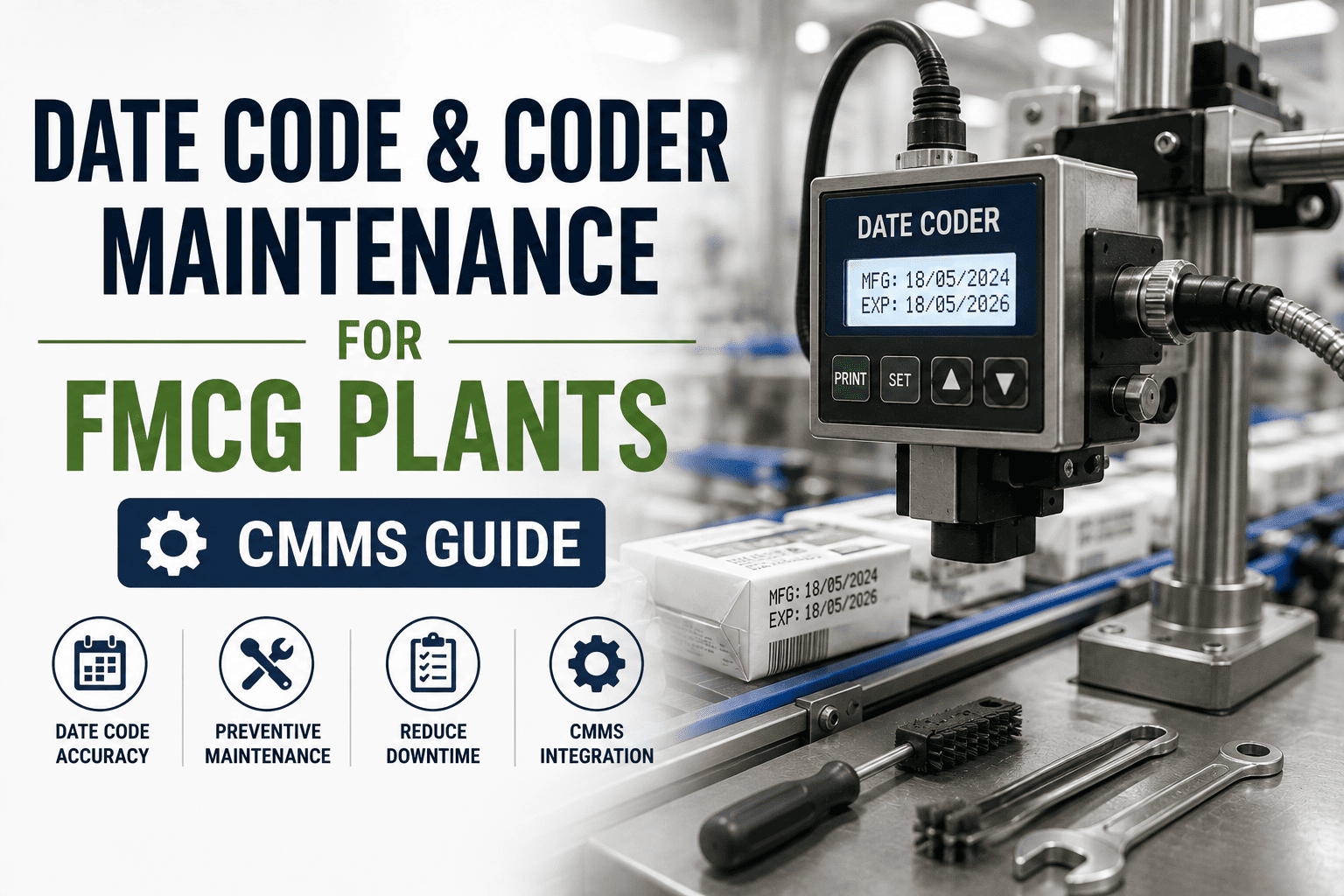
Every inkjet coder, thermal transfer printer, laser marker, and hot stamp unit is registered in OxMaint with its position on the line, print technology, ink type, and PM schedule. When AI OCR detects a print quality failure, the work order is linked to the specific coder asset at that line position — not just logged as a production event.
Print Failure Threshold Work Orders
When AI OCR detects unreadable codes above threshold — typically 3 consecutive failures — OxMaint generates a maintenance work order automatically for the linked coder asset. The work order includes failure type, consecutive count, production rate at time of failure, and last PM date. Technicians arrive with full context — not just an alert.
Ribbon and Ink Consumption PM
OxMaint tracks ink and ribbon consumption against units produced for each coder asset. Ribbon change reminders and ink level alerts are generated before exhaustion — not after. The system calculates projected ribbon life from current consumption rate and schedules the replenishment work order to coincide with the next planned changeover window, eliminating mid-run ribbon changes.
Changeover Batch Parameter Verification
OxMaint's changeover workflow includes a mandatory coder batch parameter verification step — confirming that the correct date, lot code format, and SKU parameters are loaded before the line starts. The changeover is not marked complete until the coder configuration is confirmed against the active batch record. This eliminates wrong-date-after-changeover events — the most common source of misdated product.
Traceability Record Linking
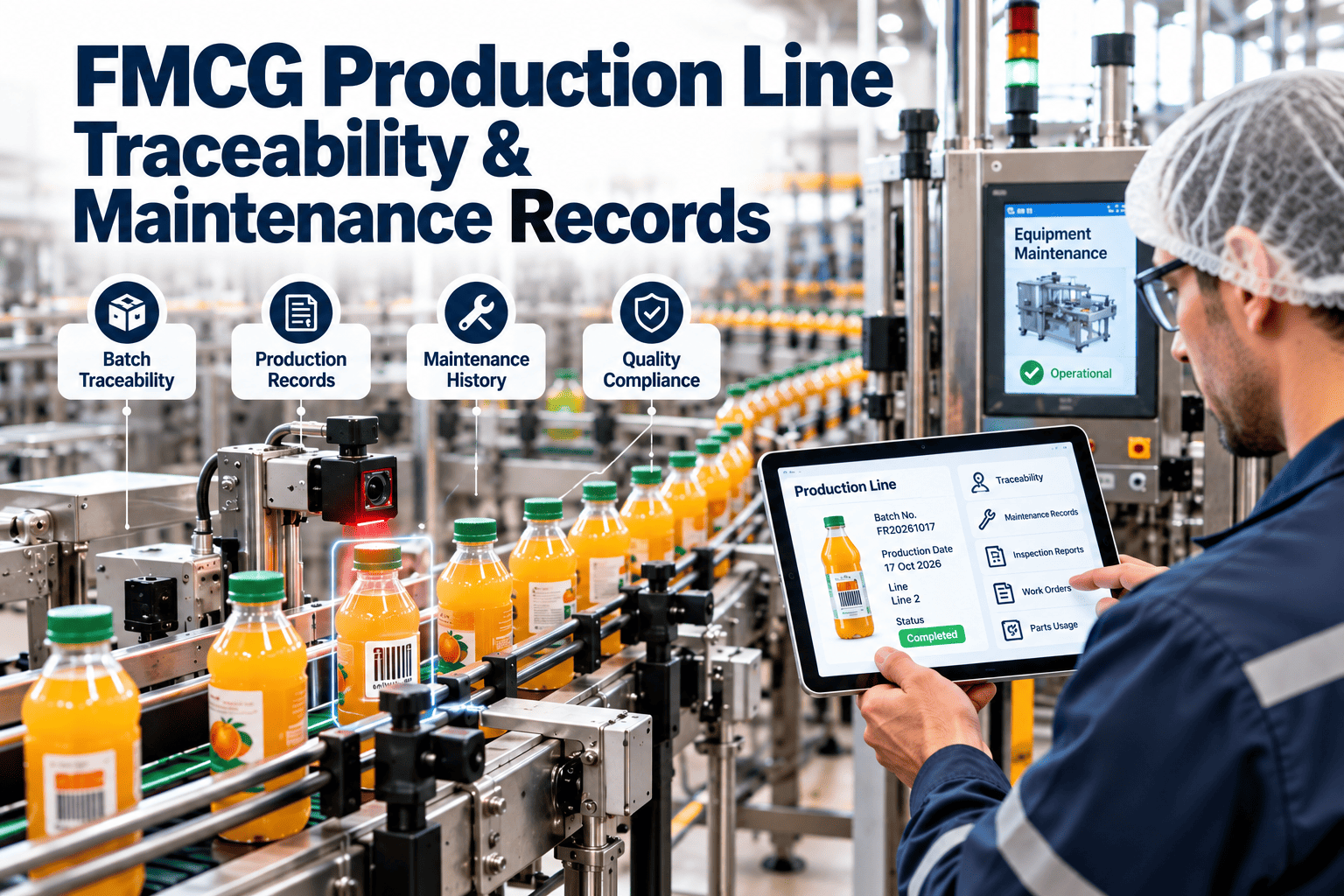
Every code verification session is stored against the production line asset and batch record simultaneously in OxMaint. When a recall event requires traceability documentation, the batch's complete code inspection history — pass rate, failure events, corrective actions — is available in a single filtered export that meets EU Regulation 178/2002 traceability requirements.
Print Head PM by Units Produced
Print head cleaning, nozzle purge cycles, and head replacement are scheduled by units produced in OxMaint — not by calendar days. A coder running at 1,200 units per minute reaches print head service intervals far faster than a theoretical calendar schedule predicts. PM triggered by actual production volume prevents the print quality drift that precedes faint or missing code events.
Manual Code Checking vs. AI OCR Verification
Verification Parameter
Manual Code Check
AI OCR Verification
Coverage rate
1–2 units per 30 min
100% of all units at line speed
Missing code detection
Detected at next check — up to 30 min lag
Detected at first unit — line stop within 1 second
Wrong date detection
Visual check — highly error-prone under fatigue
OCR match against active batch parameters — 99.9% accuracy
Faint code detection
Subjective — varies by inspector
OCR confidence score per unit — objective threshold
Traceability documentation
Paper log — incomplete and not searchable
Per-unit records — batch filterable, EU Reg. 178/2002 compliant
Changeover code change verification
First post-changeover manual check — risk window
First unit post-changeover verified immediately
Asset maintenance linkage
None — code failure and coder separate
Failure event creates work order for specific coder asset
Audit documentation
Paper record — often incomplete post-incident
Digital, timestamped, GMP-compliant export ready
Scroll right to view full table on mobile
Protect Traceability at Every Unit
AI OCR catches the missing code in 1 second. OxMaint services the printer that caused it. That is how batch quarantine stops before distribution.
Date Code Verification ROI — The Numbers Behind the Investment
€340K
Batch quarantine cost avoided
Typical cost per missing-code batch event at distribution — product, logistics, and BRC audit combined
99.9%
OCR read accuracy
AI OCR at line speed vs. 94–97% for trained manual inspectors under sustained conditions
30K+
Verifications per hour
At 500 units/min vs. 2 verifications/hr by manual spot-check protocol
5 yr
EU traceability record requirement
OxMaint's GMP documentation satisfies Regulation 178/2002 retention and retrieval requirements
Frequently Asked Questions
What print technologies does AI OCR verification support?
AI OCR verification systems are technology-agnostic in terms of print output — they read printed characters regardless of whether they were produced by continuous inkjet (CIJ), thermal inkjet (TIJ), thermal transfer overprint (TTO), laser ablation, or hot stamp. The camera system captures the printed output and the OCR model interprets the characters — the specific print technology is a configuration parameter, not a limitation. Different print technologies produce different character profiles, and the OCR model is trained on the specific profile of each printer type used at the site during commissioning.
How does AI OCR handle date codes on non-flat surfaces like curved bottles?
Date codes on curved containers require telecentric lens cameras or multi-angle imaging to maintain character flatness for OCR reading. For high-curvature applications — round bottles, cans, and cylindrical containers — the imaging system uses a short working distance telecentric lens that compresses the apparent curvature of the image plane to keep characters within the OCR model's distortion tolerance. For embossed or recessed codes (common on glass and certain plastics), structured light side-illumination creates the contrast differential required for reliable OCR reading regardless of container surface geometry.
What EU regulations require lot code traceability documentation?
EU Regulation 178/2002 (General Food Law) requires food business operators to maintain traceability records that allow identification of the supplier of any ingredient and the customer of any batch — with sufficient detail to enable a targeted recall. Lot codes are the primary traceability mechanism — and their accuracy and legibility are directly implied by the traceability obligation. EU Regulation 1169/2011 (Food Information to Consumers) requires that date marking (best before or use by) is legible, clearly visible, and meets format requirements. Germany additionally requires lot code documentation under Lebensmittel- und Futtermittelgesetzbuch (LFGB), with penalties for inaccurate or missing coding.
How does OxMaint store and retrieve code inspection records for a recall investigation?
Code inspection records in OxMaint are stored against the production line asset and batch record simultaneously — each inspection event includes timestamp, unit count, pass/fail status, OCR confidence score, defect type, and corrective action taken. During a recall investigation, the records for the implicated batch are filtered by batch number, production date, and line — returning the complete inspection history in a single export. The export is timestamped, digitally signed, and formatted to meet EU Regulation 178/2002 documentation requirements. Average retrieval time for a 24-hour production period's complete code inspection record: under 3 minutes.
Every Code. Every Unit. Every Batch.
AI OCR Catches the Missing Code. OxMaint Services the Printer. Together They Keep Your Batches Out of Quarantine.
Coder and printer asset registry by line position. Print failure threshold work orders at first non-conforming unit. Ribbon and ink consumption PM preventing mid-run exhaustion. Changeover batch parameter verification. EU Regulation 178/2002 compliant traceability documentation. Print head PM by units produced. OxMaint connects every code quality event to the maintenance action that prevents the next one — and the audit documentation that satisfies any regulator who asks.